






Bipolar Plates for Hydrogen Fuel Cells
Custom Metallic Bipolar Plates for Hydrogen Fuel Cells

Baocheng manufactures custom metallic bipolar plates and stamped flow-field plates for hydrogen fuel cell projects. Our products are developed according to customer engineering drawings, flow-field designs, material specifications and stack assembly requirements.
We only undertake custom bipolar plate projects. We do not sell standard off-the-shelf fuel cell bipolar plates because plate dimensions, active areas, flow-field patterns, channel geometry, manifold positions, sealing zones, material thickness and stack interfaces vary significantly between different fuel cell systems.
Our primary manufacturing focus is precision stamping and forming of thin stainless steel plates. For each project, critical parameters such as channel depth, flow-field accuracy, material thinning, flatness, sealing-area geometry, port position and dimensional consistency can be reviewed before tooling development.
Metallic bipolar plates perform several important functions inside a fuel cell stack, including distributing hydrogen and air, conducting electrical current between cells, supporting thermal and water management, and helping separate process gases. For this reason, the plate should be treated as a functional precision component rather than a simple stamped sheet.
Custom Dimensions & Key Purchasing Parameters
Fuel cell bipolar plates do not have one universal standard size. The final geometry must correspond to the customer's membrane electrode assembly, gas diffusion layer, sealing system, stack structure and flow-field design.
| Parameter | Customization | Engineering Consideration |
|---|---|---|
| Overall Length & Width | Made to customer drawing | Must match the fuel cell stack and surrounding components |
| Material Thickness | Project-specific | Affects weight, forming capability, rigidity and channel geometry |
| Active Area | Fully customized | Defined according to MEA and fuel cell design |
| Flow-Field Pattern | Customer-defined | Can include serpentine, parallel, interdigitated or proprietary patterns |
| Channel Width | According to drawing | Influences gas distribution and forming feasibility |
| Channel Depth | According to drawing | Requires precise forming-depth control |
| Land / Rib Width | Custom | Affects structural support and electrical contact area |
| Manifold Ports | Custom size and position | Must align accurately through the complete stack |
| Sealing Zone | According to gasket design | Important for gas and coolant separation |
| Flatness | Defined by project | Important for stack assembly and uniform compression |
| Dimensional Tolerances | Customer-specific | Critical dimensions are defined according to assembly requirements |
All bipolar plate dimensions and tolerances are customized. Final manufacturing specifications are based on approved customer drawings, technical specifications and sample validation.
Material Options
Material selection for metallic bipolar plates should consider forming capability, corrosion resistance, electrical performance, surface condition, material thickness and the operating environment inside the fuel cell.
Baocheng currently offers the following stainless steel material options for suitable custom bipolar plate projects:
- Patented Non-Magnetic Stainless Steel: Baocheng's proprietary patented stainless steel material developed for applications requiring extremely low magnetic response together with precision stamping capability.
- 304 Stainless Steel: Offers good formability and corrosion resistance and can be evaluated for customer-designed metallic flow-field plate projects.
- 316 Stainless Steel: Provides higher corrosion resistance and can be evaluated for projects with more demanding environmental and durability requirements.
The final material should not be selected only according to the stainless steel grade name. The customer's fuel cell operating conditions, electrochemical environment, coating specification, interfacial contact resistance requirements and corrosion requirements should also be considered.
If the customer's fuel cell design requires a conductive or corrosion-resistant coating, the coating specification should be provided during project review. Material and surface-treatment suitability should be validated according to the customer's fuel cell performance requirements.
Patented Non-Magnetic Stainless Steel Option
Baocheng can also provide its proprietary patented non-magnetic stainless steel for projects where low magnetic permeability is included in the technical specification.
The material is developed to maintain extremely low magnetic response while retaining the formability required for precision-stamped components.
For fuel cell bipolar plates, however, magnetic permeability is not the only material-selection criterion. Electrical contact resistance, conductivity, corrosion resistance, forming performance and surface stability are also critical. Therefore, the suitability of the patented material should be evaluated together with the customer's complete electrochemical and surface-treatment requirements.
Custom Flow-Field Design
The flow field is one of the most important functional structures of a metallic bipolar plate. Channels guide hydrogen, air and, depending on the plate design, coolant through the fuel cell system.
Baocheng manufactures flow-field geometry according to customer-approved drawings. We do not independently change the customer's electrochemical flow-field design unless a dimensional feature creates a clear manufacturing issue that requires technical discussion.
Custom flow-field parameters may include:
- Serpentine flow fields
- Parallel flow fields
- Interdigitated flow fields
- Multi-channel flow fields
- Customer-proprietary flow patterns
- Channel width
- Channel depth
- Land or rib width
- Channel pitch
- Corner radius
- Flow-field transition areas
- Inlet and outlet connections
Fine flow channels require careful coordination between geometry and forming capability. If channels are too deep, too narrow or arranged with very small radii, local material thinning, incomplete forming, cracking or springback may become manufacturing risks.
Flow Channel Depth & Forming Accuracy
Consistent channel depth is particularly important when producing metallic bipolar plates because variations in the formed flow field may affect plate geometry and stack consistency.
During tooling development, relevant characteristics can include:
- Target channel depth
- Depth consistency across the active area
- Channel-bottom geometry
- Rib height consistency
- Corner forming
- Local material thinning
- Springback after forming
- Transition between flow-field and flat areas
For complex flow fields, the forming process may require multiple stages or specific die strategies to improve material distribution and reduce excessive thinning or springback.
Ultra-Thin Stainless Steel Stamping & Forming
Metallic bipolar plates are typically designed as thin structural components in order to reduce stack weight and volume. Thin stainless steel, however, becomes increasingly sensitive to local stretching, wrinkles, springback and deformation during forming.
Baocheng evaluates the stamping process according to the customer's plate geometry and material requirements.
Relevant manufacturing processes may include:
- Precision blanking
- Flow-channel stamping
- Embossing
- Multi-stage forming
- Local re-striking or sizing where required
- Piercing of manifold and locating holes
- Outer-profile stamping
- Edge and burr control
- Custom tooling development
The final process sequence depends on material thickness, channel depth, flow-field density, plate dimensions and required dimensional accuracy.
Material Thinning & Formability Control
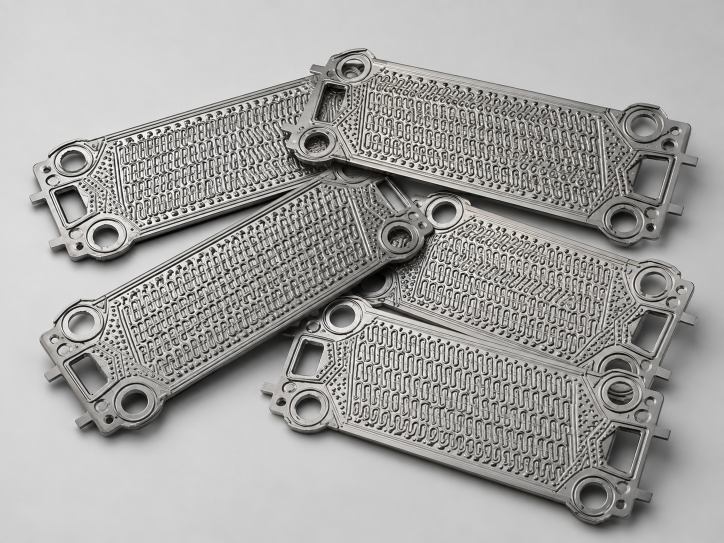
During flow-channel forming, the stainless steel sheet is stretched locally. Excessive material thinning can reduce dimensional stability and may increase the risk of cracking or inconsistent plate performance.
Therefore, custom bipolar plate development should consider not only the original sheet thickness but also the thickness distribution after forming.
Areas requiring particular attention may include:
- Channel sidewalls
- Channel corners
- Deep forming areas
- Sharp transitions
- Flow-field edges
- Manifold transition areas
When the customer has specific minimum remaining-thickness requirements, these should be included in the engineering specification for evaluation during sample development.
Flatness & Stack Alignment
Flatness is an important consideration because a large number of bipolar plates are stacked together inside a fuel cell system.
Excessive warpage or twisting may influence:
- Stack alignment
- Compression distribution
- Sealing contact
- Electrical contact consistency
- MEA and GDL interfaces
- Manifold alignment
- Final stack dimensions
For custom projects, flatness requirements should be defined according to the customer's plate dimensions, measuring method and stack assembly specification.
Locating holes, reference edges and other datum features can also be incorporated according to customer drawings to support repeatable alignment during subsequent stack assembly.
Manifold Ports & Fluid Distribution
Fuel cell bipolar plates normally contain manifold openings used to distribute hydrogen, air and coolant through the stack.
These openings must remain accurately aligned across multiple stacked plates.
Custom manifold requirements may include:
- Hydrogen inlet and outlet openings
- Air inlet and outlet openings
- Coolant inlet and outlet openings
- Custom port geometry
- Port-to-flow-field transitions
- Reference and locating features
Hole position, profile accuracy and the relationship between ports and sealing areas should be treated as critical assembly characteristics where required by the customer's design.
Sealing Zones & Gasket Interfaces
Sealing areas are another critical part of the bipolar plate design because hydrogen, air and coolant must remain properly separated inside the stack.
Baocheng can manufacture sealing-related geometries according to customer drawings, including:
- Flat gasket-contact areas
- Embossed sealing features
- Seal locating areas
- Perimeter sealing zones
- Manifold sealing zones
- Custom sealing profiles
Important parameters may include seal width, embossing height, positional tolerance, surface flatness and the relationship between the sealing area and surrounding flow channels.
The final sealing performance should be validated by the customer according to the gasket material, compression condition, stack structure and operating pressure.
Electrical Contact & Surface Requirements
A bipolar plate is also an electrical component. In addition to distributing gases, it must conduct current between adjacent cells.
For metallic bipolar plates, surface condition can significantly influence electrical contact and corrosion behavior. Therefore, surface requirements should be specified according to the customer's fuel cell design.
Relevant technical requirements may include:
- Surface cleanliness
- Surface roughness
- Electrical conductivity
- Interfacial contact resistance
- Corrosion resistance
- Coating specification
- Coating thickness
- Coating coverage
- Contact-area requirements
Baocheng does not assume that an uncoated stainless steel bipolar plate will automatically meet a customer's fuel cell electrical or corrosion targets. If specific conductivity, contact-resistance or corrosion limits are required, these should be provided as part of the project specification.
Edge, Burr & Cleanliness Control
Burrs, metal particles and uncontrolled edges can create problems during bipolar plate assembly, coating, sealing and stack production.
Relevant inspection items may include:
- Maximum burr height
- Sharp-edge control
- Cutting-edge deformation
- Loose metallic particles
- Surface contamination
- Oil residue
- Scratches
- Dents
- Handling marks
If the customer has defined cleanliness or particle-control standards, these requirements should be provided before mass production.
Single Flow Plates & Bipolar Plate Assembly Requirements
Depending on the fuel cell architecture, a metallic bipolar plate may consist of two formed half-plates that are subsequently aligned and joined.
Baocheng's primary capability is custom stamped and formed metal components. If a project requires additional processes such as coating, welding, sealing or final bipolar plate assembly, the required process and supply scope should be confirmed separately during project review.
For projects involving two formed half-plates, customers should specify relevant requirements such as:
- Anode-side plate geometry
- Cathode-side plate geometry
- Coolant-channel structure
- Alignment references
- Joining area
- Welding or sealing specification
- Gas-tightness requirement
- Leak-test specification
Accurate forming and alignment of both half-plates are important before subsequent joining processes.
Custom Tooling Development
Baocheng supports custom stamping-tool development for new metallic bipolar plate projects.
Before tooling begins, engineering review can include:
- Overall plate dimensions
- Selected stainless steel material
- Material thickness
- Flow-field pattern
- Channel width and depth
- Land / rib width
- Minimum corner radius
- Manifold positions
- Sealing zones
- Forming-depth distribution
- Material-thinning risk
- Springback
- Flatness requirement
- Critical dimensional tolerances
- Expected prototype and production quantities
The purpose of this review is to identify potential manufacturability issues before production tooling is finalized.
Prototype & Sample Verification
For new bipolar plate projects, sample production is an important stage before mass production.
Sample verification may include:
- Overall plate dimensions
- Material thickness
- Flow-channel width
- Flow-channel depth
- Rib dimensions
- Manifold position
- Sealing-zone geometry
- Forming consistency
- Flatness
- Local thinning
- Edge and burr condition
- Surface appearance
- Alignment between mating plates where applicable
Fuel cell performance, electrochemical durability, corrosion resistance, electrical contact resistance and complete stack sealing should be validated according to the customer's test conditions and acceptance standards.
Quality Control for Metallic Bipolar Plates
Because one fuel cell stack can contain a large number of repeating plates, dimensional consistency between parts and between production batches is particularly important.
Inspection requirements can be established according to the approved engineering drawing and may include:
- Material verification
- Material thickness
- Overall profile dimensions
- Channel width
- Channel depth
- Rib width and height
- Manifold dimensions and positions
- Sealing-zone dimensions
- Critical positional tolerances
- Flatness
- Forming deformation
- Burr and edge condition
- Surface scratches and dents
- Part cleanliness
Additional functional characteristics can be incorporated into the quality specification according to customer requirements.
Applications
Baocheng's custom metallic bipolar plates are primarily developed for hydrogen fuel cell systems requiring thin, precisely formed metal flow-field components.
Typical applications can include:
- PEM hydrogen fuel cells
- Fuel cell vehicles
- Commercial vehicle fuel cell systems
- Heavy-duty hydrogen mobility
- Stationary fuel cell power systems
- Backup power systems
- Portable fuel cell systems
- Other custom hydrogen fuel cell stacks
The final plate design, material, flow field, surface treatment and performance requirements should be determined according to the customer's specific fuel cell system.
About Baocheng

Baocheng specializes in custom precision metal stamping and forming components. For hydrogen fuel cell bipolar plate projects, our role is to manufacture thin metallic plates according to customer engineering designs rather than supply standardized catalog products.
Our project process can support engineering review, material evaluation, stamping-tool development, sample production, dimensional verification and repeat production after sample approval.
For metallic bipolar plates, we focus on manufacturing characteristics that directly influence the quality of thin formed components, including flow-channel geometry, forming depth, material thinning, dimensional accuracy, flatness, manifold position, sealing-area geometry, edge condition and surface quality.
Customers developing a new hydrogen fuel cell stack or evaluating an alternative bipolar plate manufacturing source can provide engineering drawings and technical specifications for manufacturing feasibility review.
Information Required for a Custom Quotation
Because Baocheng only undertakes custom metallic bipolar plate projects, complete engineering information helps us evaluate manufacturing feasibility and tooling requirements more accurately.
Please provide as much of the following information as possible:
- 2D engineering drawing
- 3D model
- Physical sample if available
- Fuel cell type
- Required material: patented non-magnetic stainless steel, 304 stainless steel or 316 stainless steel
- Original sheet thickness
- Overall plate dimensions
- Active-area dimensions
- Flow-field pattern
- Channel width
- Channel depth
- Land / rib width
- Channel pitch
- Corner-radius requirements
- Manifold dimensions and positions
- Sealing-zone dimensions
- Critical dimensional tolerances
- Flatness requirement
- Minimum remaining-thickness requirement if applicable
- Burr and edge requirements
- Surface roughness requirement
- Coating or surface-treatment specification if applicable
- Electrical contact-resistance requirements if applicable
- Corrosion requirements if applicable
- Gas-tightness or leak-test requirements if applicable
- Prototype quantity
- Estimated annual production quantity
We only undertake custom metallic bipolar plate projects. Please send your 2D drawing, 3D model and technical specification for engineering review. Baocheng can evaluate material selection, flow-channel formability, tooling requirements, dimensional control and production feasibility before quotation.
Focused FAQ
1. Do you sell standard fuel cell bipolar plates?
No. Baocheng only undertakes custom metallic bipolar plate projects. Every plate is manufactured according to customer drawings, flow-field designs, material requirements and stack specifications.
2. Can you manufacture bipolar plates according to our existing design?
Yes. This is our primary cooperation model. Customers can provide 2D drawings and 3D models defining the plate profile, material thickness, flow channels, manifold ports, sealing areas and critical tolerances for manufacturing evaluation.
3. What materials can Baocheng provide?
Baocheng currently provides patented non-magnetic stainless steel, 304 stainless steel and 316 stainless steel for suitable custom projects. Final material suitability should be evaluated according to forming requirements, corrosion conditions, electrical requirements and the customer's fuel cell specification.
4. Can the flow-field pattern be customized?
Yes. Flow-field geometry is manufactured according to customer drawings. Serpentine, parallel, interdigitated, multi-channel and customer-proprietary patterns can be evaluated for stamping feasibility.
5. Why is channel depth important?
Channel depth is a critical functional and manufacturing dimension. It influences flow-field geometry, while excessive forming depth can also increase local material thinning, springback and forming difficulty. Therefore, channel depth should be evaluated together with material thickness and channel geometry.
6. Why is bipolar plate flatness important?
Multiple bipolar plates are compressed together inside a fuel cell stack. Excessive warpage can influence stack alignment, sealing contact, compression distribution and electrical interfaces, making flatness an important quality characteristic.
7. Can Baocheng manufacture sealing areas and manifold ports?
Yes. Sealing zones, manifold openings, locating holes and related stamped features can be manufactured according to customer drawings and dimensional requirements.
8. Does stainless steel automatically meet fuel cell conductivity and corrosion requirements?
No. Stainless steel grade alone does not determine final fuel cell performance. Surface condition, protective or conductive coatings, interfacial contact resistance, corrosion environment and operating conditions must also be considered. Customer-specific electrical and corrosion requirements should therefore be included in the technical specification.
9. Can samples be produced before mass production?
Yes. Sample production can be used to verify plate dimensions, channel forming, manifold positions, sealing areas, flatness, edge condition and assembly compatibility before repeat production.
10. What information is most important for quotation?
The most important information includes 2D and 3D drawings, material, sheet thickness, overall dimensions, flow-field pattern, channel width and depth, rib dimensions, manifold positions, sealing zones, flatness, critical tolerances, surface requirements and expected production quantity.

RELATED NEWS
MESSAGE ONLINE
CONTACT US
No. 68, Dashun Shangwang Road, Jiashan County, Jiaxing City, Zhejiang Province, China

+86 13706836444

+86 13706836444

jack-shen@longyao-sh.com


Premium Engineered Wood Products for Global Excellence
Crafted with precision and certified to meet international standards, our engineered wood solutions deliver unmatched quality and reliability for diverse applications worldwide.
Internationally Recognized Certifications
KEY RESPONSIBILITIES
Identify, develop and manage all business opportunities. Map by identifying all buyers and influencers to create a constant string of revenues, achieving/exceeding the targets. Establish long term relationship with the senior exec staff and get support from ADI senior management in leveraging that constant relationship.
In collaboration with marketing, build a specific value proposition for the account.
Maintain accurate monthly forecast and sales opportunity pipeline Creation and execution of detailed sales plan to achieve revenue objectives.
Duties and responsibilities include developing and executing business partnership strategies
Responsibilities will cover all facets of strategic key account business development, identifying new market opportunities for partnerships, identifying partners, initiating conversations, enumerating requirements, negotiating terms, closing deals and support account receivables collection.
Focus on the development of national accounts with annual purchases of $....
Develop and maintain close working relationships with appropriate internal and external resources and partners.
Participate in account planning and strategy activity Understand and appropriately leverage sales and support resources
Maintain high level of knowledge of our product offerings, roadmaps, competition, pricing, market share, and key product differentiation
Work to increase awareness and interest in our products and solutions
Superior Material & Advanced Manufacturing
KEY RESPONSIBILITIES
Identify, develop and manage all business opportunities. Map by identifying all buyers and influencers to create a constant string of revenues, achieving/exceeding the targets. Establish long term relationship with the senior exec staff and get support from ADI senior management in leveraging that constant relationship.
In collaboration with marketing, build a specific value proposition for the account.
Maintain accurate monthly forecast and sales opportunity pipeline Creation and execution of detailed sales plan to achieve revenue objectives.
Duties and responsibilities include developing and executing business partnership strategies
Responsibilities will cover all facets of strategic key account business development, identifying new market opportunities for partnerships, identifying partners, initiating conversations, enumerating requirements, negotiating terms, closing deals and support account receivables collection.
Focus on the development of national accounts with annual purchases of $....
Develop and maintain close working relationships with appropriate internal and external resources and partners.
Participate in account planning and strategy activity Understand and appropriately leverage sales and support resources
Maintain high level of knowledge of our product offerings, roadmaps, competition, pricing, market share, and key product differentiation
Work to increase awareness and interest in our products and solutions
Versatile Applications Across Industries
KEY RESPONSIBILITIES
Identify, develop and manage all business opportunities. Map by identifying all buyers and influencers to create a constant string of revenues, achieving/exceeding the targets. Establish long term relationship with the senior exec staff and get support from ADI senior management in leveraging that constant relationship.
In collaboration with marketing, build a specific value proposition for the account.
Maintain accurate monthly forecast and sales opportunity pipeline Creation and execution of detailed sales plan to achieve revenue objectives.
Duties and responsibilities include developing and executing business partnership strategies
Responsibilities will cover all facets of strategic key account business development, identifying new market opportunities for partnerships, identifying partners, initiating conversations, enumerating requirements, negotiating terms, closing deals and support account receivables collection.
Focus on the development of national accounts with annual purchases of $....
Develop and maintain close working relationships with appropriate internal and external resources and partners.
Participate in account planning and strategy activity Understand and appropriately leverage sales and support resources
Maintain high level of knowledge of our product offerings, roadmaps, competition, pricing, market share, and key product differentiation
Work to increase awareness and interest in our products and solutions
Customization & Competitive Logistics
KEY RESPONSIBILITIES
Identify, develop and manage all business opportunities. Map by identifying all buyers and influencers to create a constant string of revenues, achieving/exceeding the targets. Establish long term relationship with the senior exec staff and get support from ADI senior management in leveraging that constant relationship.
In collaboration with marketing, build a specific value proposition for the account.
Maintain accurate monthly forecast and sales opportunity pipeline Creation and execution of detailed sales plan to achieve revenue objectives.
Duties and responsibilities include developing and executing business partnership strategies
Responsibilities will cover all facets of strategic key account business development, identifying new market opportunities for partnerships, identifying partners, initiating conversations, enumerating requirements, negotiating terms, closing deals and support account receivables collection.
Focus on the development of national accounts with annual purchases of $....
Develop and maintain close working relationships with appropriate internal and external resources and partners.
Participate in account planning and strategy activity Understand and appropriately leverage sales and support resources
Maintain high level of knowledge of our product offerings, roadmaps, competition, pricing, market share, and key product differentiation
Work to increase awareness and interest in our products and solutions