Rivet
Custom Rivets for Denim, Apparel, Bags and Leather Goods
Baocheng supplies custom rivets for jeans, denim garments, workwear, bags, belts, footwear and leather goods. A rivet normally consists of a visible cap and a matching post. During installation, the post passes through the material layers and is mechanically locked or deformed inside the cap, creating a permanent connection that does not require sewing.
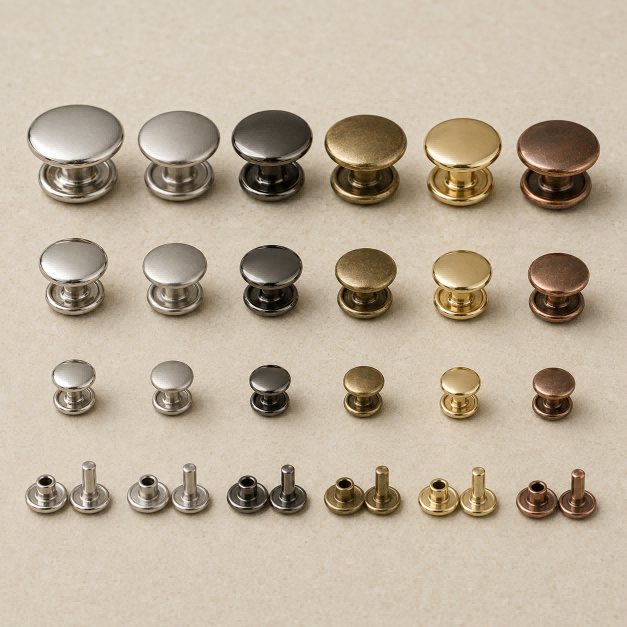
In apparel and leather-goods production, metal rivets can provide both reinforcement and decoration. They are commonly installed at pocket corners, seam intersections, strap connections and other areas exposed to repeated pulling or abrasion. Baocheng can customize rivet dimensions, cap diameter, post length, color and surface finish according to the material thickness, product design and end-use requirements.
Available Rivet Sizes
Rivet size should be selected by considering both the post length and the cap diameter. The post length must match the compressed thickness of the material stack, while the cap diameter affects the visible proportion, contact area and overall appearance. The following combinations are based on Baocheng’s referenced rivet sizes.
| Rivet Post | Cap Diameter |
|---|---|
| 5.6 mm | 4.7 mm |
| 6.4 mm | 6.0 mm |
| 7.9 mm | 4.7 mm |
| 7.9 mm | 6.0 mm |
| 7.9 mm | 7.0 mm |
| 7.9 mm | 9.2 mm |
| 9.0 mm | 7.0 mm |
| 9.5 mm | 9.2 mm |
| 9.5 mm | 11.0 mm |
| 12.7 mm | 9.2 mm |
| 12.7 mm | 11.0 mm |
| 15.0 mm | 11.0 mm |
Note: The table shows referenced post-and-cap combinations. Actual availability may vary according to the rivet structure, material, mold and order requirements. Baocheng can also evaluate custom post lengths, cap diameters and component combinations. Samples should be installed on the customer’s actual material before bulk approval.
Choosing the Correct Rivet Post Length
The correct post length is determined by the compressed thickness of all layers at the installation point. This may include denim, leather, coated fabric, webbing, lining, reinforcement patches, folded seams and decorative overlays. Material thickness should be measured in the same layered condition used in the finished product.
A post that is too short may not enter the cap far enough to create a secure lock. A post that is too long may bend sideways, leave the rivet loose, deform the cap or create an excessive gap between the rivet and the material. A longer post does not automatically provide a stronger connection. The strongest result usually comes from a suitable post length, correct setting die and controlled installation pressure.
- Provide the total material stack or a finished sample panel during development.
- Measure folded seams and reinforced areas separately from single-layer material.
- Confirm that the post enters the cap to the intended locking depth.
- Check the installed rivet for looseness, rotation, tilting and cap deformation.
- Repeat testing after the intended washing, finishing or conditioning process.
Choosing the Correct Cap Diameter
Cap diameter influences both appearance and load distribution. A smaller cap creates a subtle visual detail and is suitable for compact garment areas. A larger cap provides a stronger visual presence and spreads contact over a wider area, which can be useful for bags, straps, leather goods and heavier material stacks.
Cap diameter alone does not determine pull-out strength. The base material, post structure, installation quality, hole size, reinforcement and distance from the material edge are also important. For soft, thin or loosely woven materials, a larger cap may still require an internal reinforcement layer to prevent the rivet from pulling through the surrounding material.
Rivet Structure Options
Different rivet structures are used according to whether the back of the rivet is visible, how much force the joint must carry and what appearance the customer wants. The selected cap and post must be designed as a compatible set; components from different structures should not be mixed without installation testing.
Single-Cap Rivets
A single-cap rivet has a decorative or finished cap on the visible side and a post or base component on the reverse side. It is commonly used when only one side of the product is prominently visible. This structure can provide an economical solution for jeans, garment details and selected bag components.
Double-Cap Rivets
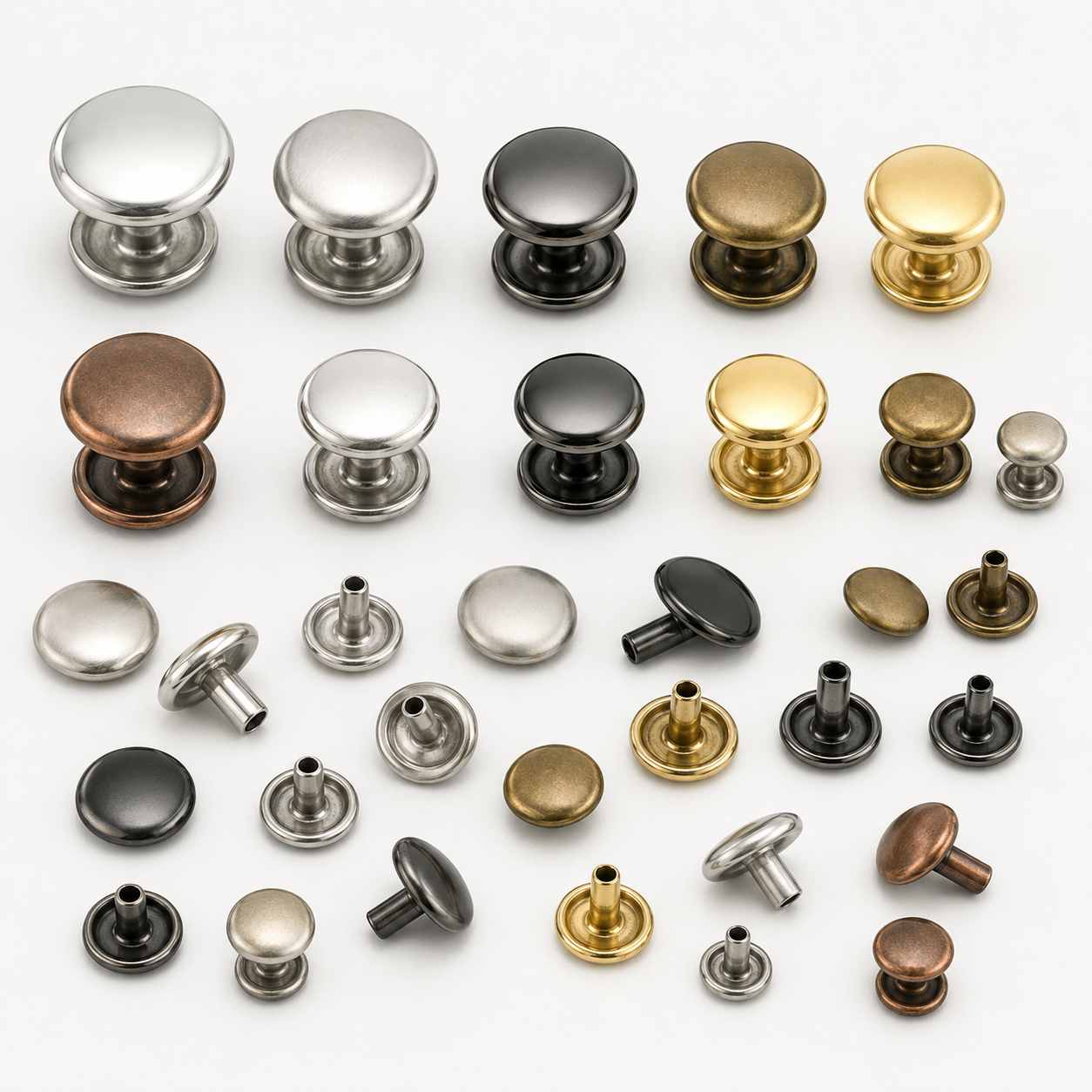
A double-cap rivet presents a finished cap-like appearance on both sides of the material. It is suitable for bag straps, belts, leather goods and other products where both the front and back of the connection may be visible. Cap proportions, post length and setting pressure should be matched carefully to prevent gaps or surface damage.
Denim Reinforcement Rivets
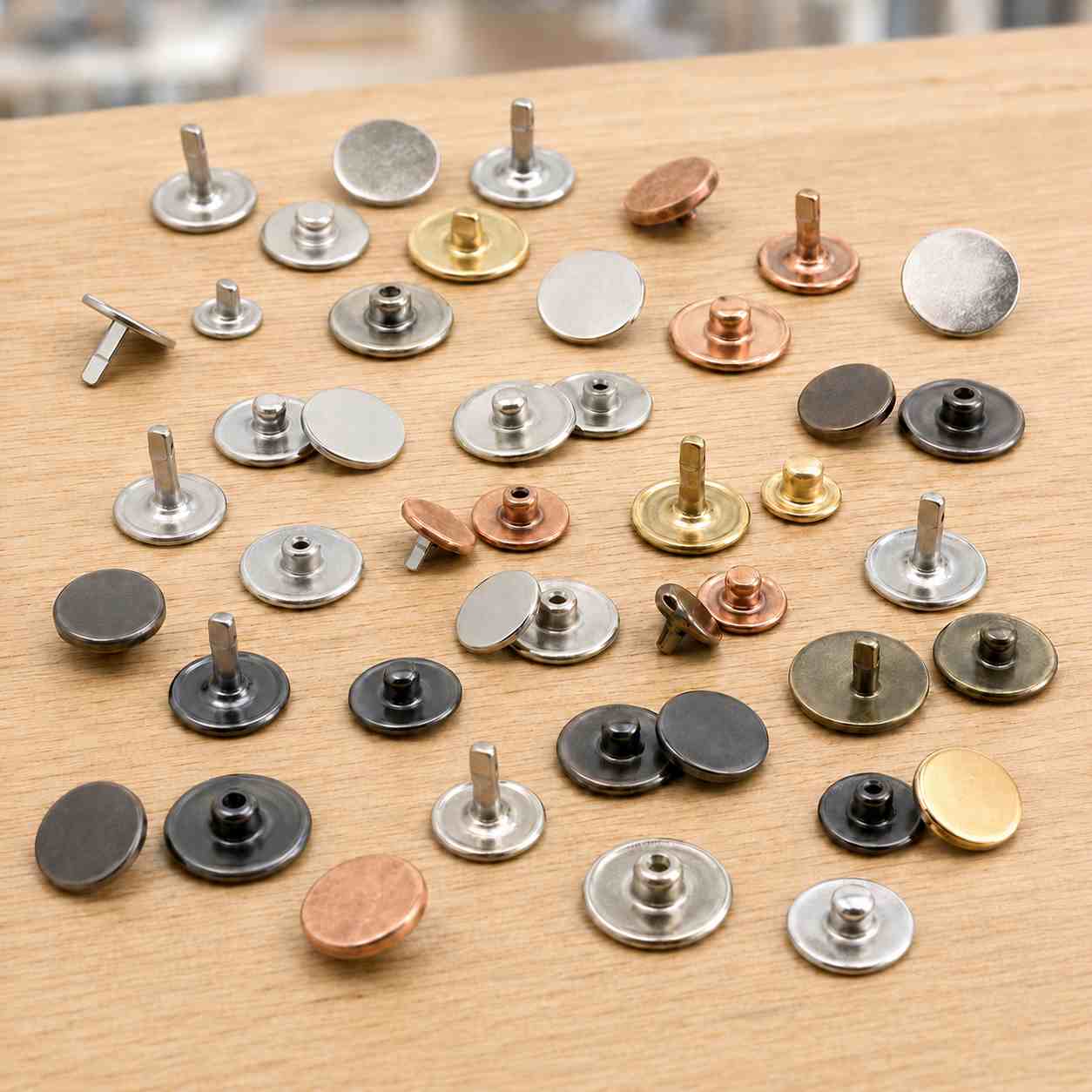
Denim rivets are commonly installed at pocket corners and other high-stress points on jeans. Their purpose is to support the stitched construction by reducing local fabric movement and helping the seam area resist repeated pulling. The rivet should be positioned far enough from the fabric edge and must not cut or excessively compress the denim during installation.
Decorative and Branded Rivets

Decorative rivets can use plain, textured, embossed, debossed or engraved cap faces. Where the selected material and structure permit, Baocheng can evaluate custom letters, symbols, border patterns and brand logos. Logo clarity depends on cap diameter, line thickness, relief depth, surface finish and forming feasibility.
Custom Colors and Surface Finishes
Baocheng can customize rivet colors and surface treatments to coordinate with jeans buttons, snap fasteners, eyelets, buckles and other metal apparel hardware. Common appearance options may include bright silver, matte silver, black, gunmetal, bright gold, antique gold, brass, antique brass, copper, antique copper, rose gold, polished, brushed, painted and vintage effects.
- Bright, matte, brushed and polished metal appearances
- Antique, oxidized and vintage-style finishes
- Black, gunmetal, gold, brass, copper and rose-gold color families
- Custom color matching based on an approved physical reference
- Coordinated finishes across different apparel-hardware products
- Custom logos and cap patterns where the structure permits
The final appearance can be affected by the base material, polishing level, plating process, coating thickness and cap geometry. For this reason, colors should be approved through physical samples rather than screen images alone. When rivets will be exposed to garment washing, leather treatments, salt, moisture or cleaning chemicals, the complete finish should be tested under representative conditions.
Material Options
A complete rivet set may use different materials for the cap and post. Material selection affects forming performance, locking behavior, corrosion resistance, surface appearance, magnetic response, weight and cost. Baocheng can discuss a suitable material combination according to the rivet structure and customer requirements.
Brass
Brass offers good formability, corrosion resistance and a premium metal appearance. It is widely suitable for apparel and leather-goods hardware and works with many bright, polished and antique finishes. Brass may be selected when a non-ferrous material is preferred, but the magnetic response and compliance of the complete assembled rivet must still be evaluated component by component.
Iron or Steel
Iron or conventional steel provides good mechanical strength and a cost-effective solution for many standard rivets. These materials normally depend on plating or coating for appearance and corrosion protection. The intended washing process, storage environment and exposure to moisture should therefore be considered when choosing the surface treatment.
Stainless Steel
Stainless steel provides good strength and resistance to moisture and everyday corrosion. It can be suitable for workwear, bags, outdoor products and applications that require durable metal hardware. The stainless-steel grade and component geometry should be selected according to forming difficulty, surface requirements, corrosion conditions and magnetic specifications.
Zinc Alloy
Zinc alloy may be considered for decorative cap components requiring deeper relief, dimensional patterns or more complex shapes. Because zinc-alloy parts and stamped sheet-metal parts behave differently during setting and impact, the complete cap-and-post structure should be assessed for weight, brittleness, locking performance and end-use conditions.
JSW20 Ultra-Low Magnetic Permeability Stainless Steel
For projects with strict magnetic-response requirements, Baocheng can evaluate its patented JSW20 ultra-low magnetic permeability stainless steel for applicable stamped rivet components. JSW20 is developed to maintain a very low magnetic response after cold-working processes such as stamping and forming, making it relevant to selected needle-detection or controlled-permeability projects.
Needle-detector performance must be evaluated on the complete finished rivet rather than the raw cap material alone. The post, internal contact area, surface treatment, component dimensions and assembly process can all affect the magnetic response. Customers should confirm assembled samples using their actual detector sensitivity and acceptance standard.
Typical Rivet Applications
Jeans and Denim Garments
On jeans, rivets are most commonly installed at front-pocket corners, coin pockets and other seam intersections exposed to repeated pulling. They can also be used on denim jackets, skirts, shorts, overalls and workwear. The rivet should reinforce the construction without cutting the fabric, creating an uncomfortable internal projection or interfering with garment movement.
Bags and Backpacks
Rivets can reinforce handle bases, shoulder-strap connections, pocket corners, flap details and decorative leather patches. For load-bearing bag positions, the rivet should usually work together with stitching and an appropriate reinforcement layer. A decorative rivet should not automatically be treated as the only structural connection for a heavily loaded strap.
Leather Goods and Belts
Leather wallets, belts, straps, cases and accessories often use rivets where material layers overlap. Post length should be chosen according to the compressed leather thickness, not the uncompressed thickness measured before setting. The cap and reverse side should also be checked for smoothness in areas that may contact skin or clothing.
Footwear, Workwear and Accessories
Rivets may be used on footwear uppers, utility pockets, protective clothing, pet accessories and other products that combine reinforcement with a metal decorative detail. Each application should be assessed for flexing, abrasion, moisture, contact safety and the forces applied during normal use.
Installation and Material Compatibility
Reliable rivet performance depends on more than the rivet itself. The hole size, installation die, press alignment, setting force and material support all influence the finished connection. A die that does not match the cap profile may scratch the surface, flatten a curved cap or apply force away from the center. Misalignment can bend the post and create a connection that appears installed but has insufficient engagement.
- Match the setting die to the rivet cap shape and diameter.
- Create a clean hole or controlled piercing point without excessive tearing.
- Keep the cap and post aligned during installation.
- Use enough pressure to lock the components without crushing the cap.
- Inspect both sides for gaps, sharp edges, tilting and surface damage.
- Test pull-off resistance and rotation on the actual production material.
Soft textiles may need backing, folded fabric or reinforcement tape to distribute the load. Thick leather and webbing require enough post length for secure engagement but should not be over-compressed. Coated materials should be checked for cracking or coating damage around the installation point.
Custom Development and Quality Control
Specification Review
Before sampling, Baocheng can review the required cap diameter, post length, cap profile, logo artwork, material, color, surface finish and installation position. Information about the material layers, intended use, washing process, testing requirements and setting equipment helps reduce repeated sampling.
Sample Development
Samples allow the customer to evaluate color, cap proportion, logo clarity and installation performance on the intended product. Important checks include post engagement, cap deformation, surface scratching, rivet rotation, pull-off resistance, material tearing and comfort on the reverse side. If the final product will be washed, conditioned or chemically treated, the installed samples should pass through the same process before approval.
Bulk Production Control
During production, inspection can focus on cap diameter, post length, component fit, burrs, edge condition, surface defects, finish consistency, logo definition and setting performance. Approved samples and agreed specifications can be used as production references. Packaging can also be arranged according to the customer’s assembly method, storage conditions and export requirements.
About Baocheng

Founded in 2013, JiaShan BaoCheng Clothing Accessories Co., Ltd. is a factory-trading integrated B2B supplier specializing in metal buttons and apparel hardware. Our experience with rivets, tack buttons, snap fasteners, eyelets and other stamped components helps us understand how material selection, surface appearance and installation performance must work together in finished garments and accessories.
For custom rivet projects, Baocheng can support communication from size and structure selection through material matching, surface-finish sampling, logo development, trial installation, bulk production and packaging. Customers can provide an existing sample, technical drawing, target dimensions or application description for evaluation.
We work with garment brands, apparel factories, bag and leather-goods manufacturers, trim importers, sourcing companies and distributors. Whether a project requires a compact denim rivet, a double-cap rivet for a bag strap, a decorative branded cap or a low-magnetic stamped component, the specification can be developed around the actual product structure and performance requirements.
Compliance and Documentation Support
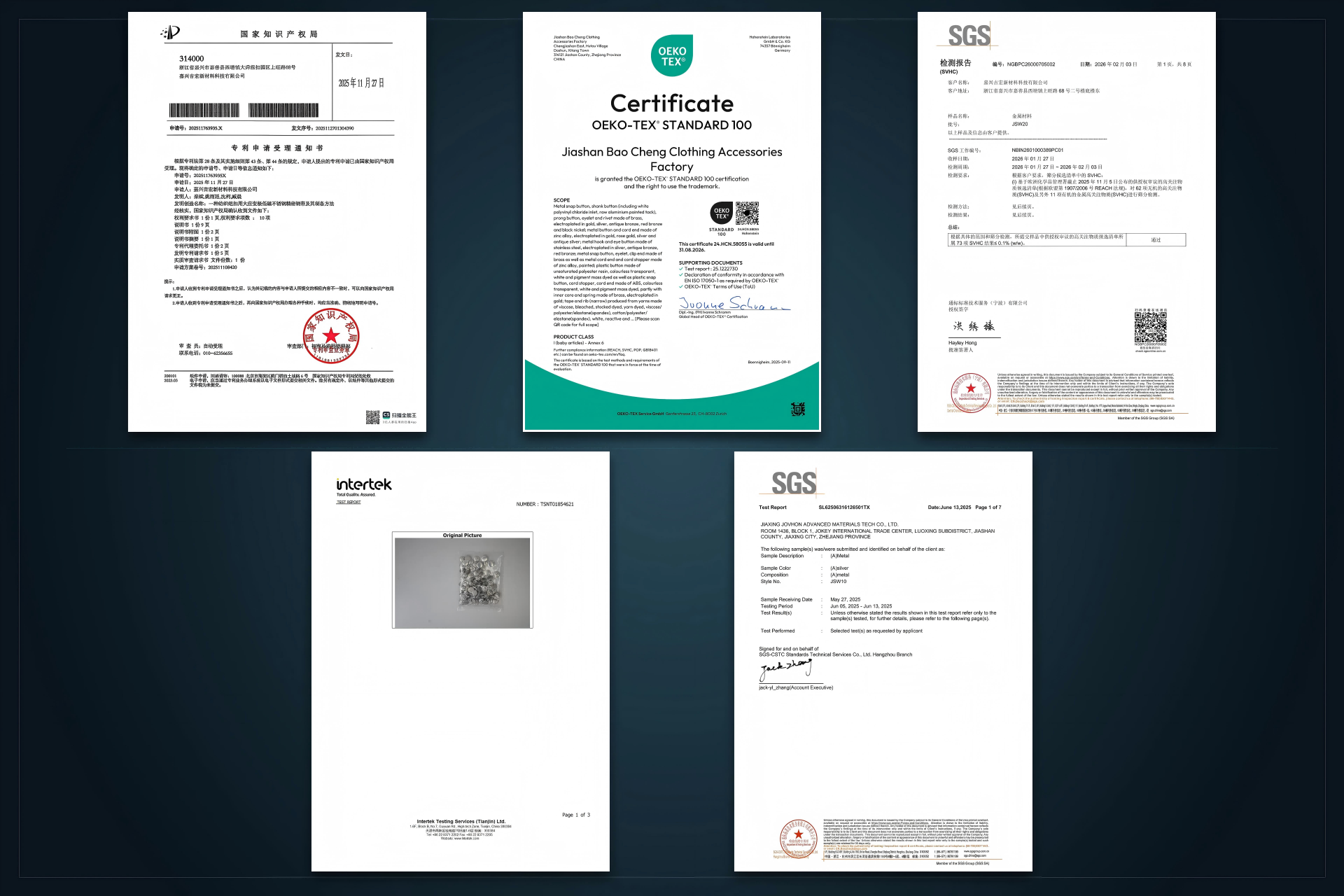
Supporting documents such as the JSW20 patent certificate, OEKO-TEX documentation, RoHS and REACH reports, Intertek reports and nickel-release test information may be provided for relevant materials or projects. Document availability and scope should be confirmed before ordering because a report may apply only to a specified material, finish, product structure or test batch.
If the finished rivet must comply with a particular brand standard, restricted-substance specification or target-market requirement, please provide the exact document during the inquiry stage. Baocheng can then review appropriate material and finish options, prepare samples and discuss any project-specific testing required before bulk production.
Focused FAQ
1. What is an apparel rivet?
An apparel rivet is a permanent metal fastener normally made from a cap and a matching post. The post passes through the material and locks into the cap during setting. Rivets are used to reinforce stress points, add decorative metal details or connect overlapping material layers.
2. What rivet sizes are available?
The referenced combinations include post lengths from 5.6 mm to 15.0 mm and cap diameters from 4.7 mm to 11.0 mm. Available combinations are shown in the size table above. Baocheng can also evaluate custom post lengths, cap diameters and structures according to the customer’s material and design requirements.
3. How do I choose the correct rivet post length?
Select the post according to the compressed thickness of every layer at the installation point. The post must be long enough to engage securely with the cap but not so long that it bends, creates a gap or deforms the finished rivet. Testing on the actual material stack is recommended.
4. How do I choose the cap diameter?
A smaller cap provides a compact appearance, while a larger cap creates a stronger visual effect and distributes contact over a wider area. The correct choice depends on the product design, available installation space, material strength and required appearance.
5. Can Baocheng customize rivet dimensions?
Yes. Baocheng can evaluate custom post lengths, cap diameters and component combinations. Tooling feasibility, material, rivet structure, order quantity and performance requirements should be confirmed before a custom size is approved.
6. Which rivet colors and surface finishes are available?
Options may include silver, matte silver, black, gunmetal, gold, antique gold, brass, antique brass, copper, antique copper, rose gold, polished, brushed, painted and vintage effects. Actual availability depends on the base material and rivet construction. Physical samples are recommended for final color approval.
7. Which materials can be used for rivets?
Common options include brass, iron or steel, stainless steel and selected zinc-alloy components. The cap and post may use different materials. Baocheng can discuss a suitable combination according to forming requirements, locking performance, corrosion conditions, magnetic response, appearance and target cost.
8. Can logos or patterns be added to the rivet cap?
Custom letters, symbols, textures and logos can be evaluated where the cap structure and tooling permit. Logo feasibility depends on cap diameter, line thickness, relief depth, base material and the selected surface finish.
9. Can Baocheng rivets be used for needle-detection projects?
Needle-detector performance depends on the complete assembled rivet, including the cap, post, surface treatment, size and forming process. JSW20 may be evaluated for suitable low-magnetic stamped components, but customers should approve complete samples using their actual detector sensitivity and acceptance standard.
10. Can Baocheng support a fully custom rivet project?
Yes. Baocheng can support size and structure selection, material matching, custom color and surface-finish development, logo evaluation, sample installation, bulk production and packaging. Providing a drawing or sample, material thickness, application position, finish reference, test requirements and estimated order quantity will help us prepare a more accurate proposal.

RELATED NEWS
MESSAGE ONLINE
CONTACT US
No. 68, Dashun Shangwang Road, Jiashan County, Jiaxing City, Zhejiang Province, China

+86 13706836444

+86 13706836444

jack-shen@longyao-sh.com


Premium Engineered Wood Products for Global Excellence
Crafted with precision and certified to meet international standards, our engineered wood solutions deliver unmatched quality and reliability for diverse applications worldwide.
Internationally Recognized Certifications
KEY RESPONSIBILITIES
Identify, develop and manage all business opportunities. Map by identifying all buyers and influencers to create a constant string of revenues, achieving/exceeding the targets. Establish long term relationship with the senior exec staff and get support from ADI senior management in leveraging that constant relationship.
In collaboration with marketing, build a specific value proposition for the account.
Maintain accurate monthly forecast and sales opportunity pipeline Creation and execution of detailed sales plan to achieve revenue objectives.
Duties and responsibilities include developing and executing business partnership strategies
Responsibilities will cover all facets of strategic key account business development, identifying new market opportunities for partnerships, identifying partners, initiating conversations, enumerating requirements, negotiating terms, closing deals and support account receivables collection.
Focus on the development of national accounts with annual purchases of $....
Develop and maintain close working relationships with appropriate internal and external resources and partners.
Participate in account planning and strategy activity Understand and appropriately leverage sales and support resources
Maintain high level of knowledge of our product offerings, roadmaps, competition, pricing, market share, and key product differentiation
Work to increase awareness and interest in our products and solutions
Superior Material & Advanced Manufacturing
KEY RESPONSIBILITIES
Identify, develop and manage all business opportunities. Map by identifying all buyers and influencers to create a constant string of revenues, achieving/exceeding the targets. Establish long term relationship with the senior exec staff and get support from ADI senior management in leveraging that constant relationship.
In collaboration with marketing, build a specific value proposition for the account.
Maintain accurate monthly forecast and sales opportunity pipeline Creation and execution of detailed sales plan to achieve revenue objectives.
Duties and responsibilities include developing and executing business partnership strategies
Responsibilities will cover all facets of strategic key account business development, identifying new market opportunities for partnerships, identifying partners, initiating conversations, enumerating requirements, negotiating terms, closing deals and support account receivables collection.
Focus on the development of national accounts with annual purchases of $....
Develop and maintain close working relationships with appropriate internal and external resources and partners.
Participate in account planning and strategy activity Understand and appropriately leverage sales and support resources
Maintain high level of knowledge of our product offerings, roadmaps, competition, pricing, market share, and key product differentiation
Work to increase awareness and interest in our products and solutions
Versatile Applications Across Industries
KEY RESPONSIBILITIES
Identify, develop and manage all business opportunities. Map by identifying all buyers and influencers to create a constant string of revenues, achieving/exceeding the targets. Establish long term relationship with the senior exec staff and get support from ADI senior management in leveraging that constant relationship.
In collaboration with marketing, build a specific value proposition for the account.
Maintain accurate monthly forecast and sales opportunity pipeline Creation and execution of detailed sales plan to achieve revenue objectives.
Duties and responsibilities include developing and executing business partnership strategies
Responsibilities will cover all facets of strategic key account business development, identifying new market opportunities for partnerships, identifying partners, initiating conversations, enumerating requirements, negotiating terms, closing deals and support account receivables collection.
Focus on the development of national accounts with annual purchases of $....
Develop and maintain close working relationships with appropriate internal and external resources and partners.
Participate in account planning and strategy activity Understand and appropriately leverage sales and support resources
Maintain high level of knowledge of our product offerings, roadmaps, competition, pricing, market share, and key product differentiation
Work to increase awareness and interest in our products and solutions
Customization & Competitive Logistics
KEY RESPONSIBILITIES
Identify, develop and manage all business opportunities. Map by identifying all buyers and influencers to create a constant string of revenues, achieving/exceeding the targets. Establish long term relationship with the senior exec staff and get support from ADI senior management in leveraging that constant relationship.
In collaboration with marketing, build a specific value proposition for the account.
Maintain accurate monthly forecast and sales opportunity pipeline Creation and execution of detailed sales plan to achieve revenue objectives.
Duties and responsibilities include developing and executing business partnership strategies
Responsibilities will cover all facets of strategic key account business development, identifying new market opportunities for partnerships, identifying partners, initiating conversations, enumerating requirements, negotiating terms, closing deals and support account receivables collection.
Focus on the development of national accounts with annual purchases of $....
Develop and maintain close working relationships with appropriate internal and external resources and partners.
Participate in account planning and strategy activity Understand and appropriately leverage sales and support resources
Maintain high level of knowledge of our product offerings, roadmaps, competition, pricing, market share, and key product differentiation
Work to increase awareness and interest in our products and solutions