





Why Shoe Eyelets Pull Out: Problems With the Upper, Hole, Barrel or Setting Die
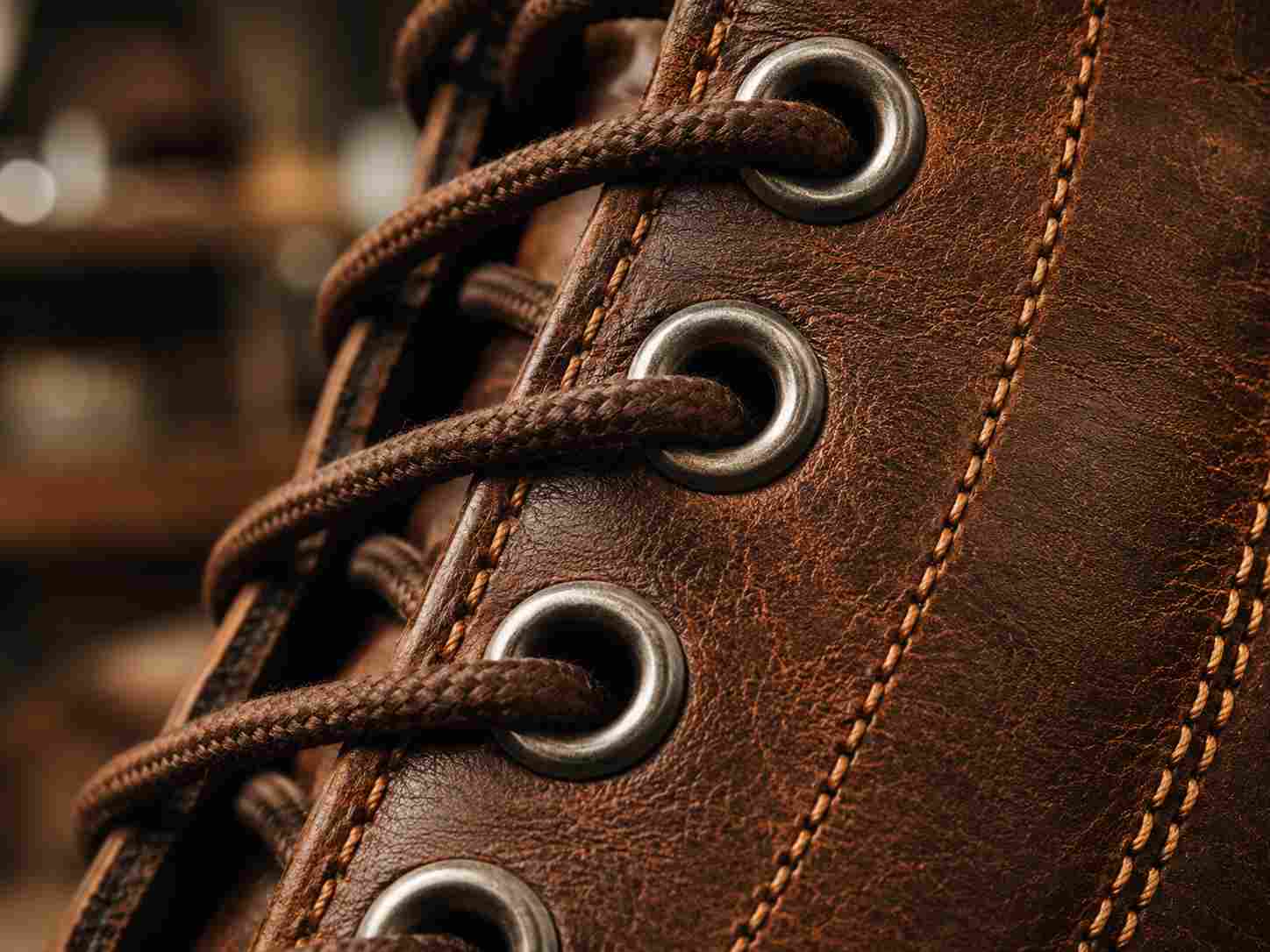
Eyelet Pull-Out Is Usually a System Failure
When a shoe eyelet pulls out, the loose metal ring is the most visible evidence, but it is not always the original cause. The failure may begin in a weak upper, an oversized or damaged hole, a barrel that cannot grip the material stack, a washer that does not match, or a setting die that forms the rear edge incorrectly. Several small deviations can also combine until the assembly fails during lacing.
A buyer should not judge the eyelet by metal thickness alone. Lace force travels through the inner rim, flange and formed barrel into the reinforced upper. Strengthening only the metal may simply move the failure into the upper.
Even a consumer shoe eyelet repair kit follows the same principle. Replacing the ring without correcting the damaged hole or weak backing may produce another failure after a few lacing cycles. For new production, diagnosis must begin before the factory changes the eyelet or press pressure.
Recognize the Failure Pattern Before Changing the Specification
| Observed symptom | Most likely starting causes | What to inspect | Typical corrective direction |
|---|---|---|---|
| Eyelet comes out with little upper damage | Hole too large, barrel too short or incomplete rear roll | Hole diameter, installed height and rear engagement | Correct punch, longer compatible barrel or adjusted matched die |
| Upper tears outward from the hole | Weak substrate, insufficient reinforcement or low edge distance | Yarn direction, backing extent and hole position | Improve reinforcement, move the hole or distribute load |
| Eyelet rotates before pulling out | Oversized hole, low clamping force, slick coating or washer mismatch | Rotation after setting, stack compression and washer contact | Correct hole and stack match; do not add pressure blindly |
| Barrel splits or rear edge becomes sharp | Barrel too long, metal too hard, wrong die radius or excessive stroke | Split location, die profile and material condition | Use the correct barrel, forming temper and die set |
| Only one side of the rear roll forms | Off-centre component, tilted press or worn die | Machine alignment, anvil condition and operator positioning | Realign tooling and control component centring |
| Failures increase after flexing or wet use | Upper softening, adhesive loss, corrosion or coating damage | Wet-conditioned samples and post-flex construction | Change reinforcement, material or environmental specification |
1. Problems With the Shoe Upper
The eyelet clamps only the material placed beneath its flange and rear roll. If the upper is weak, loosely woven, heavily skived, poorly laminated or already cut by stitching, the metal cannot create strength that is not present in the substrate.
Insufficient Local Strength
Canvas, knit, microfiber, leather and coated synthetics respond differently to punching and compression. Wovens can fray, soft synthetics can creep, leather can split within a weak fibre layer, and laminates can separate.
Good reinforcement extends beyond the eyelet flange and transfers force into a wider, stable area of the eyestay. The backing should match the upper’s flex, thickness, moisture response and adhesive system. A small, rigid patch can create a new stress concentration at its edge.
Incorrect Reinforcement Position
Reinforcement is ineffective if the eyelet lands partly outside it. Layer movement during cutting, stitching or lasting can shift the backing, so registration and pre-setting inspection matter.
Reinforcement should therefore be defined by material, size and position—not by a general instruction to “add backing.” The drawing should show how far it extends around the centre and whether it continues along the complete eyelet facing.
Edge Distance and Hole Spacing
An eyelet placed too close to an edge, seam, perforation or neighbouring hole leaves too little material to carry load. Moving the centre can help more than increasing flange thickness, while adequate spacing prevents overlapping flanges and upper buckling.
2. Problems With the Prepared Hole
The hole is the interface between the eyelet and the upper. Its diameter, roundness, cut quality and alignment determine how much material remains available for clamping.
Hole Diameter Is Too Large
An oversized shoelace hole leaves little upper material beneath the barrel. The eyelet may appear acceptable immediately after setting but rotate under lace movement and enlarge the opening until it pulls through. A generic punch selected only by nominal eyelet size is risky because barrel outer diameters vary between suppliers.
Hole Diameter Is Too Small
An undersized hole can stretch or tear the upper during insertion. It may start hidden radial cracks in coated synthetics or permanently distort leather beneath the flange.
Ragged, Burned or Misaligned Holes
A dull shoe hole punch may drag fibres instead of cutting cleanly. Heat can seal some synthetics but also make the edge brittle. Misaligned upper, lining and reinforcement layers create stepped holes that catch the barrel.
A quality plan should specify punch diameter and acceptable cut condition. If shoe repair eyelets are installed into previously damaged openings, the original hole must be assessed first; a larger compatible eyelet and added reinforcement may be required.
Self-Piercing Is Not Suitable for Every Upper
Self-piercing eyelets remove a separate punching step but still require validation. A design that works on a woven upper may ladder a knit, delaminate a coating or displace the lining; tooling, speed and upper condition all matter.
3. Problems With the Eyelet Barrel
The barrel passes through the material and forms the mechanical lock. Its outer diameter, length, wall thickness, hardness and rear-form geometry must match the installed stack.
The Barrel Is Too Short
A short barrel cannot roll far enough to capture the washer or rear surface. The eyelet may look flat from the front while the back shows only a narrow flare. Normal lacing then rocks the assembly until it disengages.
The Barrel Is Too Long
Excess barrel length does not automatically increase strength. It may fold unevenly, split, lean, bottom out in the die or leave a raised rear edge. Factories sometimes compensate by increasing press stroke, which can crush the upper without producing a stable lock.
Wall Thickness or Temper Is Incorrect
A thin wall may deform, while a very hard or thick wall may resist rolling and crack. Service strength and forming ability must be balanced.
The Washer Does Not Match
The inner diameter of an eyelet washer must accept the barrel while leaving enough metal for secure rolling. Its outer diameter and thickness should distribute force without cutting the backing. Mixing an eyelet from one series with a similar-looking washer from another can produce low engagement or an unstable rear form.
Matched shoe lace grommets and washers are often useful on soft or multilayer uppers, but they are not a substitute for reinforcement. A washer spreads load only across the material directly beneath it.
4. Problems With the Setting Die
The die converts the barrel into its installed geometry. A visually similar die may support the wrong flange radius, flare the barrel too early or apply pressure to an unsupported area. Extra force cannot correct incompatible geometry.
Upper Die Does Not Support the Flange
If the upper die cavity is too deep, shallow or incorrectly shaped, the flange can dish, scratch or tilt. Decorative rims and logos need dedicated support.
Lower Die Forms the Wrong Rear Profile
The lower die controls whether the barrel rolls smoothly or splits into irregular sections. Its pilot, taper and radius must match the eyelet design. A die made for a plain flare should not be assumed to work with a rolled-rim or washer-backed component.
Worn or Contaminated Tooling
Repeated production wears pilots and forming edges. Adhesive, leather dust and coating residue can also accumulate in the cavity. The resulting off-centre roll may appear gradually, causing defect rates to rise by shift or machine.
Handheld eyelet setting tools can be useful for development or repair, but bulk production needs controlled alignment and repeatable closing height. A production eyelet machine should be qualified with the exact upper stack, eyelet, washer and dies.
Press Force and Closing Height Must Be Controlled

Setting is a forming process, not simply “pressing hard.” Too little stroke leaves incomplete engagement; too much can crush the upper, distort the flange or split the barrel. Pressure alone is insufficient because die height and machine geometry also control the result.
Factories should approve an installed reference sample and record:
- Machine and die identification
- Closing height, stroke or pressure setting
- Upper-stack thickness range
- Front flange and rear roll appearance
- Installed inner diameter and height
- Permitted rotation and pull-out result
- Inspection frequency by operator, shift and lot
Different Shoe Types Create Different Pull-Out Risks
| Shoe type | Typical risk | Useful design direction | Essential validation |
|---|---|---|---|
| Light canvas sneaker | Fraying, low tear strength and panel distortion | Moderate flange with flexible backing | Repeated lacing and wash or flex test |
| Leather casual shoe | Thickness variation and finish marking | Barrel range matched to skived and folded areas | Pull-out across minimum and maximum thickness |
| Hiking shoe | High lace tension, moisture and grit abrasion | Strong smooth-bore eyelet with reinforcement | Wet lacing cycles, corrosion and upper tear |
| Work boot | Heavy repeated loading and industrial exposure | Robust washer-backed or validated heavy-duty structure | Pull-out, flex, corrosion and job-specific review |
| Fashion boot | Thin decorative upper and high visual requirements | Controlled flange size, colour and concealed backing | Appearance, rotation, flex and finish abrasion |
A sneaker eyelet is not automatically light-duty, and a boot component is not automatically heavy-duty. Buyers must confirm the installed construction and tests rather than relying on the application name.
Material and Finish Can Contribute to Failure
Brass, steel, stainless steel and aluminium differ in formability, strength, corrosion resistance, weight and cost. The selected temper must form without cracking yet remain strong in service.
Setting also stretches plating or coating around the barrel. A brittle finish can crack, expose the base metal and roughen the bore through corrosion; dark finishes should also be checked for transfer onto pale uppers.
For finished eyelets requiring ultra-low magnetic permeability after stamping, BaoCheng can use patented JSW20 special austenitic stainless steel. It supports needle-detection-sensitive footwear production and projects with strict magnetic requirements, subject to validation of the complete installed assembly. BaoCheng supplies finished products and customized JSW20 components, not raw sheet or coil.
A Step-by-Step Root-Cause Method
- Retain failed shoes, good shoes and loose components from the same lot.
- Record which eyelet position failed and the direction of lace loading.
- Remove selected samples carefully and inspect the upper beneath the flange.
- Measure the punched hole, barrel, washer and compressed stack.
- Compare front and rear forms with the approved sample.
- Check die identity, wear, alignment and machine setting records.
- Repeat installation on production upper material under controlled settings.
- Test dry, wet-conditioned and flexed samples as required.
- Change one variable at a time and document the result.
- Approve the correction before restarting bulk production.
A retail boot eyelet replacement may solve an individual consumer problem, but it cannot replace this root-cause process for a production defect. Bulk corrective action must identify why the original assembly failed.
Validation Before Bulk Production
Pull testing should use the complete production upper and define the load direction. A straight axial test measures one condition, while real lacing often applies angled and cyclic force. The test plan can include:
- Initial axial and angled pull-out
- Repeated lacing with the specified lace diameter
- Upper flexing before pull testing
- Wet conditioning, drying and temperature cycling
- Sweat, salt, mud or chemical exposure as applicable
- Corrosion and finish-abrasion assessment
- Rotation, hole enlargement and upper-tear inspection
- Sharp-edge and exposed-barrel checks
Acceptance criteria should state the minimum force, cycle count, allowed rotation, corrosion rating and appearance after conditioning. Testing only a loose component cannot predict the strength of the installed footwear system.
For attachment testing, SATRA TM150 measures the force required to detach an installed eyelet from its base material. SATRA TM149 loads the laced fastening in a direction that represents use and records both force and failure mode. Buyers can use these methods as a technical basis, then define project-specific limits for the shoe category and risk level.
What Buyers Should Include in the RFQ
- Shoe type and exact eyelet position
- Eyelet and washer drawing or physical sample
- Finished inner diameter, flange, barrel and material thickness
- Minimum and maximum compressed upper stack
- Upper, lining, reinforcement and adhesive details
- Punch diameter and self-piercing or pre-punched process
- Base material, colour, plating and coating
- Setting machine and matched-die requirement
- Pull-out, lacing-cycle, corrosion and finish criteria
- Sample quantity, bulk volume, packaging and required documents
If existing hardware is unavailable, send clear front, rear and section photographs plus the actual upper. A replacement request cannot be matched reliably from face diameter alone.
BaoCheng Custom Shoe Eyelet Support
JiaShan BaoCheng Clothing Accessories Co., Ltd. supports footwear brands, factories and wholesalers with custom shoe-eyelet development. BaoCheng can customize inner diameter, flange profile, barrel diameter and length, metal thickness, washer structure, material, colour, electroplating, coating and matched setting dies.
Before sampling, customers should provide a dimensioned drawing, clear photographs or a physical reference part, together with the actual upper, lining and reinforcement whenever possible. BaoCheng reviews the material stack, installation position and failure risk before recommending a structure.
When design and tooling conditions permit, BaoCheng can provide development samples without charging for the sample pieces; freight is paid by the customer. The buyer should install and test samples under production conditions. Bulk manufacturing begins after confirmation of dimensions, colour, finish, rear form, pull-out performance and required environmental tests.
Depending on the material, finish and project scope, documentation may include the JSW20 patent certificate, OEKO-TEX-related documentation, RoHS, REACH, Intertek reports and nickel-release testing. Reports must correspond to the actual component and surface process.
Conclusion
Shoe eyelets pull out when the installed system cannot transfer lace force safely into the upper. The starting cause may be weak material, misplaced reinforcement, an incorrect hole, mismatched barrel length, an unsuitable washer, worn dies or uncontrolled press settings.
The reliable solution is to inspect the failure pattern, measure the complete stack, use matched components and tooling, and validate the corrected assembly under realistic lacing, flexing and environmental conditions. Changing the visible eyelet alone is rarely enough.
Focused FAQ
1. Why does a shoe eyelet pull out even when the metal is thick?
Metal thickness is only one factor. A weak upper, oversized hole, short barrel, mismatched washer or incomplete rear roll can still cause failure.
2. Can a larger eyelet fix an enlarged hole?
Sometimes, but only with suitable reinforcement and adequate edge distance. Installing a larger ring into damaged material without backing may enlarge the failure.
3. How do I know whether the barrel is too short?
The rear roll will have limited engagement and may not capture the washer fully. Measure the installed stack and compare it with the approved barrel range.
4. Does a longer barrel provide higher pull-out strength?
Not automatically. Excess length can fold unevenly, split, tilt or crush the upper. Barrel length must match the compressed stack and die.
5. Why does the eyelet rotate before it pulls out?
Likely causes include an oversized hole, insufficient clamping, upper creep, a slick coating or an incompatible washer.
6. Can one setting die be used for similar eyelet sizes?
Only if the supplier validates the exact compatibility. Small differences in flange support and barrel-forming geometry can create serious defects.
7. Should shoe eyelets always use washers?
No, but washers are useful for soft, flexible or highly loaded uppers. The complete construction still needs appropriate reinforcement.
8. What test best predicts shoe-eyelet pull-out?
Use axial and angled pull tests together with repeated lacing, flexing and relevant wet or corrosion conditioning on the production upper.
9. Can BaoCheng analyze an existing pull-out problem?
BaoCheng can review the component, upper stack, photographs, installation sample and project requirements to support a matched development proposal.
10. What must be approved before bulk production?
Approve the drawing, upper stack, eyelet, washer, hole, dies, machine setting and installed sample after required pull, lacing and environmental tests.
#Shoe Eyelets, #Eyelet Pull Out, #Footwear Hardware, #Shoe Upper Reinforcement, #Eyelet Installation, #Boot Hardware, #Shoe Manufacturing, #Custom Eyelets, #Footwear Quality Control, #BC New Material