







Why Curtain Eyelets Scratch Rods or Make Noise—and What Buyers Can Change
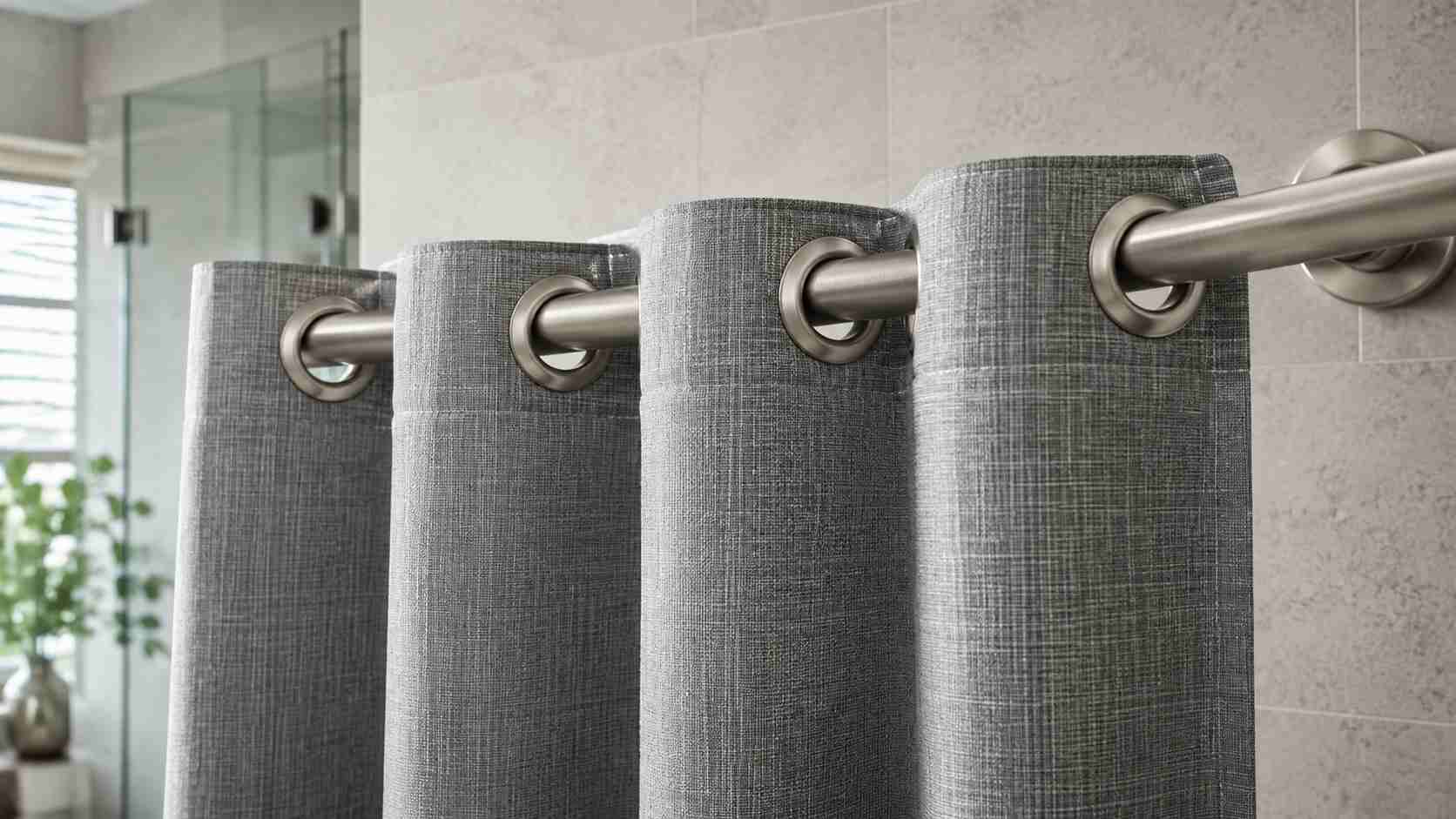
Scratching and Noise Usually Begin at the Interface, Not in the Eyelet Alone
When a customer reports that curtain eyelets are scratching the rod, clicking loudly or becoming rough after a few months, the easiest conclusion is that the eyelet material is wrong.
That conclusion is often incomplete.
A curtain system contains at least two sliding surfaces: the inside of the eyelet and the outside of the curtain rod. The curtain itself adds weight and angular movement. Decorative finishes add another layer of material behavior. Manufacturing tolerances determine whether every eyelet and every rod has the same relationship.
A scratch can therefore originate from a sharp eyelet edge, a hard particle trapped between the two surfaces, a rough rod coating, an oversized clearance that causes repeated impact, or an eyelet that was distorted during setting.
Noise can come from impact, friction, vibration or intermittent sticking.
The correct diagnosis begins by asking:
What type of contact is occurring between the eyelet and rod during actual curtain movement?
Not All Curtain Noise Is the Same
Before changing the material, buyers should classify the sound.
| Observed Sound | Likely Contact Mechanism | Typical Variables to Check |
|---|---|---|
| Sharp clicking | Eyelet repeatedly impacts the rod | Clearance, curtain movement, rod diameter |
| Metallic clatter | Several rigid eyelets strike the rod as folds move | Large clearance, heavy curtain, metal-to-metal interface |
| Scraping sound | Continuous rough sliding | Burrs, rough plating, damaged rod coating |
| Squeak or high-pitched friction | Stick-slip motion | Tight clearance, surface chemistry, coating friction |
| Noise only at one point on the rod | Local obstruction or roughness | Telescopic joint, seam, coating buildup |
The corrective action for a clicking eyelet may be completely different from the corrective action for a scraping eyelet.
A Scratch Pattern Can Tell You Which Component Is Causing the Problem
The rod surface often contains valuable diagnostic information.
If scratches form as narrow continuous lines along the direction of travel, a fixed rough feature may be contacting the rod every time the curtain moves.
This can indicate:
- a burr on the eyelet inside edge;
- a rough plating deposit;
- a split metal edge;
- a damaged rollover;
- a hard contaminant trapped at the interface.
If the rod instead shows short, repeated impact marks, excessive eyelet movement may be more likely.
If wear appears mainly at a telescopic joint, the eyelet may be catching on a local step rather than scratching the primary tube.
For B2B failure analysis, photographs of the rod wear track are often as useful as photographs of the eyelet itself.
Inside-Edge Geometry Is One of the Most Important Variables
The visible front flange receives most of the cosmetic attention during product development.
The rod, however, does not interact with the outside flange. It interacts with the eyelet inside diameter.
A visually perfect front face can therefore hide the most important functional defect.
The inside edge should be evaluated for:
- burrs;
- sharp corners;
- uneven plating;
- tool marks;
- split metal;
- local deformation after setting;
- difference between front and rear internal edges.
A very small sharp feature can concentrate contact pressure onto the rod coating.
Repeated over thousands of opening cycles, that small feature can create a long visible scratch.
A Rounded Contact Edge Usually Behaves Better Than a Knife-Like Edge
When two parts slide, contact geometry determines how pressure is distributed.
A sharp edge concentrates load over a small area.
A smoother radius spreads that load over a larger region.
This does not mean the inside of every eyelet should be aggressively rounded, because the usable opening diameter still needs to meet the curtain-rod requirement.
It means buyers should specify edge quality as a functional feature rather than treating it as an undefined result of stamping.
Why Thin Metal Can Sometimes Become More Aggressive to the Rod
Thin wall eyelets can reduce component weight and may support a refined visual profile, but wall geometry needs careful control.
If the material edge remains sharp, a thinner cross-section can create a relatively narrow contact band.
Under a heavy curtain, that narrow band can produce high local pressure.
Thin material can also be more sensitive to distortion during setting if tooling is not correctly matched.
The point is not that thin eyelets are unsuitable for curtains.
The point is that thin-wall designs need controlled radii, stable material properties and precise tooling rather than simply reducing metal thickness from an existing design.
Clearance Determines Whether the Eyelet Slides or Impacts
The difference between the rod outside diameter and eyelet inside diameter controls how much the eyelet can move before it contacts the rod.
Very small clearance can increase the risk of friction and binding.
Very large clearance can create a different problem: impact.
As the curtain changes direction, the eyelet can move from one side of the rod to the other before contact occurs.
With rigid metal components, that impact can create a distinct clicking sound.
Therefore, buyers researching how to choose grommets should avoid selecting an eyelet simply because the curtain rod physically passes through it.
The functional opening needs to be evaluated under the real curtain weight and movement angle.
Heavy Curtains Magnify Small Surface Defects
A lightweight sheer curtain produces relatively low contact force between the eyelet and rod.
A wide blackout curtain with lining places much more load on the same interface.
As the normal load rises, friction and wear become more sensitive to:
- surface roughness;
- edge radius;
- rod coating;
- eyelet material hardness;
- local contamination.
This explains why a prototype may appear quiet and smooth when tested as a short header sample, yet become noticeably rough after it is assembled into the full curtain.
The final validation should therefore reproduce the finished curtain weight.
The Rod Finish Can Be the Softer Surface
Many buyers assume the eyelet will wear first because it is the smaller component.
That is not always true.
A curtain rod may use:
- paint;
- powder coating;
- decorative plating;
- lacquer;
- other aesthetic surface systems.
The eyelet may be mechanically harder than the rod coating.
In that case, the eyelet can remain almost unchanged while the rod gradually develops polished bands or scratches.
This is why compatibility should be evaluated as a material pair.
What Are Grommets Made Of—and Why Does It Matter for Rod Wear?
Buyers asking what are grommets made of are often looking for a simple list of metals, but material choice affects more than corrosion and price.
The base material influences:
- hardness;
- formability;
- springback;
- edge behavior;
- surface finishing options;
- mass;
- corrosion performance.
Two eyelets with identical dimensions can therefore interact differently with the same curtain rod.
However, base material alone still does not determine scratching.
A carefully finished harder metal can slide better than a softer metal with a rough burr.
Brass and Steel-Type Eyelets Create Different Surface Relationships
The comparison brass eyelets vs steel eyelets is useful because the two material families offer different manufacturing behavior.
Brass generally offers good formability and an attractive decorative base color. Its contact behavior can be favorable when edges are smooth and the curtain system is correctly sized.
Steel or stainless-steel solutions can provide higher rigidity and strong dimensional stability.
But harder does not automatically mean worse for the rod.
A polished stainless contact surface with a controlled radius may create less scratching than a poorly finished softer eyelet.
For purchasing decisions, surface geometry should be evaluated together with material hardness.
Plating Changes the Contact Surface the Rod Actually Sees
The base metal may never touch the rod during the early life of the product.
The curtain rod interacts with the decorative finish first.
For example, nickel plated brass eyelets combine a brass substrate with a nickel-containing visible surface system.
Performance then depends on:
- plating thickness;
- surface roughness;
- coverage at the inside edge;
- adhesion;
- whether the component was severely formed after plating.
If the plating becomes rough at the inside edge, it can scratch a soft rod coating even though the brass substrate itself would not have created the same wear pattern.
Dark Finishes Can Make Wear More Visible
Black nickel grommets can create a premium dark metallic appearance, especially when coordinated with black or gunmetal curtain rods.
But dark finishes need careful wear validation.
If repeated sliding removes part of the dark layer, the lighter underlying metal may become visible.
Even a small amount of wear can therefore look more severe than the same dimensional wear on a silver-colored part.
For high-cycle hotel curtains, appearance retention should be included in the test—not only whether the ring remains functional.
Bright Silver Finishes Have Their Own Wear Risks
Silver plated eyelets or other bright silver decorative systems can hide certain types of light polishing because the substrate and finish may remain visually similar.
However, mirror-like surfaces can make scratches very easy to see under directional lighting.
High-gloss rods create the same issue.
A technically minor scratch may become visually unacceptable in luxury hospitality interiors.
This is an example of why aesthetic acceptance criteria should be defined separately from mechanical acceptance.
Zinc Alloy Changes Both Geometry Possibilities and Contact Behavior
Zinc alloy eyelets can support decorative shapes and complex geometries that may be difficult to achieve through conventional thin-sheet eyelet construction.
This can be useful for fashion-oriented interior hardware.
However, zinc alloy components need to be designed with suitable wall thickness, surface treatment and edge geometry.
If a decorative casting or formed part has a sharp internal transition, it can still damage the rod.
The material name does not eliminate the need for a smooth functional contact surface.
Aluminium Is Light, but Softness Does Not Guarantee Quiet Sliding
Aluminium eyelets offer low density and can provide a different balance of weight and corrosion performance.
Because aluminium is relatively soft compared with many steels, it may appear attractive for reducing rod damage.
But the real sliding surface can include oxide layers, anodizing or decorative coatings.
If the eyelet is poorly finished, a rough aluminium edge can still create audible friction.
Softness alone should therefore not be used as the purchasing criterion.
Noise Can Increase as a Finish Wears
A new curtain eyelet may slide quietly because the contact surface is smooth.
After repeated use, three changes may occur:
- the decorative layer becomes thinner;
- the surface develops a wear track;
- debris accumulates between the eyelet and rod.
The coefficient of friction can change as the interface ages.
A system that began with a soft sliding sound may gradually develop scraping or intermittent squeaking.
This is why cycle testing should include noise evaluation at both the beginning and end of the test.
Debris Can Turn a Smooth System into an Abrasive One
Dust, coating particles and small metal fragments can become trapped between the eyelet and rod.
This creates three-body abrasion.
The eyelet and rod are no longer the only two contact surfaces; small hard particles become miniature cutting tools.
In dusty outdoor or hospitality environments, regular cleaning can therefore influence long-term wear.
A badly flaking coating is particularly problematic because the finish itself becomes the abrasive debris.
The Setting Operation Can Change the Inside Diameter and Edge Condition
A curtain-eyelet supplier may deliver a perfectly round component.
After installation, the final shape can change.
Excessive setting force or mismatched dies can cause:
- ovalization;
- local inward distortion;
- split metal;
- uneven backside forming;
- loss of concentricity.
This means rod compatibility should be checked after the eyelet has been installed in the production curtain.
A buyer should not approve clearance using only loose incoming components.
Rod Scratching Can Be a Tooling Problem
If all incoming eyelets pass visual inspection but scratches appear only after assembly, setting tooling should be investigated.
The tool may contact the internal edge.
A worn die may leave a small burr.
Off-center setting can create one sharp side.
These defects may be difficult to see without close inspection, yet they contact the rod thousands of times during service.
A Simple White-Cloth or Fingernail Check Can Reveal Gross Edge Problems
For development samples, basic tactile screening can help identify obvious sharp edges before more formal testing.
However, mass-production acceptance should use a defined standard.
Depending on the project, this can include:
- visual magnification;
- controlled edge-radius specification;
- surface roughness comparison;
- rod-scratch cycle test;
- go/no-go functional gauges.
Premium curtain programs should translate “smooth edge” into a repeatable inspection requirement.
Why a Large Clearance Can Be Louder Than a Moderate One
A larger opening seems as though it should always reduce friction.
It often does reduce binding.
But as clearance increases, the eyelet has more room to accelerate before hitting the rod.
This can increase impact energy and create sharper clicking.
The effect becomes more noticeable with:
- heavy metal eyelets;
- rapid curtain movement;
- hard metal rods;
- deep curtain folds;
- wide dimensional clearance.
Therefore, the quietest system is not necessarily the loosest system.
Why an Extremely Tight Fit Can Create Stick-Slip Noise
At the other extreme, very small clearance can keep the two surfaces under continuous contact.
If friction is high, the eyelet may repeatedly stick and then suddenly release.
This can create squeaking or jerky movement.
Surface coatings can make the behavior more complex because friction may change with temperature, contamination and wear.
The target is a controlled functional window rather than either extreme.
The Telescopic Joint Can Destroy an Otherwise Good Design
A curtain may move smoothly over 95% of the rod and become noisy only when it crosses the telescopic connection.
The local diameter step can force the eyelet to tilt or impact the joint.
If the joint edge is rough, it can also scratch the eyelet.
Buyers should therefore test the complete rod system, including:
- main tube;
- extension tube;
- plastic sleeves;
- decorative collars;
- seams;
- support transitions.
Do Not Ignore Rod Roundness
A nominally round tube can have slight ovality.
With generous clearance, this may not matter.
With a tighter design, the maximum local diameter can become the true limiting dimension.
Powder coating can further increase the apparent ovality if coating thickness is uneven.
This is why the buyer should control the maximum finished rod envelope rather than only the nominal diameter.
What Buyers Can Change Before Mass Production
Scratching and noise are often highly preventable if buyers control the correct specifications early.
| Buyer-Controlled Variable | What Can Be Changed | Potential Benefit |
|---|---|---|
| Eyelet inside diameter | Adjust rod-to-eyelet functional clearance | Reduce binding or excessive impact |
| Inside-edge profile | Add controlled radius / remove burrs | Reduce rod scratching |
| Base material | Select stainless, brass, zinc alloy or other suitable option | Change rigidity, forming and corrosion behavior |
| Surface finish | Choose finish compatible with sliding interface | Improve appearance retention and friction behavior |
| Metal thickness | Adjust wall rigidity and contact geometry | Control deformation and edge behavior |
| Setting tooling | Match die to component geometry | Preserve roundness and edge quality |
| Rod specification | Control coating, surface roughness and joints | Reduce wear from mating component |
Buyers Should Test the Pair, Not the Eyelet
The strongest development method is to test the exact eyelet and rod combination.
Keep the following production conditions representative:
- real curtain weight;
- real curtain width;
- actual eyelet spacing;
- production rod coating;
- production eyelet finish;
- real setting process.
Then perform repeated opening and closing cycles.
At defined intervals inspect:
- noise;
- sliding force;
- rod scratches;
- eyelet wear track;
- finish loss;
- eyelet deformation;
- looseness in the curtain header.
Failure Should Be Graded by Severity
Not every polishing mark is a product failure.
A useful project standard can separate:
- normal contact polishing;
- visible cosmetic scratch;
- coating penetration;
- base-metal exposure;
- deep groove formation;
- functional binding;
- unacceptable noise.
This prevents engineering teams from either overreacting to harmless contact marks or accepting damage that customers will clearly notice.
When Should Buyers Replace Existing Curtain Eyelets?
Questions about how to replace curtain grommets often arise after the rod has already been scratched or the hardware has become noisy.
Replacement may be appropriate if the installed component has:
- sharp internal wear;
- severe finish loss;
- split edges;
- permanent deformation;
- loose retention in the header.
However, replacing the eyelet with an identical part will repeat the failure if the root cause is the design.
Before replacement, check whether the original problem came from:
- wrong clearance;
- rough rod surface;
- eyelet burr;
- unsuitable finish;
- incorrect setting.
Baocheng Can Customize Curtain Eyelets Around the Actual Rod Interface
For curtain projects, Baocheng / BC New Material can develop finished curtain eyelets and grommets around the customer's actual rod diameter, curtain weight, fabric construction and visual requirements.
For applications where scratching or noise is a concern, customization can focus specifically on the functional sliding surface rather than only the visible flange.
Available development variables can include:
- finished inside diameter;
- inside-edge radius;
- flange outside diameter;
- metal thickness;
- barrel geometry;
- backside structure;
- setting-die matching;
- base material;
- surface finish;
- color and gloss.
Actual curtain rods and fabric samples can be used during sampling so the eyelet is validated as part of the complete system.
Baocheng Offers Multiple Materials for Different Curtain Requirements
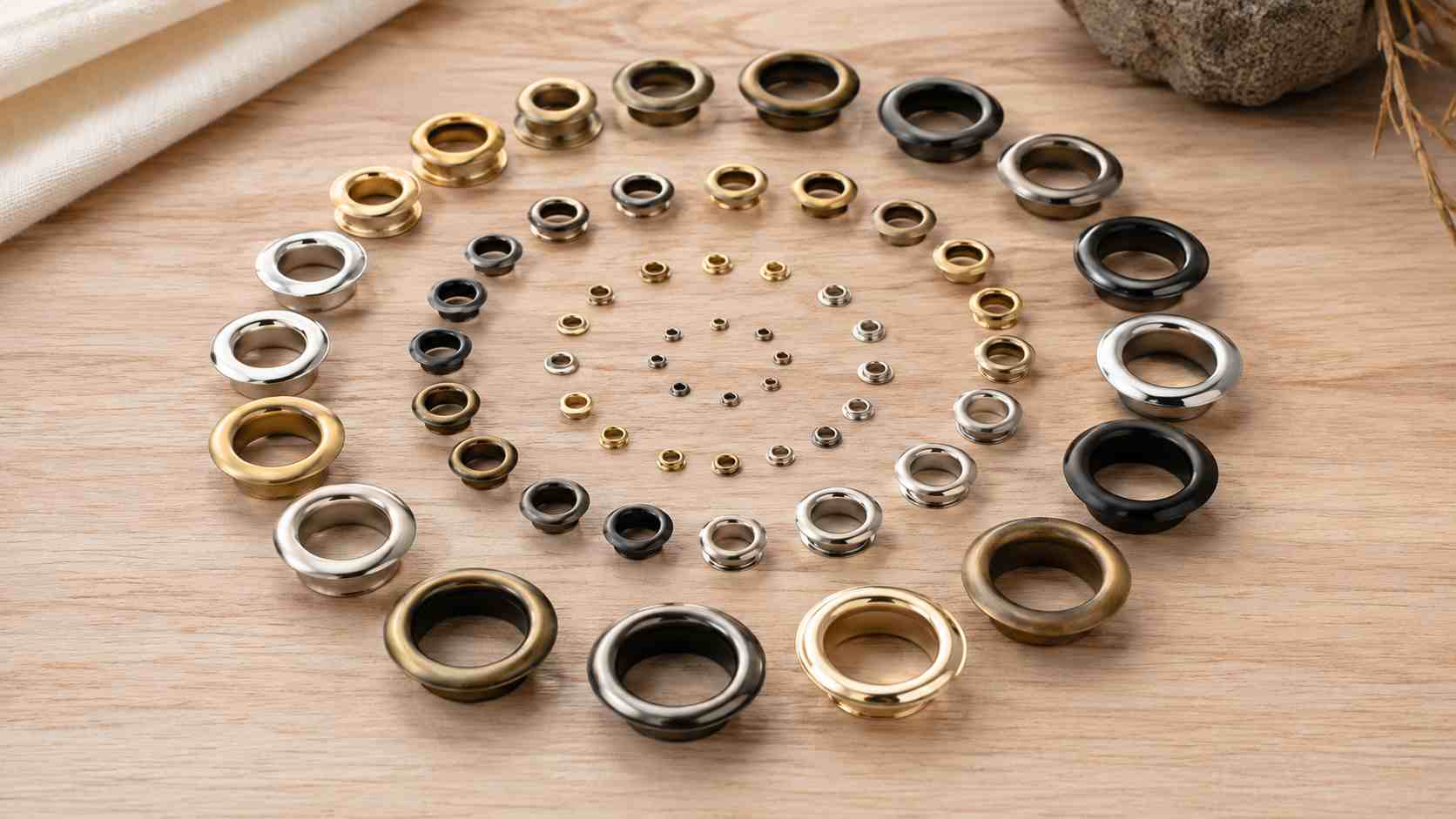
Depending on the project, Baocheng can produce customized curtain eyelets using materials such as:
- 304 stainless steel for many general decorative and corrosion-resistant applications;
- 316 stainless steel for projects requiring stronger resistance to certain chloride-related corrosion conditions;
- brass for premium decorative appearance and strong formability;
- zinc alloy for selected decorative structures and complex profiles;
- JSW20 patented ultra-low-magnetic-permeability austenitic stainless steel for specialized projects requiring extremely low magnetic response after forming.
Why Baocheng's JSW20 Is Different from Conventional Stainless Options
Curtain eyelets are not used as untouched flat raw material.
They are stamped, drawn, formed and finally set into the curtain.
Cold working can increase the magnetic response of some conventional austenitic stainless steels.
Baocheng's proprietary JSW20 was developed specifically for applications where finished components need to maintain ultra-low magnetic permeability and near-nonmagnetic performance after forming.
This makes JSW20 relevant to specialized curtain or textile hardware installed near:
- magnetic-sensitive inspection equipment;
- specialized electronics;
- controlled industrial environments;
- projects with strict permeability specifications.
Its value is not simply that the incoming raw material shows low magnetism. The key requirement is maintaining extremely low magnetic response through the forming process used to manufacture the finished hardware.
JSW20 is an ultra-low-magnetic-permeability solution, not a substitute name for 316 corrosion resistance.
Magnetic performance and chloride-corrosion performance are separate engineering requirements and should be specified independently.
Baocheng supplies finished and customized JSW20 components. We do not sell JSW20 raw coil material.
Color Can Be Customized Without Ignoring Sliding Performance
Baocheng can develop multiple decorative directions depending on the selected base material and project conditions, including:
- bright silver;
- matte silver;
- black;
- gunmetal;
- gold;
- brass tones;
- antique effects;
- other customer-specified finishes.
For a curtain eyelet that directly contacts the rod, finish selection should always be validated at the inner diameter.
A finish that looks excellent on the flange but becomes rough or wears rapidly inside the hole is not a successful curtain-hardware finish.
Baocheng Can Help Buyers Test the Finished Interface Before Volume Production
For B2B programs, sampling can be based on the actual curtain construction and rod system.
Useful evaluation can include:
- inside-diameter inspection;
- edge quality;
- rod-fit test;
- full-curtain sliding trial;
- visual wear comparison;
- setting consistency;
- corrosion or project-specific environmental checks where required.
Depending on the project, documentation or testing support can also be coordinated for requirements such as RoHS, REACH, OEKO-TEX, Intertek or nickel-release-related evaluation.
What Buyers Should Put in the RFQ
A useful RFQ for a low-noise, rod-friendly curtain eyelet should include:
- actual finished rod diameter;
- rod material;
- rod surface treatment;
- target eyelet inside diameter;
- curtain weight;
- curtain header thickness;
- desired flange size;
- base material preference;
- required color and finish;
- expected opening frequency;
- acceptable noise level or comparison sample;
- acceptable rod-wear condition;
- annual quantity.
This allows the supplier to develop the functional interface instead of only matching a catalog size.
The Quietest Curtain Eyelet Is Not Necessarily the Softest or the Largest
Rod scratching and curtain noise cannot be solved by one universal material rule.
A softer material can still contain a sharp burr.
A harder metal can slide smoothly when its contact surface is well controlled.
A very large eyelet can reduce binding yet increase impact noise.
A very tight eyelet can look premium yet develop stick-slip friction.
A premium decorative finish can become the weakest part of the system if it wears rapidly at the inside edge.
The correct purchasing decision is therefore based on the full interface.
Control the rod diameter and finish. Define the installed eyelet ID. Specify the inside-edge geometry. Match material hardness and surface treatment. Validate the setting process. Use the real curtain weight. Cycle the complete assembly and inspect both surfaces.
When these factors are addressed before production, scratching and noise become engineering variables that buyers can control rather than unavoidable characteristics of metal curtain eyelets.
Focused FAQ
1. Why do metal curtain eyelets scratch the rod?
Common causes include burrs, sharp internal edges, rough plating, setting distortion, abrasive debris or a harder eyelet surface sliding against a relatively soft rod coating.
2. Why do curtain eyelets make a clicking noise?
Clicking often occurs when there is enough clearance for the eyelet to move before striking the rod as the curtain changes direction. Heavy metal hardware can make this impact more noticeable.
3. Can making the eyelet larger reduce noise?
Not always. More clearance can reduce binding but may increase impact movement and clicking. The correct opening needs to balance sliding freedom and movement control.
4. Can a harder stainless-steel eyelet still be rod-friendly?
Yes. A smooth stainless eyelet with controlled internal radii can slide well. Surface geometry and finish quality can matter more than material hardness alone.
5. Why does the rod coating wear while the eyelet still looks normal?
The eyelet may be harder than the decorative rod coating. In that case, repeated sliding can polish or remove the rod finish before visible wear appears on the eyelet.
6. Should curtain eyelets be inspected after setting?
Yes. The setting process can change roundness, inside diameter and edge condition, so installed components provide more meaningful rod-compatibility information than loose components.
7. Are brass eyelets automatically quieter than stainless steel?
No. Brass and stainless have different mechanical properties, but noise depends strongly on clearance, edge geometry, curtain weight and the rod surface.
8. Can Baocheng customize the inside edge of a curtain eyelet?
Yes. Custom projects can evaluate inside diameter, edge radius, metal thickness, material, finish and setting geometry together according to the customer's curtain rod and fabric system.
9. What is Baocheng's JSW20 material used for?
JSW20 is Baocheng's patented ultra-low-magnetic-permeability austenitic stainless steel for finished components that need to maintain near-nonmagnetic behavior after forming. It is intended for specialized magnetic-sensitive applications.
10. What should buyers test before approving curtain eyelets?
Test installed eyelets on the real production rod with representative curtain weight. Evaluate sliding force, sound, rod scratches, finish wear, eyelet deformation and retention after repeated cycles.
