






What Is a Snap Fastener? Understanding the Four-Part Cap, Socket, Stud and Post System

What Is a Snap Button?
A snap button is a mechanical closure that joins two layers of material by pressing a male component into a female component. Instead of relying on thread, a buttonhole or a zipper track, the closure works through controlled mechanical engagement between precisely formed metal parts. Once the two halves are aligned and pressed together, the internal spring structure grips the mating stud and holds the product closed until a deliberate pulling force separates them.
Metal snap buttons are widely used because they combine quick opening, repeatable closing and a compact appearance. They are familiar on jackets, shirts, denim garments, children's clothing and leather goods, but the same fastening principle also appears on workwear, bags, outdoor equipment, canvas products, marine covers and other products that need a reusable closure.
The basic idea is simple, but a high-quality snap is not simply “two pieces of metal that click together.” A complete system normally contains four components, and its performance depends on component geometry, spring behavior, material strength, post length, installation accuracy and the construction of the material being fastened.
Understanding those elements is the first step toward selecting a snap that closes positively, opens at the intended force and remains secure after repeated use.
Snap Button, Press Stud and Snap Fastener: Understanding the Basic Terminology
The same general type of closure appears under several names in international markets. A snap fastener describes the fastening mechanism itself, while “snap button” emphasizes its use as a button-like closure. In the United Kingdom and many other markets, press studs is a common term. The singular form, press stud, refers to one complete fastening position.
These terms frequently describe the same broad product family, although individual snap systems can differ significantly in construction, size and locking mechanism. Spring snaps, ring-spring designs, prong systems and heavy-duty snaps should not automatically be treated as interchangeable simply because they belong to the same overall category.
Search terms such as snaps and fasteners also cover a wider hardware family. Buckles, hooks, clasps and other reusable closures can all be considered fasteners, whereas a snap button specifically relies on two mating snap halves that engage under pressure.
In apparel catalogs, buttons and snaps may appear beside one another because both close garments, but the attachment methods are different. A traditional sew-on button depends on thread and a buttonhole. A snap system is mechanically installed into the material and opens by separating two interlocking components.
The Four Main Parts of a Metal Snap Button
Most familiar four-part metal snap systems consist of a cap, socket, stud and post. The exact shape varies by design, but these four names provide a useful foundation for understanding the product.
| Component | Position | Main Function |
|---|---|---|
| Cap | Visible outer side of the female half | Provides the finished appearance and anchors the socket to the material |
| Socket | Inside of the female half | Contains or forms the spring geometry that grips the stud |
| Stud | Inside of the male half | Enters the socket and creates the mechanical locking connection |
| Post | Opposite the stud | Anchors the stud assembly through the material |
1. The Cap
The cap is usually the most visible component. Its diameter, profile, finish and decoration strongly influence the appearance of the finished garment or product. Caps may be plain, embossed, engraved or customized with a logo or decorative pattern. Their surface can also be matched to the overall hardware design through polished, matte, antique, black, silver-tone or other project-specific finishes.
The cap is not purely decorative. During installation it must work with the corresponding socket and attachment geometry. Excessive setting pressure can deform a thin cap, while insufficient pressure can leave the assembly loose.
2. The Socket
The socket is the functional heart of the female half. Its internal geometry receives the stud and produces the force that holds the two halves together. Depending on the snap family, this holding action may come from formed spring elements, a spring ring or another elastic metal structure.
The socket must deform enough to allow the stud to enter and leave, but it must also recover consistently. Poor geometry, unsuitable hardness or excessive deformation during installation changes the opening and closing feel.
3. The Stud
The stud forms the male engagement surface. When the user closes the snap, the stud enters the socket until the retaining structure passes over its locking profile. The shape and dimensional consistency of this interface are critical because small geometric changes affect how easily the snap closes and how strongly it holds.
4. The Post
The post completes the opposite side of the male assembly. During installation, the post or eyelet-style attachment passes through the substrate and is mechanically formed by the setting die. Its length must correspond to the thickness and number of material layers. A post that is too short cannot form a secure attachment; one that is unnecessarily long can buckle, distort or produce an unstable assembly.
How Does a Snap Button Actually Fasten?
The familiar “click” of a snap is the result of controlled elastic deformation rather than a simple friction fit.
When the two halves are aligned, the stud first contacts the entrance of the socket. Additional pressure forces the retaining portion of the socket to expand or deflect. As the widest part of the stud passes the retaining point, the spring structure recovers toward its original position and settles around the narrower locking area of the stud.
This produces a temporary mechanical lock. The snap remains closed because the stud cannot leave the socket without again forcing the spring structure to deflect.
Opening reverses the process. Pulling the two layers apart creates a separation load. Once that load exceeds the designed release force, the socket expands sufficiently for the stud to pass through and the two halves separate.
This explains why a well-designed button snap should not simply be judged as “tight” or “loose.” The correct fastening feel depends on the application. A lightweight shirt does not require the same opening force as an outdoor cover, and excessively high holding force can damage lightweight fabric even if the metal hardware itself remains intact.
Searches for snap on buttons often refer to this convenient press-to-close action. In production, however, the hardware itself still needs to be permanently and correctly installed into the substrate before the snap can perform this repeated opening-and-closing function.
Why Does a Snap Button Need Four Components?
The four-part structure allows two separate fastening assemblies to be permanently attached to two different material layers while still remaining repeatedly detachable from one another.
The cap and socket create one installed half. The stud and post create the other. Installation secures each pair to its own fabric, leather, canvas or other substrate. Normal use then occurs between the socket and stud rather than between the hardware and the substrate.
This separation of functions is important. Installation strength and opening force are related, but they are not the same property. A snap can have adequate socket-to-stud holding force yet still pull out of the fabric if the attachment area is weak. Conversely, a strongly installed snap can still perform poorly if the mating components are dimensionally inconsistent.
For this reason, professional snap selection treats the closure as a system consisting of hardware geometry, material construction and installation conditions.
Where Are Snap Buttons Used?
The usefulness of a snap comes from the combination of fast access, compact size and repeatable operation. That combination supports a much wider range of applications than ordinary fashion garments alone.
Fashion and Everyday Apparel
Snap buttons are common on jackets, shirts, coats, denim garments, trousers and other clothing where designers want faster operation than a conventional button-and-buttonhole system. Decorative caps can also become part of the visual identity of the garment rather than remaining hidden hardware.
Children's and Baby Clothing
Baby bodysuits, children's garments and similar products frequently use snaps because they provide fast access. In these applications, attachment security, smooth exposed surfaces, appropriate opening force and material compliance become especially important. The correct product must be evaluated as part of the finished garment rather than chosen solely by cap diameter.
Workwear and Functional Clothing
Work jackets, uniforms and functional garments use snaps where repeated opening and closing is required. The substrate may be thicker or contain several layers, making post length, reinforcement and installation control more important than in lightweight fashion fabric.
Leather Goods, Bags and Accessories
Wallets, handbags, cases, straps and leather accessories use metal snaps as both closures and visible hardware details. Leather thickness introduces different installation requirements, and the finished snap should close securely without crushing or tearing the surrounding material.
Outdoor, Canvas and Technical Textile Products
Outdoor covers, tents, awnings, canvas products and equipment bags can also use fastening snaps. In these products, the fastener may face higher tension, moisture, dirt, temperature variation and repeated loading. Material choice and reinforcement around the attachment point therefore become part of the engineering decision.
Marine and Other Demanding Environments
Boat covers, marine canvas and similar products expose hardware to moisture and potentially chloride-containing environments. A snap intended for these conditions requires more careful material and surface selection than hardware used on a dry indoor fashion accessory.
What Determines Whether a Snap Button Performs Well?
Two snaps of similar diameter can perform very differently. Reliable operation results from several variables working together.
Component Geometry
The stud profile and socket geometry establish the basic engagement condition. Dimensional consistency matters because the locking action occurs over relatively small contact features. Variations affect closing force, release force and fastening feel.
Material Thickness and Layer Construction
The fastener does not operate independently from the material surrounding it. A thin single-layer fabric behaves differently from folded denim, leather or reinforced canvas. The number of layers, local thickness, coating, elasticity and tendency to fray or tear all affect installation.
Post Length
Post length must provide enough material for secure forming without creating excessive unused length. This is one of the most common reasons a sample should be tested on the actual substrate rather than selected only from a catalog specification.
Installation Tooling
A properly designed snap can fail when installed with the wrong die or incorrect setting pressure. The components must remain centered, the attachment must form evenly and the cap should not be crushed. Consistent tooling is therefore part of snap quality, not merely a production convenience.
Opening Force and User Experience
Higher opening force is not automatically better. The appropriate force must match the substrate strength and intended user experience. A closure that is unnecessarily difficult to open transfers excessive load into the surrounding fabric or leather. A closure that is too weak can open unintentionally.
Repeated Cycling
The socket undergoes repeated elastic movement each time the snap closes and opens. Stable spring behavior, component hardness and accurate forming are essential for maintaining a consistent fastening feel throughout repeated use.
Common Materials Used for Metal Snap Buttons
Material selection affects appearance, forming behavior, corrosion performance, magnetic characteristics, cost and compliance requirements.
Brass is widely used in garment hardware because of its formability and corrosion characteristics. It is also suitable for many decorative finishes.
Stainless steel is selected when strength, wear resistance or environmental performance is important. 304 and 316 stainless steels serve different application requirements, and the final choice should reflect the actual exposure conditions and manufacturing process.
Zinc alloy can be used for selected decorative or structural components where design freedom and surface appearance are priorities, depending on the snap construction.
For projects with demanding magnetic requirements, Baocheng also manufactures finished snap-button products and customized components using patented JSW20 ultra-low magnetic permeability stainless steel. JSW20 is designed to retain extremely low magnetic permeability after forming and also provides chloride-corrosion resistance, making it relevant to projects where conventional assumptions about formed stainless steel magnetism are not sufficient.
Material selection should therefore start from the finished product requirement rather than from the metal name alone.
Five Common Misunderstandings About Snap Buttons
“All snaps of the same diameter are interchangeable.”
They are not. Cap diameter alone does not define stud profile, socket geometry, post design, installation die or opening force. Components from different systems should never be assumed to match without verification.
“The strongest snap is always the best snap.”
Excessive closing or opening force can damage the substrate and reduce usability. The correct snap balances secure retention with controlled release.
“If the snap becomes loose, the metal must be defective.”
Loose snaps can result from incorrect post length, poor die alignment, insufficient setting pressure, excessive setting pressure or inadequate material reinforcement. Failure analysis must separate component performance from installation performance.
“Stainless steel means every stainless snap behaves the same.”
Different stainless-steel grades have different forming, corrosion and magnetic characteristics. Finished-part properties also depend on manufacturing history, not just the nominal raw-material designation.
“A sample tested on one fabric will work on every product.”
Changing fabric thickness, layer count, coating or reinforcement changes the installed condition. Final verification should use the actual production material stack.
What Information Should a Buyer Provide When Selecting a Snap Button?
A good RFQ contains more than a photograph and a target price. For an efficient technical evaluation, buyers should provide the intended application, material type, material thickness, number of layers, preferred cap diameter, required appearance, expected opening feel, environmental exposure and estimated order quantity.
Drawings or physical samples are particularly useful when an existing snap must be matched. If the fastener will be installed on leather, coated fabric, denim, canvas or a multi-layer assembly, the total installed thickness should be stated.
Buyers should also identify relevant requirements for corrosion resistance, nickel release, restricted substances, needle detection or magnetic permeability. These factors can change the recommended material and finishing route.
The right question is therefore not simply “Which snap size do you have?” It is “Which snap system fits the construction and performance requirements of this finished product?”
Custom Snap Button Solutions from BC New Material
Baocheng supplies finished metal snap button products and customized snap components for apparel, leather goods, bags, outdoor products and other applications. Rather than treating the snap as a generic commodity, we can develop the component combination around the customer's finished product and installation conditions.
Customization can cover cap diameter, cap profile, component structure, post length, logo, pattern, material, color and surface finish. Fastening feel can also be evaluated through sample development so that the selected socket-and-stud combination matches the actual substrate instead of relying only on a nominal size.
Material options can include brass, conventional stainless-steel grades and other project-appropriate metals. For applications requiring extremely low magnetic permeability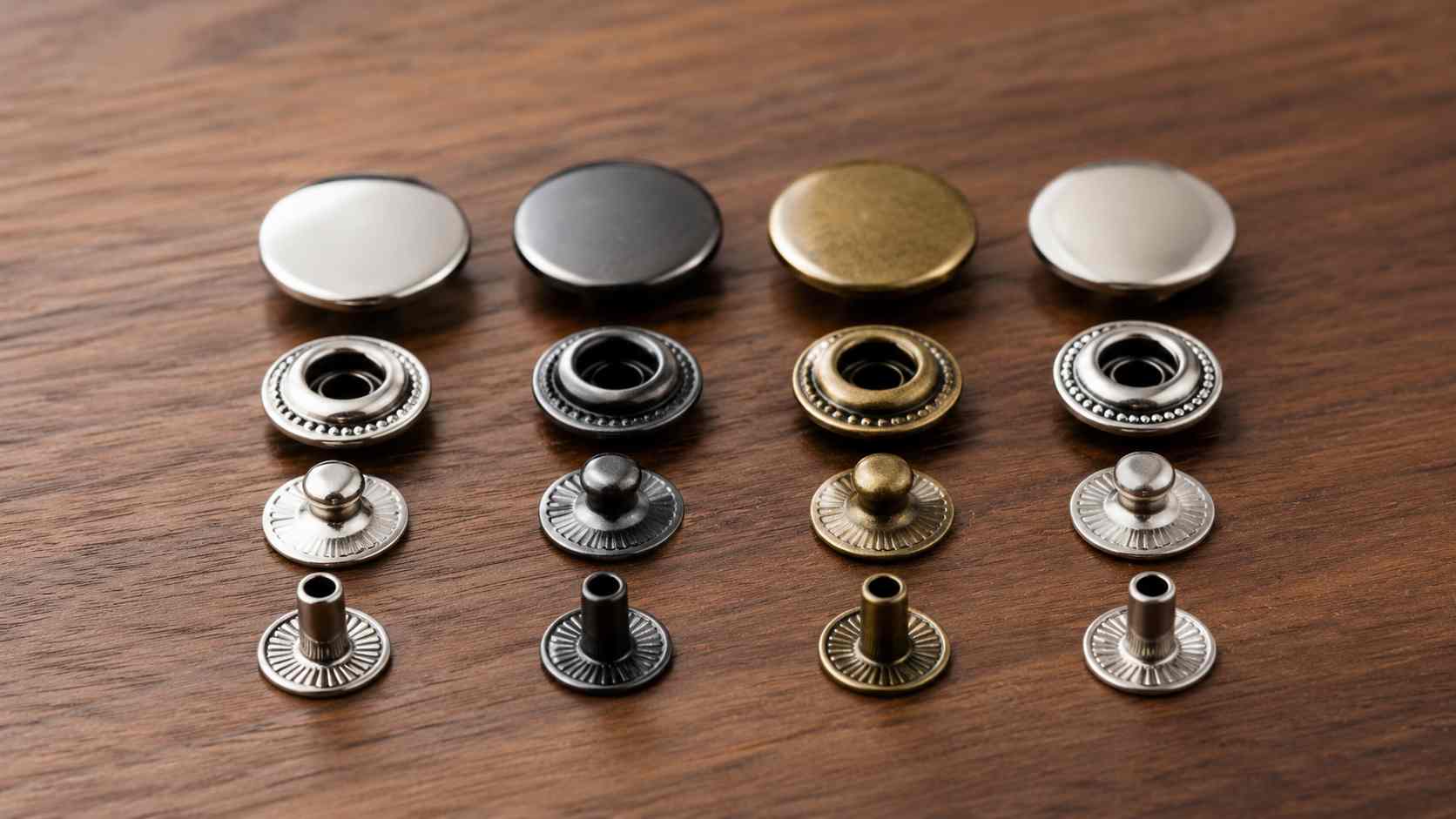 after forming, Baocheng can provide finished products and customized components made from patented JSW20 ultra-low magnetic permeability stainless steel. JSW20 also provides chloride-corrosion resistance, expanding its relevance beyond magnetic-sensitive garment hardware to demanding environmental applications.
Baocheng supplies JSW20 as finished products and customized components rather than selling raw JSW20 coils or sheets.
Sampling can be developed around actual fabric, leather or technical textile thickness. Where applicable to the project and certificate scope, compliance requirements such as REACH, RoHS, OEKO-TEX and nickel-release control can also be considered during material and process selection.
This application-based approach is particularly important for snap buttons: the finished fastener must be compatible with the product it is installed on, not merely look correct before assembly.
Conclusion: A Snap Button Is a Small Mechanical System
A snap button may occupy only a few millimeters of a garment or product, yet it combines appearance, spring mechanics, material forming and installation engineering in one compact closure.
The cap and socket create one half, the stud and post create the other, and the controlled interaction between the socket and stud produces the familiar snap action. Reliable performance then depends on choosing the correct structure, material, post length and installation conditions for the actual substrate.
For buyers, designers and product developers, understanding this system is more useful than choosing hardware by appearance alone. A well-specified snap closes consistently, releases at the intended force, remains securely attached and supports the performance requirements of the finished product.
Focused FAQ
What is the basic snap button meaning?
A snap button is a reusable mechanical closure in which a male stud engages with a female socket under pressure. The installed system usually consists of four components: cap, socket, stud and post.
Are snap buttons and press studs the same thing?
In many markets the terms describe the same broad type of press-to-close fastener. However, individual designs can use different spring structures, sizes and component geometries, so specific snap systems should not automatically be treated as interchangeable.
Why does a snap button have four parts?
Two components permanently form the female half and two form the male half. This allows each half to remain attached to its own material layer while the socket and stud repeatedly connect and disconnect during use.
What causes the “snap” feeling when the button closes?
The socket temporarily deflects as the stud enters. Once the stud passes the retaining point, the spring structure recovers around the locking profile. That controlled elastic movement creates the characteristic closing sensation and holding force.
Can the same snap button be used on fabric, denim and leather?
Not automatically. Substrate thickness, layer count, stiffness and tear resistance affect post length, reinforcement and installation conditions. The snap should be validated on the actual material construction.
How should buyers choose between brass and stainless-steel snap buttons?
The choice should reflect forming requirements, appearance, corrosion exposure, magnetic requirements, finishing expectations and cost. For projects requiring ultra-low magnetic permeability after forming, Baocheng can also manufacture finished snap components from JSW20 stainless steel.
Can Baocheng customize snap button logos and finishes?
Yes. Baocheng supports project-specific cap dimensions, profiles, logos, patterns, post lengths, materials, colors and surface finishes, together with sample development based on the customer's substrate and fastening requirements.
Does Baocheng sell raw JSW20 stainless-steel material?
No. Baocheng supplies finished products and customized components manufactured from JSW20 rather than selling raw JSW20 coils or sheets.
#SnapButton, #PressStud, #SnapFastener, #MetalFasteners, #GarmentHardware, #ClothingAccessories, #FasteningSystems, #SnapButtonComponents