







Vinyl vs Mesh Banner Grommets: Why Material Construction Changes Installation

The Same Metal Grommet Behaves Differently in Vinyl and Mesh
Vinyl and mesh banners are often grouped together because they belong to the same visual-display market. Both can be printed, hemmed, fitted with metal hardware and mounted using ropes, cable ties, hooks or elastic fixings.
That similarity ends at the grommet hole.
A vinyl banner presents a largely continuous coated surface. The metal flange rests on material across almost its entire bearing area.
A mesh banner contains open spaces between yarns or strands. The same flange therefore contacts a smaller amount of actual material unless a reinforced perimeter has first created a denser support zone.
This difference changes:
- how the hole should be prepared;
- how wide the reinforcement needs to be;
- whether self-piercing is suitable;
- how much compression the material tolerates;
- how a washer supports the backside;
- how the setting dies should be adjusted;
- where failure begins under load.
Vinyl and mesh require different installation systems even when the finished grommets look identical from the front.
Material Continuity Is the First Engineering Difference
Vinyl banner material normally contains a polymer coating combined with an internal scrim or textile reinforcement.
The surface is continuous.
When a flange presses against vinyl, load enters the banner through a relatively broad contact area.
Mesh behaves differently.
The material contains intentional openings, so the grommet does not press against a continuous sheet. Without additional edge reinforcement, only a limited number of strands directly beneath the flange carry the load.
| Characteristic | Vinyl Banner | Mesh Banner |
|---|---|---|
| Surface structure | Continuous coated or laminated sheet | Open woven, knitted or perforated structure |
| Flange contact | Broad, continuous contact | Interrupted contact unless reinforced |
| Typical hole failure | Tear, elongation, coating or layer separation | Strand breakage, opening growth, reinforcement separation |
| Primary installation priority | Protect the composite layer structure | Create a dense load-bearing interface first |
| Setting sensitivity | Compression and cutting of coated material | Strand distortion and reinforcement displacement |
The installation process must therefore follow the substrate structure rather than the visible banner category.
Grommet vs Reinforced Hole: These Are Not the Same Thing
The phrase grommet vs reinforced hole highlights an important distinction.
A grommet is the metal hardware.
A reinforced hole is the complete structural system around that hardware.
The reinforced hole includes:
- the substrate;
- the reinforcement layer;
- the punched or pierced opening;
- the flange;
- the barrel;
- the washer where used;
- the finished backside rollover.
A strong grommet does not automatically create a strong hole.
If the surrounding mesh strands are weak, the grommet remains intact while the mesh tears.
If vinyl reinforcement delaminates, the metal remains intact while the bonded edge separates.
Banner durability is determined by the reinforced hole system, not by metal thickness alone.
Eyelet Hole Reinforcement Must Match the Substrate
Eyelet hole reinforcement performs the same basic job in both materials: it spreads concentrated load beyond the hole.
The method, however, must change.
Vinyl reinforcement
Vinyl can use:
- heat-welded hems;
- double-layer folded edges;
- reinforcement tape;
- welded local patches;
- internal webbing.
The objective is to create one bonded structural region around the hole.
Mesh reinforcement
Mesh needs a denser interface such as:
- solid PVC edge tape;
- heat-welded perimeter reinforcement;
- woven webbing;
- folded dense fabric edging;
- localized solid patches.
The metal grommet should sit inside that reinforced zone rather than directly on open mesh.
Vinyl reinforcement strengthens a continuous composite; mesh reinforcement first creates the continuous bearing surface that the mesh itself does not provide.
Why Direct Grommet Installation Works Better on Vinyl Than Open Mesh
Vinyl supplies material beneath the complete flange.
That does not eliminate the need for reinforcement, but it means the flange begins with a continuous support surface.
Open mesh has no equivalent support.
If the grommet flange covers ten strands, those ten strands initially carry most of the load.
As the banner moves, the strands nearest the direction of pull carry even more.
Once one strand breaks, the effective bearing area decreases and neighboring strands receive higher stress.
This creates progressive failure.
A reinforced mesh edge interrupts that chain by distributing the grommet load across a much wider section of the mesh.
How to Reinforce Fabric for Grommets Depends on How the Fabric Carries Load
Buyers researching how to reinforce fabric for grommets should begin by identifying the load-bearing structure of the material.
For a coated vinyl composite, reinforcement needs to bond effectively to the coating and internal scrim.
For woven or knitted mesh, reinforcement must engage a large number of yarns or strands.
The correct reinforcement should:
- extend well beyond the flange;
- remain continuous around the hole;
- stay stable during setting;
- transfer force into the wider banner;
- resist peeling or separation under cyclic loading.
A narrow reinforcement strip that ends beside the flange produces a hard-soft transition and simply relocates the tear point.
Reinforcement needs enough width to spread both load and stiffness gradually into the banner.
Hole Preparation for Vinyl
Pre-punched vinyl requires a clean hole with controlled diameter.
The punch should remove enough material for the barrel to pass without forcing excessive vinyl inward.
It should not remove so much material that the barrel becomes loosely located inside the opening.
The production team needs to coordinate:
- punch diameter;
- barrel outside diameter;
- finished banner thickness;
- reinforcement thickness;
- washer geometry;
- setting displacement.
Vinyl that is torn instead of cleanly cut develops an initial defect before the grommet is installed.
The press then clamps that defect inside the finished assembly.
A clean, concentric vinyl opening is the foundation of a repeatable grommet installation.
Hole Preparation for Mesh
Mesh requires a different decision.
Cutting directly through open strands can leave severed yarns beside the grommet barrel.
Those cut ends do not carry load effectively.
The stronger process reinforces the perimeter first and creates the hole through the complete reinforced assembly.
This ensures that the grommet engages:
- the reinforcement strip;
- the underlying mesh;
- the complete thickness of the finished edge.
The result is a defined structural zone rather than a metal ring attached to a few isolated strands.
A Fabric Grommet Punch Must Match Material Behavior
A fabric grommet punch is not only a sizing tool.
Its cutting condition directly affects the integrity of the hole.
A sharp punch produces a controlled edge.
A worn punch can:
- drag the coating;
- stretch the material before cutting;
- leave partially attached fibers;
- produce an irregular opening;
- pull mesh strands out of position.
For reinforced mesh, the punch must cut through the entire finished perimeter structure cleanly.
For vinyl, it must avoid excessive deformation of the coated composite.
Punch condition is a production-quality variable and should be maintained like the setting dies.
Self-Piercing Grommets Change the Manufacturing Sequence
Self piercing grommets combine material penetration and hardware setting into one operation.
This eliminates a separate punching step when the substrate and tooling are suitable.
The main production benefits are:
- fewer operations;
- less handling;
- better alignment between opening and hardware;
- higher throughput.
Vinyl often provides a more predictable self-piercing interface because the material presents a continuous surface.
Mesh requires closer control.
If the cutting feature meets open space instead of a stable reinforced region, the material can distort before the hardware finishes penetrating it.
Self-piercing on mesh should act through a designed reinforcement zone, not unsupported open netting.
Self-Piercing Grommets with Washers Add Backside Support
Self piercing grommets with washers combine the speed advantage of integrated piercing with a controlled backside bearing surface.
The washer supports the barrel during setting and increases the load-bearing region behind the banner.
This is valuable when the finished edge contains:
- multiple vinyl layers;
- reinforcement tape;
- webbing;
- dense mesh edging;
- thicker structural patches.
The washer still has to match the barrel.
The opening must accept the barrel without excessive clearance, and the barrel must extend far enough through the complete material stack to form a secure rollover.
The piercing feature, washer and barrel length have to be designed as one setting system.
Barrel Length Changes When Mesh Reinforcement Is Added
A plain vinyl banner edge and a reinforced mesh edge can differ substantially in finished thickness.
A mesh construction may include:
- the mesh itself;
- two layers of edge tape;
- welded overlap;
- webbing;
- a backside washer.
If the same short-barrel grommet is used for both materials, the mesh assembly can consume too much barrel length before the rollover even begins.
An incomplete backside flare then creates weak retention.
The opposite problem occurs when a long barrel designed for thick reinforced mesh is installed into thin vinyl.
Excess metal wrinkles, buckles or splits.
Barrel depth must be specified from the compressed finished banner stack, not from the raw material sheet.
Compression Behavior Is Different Too
Vinyl compresses as a continuous composite.
If setting pressure is too high, the flange can cut into the coating or squeeze the laminate excessively.
Mesh reinforcement compresses through several structural elements.
Excessive pressure can flatten webbing, displace strands or distort the perimeter tape.
The correct setting force is the force that produces:
- a complete metal rollover;
- stable retention;
- a flat front flange;
- an undamaged substrate;
- a controlled installed height.
Maximum press force is not the target; controlled final geometry is the target.
The Banner Grommet Tool Must Support the Full Flange
A banner grommet tool needs a lower die that supports the front flange without marking or bending it.
The upper tool then forms the barrel on the backside.
For vinyl, insufficient lower support can dish the flange and concentrate pressure near the barrel.
For reinforced mesh, uneven support can compress the edge stack differently on opposite sides.
Correct tooling therefore controls:
- flange flatness;
- barrel expansion;
- washer position;
- installed height;
- inside-diameter distortion.
Tool geometry is part of the grommet specification, not a separate production detail.
An Automatic Banner Grommet Machine Still Needs Material-Specific Settings
An automatic banner grommet machine improves production speed and repeatability, but automation does not eliminate material differences.
The machine still needs controlled parameters for:
- feed position;
- edge registration;
- punching or piercing action;
- setting stroke;
- pressure;
- washer feeding;
- grommet pitch.
A vinyl program and a reinforced mesh program should not automatically share the same settings.
Mesh edge thickness, reinforcement compressibility and strand structure change the mechanical response of the assembly.
Automation repeats the process accurately; it does not correct an incorrect process specification.
Vinyl Failure Usually Starts as Tearing or Delamination
Under high loading, vinyl commonly develops one of four failure patterns:
- the hole elongates toward the banner edge;
- the coating tears beside the flange;
- the reinforced hem separates;
- the grommet pulls through the softened local region.
The visible metal component can remain completely undamaged.
This confirms that increasing grommet hardness alone does not fix a weak vinyl edge.
Reinforcement width, weld integrity, spacing and flange area determine how effectively the load leaves the hole.
Mesh Failure Starts by Losing Load-Bearing Strands
Mesh failure is more progressive.
A few strands near the direction of pull begin carrying the greatest load.
Once one breaks, the load moves to the adjacent strands.
The opening around the grommet gradually enlarges.
Eventually the flange no longer overlaps enough stable material to remain locked in place.
The correct reinforcement strip prevents this sequence by spreading the initial load into a much larger network of strands.
Mesh reinforcement must increase the number of strands participating in the load path before significant loading begins.
Wind Exposure Changes the Advantage of Mesh
Mesh is selected for many outdoor banners because its openings allow part of the airflow to pass through the panel.
This reduces the pressure acting on the complete banner compared with a similarly sized closed sheet under equivalent conditions.
That benefit does not remove the need for strong grommet zones.
The perimeter still transfers mounting load.
Wind still produces:
- cyclic tension;
- direction changes;
- edge vibration;
- localized loading when one fixing point is tighter than another.
A poorly reinforced mesh hole can fail even when overall wind pressure is lower.
Mesh reduces panel pressure; perimeter reinforcement still determines how that pressure reaches the mounting hardware.
Vinyl Has Higher Continuous Surface Loading
A closed vinyl surface catches more air.
As banner area increases, the total load transferred into the perimeter also increases.
That makes four variables especially important:
- grommet spacing;
- edge reinforcement;
- flange size;
- mounting method.
A strong grommet cannot compensate for a very wide pitch on a large exposed banner.
The full perimeter system needs to distribute wind load across enough fixing points.
Grommets for Banner Production Should Be Specified by Material
A purchase order for grommets for banner is incomplete unless the supplier also knows what type of banner is being manufactured.
Useful RFQ information includes:
- vinyl, mesh or woven substrate;
- material weight and thickness;
- mesh openness;
- finished edge structure;
- reinforcement width;
- grommet inside diameter;
- flange diameter;
- barrel depth;
- washer structure;
- self-piercing or pre-punched installation;
- grommet spacing;
- indoor or outdoor use.
The material construction belongs in the hardware specification because it directly changes the installation geometry.
Custom Vinyl Banners with Grommets Need the Hardware Designed Around the Finished Hem
Custom vinyl banners with grommets vary widely in edge design.
One product can use a simple welded fold.
Another can contain internal webbing, multiple vinyl layers and washer-backed grommets.
Therefore the hardware must be selected from the finished hem rather than the base banner sheet.
For a custom program, the supplier should verify:
- compressed hem thickness;
- hole size;
- barrel length;
- flange overlap;
- washer fit;
- finished backside geometry.
A custom banner needs a grommet specification matched to the custom edge structure.
Mesh Needs More Attention to Reinforcement Alignment
A vinyl hem remains visually continuous, so a small positional error still leaves material under most of the flange.
Mesh is less forgiving.
If the grommet center drifts toward the edge of the reinforcement strip, one side of the flange can lose solid support.
That produces an asymmetric load path immediately.
Production equipment therefore needs tighter control of:
- edge registration;
- reinforcement-strip width;
- grommet centerline;
- corner positioning.
For mesh banners, reinforcement alignment is a functional quality dimension.
Corner Grommets Need Separate Validation
Corner positions carry load from two perimeter directions.
They also contain additional folds or overlap between horizontal and vertical reinforcement strips.
This changes the local thickness.
A barrel that works correctly in the middle of a vinyl edge can become too short at the corner.
The same issue appears in mesh when perimeter tape overlaps.
Corner development should verify:
- actual stack thickness;
- complete rollover;
- washer seating;
- flange flatness;
- distance from both finished edges.
Corner grommets must be approved as separate structural positions rather than assumed to match the center of the edge.
One Pull Test Is Not Enough
A static pull test provides useful baseline strength.
Banner grommets also experience repeated loading throughout service.
A better comparison between vinyl and mesh records:
- initial pull-out force;
- hole elongation;
- reinforcement separation;
- strand breakage;
- grommet rotation;
- backside rollover stability;
- performance after repeated loading.
For outdoor products, environmental conditioning should be added according to the project environment.
The failure mode explains the design weakness more clearly than one peak-force number.
What Quality Control Should Measure
| QC Item | Vinyl | Mesh |
|---|---|---|
| Hole quality | Clean cut, no coating tear | Clean cut through full reinforced stack |
| Reinforcement | Bonded and correctly positioned | Continuous, dense and connected to enough strands |
| Barrel depth | Matched to folded / welded thickness | Matched to mesh + perimeter reinforcement stack |
| Washer | Centered on stable substrate | Centered on reinforced perimeter, not open mesh |
| Front flange | Flat without cutting coating | Fully supported by reinforced region |
| Backside forming | Even rollover without laminate damage | Even rollover without strand displacement |
| Functional test | Tear, delamination and elongation | Strand breakage and reinforcement pull-away |
Baocheng Can Customize Grommets Around Vinyl and Mesh Construction
Baocheng / BC New Material can provide customized finished eyelets and grommets for vinyl banners, mesh banners, signs, tarps, screens and other flexible materials.
The hardware can be developed around the customer's actual finished edge rather than a generic material thickness.
Customization includes:
- finished inside diameter;
- flange outside diameter;
- barrel outside diameter;
- barrel depth;
- metal thickness;
- washer structure;
- self-piercing or pre-punched design;
- setting-die geometry;
- surface color and finish.
Customers can supply production vinyl, mesh, reinforcement tape, webbing or complete edge samples for setting trials.
The development target is the installed grommet assembly, not the loose metal component.
Material Options for Banner Grommets
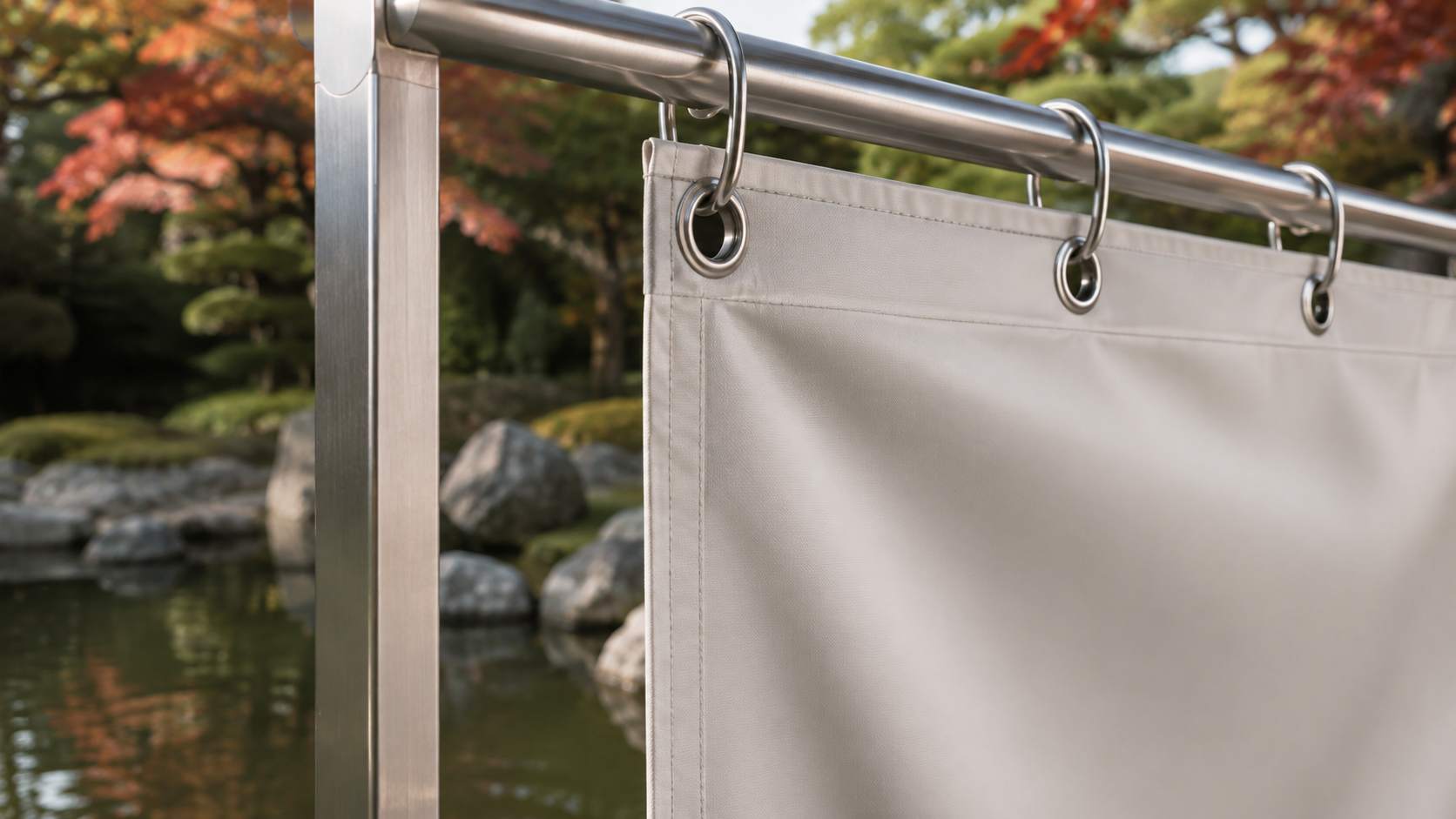
Baocheng can manufacture finished banner grommets from several materials according to forming, corrosion, appearance and functional requirements.
- 304 stainless steel — suitable for many general corrosion-resistant banner hardware programs.
- 316 stainless steel — suitable for demanding corrosion environments, including many chloride-exposed projects.
- Brass — provides strong formability and a premium metallic appearance.
- Zinc alloy — supports selected decorative and special structural designs.
- JSW20 ultra-low-magnetic-permeability austenitic stainless steel — combines extremely low magnetic response after forming with corrosion resistance, including resistance to chloride-containing environments.
The material needs to match the actual banner environment, forming process and finished-component requirements.
JSW20 Adds Chloride-Corrosion Resistance to an Ultra-Low-Magnetic Material Platform
Most ordinary advertising banners do not require ultra-low magnetic permeability.
Special industrial banners, flexible partitions, equipment covers and textile hardware can operate near magnetic-sensitive inspection equipment or electronic systems.
For those projects, magnetic behavior must be evaluated after the grommet has been formed.
Grommet production includes stamping, drawing and setting deformation. Some conventional austenitic stainless steels develop a stronger magnetic response after substantial cold working.
Baocheng's proprietary JSW20 is designed for finished formed components that retain ultra-low magnetic permeability and near-nonmagnetic behavior after processing.
JSW20 also provides chloride-corrosion resistance.
This combination is important when finished hardware is exposed to:
- coastal environments;
- salt-containing moisture;
- humid industrial locations with chloride contamination;
- magnetic-sensitive equipment areas;
- projects requiring both corrosion performance and strict magnetic control.
JSW20 therefore should not be described as a material focused only on magnetic permeability.
Its value lies in combining stable ultra-low magnetic response after forming with corrosion performance for demanding finished components.
When a project compares JSW20 with 304 or 316, selection should be based on the actual chloride concentration, temperature, surface condition, wet-dry exposure, forming history and required magnetic permeability.
Without a direct project-specific comparison test, JSW20 should not be automatically ranked above or below 316 for chloride corrosion.
The correct approach is to evaluate each alloy against the complete corrosion and magnetic specification of the finished part.
Baocheng supplies finished eyelets, grommets and customized components manufactured from JSW20 rather than JSW20 raw coil material.
Surface Finish Must Survive Both Setting and Service
Depending on base material and process, banner grommets can be developed in:
- bright silver;
- matte silver;
- black;
- gunmetal;
- gold;
- brass tones;
- antique effects;
- other project-specific finishes.
Vinyl and mesh both require the finish to survive barrel deformation during setting.
Outdoor projects add corrosion, moisture and repeated movement to the requirement.
The approved finish should therefore be judged on a fully installed grommet, not only on a loose plated sample.
Sampling Must Use the Real Material Construction
A supplier cannot validate a mesh-banner grommet by installing it into a random piece of thin vinyl.
Likewise, a grommet developed on a thin single-layer vinyl sample does not automatically suit a heavy welded banner hem.
Production-equivalent sampling should use:
- the actual banner substrate;
- the actual perimeter reinforcement;
- the actual finished thickness;
- the planned washer;
- the production-equivalent tooling;
- the intended grommet spacing.
Material construction must remain part of the grommet qualification sample from the first prototype through mass production.
What Buyers Should Send in an RFQ
A complete RFQ should include:
- vinyl or mesh material type;
- base material thickness or weight;
- mesh openness where applicable;
- finished hem design;
- reinforcement material and width;
- grommet inside diameter;
- flange outside diameter;
- barrel depth;
- washer requirement;
- pre-punched or self-piercing installation;
- grommet spacing;
- mounting method;
- indoor, outdoor or coastal exposure;
- expected chloride exposure where relevant;
- surface finish;
- magnetic requirement where relevant;
- annual quantity;
- testing and documentation requirements.
With this information, the supplier can engineer the complete installed hardware system instead of selecting a grommet from inside diameter alone.
Vinyl and Mesh Need Different Installation Logic
The conclusion is clear.
Vinyl provides a continuous composite surface. The installation process must preserve that surface, maintain bond integrity and prevent the metal from cutting the coated material.
Mesh provides an open structural network. The installation process must first create a dense reinforced perimeter that collects grommet load and transfers it into many strands.
The same grommet drawing can therefore require different:
- hole preparation;
- reinforcement;
- barrel depth;
- washer structure;
- setting force;
- tooling;
- production controls.
Banner grommet installation starts with the material construction. Once the substrate is understood, the correct metal structure and setting process become much easier to define.
Focused FAQ
1. Can the same grommet be used for vinyl and mesh banners?
The same basic grommet size can be used only when barrel depth, reinforcement, washer structure and setting parameters match both finished material stacks. The installation specification must still be developed separately.
2. Why does mesh need more reinforcement around a grommet?
Open mesh provides less continuous material beneath the flange. A reinforced perimeter creates a dense bearing zone and distributes the grommet load into many more strands.
3. Is vinyl strong enough to install grommets without reinforcement?
For loaded or outdoor banners, the perimeter should be designed as a reinforced structure. The grommet must transfer load into a hem, welded reinforcement or other suitable edge construction.
4. Are self-piercing grommets suitable for mesh?
They should pierce through a stable reinforced mesh edge rather than unsupported open mesh. The reinforcement and die geometry determine whether the cutting and setting operation remains controlled.
5. Why does barrel length change between vinyl and mesh?
The finished stacks differ. Reinforced mesh can contain edge tape, mesh, webbing and a washer, while a vinyl hem may use a different number of folded or welded layers. Barrel depth must match the compressed finished stack.
6. Does mesh require a washer?
A washer provides valuable backside support when it sits on a stable reinforced perimeter. It should not be used directly against unsupported open mesh as a substitute for reinforcement.
7. Why does automatic installation still require separate vinyl and mesh settings?
The two substrates compress, cut and deform differently. Machine stroke, pressure, feeding, hole preparation and reinforcement alignment must match the actual material construction.
8. Can Baocheng customize grommets for both vinyl and mesh banners?
Yes. Baocheng can customize inside diameter, flange, barrel depth, washer structure, material, finish, self-piercing design and matching tooling around the actual finished banner edge.
9. What are the main advantages of JSW20 for specialized banner hardware?
JSW20 combines ultra-low magnetic permeability after forming with corrosion resistance, including chloride-corrosion resistance. It is designed for finished components used where both magnetic and corrosion requirements matter.
10. What should be approved before mass production?
Approve the complete installed assembly using production-equivalent vinyl or mesh, reinforcement, washers, grommets and tooling. Check hole condition, rollover, retention, tear behavior and batch consistency.
#BannerGrommets, #VinylBanner, #MeshBanner, #BannerEyelets, #GrommetInstallation, #BannerHardware, #MetalGrommets, #CustomGrommets
