






Ventilation Eyelets for Hats, Jackets and Workwear: A Size and Placement Guide
 Why Ventilation Eyelets Need Engineering, Not Guesswork
Ventilation eyelets look simple, but their performance depends on more than drilling several holes through a garment. Each opening must allow air and moisture to move while the surrounding fabric continues to resist tearing, laundering, abrasion and repeated flexing. On a hat, the eyelet also affects crown shape and appearance. On a jacket, it can interrupt a windproof or waterproof layer. On workwear, careless placement may conflict with reflective materials, protective zones, pockets, harnesses or job-specific certification.
For buyers, designers and wholesalers, the practical question is which installed eyelet system gives the required open area without weakening the product. That system includes the finished inner diameter, flange, barrel, washer, material, finish, reinforcement, prepared hole and setting dies.
Catalogues may group ventilation parts under grommets clothing, but a decorative grommet and a functional ventilation eyelet are not automatically interchangeable. A suitable ventilation design must have a smooth opening, a secure rear form and dimensions compatible with the fabric, lining and reinforcement.
1. Start With the Ventilation Objective
Before selecting hardware, define why the product needs ventilation. A casual cotton cap may use eyelets mainly to release heat around the crown. A lined work jacket may need local airflow to reduce moisture accumulation. A waterproof shell may need protected exhaust openings, but every punched hole creates a potential water path. A flame-resistant or chemical-protective garment may not permit an ordinary metal opening at all unless the complete construction is assessed under the relevant protective-clothing requirements.
Ventilation eyelets are passive openings. Air movement depends on wind, body motion, liner obstruction, opening quantity and position. Moisture comfort also depends on the complete textile assembly, so buyers should not assign a “breathable” claim from hole diameter alone. ISO 11092:2026 measures textile thermal and water-vapour resistance under steady-state conditions, but it does not set physiological-comfort performance specifications.
Define these project inputs first:
- Product type, season and activity level
- Target wearer and destination market
- Outer fabric, coating, membrane, foam, lining and reinforcement
- Required number of openings and desired appearance
- Rain, sweat, salt, detergent, heat and abrasion exposure
- Protective, high-visibility, children’s or other market requirements
- Expected wash cycles and service life
2. Understand Which Eyelet Dimensions Control Performance
Supplier size numbers are not universal. One factory’s No. 4 can differ from another factory’s No. 4, so a purchase specification must use actual dimensions. A generic grommet sizes chart is useful for initial comparison, but it cannot replace a dimensioned drawing and an installed sample.
Finished Inner Diameter
The finished inner diameter is the clear opening after setting. It controls nominal open area and visual scale. It does not necessarily equal the punch or barrel diameter because forming can alter the opening.
Flange Outer Diameter
The flange is the rounded visible front face. It covers the prepared hole and spreads force. A narrow flange may sink or expose fibres; an oversized flange may look heavy or interfere with seams.
Barrel Length
Barrel length must suit the compressed shell, lining, reinforcement and washer stack. A short barrel may not lock; a long barrel can tilt, split, spin or leave a rough rear edge.
Washer and Rear Form
A matched washer distributes rear load and is a sound starting point for soft, stretchy, loosely woven or multilayer materials. Its outside diameter is normally the same as or slightly smaller than the flange, with compatible material thickness.
When explaining how to measure grommet size to a supplier, specify at least the finished inner diameter, flange outer diameter, barrel outer diameter and length under flange. Add washer dimensions, metal thickness and acceptable tolerances. A photo beside a ruler is not enough for a production specification.
3. Practical Starting Size Guide
The following dimensions are engineering starting ranges for product development, not universal standards. The correct choice depends on fabric strength, garment construction, desired airflow, visual scale and test results. For fashion hats, small grommets usually maintain a cleaner appearance, while heavy workwear may require a wider flange and washer even when the opening itself remains moderate.
| Application | Starting finished ID | Starting flange OD | Typical quantity or pattern | Main validation point |
|---|---|---|---|---|
| Lightweight cotton or polyester cap | 2.5–4 mm | 6–9 mm | 2–6 openings around side crown panels | Crown remains smooth and cut yarns stay covered |
| Bucket hat or outdoor sun hat | 3–5 mm | 7–10 mm | 2–6 openings, normally balanced left and right | Lining does not block the opening |
| Lightweight unlined jacket | 3–5 mm | 7–10 mm | 4–10 openings in protected vent zones | No tearing after movement and laundering |
| Lined jacket or coated shell | 4–6 mm | 8–12 mm | 4–12 openings with designed liner clearance | Water path, liner alignment and reinforcement |
| Heavy work jacket or coverall | 5–8 mm | 10–15 mm | 4–12 openings according to panel area | Pull-out, snagging, corrosion and protective-zone review |
| High-visibility workwear | 4–6 mm | 8–12 mm | Project-specific | Required visible material area and placement remain compliant |
4. Calculate Effective Open Area Before Increasing Size
A useful first comparison is the total geometric opening area:
Four 4 mm openings provide approximately 50.3 mm² of geometric area. Four 6 mm openings provide approximately 113.1 mm²—about 2.25 times as much. This calculation helps a designer compare patterns, but it does not predict real airflow. The actual flow is reduced by the eyelet profile, lining, mesh, body position and pressure conditions.
Several moderate openings can distribute airflow and stress more evenly than one large opening, but every extra eyelet adds an installation operation and defect point. Balance open area, strength, appearance and cost.
5. Placement Guide for Hats
On a cap or hat, upper side crown panels are usually more suitable than the centre front, top button or brim seam. These zones release warm air while keeping hardware away from the forehead; paired openings preserve visual balance.
Use the following placement logic:
- Keep the eyelet clear of crown seams, embroidery backing and panel junctions.
- Avoid placing the flange partly over a seam allowance because the stack becomes uneven.
- Check that the sweatband, foam or lining does not cover the rear opening.
- Keep the hardware away from pressure points that contact the wearer’s head.
- Place mirrored openings from controlled reference points, not from the raw panel edge alone.
- Test the finished crown because curved assembly changes apparent spacing.
As a starting point, keep the centre about 1.5 flange diameters from a cut edge or seam and adjacent centres about two flange diameters apart. These are not standards; weak or curved panels may require more distance.
For thin cap panels, small fabric grommets still need adequate flange coverage and local support. A small inner opening does not justify a narrow flange if the textile frays easily.
6. Placement Guide for Jackets
Jacket ventilation must be coordinated with rain protection, body movement and the lining. Candidate areas include the underarm, upper back beneath a flap and protected side-back panels. Underarms flex and rub, so keep eyelets away from the armhole seam and use compatible reinforcement. Upper-back openings should not sit beneath backpack panels, harness straps or reflective bands.
Coated and Waterproof Jackets
An eyelet punctures the barrier and is not inherently waterproof. Place openings under a protective flap, control drainage direction and test the finished garment. ISO 811:2018 can evaluate fabric resistance to water penetration by hydrostatic pressure, but fabric-level data cannot prove the installed eyelet area remains watertight.
When buyers compare metal grommets for fabric used on jackets, they should request installed samples on the complete shell-and-lining stack. Testing an eyelet on a single loose swatch does not reproduce bulk construction.
7. Placement Guide for Workwear
Workwear adds risks beyond fashion garments. Openings may catch debris, conduct heat, admit chemicals, reduce a barrier or occupy high-visibility material. Review the applicable standard and hazard assessment first. ISO 20471 controls minimum areas and placement of high-visibility materials; eyelets and reinforcement must not invalidate the approved garment layout. Ordinary metal eyelets should not be added to flame, arc, welding, chemical or cleanroom garments by assumption.
Practical workwear placement principles include:
- Keep eyelets outside certified barrier or impact-protection zones unless specifically approved.
- Avoid direct contact with a tool belt, fall-arrest harness, backpack or seat belt.
- Do not place open holes where sparks, chips, dust or liquid can enter toward the body.
- Keep openings clear of cargo-pocket corners and other concentrated load points.
- Assess corrosion from sweat, salt water, industrial washing and workplace chemicals.
- Confirm that rear washers and formed edges cannot scratch the wearer.
The phrase metal grommets for clothing covers many component grades, but workwear buyers should specify the exact base metal, finish, dimensions and performance tests. Appearance alone does not establish suitability for an occupational environment.
8. Reinforcement and Washer Selection
Ventilation openings remove yarns, so good grommet reinforcement extends beyond the flange and washer. It must remain compatible with the stretch, wash shrinkage, heat resistance and hand feel of the main fabric.
Common reinforcement options include:
- Fusible or non-fusible woven patches for stable garment panels
- Compatible knit reinforcement for stretch zones
- Double-layer self-fabric where appearance and wash behaviour must match
- Polymer or coated support films for technical shells, subject to adhesion testing
- Mesh-backed vent constructions when airflow through the lining must be maintained
Washer-backed eyelets often suit loose, soft or heavily flexed panels. A one-piece eyelet may suit stable reinforced material after pull-out and spin testing. Treat the flange, barrel and washer as one system.
A broad category such as clothing eyelets may include parts designed for drawcords, decoration, lacing or ventilation. Tell the supplier the intended function because the required rear form and edge smoothness are different.
9. Choose Material and Finish for the Exposure
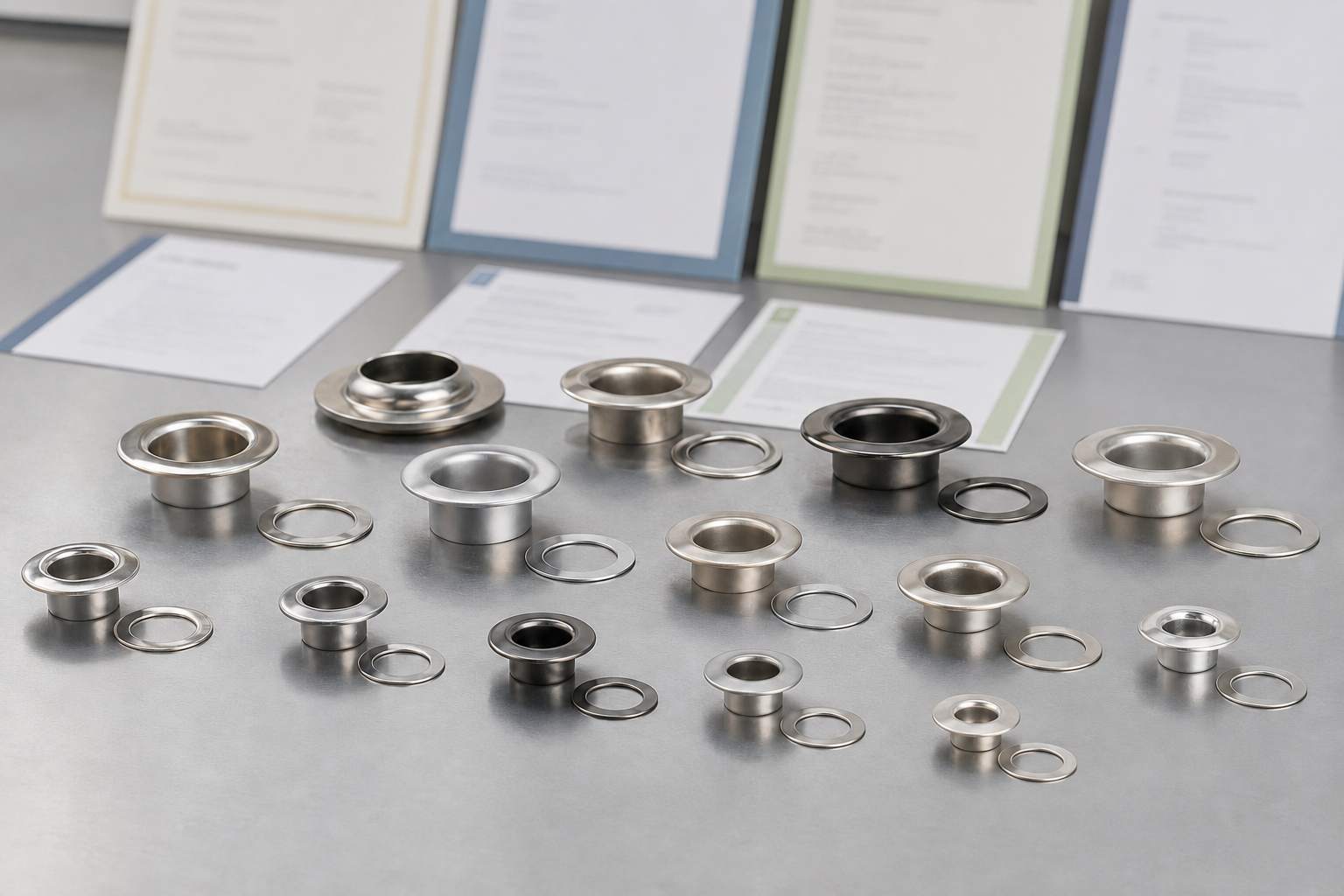
Base metal affects forming, corrosion, magnetic response, weight and price. Brass forms well; plated steel is economical but can rust if coating is damaged; aluminum is light; stainless steel offers useful corrosion resistance. Grade, temper, thickness and finish still require control.
For finished components requiring ultra-low magnetic permeability after stamping, BaoCheng can use patented JSW20 special austenitic stainless steel. BaoCheng supplies customized components, not JSW20 sheet or coil. Mechanical, chemical and garment-level validation still applies.
Specify finish by approved sample and performance, not only colour name. Forming, washing and abrasion can change dark or painted finishes, while a rough inner rim can damage fabric or skin.
If a metal accessory is intended for direct and prolonged skin contact in the EU, the buyer should assess applicable nickel-release requirements. Documentation must match the actual base metal, coating, colour and product construction rather than being generalized across every finish.
10. Installation Control Is Part of Product Design
Correct hardware can fail with approximate tooling. The punch, dies and press closing height control the flange and rear form. A matched eyelet setter supports the face; extra force cannot correct a wrong barrel or oversized hole.
A production setting sequence should control:
- Panel orientation and reinforcement position
- Prepared-hole diameter and cut quality
- Eyelet and washer identification
- Die set, machine and closing-height setting
- Front and rear appearance against an approved sample
- Finished inner diameter and flange distortion
- Inspection frequency by operator, shift and lot
An undersized hole can stretch, pucker or cut the fabric; an oversized hole reduces engagement and can cause spinning or pull-out. Self-piercing designs require validation because they can ladder knits or displace layers.
11. Validation Before Bulk Production
The buyer should approve the installed system, not a loose eyelet. Testing should use production fabric, lining, reinforcement, washer and dies. For metal grommets for clothing, a practical plan can include:
- Dimensional inspection of inner diameter, flange and rear form
- Visual checks for burrs, sharp edges, cracks, exposed fibres and puckering
- Rotation or spin resistance
- Axial pull-out and panel-tear evaluation
- Repeated flexing around the installed opening
- Domestic or industrial laundering according to end use
- Sweat, salt, corrosion and finish-abrasion tests
- Water-penetration testing for coated or rainwear constructions
- Thermal and water-vapour evaluation when comfort claims are important
- Wear trials in the intended body position
Set numeric acceptance criteria: pull force, wash cycles, colour change, corrosion rating and dimensional tolerance. “Must be strong” is not measurable.
12. What Buyers Should Include in an RFQ
A clear RFQ reduces sampling rounds. For small fabric grommets or larger workwear eyelets, send:
- Dimensioned eyelet and washer drawing, or a physical reference sample
- Finished inner diameter, flange OD, barrel OD and barrel length
- Complete compressed material-stack range
- Garment type, installation position and destination market
- Base metal, colour, plating or coating requirement
- Reinforcement type and prepared-hole diameter
- Setting machine and required matching dies
- Mechanical, wash, corrosion, chemical and magnetic requirements
- Sample quantity, bulk quantity, packaging and inspection level
- Required certificates or project-specific reports
Without a drawing, provide the physical component and garment panel. Pictures cannot reveal metal thickness, hardness, barrel length, coating stack or rear geometry.
13. BaoCheng Custom Ventilation Eyelet Service
JiaShan BaoCheng Clothing Accessories Co., Ltd. is a factory-trading integrated B2B supplier with metal-stamping and garment-hardware production experience. BaoCheng can customize ventilation eyelets for hats, jackets, uniforms and workwear according to the customer’s drawing, sample and installed-material requirements.
Customizable details include:
- Finished opening and barrel diameter
- Flange diameter, profile and visible proportions
- Barrel length for different fabric-stack ranges
- One-piece or washer-backed construction
- Brass, steel, stainless steel and project-suitable alternatives
- Colour, gloss, electroplating, painting and other surface processes
- Matched setting dies and installation recommendations
- Bulk packaging and inspection requirements
Before bulk production, customers should provide a dimensioned drawing, clear reference images or a physical sample, together with the actual fabric, lining and reinforcement whenever possible. BaoCheng reviews the structure and can provide development samples without charging for the sample pieces when the design and tooling conditions permit; freight is paid by the customer. Bulk production begins after the customer confirms the installed sample, dimensions, colour, finish and required tests.
Depending on the selected material, finish and project scope, relevant documentation may include the JSW20 patent certificate, OEKO-TEX documentation, RoHS, REACH, Intertek reports and nickel-release-related test documents. Each document must be checked against the exact component and finish being ordered.
Conclusion
Ventilation eyelet selection is a balance between open area, textile strength, placement, comfort, water resistance, appearance and production control. Hats generally use smaller, visually balanced openings around the crown. Jackets require coordination with movement zones, liners and rain protection. Workwear requires an additional review of hazards, protective zones and applicable garment standards.
The most reliable approach is to specify actual dimensions, install the proposed eyelet and washer on the complete material stack, and validate the finished product before bulk production. This turns a small metal component into a controlled part of the garment system rather than an uncontrolled hole in the fabric.
Focused FAQ
1. What size ventilation eyelet is suitable for a cap?
A 2.5–4 mm finished ID is a practical starting range for many lightweight caps. The flange must cover cut yarns. Confirm the result on the assembled crown.
2. Are larger eyelets always better for jacket ventilation?
No. A larger opening removes more fabric and can increase water entry, snagging and visual weight. Several moderate openings may distribute airflow and stress better.
3. Where should eyelets be positioned on a hat?
Upper side crown panels are common starting zones. Avoid seams, embroidery backing, sweatband interference and head-pressure points. Use symmetrical reference points.
4. Can eyelets be installed in a waterproof jacket?
Yes, but the opening interrupts the barrier. Use protected placement and reinforcement, then test the finished garment. A tight-looking flange does not prove waterproofness.
5. Do ventilation eyelets need washers?
Washers spread rear load on soft, loose or heavily flexed materials. Stable reinforced panels may accept a one-piece construction after pull-out and spin testing.
6. How far should an eyelet be from a seam?
About 1.5 flange diameters from the centre to a seam or edge is a useful starting point, not a standard. Weak or curved panels may need more space.
7. Which metal is best for workwear ventilation eyelets?
It depends on corrosion, forming, weight, magnetic response and cost. Brass, plated steel, stainless steel and aluminum have different trade-offs; test the finished component.
8. Can ventilation eyelets be added to certified protective clothing?
Only after the responsible compliance party confirms that the openings do not compromise protective performance or certification. Never add ordinary eyelets by assumption.
9. Why do ventilation eyelets spin or pull out?
Common causes include an oversized hole, wrong barrel, weak fabric, mismatched washer, incorrect dies, incomplete forming or variable panel thickness.
10. What should be approved before bulk production?
Approve the drawing, material, finish, washer, dies and installed sample. Confirm dimensions, rear form, pull-out, washing, corrosion and project-specific tests.
#Ventilation Eyelets, #Hat Eyelets, #Jacket Hardware, #Workwear Hardware, #Eyelet Size Guide, #Eyelet Placement, #Garment Ventilation, #Custom Metal Eyelets, #Apparel Hardware, #BC New Material