






Types of Snap Fasteners Explained: Spring Snaps, Ring-Spring Snaps, Prong Snaps and Heavy-Duty Designs
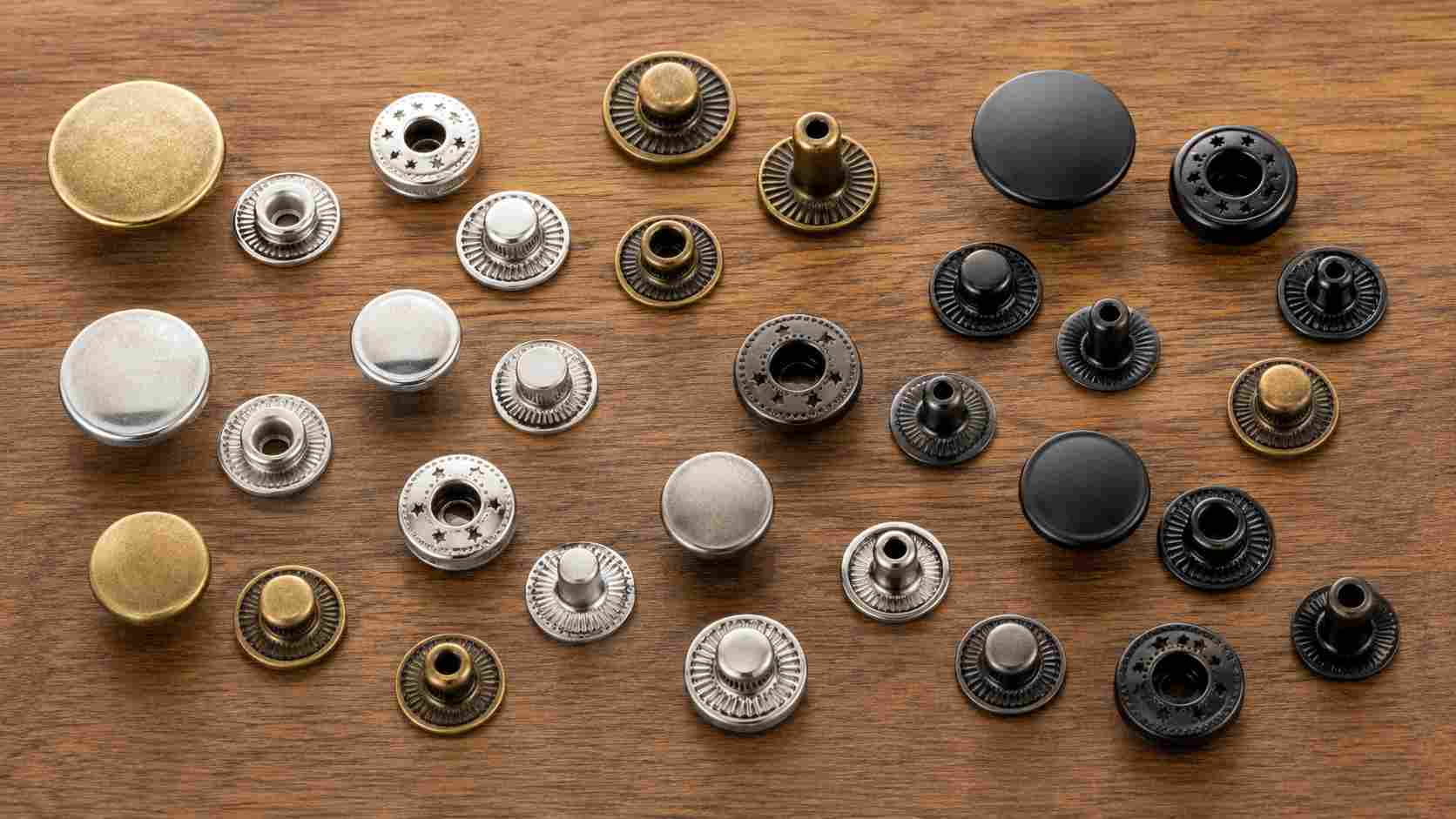
Types of Snap Fasteners Explained: Why the Names Describe Different Things
Spring snaps, ring-spring snaps, prong snaps and heavy-duty snap fasteners are frequently listed together as if they were four equivalent product categories. Technically, they describe different dimensions of a fastening system.
“Spring snap” primarily describes how the socket creates elastic retention around the stud. Ring-spring and S-spring systems describe particular spring architectures. “Prong snap” describes how a component is attached to the substrate. “Heavy duty” describes the expected performance level of the complete fastening system rather than one universal internal geometry.
This distinction matters because a single snap can belong to several categories at the same time. One product can be a ring-spring snap, use a post-style attachment, be designed for heavy-duty service, use stainless steel and carry a black decorative finish.
Buyers who separate these structural dimensions are much less likely to order incompatible components, incorrect dies or a fastening force that does not match the finished product.
A Better Classification Framework for Snap Fasteners
The most practical way to compare snap fasteners is to divide the specification into four questions:
| Question | Classification | Examples |
|---|---|---|
| How does the snap lock? | Locking mechanism | Ring-spring, S-spring, formed spring |
| How is it attached? | Attachment structure | Post-style, eyelet-style, prong-style |
| How much load should it handle? | Performance class | Light, medium, heavy duty |
| Where will it be used? | Application system | Apparel, denim, leather, canvas, technical textiles |
Material, finish, cap diameter and branding form additional specification layers, but they do not replace the four questions above.
1. What Is a Spring Snap?
A spring snap is a reusable fastener in which an elastic feature inside the female component deforms as the stud enters and then recovers into a retaining position.
The term is broad.
It does not tell the buyer exactly what the spring looks like. The elastic feature may be a separate ring-shaped spring, an S-shaped formed spring or another engineered retaining structure.
The mechanical sequence remains similar:
- the stud approaches the socket;
- the widest engagement section reaches the retaining structure;
- the spring deflects;
- the stud passes the maximum interference point;
- the spring recovers around the retaining area;
- the two halves remain connected until sufficient opening force is applied.
This controlled elastic recovery is the core difference between a reusable snap connection and a simple permanent rivet.
2. Ring-Spring Snap Fasteners
A ring-spring snap uses a ring-shaped spring inside the female socket.
When the male stud is pressed inward, the spring expands around the stud's wider engagement profile. Once the stud passes that region, the ring contracts toward a narrower retaining section.
The result is a distinct mechanical connection that can provide strong and repeatable retention when the geometry is correctly matched.
What the Ring Actually Does
The ring is not simply a decorative circular component. It is the elastic retaining member of the fastening mechanism.
Its dimensions, material condition and relationship with the stud influence:
- closing force;
- opening force;
- holding behavior;
- cycle durability;
- wear;
- consistency between production batches.
A slightly different stud diameter can require the ring to expand farther, increasing both closing and opening force. A ring with insufficient elastic recovery can gradually produce a looser fastening action.
Ring-Spring Does Not Automatically Mean Heavy Duty
Ring-spring identifies the locking architecture. It does not define a universal strength level.
A large ring-spring system with robust components may be designed for demanding applications, but another ring-spring product can be engineered for more moderate loads.
Performance still depends on the complete geometry, material thickness, stud design and substrate.
3. S-Spring Snap Fasteners
An S-spring snap uses formed elastic sections inside the socket rather than a separate circular retaining ring.
As the stud enters, the spring sections move apart and then recover around the stud after the critical engagement point has passed.
The same fundamental mechanical objective is achieved—controlled retention and release—but through a different socket architecture.
Why S-Spring and Ring-Spring Components Should Not Be Mixed
Both systems can look similar from the outside. The cap diameter can be comparable, and the finished garment may show no obvious difference.
Internally, however, the socket and stud are designed around different interference relationships.
Mixing a stud from one system with a socket from another can produce:
- excessive closing force;
- weak retention;
- no complete engagement;
- permanent deformation of the socket;
- poor cycle durability.
Compatibility must therefore be confirmed as a complete socket-and-stud system.
4. Ring-Type Press Stud Terminology Can Be Confusing
Search data sometimes contains mixed expressions such as metal ring button press studs fastener. A buyer using this kind of phrase is usually trying to identify a metal press-stud system with a ring-type retaining structure.
For technical sourcing, however, the useful specification should go beyond the mixed commercial wording.
The RFQ should identify:
- socket spring architecture;
- stud profile;
- cap diameter;
- attachment method;
- material;
- required opening force;
- tooling compatibility.
This converts an ambiguous search phrase into a manufacturable technical specification.
5. What Is a Prong Snap?
A prong snap is classified primarily by attachment method.
Instead of relying on one central tubular post passing through a prepared hole, the attachment component uses multiple prongs or legs that penetrate the substrate and are formed into the mating part during setting.
This changes how the snap interacts with the material.
Prong Attachment Changes the Load Path
Multiple prongs distribute attachment through several penetration points rather than one central formed post.
Depending on the system, this can provide:
- good resistance to component rotation;
- controlled penetration into textile layers;
- installation without the same pre-punched hole used by some post systems;
- a relatively compact attachment structure.
However, prongs also concentrate stress at several individual points, so the textile still needs adequate local strength.
Prong Snap Does Not Define the Locking Spring
This is another important classification rule.
“Prong” tells the buyer how the hardware attaches to the material.
It does not automatically tell the buyer exactly how the socket retains the stud.
Attachment architecture and locking mechanism should therefore be specified separately.
6. Post-Style Snap Fasteners
Post-style systems use a central post, eyelet or tubular attachment feature that passes through the substrate and is mechanically formed during setting.
In many familiar four-part apparel snaps:
- the cap and socket form the female half;
- the stud and post form the male half.
The post length must correspond to the actual installed material thickness.
A short post cannot provide enough material for secure forming. An excessively long post can buckle, lean to one side or distort the mating component.
This is why the installation structure must be selected using the real fabric stack rather than only the cap size.
7. Prong Snap vs Post-Style Snap
| Feature | Prong Snap | Post-Style Snap |
|---|---|---|
| Attachment feature | Multiple legs or prongs | Central post / eyelet / tubular feature |
| Material penetration | Several penetration points | One main central position |
| Rotation resistance | Can be strong because multiple prongs resist turning | Depends on formed joint and substrate compression |
| Thickness selection | Prong geometry must match material | Post length is a critical parameter |
| Tooling | Prong-specific dies | Post-forming dies |
Neither structure is universally superior. Their suitability depends on the product, textile construction, available setting equipment and expected loading.
8. What Makes a Snap “Heavy Duty”?

Heavy-duty terminology is frequently misunderstood.
A heavy duty snap fastener is not simply a standard snap made from thicker metal. Greater performance can come from several coordinated changes.
These may include:
- larger socket and stud dimensions;
- stronger or differently shaped spring elements;
- greater material thickness;
- more robust attachment components;
- different stud retaining geometry;
- larger load-distribution area;
- stronger substrate reinforcement.
The complete assembly must be considered.
9. Heavy-Duty Snap Fasteners Are a System, Not a Marketing Label
The phrase “heavy duty” is useful only when connected to the finished application.
For example, heavy duty popper fasteners intended for reinforced textile equipment do not necessarily require the same performance as snap hardware used on a jacket.
The buyer should convert the general term into measurable or at least clearly defined application conditions:
- substrate thickness;
- substrate strength;
- direction of loading;
- opening frequency;
- required release behavior;
- environmental exposure;
- expected service life.
Only then does “heavy duty” become a useful engineering requirement.
10. Heavy-Duty Snaps for Thick Fabric
Heavy duty snaps for thick fabric need more than increased holding force.
Thick fabric creates installation challenges of its own.
The material stack can include:
- multiple textile layers;
- reinforcement tape;
- coatings;
- foam;
- lining;
- folded seam allowances.
The attachment component must pass through or engage this complete stack and still form correctly.
A strong socket-and-stud pair cannot compensate for an attachment post that is too short.
Likewise, a longer post is not automatically safer. Excess metal can buckle during setting.
11. Heavy-Duty Metal Snap Buttons
Heavy duty metal snap buttons generally require coordinated control of component strength and the material around the installation point.
Opening the snap transfers force through the stud, socket, attachment pieces and finally into the substrate.
If the substrate is weaker than the required opening load, the surrounding fabric or leather can fail before the metal snap releases normally.
This creates an important design principle:
Higher retention is only useful when the finished product can safely carry the resulting load.
12. Light- and Medium-Duty Spring Snaps
At the opposite end of the range, apparel and lighter textiles often need lower release forces.
The same spring-retention principle is used, but the system is optimized so that the wearer can open the garment without damaging the substrate.
That may involve:
- smaller components;
- different spring geometry;
- lower interference;
- lighter attachment structures;
- more appropriate post length.
A lightweight garment does not need a “weaker-quality” snap. It needs a snap engineered for a lower mechanical load.
13. Snap Fasteners for Clothing
Metal snap buttons for clothing cover a much wider range of conditions than the phrase suggests.
Clothing includes:
- lightweight shirts;
- children's garments;
- denim;
- structured jackets;
- workwear;
- technical outerwear.
The correct snap system therefore depends on the specific garment rather than the general category “clothing.”
14. Shirt Snap Fasteners
Shirt snap fasteners usually place greater emphasis on moderate opening force, compact size and garment comfort than a heavy canvas snap.
The material can be comparatively thin, so excessive release force can distort the placket or pull the attachment through the fabric.
Designers should consider:
- fabric weight;
- interfacing;
- number of folded layers;
- snap spacing;
- cap appearance;
- required opening behavior.
Western and fashion shirts may also use the visible snap cap as a decorative feature, adding another design requirement without changing the need for controlled mechanical performance.
15. Snap Fasteners for Leather
Snap fasteners for leather face a different substrate condition from woven fabric.
Leather is generally denser and less flexible around a localized installation point. Thickness can vary considerably depending on leather type, finishing and whether several layers are stacked together.
The hardware must therefore be selected around:
- actual leather thickness;
- compressibility;
- surface marking risk;
- attachment length;
- required opening force;
- edge distance;
- expected flexing.
Using a snap designed only around lightweight apparel conditions can produce poor attachment in thick leather.
16. Leather Snap Fasteners and Heavy-Duty Designs
Leather snap fasteners often need strong permanent attachment, but that does not mean maximum socket retention is always desirable.
A small wallet flap, handbag closure and heavy leather strap have very different opening requirements.
For thicker leather goods, increased component size and attachment strength may be valuable. For premium lightweight leather, excessive pressure during installation can mark or crush the material.
The correct system balances hardware strength with the finished product's handling characteristics.
17. Spring Geometry Determines More Than “Tightness”
Buyers often describe snaps simply as tight or loose. Engineering performance is more complex.
Spring geometry affects:
- initial closing resistance;
- tactile snap action;
- holding behavior while closed;
- opening force;
- recovery after each cycle;
- long-term wear.
A socket that requires very high force to deform can feel secure but may create excessive load on the product.
A socket with insufficient recovery may initially work but gradually become loose.
Reliable fastening therefore depends on controlled elastic behavior, not simply high stiffness.
18. Stud Profile Is Equally Important
The spring cannot be evaluated by itself.
The stud determines how the spring is loaded.
Critical stud features can include:
- lead-in geometry;
- maximum engagement diameter;
- retaining-neck diameter;
- head height;
- transition radius;
- concentricity.
Small changes in these dimensions can produce noticeable changes in opening and closing force.
This is why ring-spring and S-spring components should be treated as matched systems rather than generic interchangeable parts.
19. Tooling Is Part of the Snap System
Different fastening architectures require different setting dies.
A prong attachment must be supported and folded correctly. A post-style snap needs dies that control post forming. A decorative cap requires a lower die that supports its profile without denting the visible surface.
Incorrect tooling can cause:
- crushed sockets;
- bent posts;
- misformed prongs;
- dented caps;
- off-center assemblies;
- weak installation.
Therefore, changing snap structure can require changing the setting tooling even when the external cap diameter appears similar.
20. Material Type Changes the Behavior of the Structure
Structure and material are separate specifications, but they interact strongly.
The spring area needs predictable elastic behavior. Attachment features must form without uncontrolled cracking. Caps must withstand setting pressure. Studs need dimensional stability.
Brass is widely used because it offers good forming characteristics and many decorative finishing possibilities.
Stainless steel is valuable where corrosion behavior, wear resistance or other material properties become more demanding.
Different snap components within a complete system may place different demands on the selected metal.
21. Environmental Conditions Affect Snap Type Selection
Outdoor, marine, high-humidity and chloride-containing environments create additional requirements.
Corrosion can influence more than appearance.
At the spring and stud interface, corrosion products can:
- increase surface roughness;
- change friction;
- restrict spring movement;
- alter opening force;
- reduce long-term mechanical consistency.
Material and finishing decisions therefore contribute directly to fastening reliability.
22. Ultra-Low Magnetic Snap Components
Some garment and technical-textile applications add another requirement: extremely low magnetic permeability after forming.
Needle-detection systems and magnetically sensitive applications require attention to the actual finished component.
Forming can change the magnetic response of some conventional austenitic stainless steels, so raw-material classification alone is not always enough for demanding projects.
Baocheng / BC New Material can manufacture finished snap components from patented JSW20 ultra-low magnetic permeability stainless steel.
JSW20 is designed to maintain extremely low magnetic permeability after forming and also provides chloride-corrosion resistance.
This allows low-magnetic performance and environmental resistance to be considered together in suitable projects.
Baocheng supplies finished JSW20 products and customized components rather than raw JSW20 coils or sheets.
23. Which Snap Type Should a Buyer Choose?
The selection process should begin with the application rather than the product name.
A useful decision sequence is:
- Define the finished product.
- Measure the actual installation thickness.
- Determine substrate strength and reinforcement.
- Define whether rapid or high-frequency opening is required.
- Determine the desired opening-force level.
- Choose a locking mechanism.
- Choose an attachment architecture.
- Confirm material and environmental requirements.
- Confirm tooling compatibility.
- Test the complete installed assembly.
This approach is more reliable than beginning with a catalog label such as “heavy duty” and trying to make the garment fit the hardware afterward.
24. How to Specify a Heavy-Duty Snap Project
A professional heavy-duty RFQ should include:
- finished-product application;
- actual substrate sample;
- total thickness;
- reinforcement details;
- preferred spring or socket architecture;
- cap diameter;
- post or prong attachment requirement;
- material;
- finish;
- opening / closing requirements;
- loading direction;
- environmental exposure;
- existing setting equipment;
- sample quantity and production volume.
This allows the manufacturer to select the fastening architecture around real mechanical conditions.
25. Custom Spring, Prong and Heavy-Duty Snap Solutions From Baocheng / BC New Material
Baocheng / BC New Material supplies finished metal snap buttons, press studs and customized snap components for apparel, denim, leather goods, bags, workwear, outdoor textiles and other finished-product applications.
Customization can extend beyond the visible cap and include:
- socket and spring structure;
- stud geometry;
- post dimensions;
- attachment configuration;
- cap diameter and profile;
- material;
- surface finish;
- logo and decorative patterns;
- opening and closing behavior;
- component combinations matched to actual substrates.
Material options can include brass, 304 stainless steel, 316 stainless steel, patented JSW20 ultra-low magnetic permeability stainless steel and other project-appropriate metals depending on the component geometry and application.
For apparel, leather and technical-textile projects, samples can be developed using the customer's actual material stack so attachment length, setting quality, opening force and substrate behavior are evaluated together.
Where applicable to the project and relevant certificate scope, development can also consider REACH, RoHS, OEKO-TEX and nickel-release requirements.
Conclusion: Snap Type Is Defined by Mechanism, Attachment and Performance Together
Spring snap, ring-spring snap, prong snap and heavy-duty snap should not be treated as four equivalent labels.
A spring or ring-spring designation describes how the socket creates elastic retention. A prong designation describes how the hardware attaches to the substrate. Heavy duty describes the performance level expected from the complete assembly.
The most reliable snap specification therefore combines several layers:
- locking mechanism;
- attachment structure;
- component geometry;
- material;
- opening-force requirement;
- substrate;
- tooling;
- service environment.
Once these layers are separated, buyers can compare snap systems much more accurately.
The next level of structural analysis is even more specific: Ring-Spring and S-Spring snaps both rely on elastic socket behavior, but their spring geometry, force path and fastening characteristics are different. Understanding that difference is the next step in selecting the correct snap architecture.
Focused FAQ
What is a spring snap fastener?
A spring snap uses an elastic retaining structure inside the female component. The spring deflects as the stud enters and recovers around the retaining area after engagement.
What is a ring-spring snap?
A ring-spring snap uses a ring-shaped spring inside the socket to expand around and retain the stud.
What is an S-spring snap?
An S-spring snap uses formed S-shaped or similar elastic sections in the socket instead of a separate circular retaining ring.
Is a prong snap a different spring mechanism?
Not necessarily. “Prong” primarily describes the attachment method: multiple prongs penetrate the substrate and are formed into the mating component.
What makes a snap fastener heavy duty?
Heavy-duty performance can result from larger components, stronger spring geometry, thicker material, more robust attachment structures and stronger substrate reinforcement. It is a system-level description rather than one universal socket design.
Are ring-spring snaps always stronger than S-spring snaps?
No. Final performance depends on component dimensions, spring geometry, stud profile, material and the finished application. Locking architecture alone does not define total strength.
Which snap is better for thick fabric?
The correct system must match the actual material stack, attachment length, substrate strength and required opening force. A robust socket alone does not guarantee reliable installation.
Can prong snaps and post-style snaps use the same setting dies?
They normally require dies designed around their specific attachment geometry. Tooling compatibility should always be confirmed before production.
Which snap fasteners work for leather?
Leather projects require hardware matched to actual leather thickness, compressibility, opening force and attachment geometry. The best system depends on the finished leather product rather than one universal snap type.
Can Baocheng develop heavy-duty snap fasteners?
Yes. Baocheng / BC New Material can develop customized snap components around substrate thickness, locking geometry, attachment structure, material, finish and target fastening performance.
Can JSW20 be used for spring snap components?
Yes, where component geometry and project requirements are suitable. Baocheng can manufacture finished snap components from patented JSW20 ultra-low magnetic permeability stainless steel for projects requiring extremely low magnetic permeability after forming. JSW20 also provides chloride-corrosion resistance.
Does Baocheng sell raw JSW20 material?
No. Baocheng supplies finished products and customized components made from JSW20 rather than raw JSW20 coils or sheets.
#SnapFasteners, #SpringSnaps, #RingSpringSnap, #SSpringSnap, #ProngSnap, #HeavyDutySnap, #PressStuds, #SnapButtonStructure