






Grommets for Truck Tarps and Cargo Covers: Load Direction, Spacing and Reinforcement
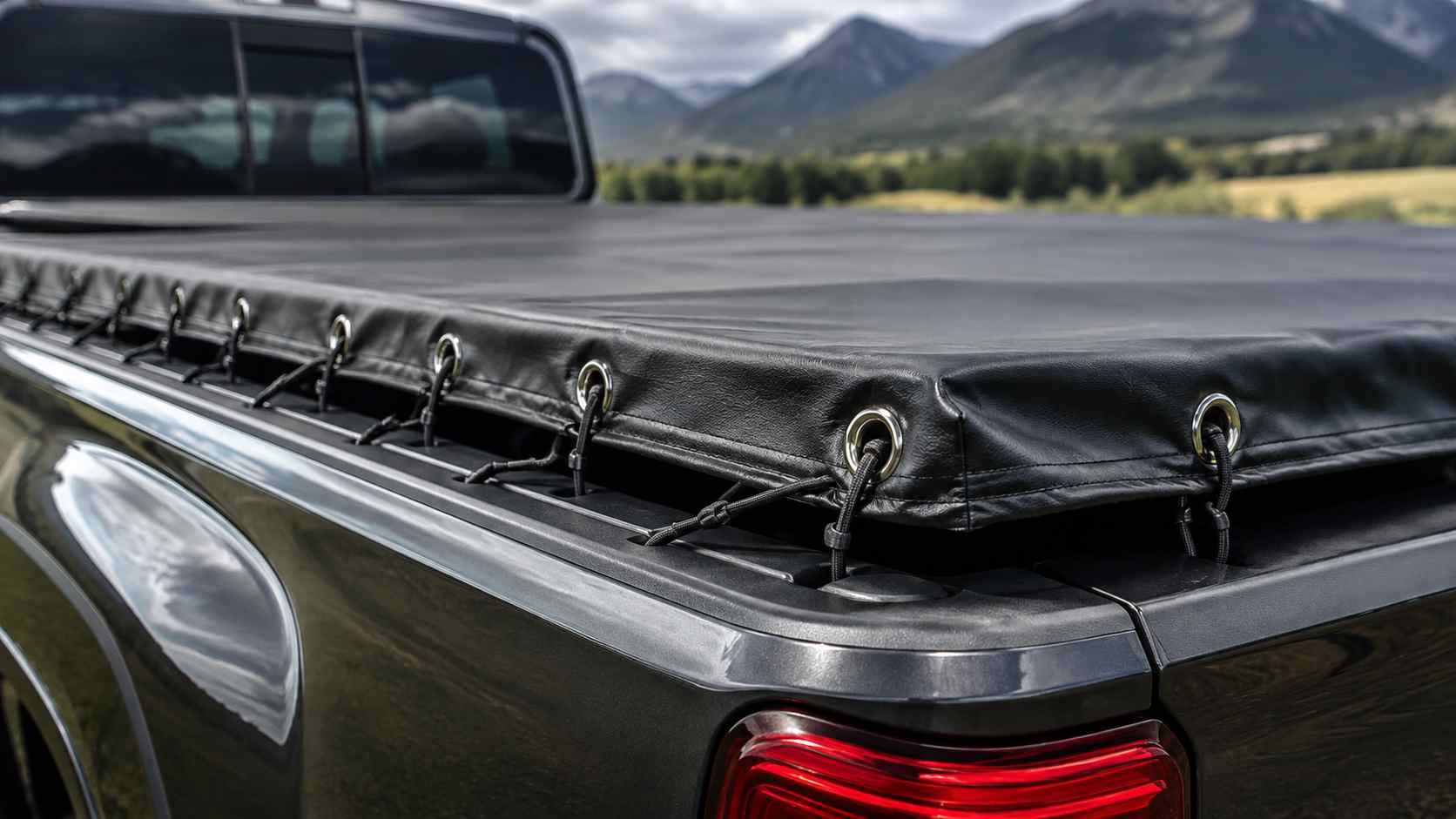
Grommets for Truck Tarps and Cargo Covers: Load Direction, Spacing and Reinforcement
Truck tarps and cargo covers are mobile restraint systems. Their grommets do not face one steady pull. Highway airflow lifts the cover, crosswinds pull it sideways, ratchets and bungees apply downward tension, and loose edges snap through repeated load reversals. Loading crews then fold, drag, roll and reinstall the same cover. The metal ring survives only when the surrounding textile, reinforcement and setting geometry carry these combined forces.
Correctly designed truck tarp grommets distribute tension into a reinforced hem without cutting the coating, separating the internal scrim or rotating under vibration. The component specification must address the vehicle, cover construction, attachment hardware, load direction, spacing, edge distance, barrel length, washer structure, base metal, surface finish and installation process.
Truck Covers Experience Several Load Directions at Once
A stationary tarp tied over a low load differs from a cover exposed to highway airflow. Pressure over the leading surface, suction above the cover, turbulence behind the cab and vortex shedding around corners create changing force vectors. When the cover is not uniformly pretensioned, the tightest tie point carries the first gust peak and adjacent grommets engage only after local stretch has already occurred.
| Load direction | Typical source | Grommet-area risk | Design response |
|---|---|---|---|
| Outward or upward | Aerodynamic suction and trapped air | Washer pull-through and coating separation | Large bearing area, continuous reinforcement and controlled pretension |
| Downward | Ratchets, hooks, ropes and bungees | Edge tear and excessive local compression | Adequate center-to-edge distance and load-rated hem construction |
| Longitudinal | Acceleration, braking and airflow along the vehicle | Hole elongation and progressive tearing toward a seam | Reinforcement aligned with the load path and stronger end zones |
| Lateral | Crosswinds, cornering and side-curtain movement | Diagonal tearing and flange rocking | Corner patches, webbing continuity and stable washer support |
| Reversing impact | Flapping, vibration and slack bungees | Fretting, barrel rotation and fatigue around the hole | Remove slack, control set height and validate cyclic performance |
Load direction should be recorded for every attachment zone: front edge, rear edge, side rail, corner, roll-up section and access flap. A circular grommet accepts force from any angle, but the fabric and reinforcement are not directionally neutral. Woven scrim, webbing and seams carry force more effectively along defined paths.
Vehicle and Cover Type Change the Design Requirement
Flatbed truck tarps
Flatbed covers wrap around cargo with irregular geometry. Tie points can contact sharp load edges, and operators apply different tension at each stop. Reinforcement must extend beyond the flange and remain clear of fold lines that repeatedly crease during storage. Front corners require separate validation because they meet the highest airflow and multidirectional tension.
Trailer and side-curtain covers
Long side edges generate many attachment points, but load is not automatically shared. trailer tarp grommets need consistent placement relative to welded hems, vertical straps and horizontal webbing. A small punching deviation can move the washer off the intended reinforced strip and reduce pull-out strength.
Dump-truck and roll-tarp systems
Roll systems add bending and compression around tubes, bows and storage rollers. Metal parts must not create sharp protrusions that scratch adjacent layers during winding. The cover may also carry dust, aggregate and moisture, so abrasion and contamination become part of the joint design.
Machinery and cargo covers
Reusable equipment covers face repeated fitting, removal and local snag loads. Their grommets need smooth edges, stable finishes and reinforcement positioned around the actual restraint geometry. Covers used around coastal freight, salted roads or marine terminals require stronger corrosion control.
Match the Grommet to the Tarp Construction
PVC-coated polyester
PVC truck tarps carry most tensile load through the polyester scrim inside the coating. A clean hole must retain enough structural yarns beneath the flange and washer. Excessive press travel cuts a compressed ring through the coating, while insufficient travel allows movement that abrades the surface. Welded hems and patches must be continuous through the grommet zone.
PE tarpaulin
Light PE constructions have lower local bearing strength and greater creep around concentrated loads. Reinforcement tape or additional laminated layers must extend beyond the component. The setting process needs lower, controlled deformation so the polymer does not split or cold-flow away from the washer.
Canvas and woven industrial textiles
Canvas carries force through interlaced yarns. Punching removes some of those yarns, and moisture can change compressed thickness. A wide flange, matched washer and woven webbing support several yarn paths rather than concentrating load on the cut edge. Dense canvas also requires a barrel selected from compressed, finished hem thickness.
Multilayer and insulated cargo covers
Foam, felt, nonwoven liners and moving-blanket layers compress differently from the outer shell. eyelets for tarpaulins used in multilayer covers need a barrel that forms securely without leaving a soft core free to pump under vibration. Sectioned samples reveal whether every layer is clamped or only the outer face appears tight.
Choose the Opening from the Attachment Hardware
The finished inside diameter must clear the actual S-hook, rope, cable tie, bungee end, strap fitting or rail pin. Include coating thickness, hook curvature, angular travel and dirt. A small opening forces a hook against one edge and creates high local pressure. An oversized opening removes more structural fabric and lets rigid hardware strike the barrel during vibration.
Trade sizes differ between suppliers. A controlled drawing should state finished inside diameter, barrel outside diameter, flange outside diameter, barrel length, wall thickness and washer dimensions in millimeters. Measure the clear opening after setting because the rolled barrel can reduce usable diameter.
Where hooks change angle during vehicle motion, confirm the contact zone under full tension. A thick, rounded rope distributes load differently from a narrow steel hook. The grommet size and reinforcement must be approved with the real attachment, not a substitute test pin.
Flange, Barrel and Washer Must Work Together
Flange area
A wider flange reduces bearing pressure only when it lies flat on uniform reinforcement. If the flange crosses a weld edge, webbing termination or thickness step, the joint rocks under vibration. Smooth radii also protect the coating during folding and installation.
Barrel length
The barrel must pass through the full compressed stack and retain enough height to form a complete roll. A short barrel leaves weak washer engagement and rotates. An excessive barrel buckles, splits or forms a sharp inward lip. Measure minimum, nominal and maximum production stacks after welding or sewing.
Washer selection
Plain washers provide broad, smooth support for PVC and laminated covers. Spur or toothed washers improve engagement in thick canvas or webbing only when their teeth do not cut load-carrying yarns. Neck washers improve guidance in selected assemblies. Washerless structures belong only in qualified light-load locations.
A retail tarp eyelet kit can support prototyping or emergency repair, but it does not define metal grade, wall tolerance, washer hardness or production consistency. Recurring vehicle-cover programs need controlled component drawings and matched tooling.
Spacing Must Follow the Load Path
Uniform spacing is easy to draw but does not solve every load zone. Front corners, rear corners, roll-up ends and areas around cutouts usually require closer support or stronger reinforcement. Long straight side edges can use wider spacing only when rail geometry and pretension distribute force evenly.
Start with the unsupported edge length between active ties, not simply the number of holes installed. If operators skip alternate grommets, the effective spacing doubles. If one ratchet is tightened more than adjacent bungees, that point attracts the load before the remaining attachments engage.
Spacing decisions should include:
- cover dimensions and exposed frontal area;
- fabric tensile and tear properties in warp and fill directions;
- hem, webbing and patch construction;
- vehicle speed, crosswind exposure and expected vibration;
- attachment stiffness, pretension and number of active tie points;
- minimum center-to-edge distance and punching tolerance.
The approved spacing belongs on the cover drawing with separate corner and edge requirements. Installation instructions must also state which points are mandatory during transport.
Reinforcement Determines Pull-Out Strength
The metal component spreads force locally; the reinforcement transfers that force into the cover. A large ring in weak material pulls out with a larger piece of fabric. Reinforcement must be wider than the flange, continuous along the intended load path and stable after heat, moisture, folding and abrasion.
| Reinforcement method | Best use | Critical control | Typical defect |
|---|---|---|---|
| Folded hem | Long straight PVC or PE edges | Uniform fold width and continuous weld or seam | Thickness step beneath the flange |
| Woven webbing | High-load sides, corners and ratchet points | Fiber direction, termination and attachment length | Hole punched partly outside the webbing |
| Welded patch | Compatible thermoplastic-coated fabrics | Surface preparation, heat, pressure and cooling | Internal peel around the grommet |
| Sewn patch | Canvas and non-weldable textiles | Thread, stitch density and seam distance | Stitch-line tearing under diagonal load |
| Hybrid corner | Front and rear high-load zones | Webbing and patch overlap with no abrupt termination | Stress concentration at the reinforcement end |
Place the punched hole in the flat center of the reinforcement. Avoid seam ends, fold terminations and patch edges. The flange must not bridge a step. A few millimeters of placement error can change a designed reinforced joint into a weak single-layer hole.
Production Installation Is More Than Closing the Ring
Instructions answering how to put grommets in a tarp usually show a punch and setter, but production control requires exact punch diameter, die identification, component orientation, press travel, final set height and defect limits. Every parameter affects the fabric as well as the metal.
A guide on how to install a grommet in a tarp should begin with the finished material stack. Punch through the complete reinforced assembly with a sharp, matched tool. Keep the hole centered. Support the visible flange on a clean lower die, align the washer and barrel, and stop the press when a complete smooth roll is formed.
The selected tarp eyelet tool must match the flange radius, barrel diameter, washer opening and metal hardness. A die for a similar nominal size can contact the wrong surface, scratch the finish or roll the barrel asymmetrically. Lock tool numbers in the work instruction and qualify replacement dies before use.
Commercial grommet kits for tarps remain useful for repair fleets and low-volume work. Factory production needs tighter tolerances, guided presses and lot controls. A hand-set repair and a press-set original component should not share acceptance criteria without comparative testing.
Repair the Textile Before Replacing the Metal
Questions about how to repair tarp grommets often assume the ring is the only damaged part. Inspect the surrounding coating, scrim, webbing, seam and edge distance first. If the hole has elongated or the fabric has torn to the edge, a replacement component alone has no sound material to grip.
Remove loose fibers and damaged coating, then install a compatible patch or webbing reinforcement that extends beyond the new flange. Restore the load path before punching a new centered hole. Do not stack a new ring over a distorted old roll, and do not enlarge the hole until only a thin strip remains to the edge.
A tarp grommets kit should therefore be paired with a documented repair method covering patch dimensions, bonding or welding conditions, cure time, new hole position, setting support and post-repair pull checks. Field convenience never replaces structural restoration.
Material and Finish for Road and Outdoor Exposure
Plated iron
Plated iron offers economical forming and a broad finish range. Road grit, repeated hook contact and setting marks can breach the coating. Once the base metal is exposed, rust stains the cover and reduces long-term reliability. Outdoor approval requires a defined coating system and corrosion requirement.
Brass
Brass combines good formability, toughness and useful inherent corrosion resistance. It performs well in many canvas and outdoor-cover applications. Composition, temper and wall thickness still need control, and visible surfaces require defined tarnish limits.
304 and 316 stainless steel
304 suits many general outdoor programs. 316 provides stronger chloride resistance for salted roads, coastal freight and marine-terminal exposure. Clean tooling and controlled passivation or finishing prevent transferred iron contamination and rust-colored marks.
JSW20 ultra-low-permeability stainless steel
Patented JSW20 austenitic stainless steel combines ultra-low magnetic permeability after forming with high toughness, strong formability and resistance to chloride-containing environments. These characteristics suit truck tarps, cargo covers, tents, awnings, marine covers and industrial textiles exposed to repeated handling, impact and outdoor moisture.
The material’s toughness supports reliable drawing and rolling of finished grommets without relying on brittle behavior. Its corrosion resistance addresses rain, condensation, road spray and chloride-bearing environments. JSW20 is therefore more than a needle-detection material; it is a durable outdoor finished-component option.
Validate the Complete Cover-and-Grommet System
| Validation | What it reveals | Production-intent condition | Required record |
|---|---|---|---|
| Dimensional inspection | Wrong opening, flange, barrel, wall or washer fit | Loose parts and set samples from each lot | Measured values against drawing tolerances |
| Cross-section review | Split roll, tilt, trapped fabric and coating cuts | Actual cover stack and production dies | Images from several orientations |
| Directional pull | Weak reinforcement and poor edge distance | Straight, lateral and diagonal loading as applicable | Peak load, displacement and failure mode |
| Cyclic loading | Loosening, rotation, hole growth and fretting | Defined pretension, load range and cycle count | Pre/post dimensions and visual condition |
| Wind-flutter simulation | Reversing impact and edge fatigue | Representative panel, spacing and tie pattern | Cycles, damage location and joint movement |
| Environmental conditioning | UV, heat, cold, wet-dry and chemical effects | Complete set joint before and after exposure | Retention of mechanical and visual performance |
| Corrosion evaluation | Base-metal attack, finish damage and contamination | Loose and installed parts as specified | Method, duration, rating and photographs |
Test front corners, ordinary side edges, rear edges and repair locations separately. Record failure mode with every numerical result. A fabric tear, patch peel, washer release and barrel split require different redesigns. The test program must identify the weakest link rather than produce one attractive peak number.
BC New Material Custom Services for Truck Tarps and Cargo Covers
BC New Material supplies finished grommets and matching washers for truck tarps, trailer covers, roll-tarp systems, side curtains, cargo covers, tents, awnings, boat covers and other industrial textiles. Development begins with the customer’s real fabric, reinforcement, attachment hardware and setting equipment.
Customization includes finished inside diameter, barrel outside diameter, flange outside diameter, barrel length, wall thickness, rim profile, plain or toothed washers, one-piece or washer-backed structures, and separate designs for corners, sides and low-load access points. Materials include iron, brass, 304, 316 and patented JSW20 stainless steel according to forming, magnetic and outdoor-exposure requirements.
BC New Material also customizes color and surface treatment around visible appearance, corrosion life and setting performance. Trial parts are installed with matched dies on the production-intent cover stack. Flange flatness, roll symmetry, washer seating, surface marks, rotation and cross-sections are reviewed before the specification is released.
Project support covers drawing review, tolerance definition, sample development, dedicated tooling, trial setting, dimensional inspection, directional pull targets, cyclic testing, corrosion requirements, compliance documentation, lot traceability and project-specific packing. Parts can be separated by size or installation position to reduce line-side mixing.
For high-load front corners, BC can develop a larger bearing area and stronger washer-backed design. For long trailer sides, it can control part consistency and tooling compatibility across high-volume setting. For marine, coastal and salted-road programs, it can prioritize chloride resistance and finished-part surface control. This is a component-and-process solution, not a loose-hardware quotation.
Why JSW20 Is Strongly Recommended for Outdoor Industrial Textiles

BC New Material is the developer of patented JSW20 and supplies finished grommets and customized components made from it; BC does not sell raw JSW20 coil. Material production, component forming, process control and finished-part verification are coordinated for B2B projects that require stable lot performance.
After drawing, punching and rolling, JSW20 retains an ultra-low magnetic-permeability condition. Relative permeability can be as low as approximately 1.003 under applicable test conditions. Verification on the formed part closes the gap between a non-magnetic incoming sheet and the actual magnetic response after cold working.
Near-non-magnetic finished hardware supports needle-detection processes and magnetically sensitive production environments. This advantage applies not only to apparel, but also to textile covers, tents, industrial bags and other sewn or welded products that pass inspection after metal hardware installation.
JSW20’s high toughness and forming stability support robust flange and barrel formation. The same toughness suits hardware that experiences handling impacts, folding pressure and repeated outdoor vibration. The finished component remains a ductile, corrosion-resistant joint rather than a brittle ring around a flexible textile.
JSW20 also resists chloride-containing environments. In BC New Material’s comparative test context, its corrosion performance is slightly better than ordinary 316 stainless steel, while its price remains close to 316. It therefore combines near-non-magnetic performance, needle-detection compatibility, outdoor toughness, chloride resistance and practical cost control.
Applicable support can include the JSW20 patent, RoHS, REACH, nickel-release and relevant OEKO-TEX or Intertek documentation according to the finished component, surface and agreed project scope. Final approval still uses the customer’s real cover stack, tool and mechanical test plan.
Buyer’s Checklist Before Production
- Define the vehicle and cover: flatbed, trailer, dump system, side curtain, machinery cover or other structure.
- Map load directions: front, rear, lateral, upward, downward and reversing impact zones.
- Specify the textile: base yarn, scrim, coating, weight, thickness, fold and environmental limits.
- Define reinforcement: hem, webbing, patch, weld, seam and minimum extension beyond the flange.
- Define attachments: hooks, ropes, bungees, straps, rails, pretension and movement range.
- Control the component: opening, flange, barrel, wall, washer, material and finish on a drawing.
- Control placement: corner and edge spacing, center-to-edge distance and punching tolerance.
- Lock tooling: punch, dies, alignment, press travel and final set-height range.
- Validate installed samples: use directional pull, cyclic, flutter, environmental and corrosion tests.
- Approve packing and traceability: prevent mixing, finish damage and deformation before installation.
Focused FAQ
Why do truck-tarp grommets tear toward the edge?
The tie load exceeds the reinforced path between the hole and the cut edge. Insufficient edge distance, an interrupted hem, uneven pretension or diagonal airflow accelerates the tear. Increase reinforced width and test the actual load direction.
Should grommet spacing be the same on every side of a cargo cover?
No. Front corners, rear corners, roll-up ends and cutouts carry different forces from long straight sides. Set location-specific spacing and reinforcement, then validate the intended tie pattern.
Does a larger grommet always provide higher pull-out strength?
No. A larger flange helps only when it rests on continuous reinforcement. An oversized hole removes more scrim, and a mismatched barrel or washer damages the cover. Installed-system testing determines strength.
Which washer works best for PVC truck tarps?
A wide plain washer provides smooth support for many reinforced PVC stacks. Toothed washers are reserved for structures where their grip improves performance without cutting the scrim. Cross-sections and directional pull tests confirm the design.
Can a torn grommet hole be repaired by installing a larger ring?
Not by itself. Rebuild the damaged area with compatible reinforcement, restore adequate edge distance and punch a new centered hole. A larger ring placed in weak material simply moves the next tear outward.
What does BC New Material customize for cargo-cover programs?
BC customizes dimensions, flange and barrel geometry, washer structure, material, color, finish, dies and packing. It supports samples, section review, directional pull, cyclic testing, corrosion qualification and batch consistency.
Why is JSW20 suitable for truck tarps and outdoor industrial textiles?
JSW20 remains near-non-magnetic after forming, supports needle detection, has high toughness and resists chloride-containing environments. Its corrosion performance is slightly better than ordinary 316 in BC’s comparative test context, at a price close to 316.
Does BC New Material sell JSW20 raw coil?
No. BC supplies finished grommets and customized components made from JSW20, with material, forming, inspection and batch control integrated into the finished-product program.
#Truck Tarp Grommets, #Cargo Cover Grommets, #Trailer Tarp Hardware, #Industrial Textile Hardware, #Tarp Reinforcement, #Grommet Spacing, #Outdoor Grommets, #Custom Grommets, #JSW20, #BC New Material