






Tent and Canopy Grommets: Designing for Repeated Tension and Outdoor Exposure
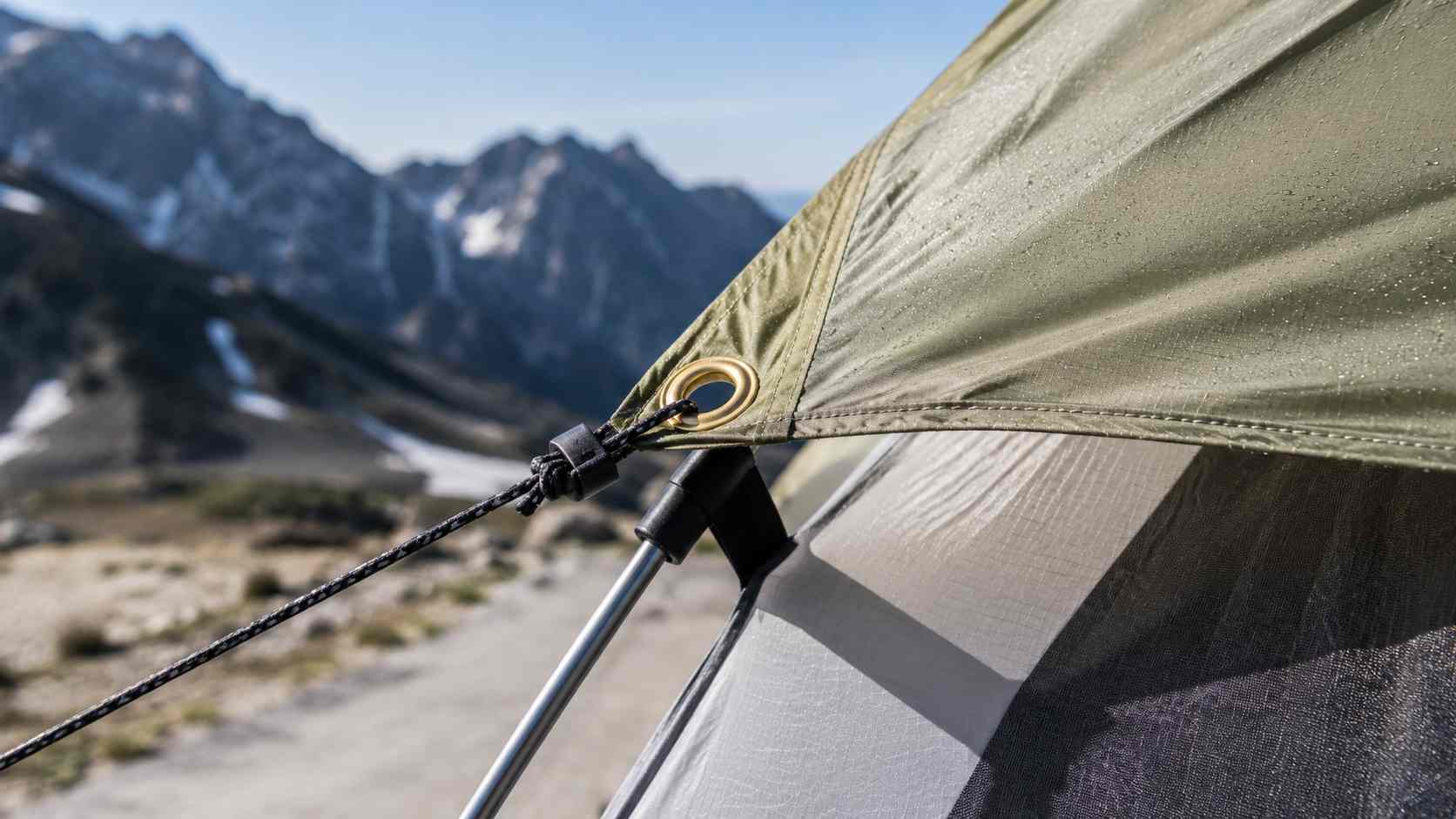
Tent and Canopy Grommets: Designing for Repeated Tension and Outdoor Exposure
A tent or canopy grommet is a structural load-transfer point. It connects a flexible roof, wall, skirt or ground loop to poles, ropes, hooks, stakes and frames that move under wind. Every gust changes the direction and magnitude of force. Packing, folding, erection and dismantling add further cycles. A joint that survives one strong pull can still loosen, ovalize or cut the fabric after thousands of smaller movements.
Reliable design therefore starts with the installed system rather than the loose metal part. The fabric construction, reinforcement patch, hem, hole geometry, flange area, barrel length, washer, material, finish, die profile and placement all determine durability. Outdoor exposure adds ultraviolet aging, moisture, condensation, temperature change, salt, cleaning chemicals and abrasive dirt. These factors act together at the same small opening.
Why Repeated Tension Is Different from a Single Pull
Static pull testing identifies the peak force that causes a defined displacement or failure. Tent and canopy hardware also faces cyclic loading. Fabric relaxes between gusts, the fastener changes angle, the barrel rubs against the hole and the washer repeatedly compresses the reinforcement. Small movements accumulate into coating wear, yarn displacement, washer polishing and permanent hole growth.
Repeated tension has three damaging components:
- Alternating direction: wind suction lifts the roof while guy lines and frame attachments pull down or outward.
- Load peaks: gusts create short force spikes above the average line tension.
- Micro-movement: a slightly loose set rotates and frets the fabric long before the joint visibly separates.
The correct tent grommet limits movement at the metal-to-fabric interface without crushing the substrate. Its flange and washer spread the load, while the reinforcement carries that load into a broader area. The joint remains stable because each part of the load path has a defined role.
Map the Load Before Choosing the Hardware
Not every opening on a shelter carries the same force. A procurement drawing that assigns one grommet to every position ignores the dominant failure patterns. Engineers should classify each location before specifying the component.
| Location | Dominant load | Common failure | Design response |
|---|---|---|---|
| Roof corner | High, multidirectional wind and frame tension | Diagonal fabric tear, washer pull-through or seam opening | Large reinforcement zone, generous edge distance and high-bearing-area grommet |
| Guy-line point | Repeated angled tension with shock peaks | Hole elongation, barrel rotation and patch peeling | Align reinforcement with the load direction and validate cyclic movement |
| Ground skirt | Stake pull, foot traffic, mud and abrasion | Edge tear, corrosion staining and deformation | Tough reinforcement, adequate clearance and corrosion-resistant material |
| Canopy side edge | Distributed frame or rope tension | Progressive tearing between widely spaced points | Controlled spacing and even pretension across the edge |
| Vent or accessory point | Low mechanical load plus repeated handling | Finish wear, local fraying or cosmetic distortion | Smaller component with clean setting and sufficient local support |
Corner positions require separate part numbers when their load and reinforcement differ from ordinary edge positions. Standardizing the visible opening is reasonable; standardizing the entire barrel, flange and washer assembly without validation is not.
Match the Grommet to the Shelter Fabric
Woven canvas and polyester canvas
Canvas carries load through interlaced yarns. Punching removes some yarns and concentrates force around the hole. Cotton and blended canvas also change thickness with moisture. The joint needs a wide support area, a clean cut, a reinforcement that captures several yarn paths and a barrel long enough for the compressed folded stack.
A canvas eyelet kit is useful for development or field repair, but production qualification must control component dimensions, metal temper, washer profile and tooling. A generic kit label does not define the stable setting window required for repeat orders.
PVC-coated polyester
PVC canopy fabric carries most tensile load through the internal polyester scrim. The coating protects the yarns and seals the surface. An oversized hole removes scrim; an over-set component cuts a compressed ring through the coating; a weak welded patch separates from the base layer. The grommet must clamp an intact, reinforced stack with a smooth flange and uniform washer support.
Specifications written for grommets for tarps also apply to many PVC shelter panels, but the finished canopy usually sees more repeated erection, folding and wind flutter. Cyclic testing must therefore be stricter than a one-time cover or storage-sheet application.
PE tarpaulin and laminated lightweight fabrics
Light PE constructions offer low weight but limited bearing strength around punched holes. Reinforcement tape, additional laminated layers or webbing must extend beyond the flange. The setting force must remain controlled because aggressive roll formation can split or cold-flow the polymer stack.
A tarpaulin grommet kit may fit the nominal thickness while still producing insufficient bearing area. Approve the installed part by hole-growth and pull-through testing rather than by whether the barrel closes.
Shade cloth, mesh and open-weave textiles
Open fabrics have fewer continuous yarns beneath the flange. The metal must not clamp unsupported apertures. A reinforced border, folded tape or solid patch is essential. Products such as greenhouse shade cloth with grommets also face ultraviolet exposure and continuous edge tension, so the reinforcement and thread or weld must age at the same rate as the main fabric.
Inside Diameter Must Fit the Actual Attachment
Choose the finished inside diameter from the rope, hook, bungee fitting, pole pin or stake that will pass through it. Include coating thickness, knots, molded ends, angular movement and contamination. An opening that is too small abrades the attachment and forces the line against a sharp angle. An oversized opening removes extra fabric and allows the hardware to hammer against the barrel.
Trade sizes vary by supplier. A controlled drawing should state finished inside diameter, barrel outside diameter, flange outside diameter, barrel length, wall thickness and washer dimensions in millimeters. Measure the clear opening after setting because the rolled barrel may reduce it.
For rigid pins, define clearance and angular travel. For rope, verify the maximum compressed rope diameter and the bend radius at full load. For hooks, inspect the contact point; a narrow hook bearing on one small section of the rim creates much higher local stress than a soft line distributed around the opening.
Flange, Barrel and Washer Form One System
Flange diameter spreads bearing stress
A wider flange distributes load over more fabric, but width alone does not guarantee strength. The flange must lie flat, have smooth radii and sit entirely on a uniform reinforcement zone. If it crosses a seam edge, webbing termination or thickness step, pressure becomes uneven and the joint starts to rock.
Barrel length controls roll quality
The barrel must pass through the full compressed stack and retain enough length to form a complete roll. A short barrel leaves weak engagement and permits rotation. An excessive barrel buckles, splits or creates a sharp inward lip. Measure production stacks after sewing, welding or bonding, then qualify minimum and maximum thickness samples.
Washer structure must match the substrate
Plain washers provide broad support for PVC and many coated textiles. Spur or toothed washers can improve engagement in dense woven canvas and webbing, but teeth that are too long or sharp sever yarns. Neck washers improve guidance in selected assemblies. Washerless designs belong only in qualified light-load locations.
A heavy duty tarp grommet kit often uses larger components, yet industrial durability still depends on matched washer hardness, roll geometry and fabric reinforcement. “Heavy duty” becomes meaningful only after dimensions and installed performance limits are defined.
Reinforcement Carries More Load Than the Metal
The grommet distributes force locally; the reinforcement transfers it into the panel. A strong metal ring installed into weak fabric simply pulls out with a larger piece of material. Reinforcement design must follow the expected load direction and extend beyond the high-stress zone.
- Folded hems: add layers and stabilize edges when every fold is uniform.
- Webbing: carries high line loads along a defined path and works well at corners or guy points.
- Welded patches: suit compatible thermoplastic-coated fabrics and avoid needle holes.
- Sewn patches: suit canvas and non-weldable materials when stitch density and seam geometry are controlled.
- Hybrid structures: combine webbing, patch and folded hem for demanding roof corners.
Keep the opening away from patch edges, stitch lines, weld terminations and fabric cuts. The flange should compress a flat, continuous stack. Reinforcement that ends beneath the flange creates a hinge and accelerates fretting.
Spacing Controls Load Distribution
There is no universal spacing rule for tents and canopies. Correct spacing depends on panel size, fabric strength, reinforcement, wind exposure, line elasticity, frame geometry and the number of tie points actually used. Closely spaced holes improve distribution only when the installation applies reasonably even tension to them.
Searches for how to tie down a tarp with grommets often focus on rope patterns, but product designers must first ensure that the metal points share load. A canopy with twelve openings but only four heavily tensioned corners behaves as a four-point structure. Uneven pretension makes the tightest point carry gust loads first.
Use smaller spacing near corners, high-curvature edges and expected windward zones when structural analysis and testing support it. Maintain adequate center-to-edge distance so the reinforcement can develop strength between the hole and the cut edge. Record placement tolerances because a few millimeters of drift can move the flange off the intended webbing or patch.
Setting Process Determines Whether the Design Works
A correct drawing can fail under the wrong die. The punch, upper die, lower support, alignment, press travel and final set height must be treated as controlled production parameters. A dull punch drags yarns and produces a ragged opening. Misaligned dies roll one side first. Excess travel cuts the fabric or splits the barrel, while insufficient travel leaves a rotating joint.
Approve a process window at minimum, nominal and maximum stack thickness. Inspect both faces and sectioned samples. The rolled rim should be concentric, smooth and fully engaged with the washer. The flange should remain flat without a circular cut mark in the coating. Operators should not compensate for part or stack variation by continually increasing pressure.
Repair products such as a tarp grommet repair kit address local damage only when sound reinforced material remains around the hole. Installing a new component into an enlarged tear without a patch moves the failure to the edge of the new flange. Field repair instructions must define trimming, patch size, cure or weld condition and final placement.
A tarpaulin eyelet repair kit also requires tool compatibility. Hand setters can create tilted rolls when the work surface is soft or the strike is uneven. Production canopies need guided tooling and a controlled stop; repair hardware should be validated separately from factory-set components.
Outdoor Exposure Changes the Joint
Moisture and condensation
Water enters folds, rests beneath washers and carries contaminants. Cotton canvas swells; plated steel with damaged coating rusts; dissimilar metals can form a galvanic couple in conductive moisture. Drainage, drying behavior and finish integrity belong in the design review.
Ultraviolet radiation and heat
Sunlight ages fabric, thread, patches and polymer coatings. Dark metal finishes also reach elevated surface temperatures. Testing only new indoor-conditioned fabric overstates long-term margin. Age representative assemblies before mechanical testing when the expected service life demands it.
Cold folding and wind flutter
Low temperature increases stiffness in many coated fabrics. Folding creates sharp creases, and wind movement repeatedly bends the material at the rigid flange boundary. Cold-conditioned cyclic tests reveal cracking and delamination that room-temperature pull tests miss.
Salt and cleaning chemicals
Coastal air, deicing residue, pool chemicals and cleaners attack exposed edges and damaged finishes. Material selection must reflect the actual chemical environment. Corrosion products also abrade fabric and create visible stains before structural failure occurs.
Testing the Installed Tent-and-Canopy Joint
| Test | Purpose | Critical record | Pass decision |
|---|---|---|---|
| Dimensional inspection | Confirms flange, barrel, wall, opening and washer fit | Measured component and installed dimensions | Within controlled drawing tolerances |
| Section review | Finds split rolls, trapped material, tilt and substrate cutting | Cross-section images at several orientations | Complete smooth roll without damage |
| Static pull | Measures peak joint strength | Peak load, displacement and failure mode | Meets location-specific requirement |
| Cyclic tension | Reproduces gusts, handling and line movement | Load range, frequency, cycles and hole growth | No prohibited loosening, tearing or rotation |
| Environmental conditioning | Evaluates heat, cold, wet-dry, UV or chemical effects | Conditioning method and pre/post values | Retains defined mechanical and visual performance |
| Corrosion test | Checks base metal, finish damage and contamination | Method, duration, rating and photographs | Meets project-specific appearance and function limits |
Test corners and ordinary edges separately. Use production fabric lots, reinforcement, thread or weld parameters, finished components and production dies. Record the failure mode with every value. A fabric tear, patch peel, washer release and barrel split require different corrective actions.
A configuration described as a tarp with grommets on all sides should also be tested as a system. Distributed openings do not guarantee distributed force; test the intended lacing or tie-down arrangement so the actual load path is represented.
BC New Material Custom Tent and Canopy Grommet Services

BC New Material supplies finished metal grommets and matching washers for tents, event canopies, awnings, shade structures, greenhouse covers, sidewalls and related outdoor textile products. Development starts with the customer’s actual fabric stack and attachment method rather than a generic size chart.
Customization covers finished inside diameter, flange diameter, barrel outside diameter, barrel length, wall thickness, rim profile, plain or toothed washers, one-piece or washer-backed structures, and dedicated dimensions for corners, guy points or ordinary edges. Materials include iron, brass, 304 stainless steel, 316 stainless steel and patented JSW20 stainless steel according to exposure and forming requirements.
Colors and finishes are selected around appearance, outdoor life and setting behavior. Options are reviewed for plating integrity, coating adhesion, color consistency, visible surface requirements and compatibility with production dies. A decorative finish is not approved until the set component remains smooth and free from unacceptable cracking, peeling or tool marks.
BC New Material supports drawing review, tolerance definition, sample development, matched setting dies, trial installation, cross-section inspection, static pull targets, cyclic-loading plans, corrosion requirements, lot inspection and project-specific packing. Components can be separated by size, color or installation position, with labeling and traceability aligned to the customer’s assembly process.
For high-load corners, BC can develop a wider flange, matched washer and barrel length around the reinforced stack. For lightweight walls or vents, it can reduce size and weight without sacrificing stable roll formation. For outdoor canopies, it can coordinate component material and finish with corrosion, appearance and service-life targets. This finished-product approach keeps the metal, textile and tooling specifications connected.
JSW20 for Near-Non-Magnetic and Corrosion-Resistant Finished Grommets
BC New Material supplies finished grommets and customized components made from patented JSW20 austenitic stainless steel; it does not sell raw JSW20 coil. After drawing, punching and rolling, JSW20 retains an ultra-low magnetic-permeability condition. Relative permeability can be as low as approximately 1.003 under applicable test conditions, so qualification can focus on the formed part rather than only the incoming sheet certificate.
This near-non-magnetic performance supports needle-detection workflows and magnetically sensitive production lines. It is especially valuable when tents, canopy walls, bags or textile accessories pass through inspection equipment after metal hardware has already been assembled. Ordinary austenitic stainless grades may increase magnetic response after cold forming; JSW20 is developed to control that finished-component risk.
JSW20 also resists chloride-containing environments. In BC New Material’s comparative test context, its corrosion performance is slightly better than ordinary 316 stainless steel, while its price remains close to 316. Buyers receive near-non-magnetic behavior, strong outdoor corrosion resistance and practical cost control in one finished-component option.
Applicable documentation can include the JSW20 patent, RoHS, REACH, nickel-release and relevant OEKO-TEX or Intertek-supported reports according to the agreed component, finish and project scope. These documents support material and compliance review. The installed shelter joint still requires mechanical, cyclic and environmental validation.
Buyer’s Production Checklist
- Classify every position: roof corner, guy-line point, frame edge, skirt, wall or vent.
- Define the fabric: fiber, weave or scrim, coating, weight, finished thickness and environmental limits.
- Define reinforcement: fold, patch, webbing, seam, weld and minimum extension beyond the flange.
- Define the attachment: rope, hook, pin, bungee, stake, direction of pull and movement range.
- Control dimensions: inside diameter, flange, barrel, wall, washer and installed set height.
- Lock tooling: punch, upper die, lower die, alignment and press window.
- Validate production samples: inspect surfaces and sections, then test static and cyclic performance.
- Condition for service: include wet-dry, UV, heat, cold, salt or chemicals where relevant.
- Approve packaging: prevent mixing, finish damage and deformation during transport and line feeding.
Focused FAQ
Why do canopy grommets become loose even when they pass a pull test?
A static pull test does not reproduce repeated wind movement. Small changes in load direction cause rotation, fabric compression and coating wear. Add cyclic tension testing and define limits for hole growth, set height and post-test movement.
Should corner grommets be different from edge grommets?
Yes when the corner carries higher or multidirectional load. Corners need a larger reinforcement area, generous edge distance and often a wider flange or stronger washer-backed structure. Approve corner and edge samples separately.
Which washer works best for tent canvas?
A wide plain washer suits many reinforced canvas stacks. A spur or toothed washer improves grip only when its teeth match the fabric and do not sever yarns. Section inspection and cyclic pull testing determine the correct design.
How should grommet spacing be selected for a canopy?
Set spacing from panel geometry, fabric strength, reinforcement, wind exposure, frame design and actual tie usage. Reduce unsupported edge length while maintaining adequate center-to-edge distance. Validate the intended lacing or tie-down pattern.
Can a repair grommet be installed into an enlarged torn hole?
Not directly. Remove loose damage and rebuild the area with a compatible patch or reinforcement that extends beyond the new flange. A larger ring placed into weak material shifts the tear to its outer edge.
What can BC New Material customize for tent and canopy projects?
BC customizes inside diameter, flange, barrel, wall thickness, washer structure, material, color, finish, setting dies and packing. It also supports production-intent samples, section inspection, pull requirements, cyclic testing and corrosion qualification.
When is JSW20 appropriate for outdoor textile hardware?
Choose JSW20 when the finished component must remain near-non-magnetic after forming, support needle detection and resist chloride-containing exposure at a price close to 316. Verify permeability and corrosion requirements on the actual finished part.
#Tent Grommets, #Canopy Grommets, #Outdoor Textile Hardware, #Tent Manufacturing, #Canopy Hardware, #Grommet Reinforcement, #Cyclic Load Testing, #Custom Grommets, #JSW20, #BC New Material