







How to Specify Snap Button Performance: Size, Holding Force, Pull-Out Strength and Cycle Life
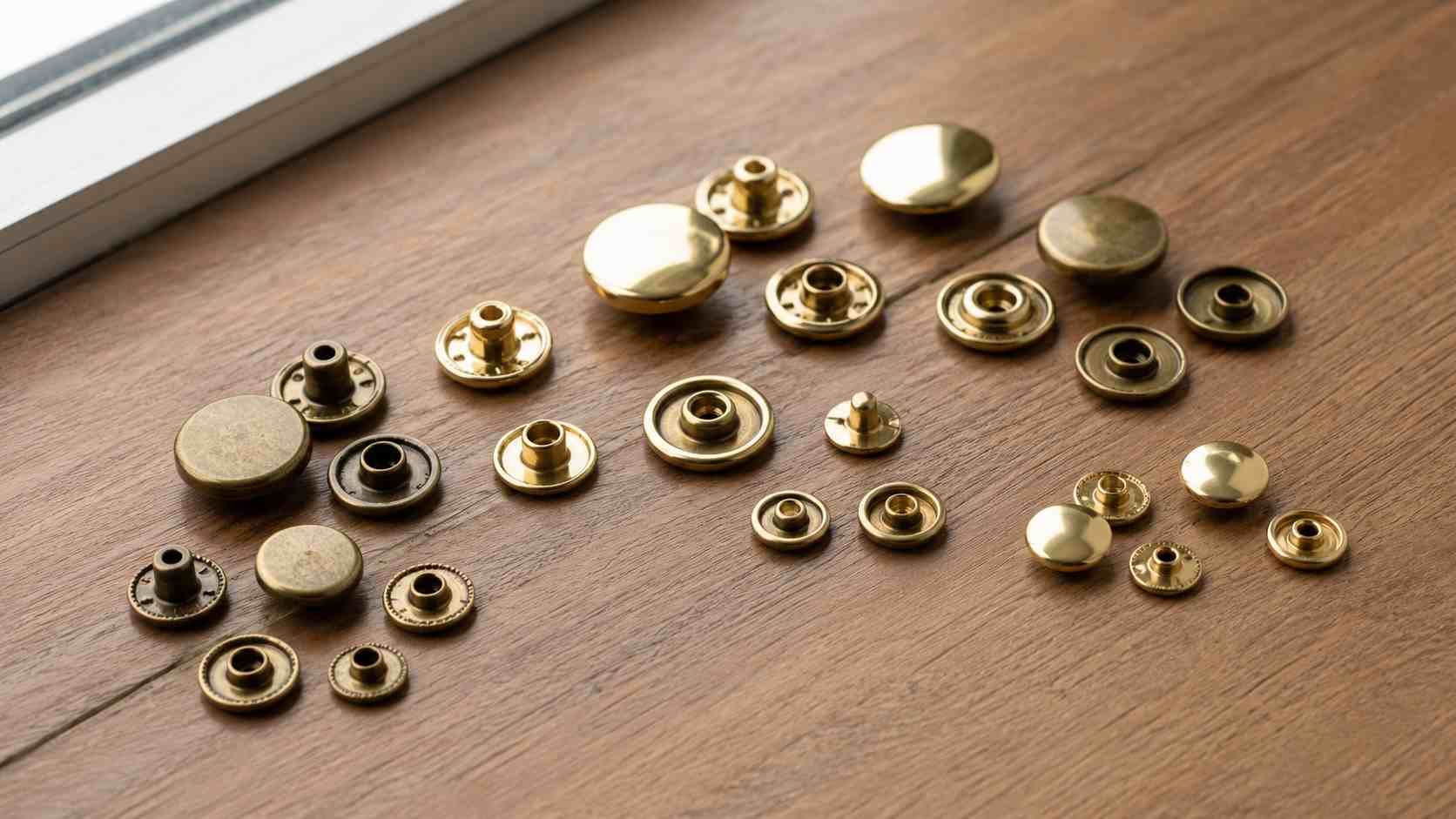
A purchasing request such as “15 mm metal snap, strong holding, washable” looks clear, but it leaves most performance decisions undefined. One supplier may interpret 15 mm as the cap diameter, another may use it as a trade-size reference, and a third may pair a similar-looking socket and stud from a different product family. All three quotations can appear compliant while the finished garments close, open and age very differently.
A useful snap button specification separates four linked requirements: physical size, operating and holding behavior, attachment strength, and performance after repeated use. It also states the substrate, setting method, finish, environment and inspection plan. This buyer-facing guide shows how to build that specification without relying on engineering formulas. It is intended for procurement teams, distributors, product developers and users who need a dependable way to compare samples and shipments.
This article is about what to put in a purchase specification. For deeper design background, see What Controls Snap Button Holding Force?, How Snap Button Dimensions Affect Holding Force and Snap Button Tolerances Explained.
The Short Answer: Specify Four Performance Blocks, Not One “Strength” Number
| Performance block | Buyer needs to define | What it prevents |
|---|---|---|
| Size and combination | Complete cap, socket, stud and post or prong combination; critical dimensions; substrate stack; setting dies | Parts that look similar but do not mate correctly, posts that are too short or too long, and unapproved component mixing |
| Operating and holding behavior | Closing-force range, release-force range, pull direction, seating condition and test setup | Snaps that are difficult to close, open unexpectedly, feel inconsistent or are judged only by hand |
| Attachment or pull-out strength | Actual substrate, reinforcement, setting method, pull direction, failure definition and minimum requirement | A secure socket–stud engagement being mistaken for secure attachment to fabric or leather |
| Cycle life and conditioning | Number of cycles, test rate, environmental exposure, inspection intervals and post-cycle acceptance criteria | A sample that works once but loosens, jams, corrodes or separates after use and care |
These blocks should appear together in the same approved specification. A larger snap is not automatically stronger, a high release force does not prove attachment security, and an initial pass does not prove durability. The complete installed system is the product that must perform.
1. Define Size as a Complete Matching System
Buyers often start with a cap diameter because it is easy to see. Cap diameter matters for appearance, branding, contact area and the space available on a garment, but it does not fully identify the working socket and stud. Trade sizes and line sizes are not always interchangeable across manufacturers. A search for snap button size chart mm inches ligne may help translate common naming conventions, but it cannot confirm that two different product families will mate.
The purchase specification should identify the approved four-part combination and revision. Depending on the construction, this may include cap, socket, stud and post; or socket with prong ring and stud with prong ring. Record the supplier’s part numbers, a drawing or controlled dimension sheet, material, finish and any approved alternative. Do not write “compatible equivalent” unless the alternative has passed the same installed performance tests.
Dimensions that matter to a buyer
- visible cap diameter and profile;
- socket shell diameter, depth and active retaining structure;
- stud engagement profile, neck and height;
- post, eyelet or prong length;
- finished dimensions after plating or coating;
- installed stack height and alignment;
- space required by the setting dies and surrounding product design.
The answer to how to choose press stud size therefore begins with the application, not the catalog label. A lightweight shirt placket, a jacket cuff, a leather bag, a marine cover and a medical textile do not impose the same visual, operating, attachment or environmental demands.
Post length must match the compressed substrate
Measure the real assembly: face fabric, lining, reinforcement, coating, foam, seam allowance and any local folds. The relevant thickness is the condition under the setting dies, not only the relaxed thickness shown on a fabric data sheet. A post that is too short may not form enough material to secure the mating component. A post that is too long can buckle, distort the socket, tilt the stud or damage the visible surface.
Approve samples on the thinnest and thickest expected material stacks. If one product uses several constructions, list each approved substrate group and the matching post or prong option. Distributors should keep these options under separate stock codes even when the visible caps are identical.
2. Separate Closing Force, Release Force and Retention
“Holding force” is often used as a convenient phrase, but it can hide several different actions. Closing force is the load needed to push the socket over the stud and reach a fully seated condition. Release force is the load needed to disengage a seated pair in a defined direction. Retention describes the ability to remain closed under the forces, movement and vibration of the intended use.
Buyers should normally specify a range rather than request “the highest possible force.” A lower boundary protects against accidental opening. An upper boundary protects usability, fabric, seams and the user’s fingers. The correct window depends on where the snap is used and who operates it. A snap for protective equipment may need a different balance from a snap on children’s clothing or a frequently opened pocket.
| Requirement | State in the specification | Typical mistake |
|---|---|---|
| Closing force | Minimum and maximum, loading direction, speed or procedure, fixture, full-seat definition and number of specimens | Accepting a high value as proof of quality even when users cannot close the product comfortably |
| Release force | Minimum and maximum, pull direction, fixture, conditioning, new or cycled state and component combination | Comparing results from different pull directions or laboratories as though the methods were identical |
| Retention in use | Expected service loads, peel or side loading, movement, product orientation and unacceptable opening events | Assuming a straight pull result predicts every real garment or cover load |
ASTM D4846-96(2021) covers the force required to disengage snap fasteners with pulls perpendicular and parallel to the plane of the fastener. It also requires snaps to be attached to specimens using producer specifications. When ASTM D4846 is referenced, the purchase document should still state the selected direction, specimen construction, conditioning and acceptance range.
Plain-language rule: describe the action you want to measure. “Force to close,” “force to unsnap in this direction” and “force to tear the hardware from this material” are three different requirements.
3. Specify Pull-Out Strength as an Installed-Assembly Requirement
A socket and stud can engage firmly while one side is poorly attached to the product. Attachment performance depends on the post or prong geometry, setting quality, substrate strength, reinforcement, hole preparation, edge distance and local product construction. The same hardware can pass on one fabric and fail on another.
For that reason, snap button pull out strength should be specified on the actual or fully representative material stack. State which component is pulled, the direction, grip arrangement, test speed or procedure, minimum result, and what counts as failure. Record whether failure occurs by hardware separation, post pull-through, prong release, fabric tearing, coating delamination or another mode.
ASTM D7142-05(2021) covers the holding strength of a prong ring attached to the socket or stud of a snap fastener. ASTM notes that the method can evaluate compatibility between prong-ring snap fasteners and apparel fabrics when the fasteners are attached as they will be used. This is not the same test as disengaging a socket from a stud.
What the attachment specification should record
- fabric, leather, coated textile or multilayer construction and its thickness range;
- reinforcement type, size, position and orientation;
- hole, piercing or no-pre-piercing process;
- post or prong option and setting die identification;
- setting machine and approved setup window;
- installed appearance, height, alignment and signs of cracking;
- test method, direction, sample count and acceptance value;
- failure mode and whether fabric damage is allowed before the force limit.
Do not copy an attachment value from a different fabric and assume it transfers. A result on dense woven material may say little about a knitted, elastic, perforated, laminated or heavily coated construction. When materials change, the installed system should be reapproved.
4. Define Cycle Life with a Complete Test Protocol
Cycle life is the number of controlled closing-and-opening cycles completed under agreed conditions while the snap remains acceptable. The number alone is incomplete. A slow laboratory cycle on a clean, aligned specimen is different from rapid operation, angled hand use or cycling after laundering and contamination.
There is no single cycle count that suits every snap application. Procurement should derive the target from expected service frequency, product life, replacement risk and customer requirements. A rarely opened decorative panel and a pocket used many times per day need different evidence.
| Cycle-test item | What to define | Why it matters |
|---|---|---|
| Starting sample | Final finished hardware installed on the approved substrate with the production setting process | Loose components do not include installation effects |
| Motion | Closing and opening direction, alignment, travel and whether side or peel loading is included | Different motions wear the contact areas differently |
| Rate and rest | Cycles per minute, pauses, inspection intervals and temperature limits | High speed can create heating or a mechanism unlike real use |
| Measurements | Initial, intermediate and final closing/release force; visual condition; attachment security | A snap can complete the motion while its force drifts outside the usable window |
| Failure criteria | Accidental opening, inability to seat, broken spring, permanent deformation, pull-out, finish damage or force outside limits | “Completed the cycles” is not a sufficient pass definition |
Use fresh specimens for the initial production-force distribution. Use separate specimens for cycle testing unless the protocol intentionally measures the same pair over time. If a snap is checked repeatedly by hand before the official test, that conditioning should be recorded because it can alter the result.
5. Add the Real Care and Environment Sequence
Cycle life should represent the product’s environment. Laundering can combine detergent, heat, water, tumbling and contact with other items. Outdoor or marine use may introduce moisture, salt and grit. Workwear may expose hardware to abrasion, perspiration and repeated impact. A coated bag or upholstery application may add cleaning agents and flexing.
A buyer requesting a snap button washing test should name the washing and drying procedure, detergent, temperature, number of treatments, load and inspection points. ISO 6330:2021 specifies domestic washing and drying procedures for textile testing; each washing procedure represents a single domestic wash, and a complete test combines a washing and drying procedure. Referencing the standard without selecting the actual procedure still leaves the requirement incomplete.
A snap button abrasion test also needs a defined contact material, load, motion, cycle count, location and finish-damage criteria. A general textile abrasion method is not automatically a snap-specific finish test. If the important risk is cap rubbing, stud contact wear or surface damage during laundering, the fixture should reproduce that risk as closely as practical.
A practical test sequence
- Inspect and measure the installed sample before conditioning.
- Record initial closing and release behavior using the agreed method.
- Apply the specified washing, drying, corrosion, temperature or contamination exposure.
- Condition samples for the agreed time before retesting.
- Run the defined opening-and-closing cycles.
- Measure final operating force and attachment strength on the specified specimens.
- Inspect for cracking, deformation, red rust, coating loss, staining, sharp edges and substrate damage.
The order must be fixed because exposure can change friction, the substrate and the setting. If one laboratory cycles before laundering and another cycles afterward, their results may not be comparable.
6. Turn Requirements into an Unambiguous Purchase Specification
The specification should be short enough to use and detailed enough to reproduce. The following structure works for a request for quotation, sample approval and mass-production control plan.
| Specification field | Information to enter |
|---|---|
| Application | Product, snap location, user group, opening frequency and expected service environment |
| Approved combination | Cap, socket, stud and post or prong part numbers, drawings, revisions and permitted alternatives |
| Size | Visible cap size, active component dimensions, post/prong options, finished state and installed stack |
| Material and finish | Material for each component, plating/coating system, color, logo and applicable restricted-substance scope |
| Substrate and setting | Actual material layers, thickness range, reinforcement, dies, equipment and approved sample |
| Operating force | Closing and release ranges, directions, fixture, rate/procedure, conditioning and sample count |
| Attachment strength | Tested side, pull direction, minimum requirement, failure definition and substrate condition |
| Cycle life | Cycle target, motion, rate, inspections and final force/appearance/attachment criteria |
| Environment | Selected wash, dry, corrosion, temperature, abrasion or chemical procedures and sequence |
| Quality plan | Lot definition, sampling, test frequency, records, traceability, nonconformance response and change notification |
Use controlled blanks rather than vague adjectives. Write “customer to define after wear trial” if a limit is not yet known. That makes the development gap visible. Words such as strong, smooth, durable, normal and heavy duty are useful design intentions, but they are not acceptance criteria.
7. Set an Acceptance Window, Not a Maximum-Strength Contest
A snap that is harder to open may resist accidental release, but it can also pull the garment, strain a seam, deform the substrate or frustrate the user. A snap that is very easy to close may still have inadequate retention. Procurement should establish both lower and upper limits where usability and security both matter.
Develop the window with representative users and products. Test samples near the expected loose and tight boundaries. Include the thinnest and thickest substrate stacks, relevant finish options and production-setting variation. Record what users consider easy, firm, too loose and too difficult, then connect those judgments to controlled test results.
Do not treat a golden sample as the entire specification. It can wear, become polished, be cycled unknowingly or represent only one point inside the permitted range. Keep controlled drawings, test conditions, approved data and, where practical, boundary samples that show the acceptable loose and tight limits.
8. Diagnose Failures by the Requirement That Failed
The questions why snap buttons come undone and why snap buttons fall off fabric describe different problems. The first points toward engagement, release direction, fit, wear or incomplete seating. The second points toward attachment, post or prong selection, setting quality, reinforcement or substrate damage.
| Observed symptom | Check first | Do not assume |
|---|---|---|
| Opens during use | Full seating, release direction, socket–stud match, initial force, post-cycle force and product load path | That a larger cap will solve the engagement problem |
| Difficult to close | Component match, alignment, finish, installed distortion and upper closing-force limit | That difficulty proves high quality |
| Hardware pulls from material | Post/prong length, setting, reinforcement, material strength, edge distance and pull-test failure mode | That socket–stud release force predicts attachment strength |
| Force changes after use | Spring or socket wear, deformation, contamination, finish wear, cycle protocol and initial distribution | That passing the first operation proves service life |
| Only some lots fail | Component revision, tool cavity, material lot, finish lot, setting line and retained samples | That the catalog number guarantees an unchanged process |
Preserve failed products, matching unused hardware, labels and production records. Photograph the installed condition before destructive testing. Separating engagement failure from attachment failure makes supplier communication faster and prevents corrective action from targeting the wrong feature.
9. Build Sampling and Batch Acceptance Around Risk
Not every test belongs at the same frequency. Appearance, component identity and obvious setting defects can be checked as attributes. Dimensions and operating force are continuous measurements and may need trend data. Pull-out and end-of-life tests are destructive or time-consuming, so they are often scheduled for qualification, defined production intervals and change validation.
ISO 2859-1:2026 provides acceptance sampling plans for inspection by attributes and includes single, double and multiple sampling schemes indexed by AQL for lot-by-lot inspection. It helps organize shipment acceptance, but it does not create a snap performance requirement. The buyer must still define defect classes, AQLs, lot formation, switching rules and the performance tests behind each defect decision.
- Qualification: complete dimensional, operating-force, pull-out, cycle and environmental validation.
- First production: increased checks across cavities, shifts, finish lots and setting lines.
- Routine lots: agreed sampling and trend monitoring for critical characteristics.
- Periodic verification: cycle and environmental tests at a stated interval.
- After change: targeted or full requalification based on the affected risk.
Define the reaction plan before a failure occurs. State whether the lot is contained, sorted, retested, rejected or reviewed under an agreed concession process. Include who pays for destructive verification and whether replacement samples must come from the same production lot.
10. Distributor Controls Are Part of Performance Control
Distributors manage an additional risk: visually similar components from different families, revisions or factories may be mixed in storage or repacking. A socket may appear to fit a stud during a quick hand check yet fall outside the approved force or life window.
Keep matched component sets under controlled stock codes. Labels should identify manufacturer, product family, size, material, finish, component type, lot and revision. Returns and loose samples should not be put back into saleable stock without identity control. When supplying several post lengths, use packaging that makes the difference obvious.
A qualified press stud supplier should be able to provide more than a catalog size. Ask for the approved combination, dimensional definition, material and finish declaration, recommended setting tooling, performance-test method, lot traceability and change-notification process. For private-label distribution, keep the underlying manufacturer and revision traceable even when customer-facing packaging uses the distributor’s brand.
11. Approve Samples on the Actual Product Construction
A loose snap sample can show appearance and basic mating, but it cannot prove attachment or installed operating force. The sample-approval plan should include the real product construction or a controlled panel that reproduces it. Use production-intent dies and equipment where possible.
Approval panels should cover:
- the normal, minimum and maximum compressed stack;
- all reinforcement options and local seam constructions;
- each material or finish combination that may affect force;
- expected user direction and product loading;
- initial force, attachment and appearance results;
- post-conditioning and post-cycle performance;
- signed part numbers, revisions and setting parameters.
When a buyer and supplier use different laboratories, align the fixtures, equipment principle, specimen preparation and interpretation before mass production. ASTM D4846 and D7142 both discuss comparative testing when acceptance results differ between parties. A shared method is more valuable than arguing over two numbers produced under different conditions.
How Baocheng Supports Application-Specific Snap Specifications
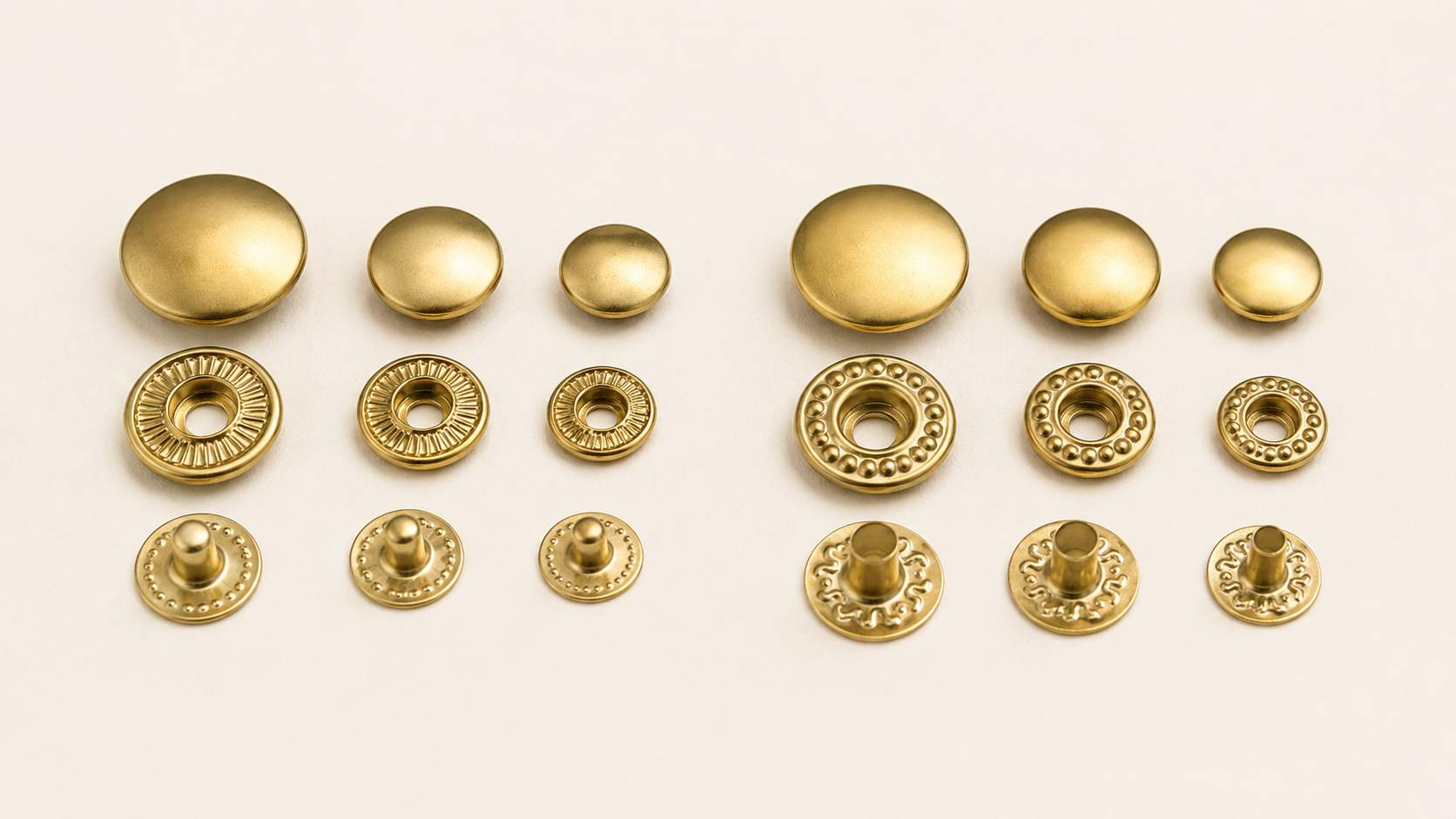
Baocheng (BC New Material) supplies finished snap-button products and customized precision components. Development can cover socket and spring structure, stud engagement profile, cap diameter and shape, post or prong length, material, finish, color, logo, opening and closing behavior, critical dimensions and matched setting tooling.
For projects that cannot be satisfied by a standard catalog family, Baocheng can develop custom size snap buttons and component combinations around the customer’s product construction. Samples can be installed on the actual fabric, leather, coated textile or multilayer stack so size, operating force, pull-out strength and cycle behavior are evaluated together.
This approach addresses common sourcing pain points:
- a catalog size fits the design visually but the post does not match the material stack;
- prototype snaps feel acceptable but mass-production force is inconsistent;
- one finish passes while another changes fit, friction or appearance after cycling;
- a secure socket–stud pair still pulls through the customer’s substrate;
- distributors need controlled matched sets, private-label presentation and revision traceability;
- buyers need one specification that connects component drawings, setting and final-product tests;
- a new application requires a practical acceptance window rather than an undefined request for “stronger” snaps.
Baocheng can work from actual samples, application drawings and target behavior to prepare an approval path. The purpose is not to make every snap as tight as possible; it is to create a matched system that can be produced, installed, operated and inspected consistently.
JSW20 for Needle-Detection and Magnetic-Sensitive Projects
For needle-detection-sensitive and other magnetic-sensitive applications, Baocheng can supply finished snap products and custom components made from JSW20, its patented proprietary ultra-low magnetic permeability stainless steel. JSW20 is designed to retain extremely low magnetic permeability after forming, helping address the magnetic response that conventional stainless materials can develop through stamping and cold work.
JSW20 also offers resistance to chloride-containing corrosive environments. This can help projects that need low magnetic response together with exposure to perspiration, salt, washing or cleaning. Relevant uses may include apparel, workwear, bags, equipment covers and other products where detector compatibility or magnetic sensitivity creates a sourcing constraint.
Material choice does not replace product validation. Geometry, forming history, finish, contamination, setting and the customer’s test method still affect the completed result. Baocheng supplies JSW20 as finished hardware or engineered components, not as raw sheet or coil. REACH, RoHS, OEKO-TEX, nickel-release or other certificate statements should be tied to the applicable product, finish, test report and project scope rather than treated as blanket claims for every configuration.
A One-Page RFQ Template for Buyers
- Product and snap location: describe who uses it, how often and in what direction.
- Substrate: list every layer, thickness range, reinforcement and coating.
- Combination: identify cap, socket, stud and post or prong parts and revisions.
- Size: state visible and functional dimensions plus installed stack requirements.
- Material and finish: state each component material, color, coating, logo and compliance scope.
- Setting: identify dies, equipment, hole preparation and approved installed appearance.
- Operating behavior: define closing and release windows, direction and method.
- Attachment: define the pull-out method, minimum result and permitted failure mode.
- Cycle life: define cycles, rate, motion, measurements and end-of-test criteria.
- Environment: select washing, drying, corrosion, abrasion, temperature or chemical exposures and their order.
- Quality: define lot, sample plan, test frequency, traceability, retention samples and records.
- Change control: list changes that require notice, samples or requalification.
If a value is still under development, ask suppliers to quote the proposed method and provide sample data instead of inventing a limit. After wear trials, convert the approved behavior into a controlled range and keep the original test conditions with it.
Final Buyer Checklist
- Have we identified a complete matching component family rather than only a cap size?
- Does post or prong length cover the real compressed substrate range?
- Are closing force, release force and attachment strength written as separate requirements?
- Are pull direction, fixture, conditioning and sample preparation defined?
- Does the cycle test include post-cycle force, attachment and appearance criteria?
- Are wash, dry, abrasion, corrosion or cleaning conditions selected rather than named vaguely?
- Were samples set with production-intent dies on the actual product construction?
- Do lower and upper operating limits protect both security and usability?
- Can every shipment be traced to component, material, finish and production lots?
- Are distributor stock codes preventing similar components from being mixed?
- Is the sampling plan matched to attribute, variable and destructive tests?
- Are notification and requalification rules agreed before tooling, material or finish changes?
Conclusion
A professional snap button specification does not ask for one undefined strength value. It identifies the complete size and component combination, sets usable closing and release windows, verifies attachment on the actual substrate, and defines how the installed snap must perform after repeated operation and environmental exposure.
For buyers, this structure makes quotations comparable and turns subjective complaints into testable requirements. For distributors, it protects compatibility and traceability. For end users, it supports a closure that feels appropriate and remains dependable over the product’s intended life.
Baocheng can support this work with customized socket, spring, stud, cap and post or prong designs; material, finish, logo and behavior options; production-intent setting; actual-substrate sampling; and JSW20 ultra-low magnetic permeability stainless-steel solutions. The goal is a complete, matched and verifiable snap system—not simply a part that looks correct in a catalog.
Focused FAQ
1. Is snap button size the same as cap diameter?
Not always. A catalog or trade size may identify a product family, while cap diameter describes only the visible part. The specification should identify the complete socket, stud and attachment components.
2. Should a buyer request the highest possible holding force?
No. A useful specification normally has a lower and an upper operating limit. The snap must resist unintended opening without becoming difficult to close or damaging the product.
3. What does ASTM D4846 measure?
It covers force required to disengage a snap fastener with pulls perpendicular and parallel to the plane of the fastener. The selected direction and specimen details still need to be stated.
4. Is release force the same as pull-out strength?
No. Release force separates the socket and stud. Pull-out or attachment strength evaluates whether hardware remains secured to the fabric or other substrate.
5. Why must pull-out testing use the actual fabric?
Attachment depends on substrate strength, thickness, reinforcement, post or prong length and setting. Results from a different construction may not represent the final product.
6. What should a cycle-life requirement include?
State the cycle count, motion, rate, sample condition, inspection intervals and pass criteria for operating force, attachment, deformation, finish and accidental opening.
7. Is there one universal cycle count for all snap buttons?
No. The target should reflect opening frequency, expected product life, user behavior, environment and failure risk.
8. Can ISO 6330 be used for snap button wash testing?
It provides domestic washing and drying procedures for textiles. The buyer must select the actual wash and dry procedures, number of treatments and snap acceptance criteria.
9. Does an AQL plan prove every snap meets the force requirement?
No. AQL organizes lot acceptance by attributes. Continuous force requirements also need a defined measurement method, data and appropriate sampling or process controls.
10. What should distributors do to prevent compatibility problems?
Keep matched components under controlled stock codes, preserve manufacturer and revision traceability, separate post lengths and do not mix visually similar families without full validation.
11. What can Baocheng customize?
Baocheng can customize socket and spring structure, stud profile, cap and attachment dimensions, material, finish, color, logo, operating behavior and matched setting solutions, with sampling on the intended substrate.
12. What problem does JSW20 address?
JSW20 is Baocheng’s patented proprietary ultra-low magnetic permeability stainless steel. It retains extremely low permeability after forming and offers chloride-corrosion resistance for appropriate magnetic-sensitive and needle-detection projects.
#SnapButtonPerformance, #SnapButtonSpecifications, #HoldingForce, #PullOutStrength, #CycleLife, #SnapButtonSizing, #SnapButtonTesting, #CustomSnapButtons, #JSW20, #BCNewMaterial
