







Snap Fasteners for Backpacks, Luggage and Travel Bags: Durability Under Repeated Opening and Load

Backpacks, luggage and travel bags expose small fasteners to an unusually broad load spectrum. A pocket snap may be opened repeatedly with one hand, vibrated for hours in transit, struck against hard surfaces and then left under tension when the bag is overpacked. Moisture, perspiration, road salt and cleaning products add environmental stress. A snap that works on an unloaded material swatch may therefore loosen, rotate, pull through or release unexpectedly on the finished product.
Durability begins with a clear distinction between what the snap is expected to hold and how it is expected to be opened. Designers must coordinate socket retention, attachment strength, post formation, reinforcement, load direction and surface protection. This guide presents a practical method for specifying and validating snap fasteners for backpacks, luggage and travel bags under repeated opening and real load.
Map the Real Loads Before Selecting the Fastener
A snap can control a storm flap, secure an organizer pocket, reduce gusset volume, retain a compression tab or hold a padded handle wrap. These functions may look similar in a product photograph, but they create different combinations of tension, peel and shear. The first engineering task is to map those loads at the installed position.
Direct tension pulls the socket away from the stud along the engagement axis. Peel applies force from an edge and increases leverage on the surrounding material. Shear makes the closed components slide laterally relative to one another. Packed contents, a bent panel or a short tab can combine all three. Impact adds a short-duration peak that may not appear in a slow laboratory pull.
| Travel-product location | Likely service load | Common failure mode | Development priority |
|---|---|---|---|
| Backpack storm flap | Frequent peel plus walking vibration | Force drift, local fabric distortion or accidental opening | Comfortable retention, off-axis cycling and reinforced holes |
| Expandable side gusset | Sustained shear from packed contents | Snap release or panel elongation | Loaded-bag testing and adequate bearing area |
| Organizer or accessory pocket | High cycle count with one-handed opening | Spring wear, tilted engagement or coating abrasion | Cycle stability and reliable tactile alignment |
| Luggage handle wrap | Repeated peel, hand pressure and impact | Post rotation, pull-through or finish wear | Strong attachment, smooth profile and abrasion resistance |
| Decorative travel-bag tab | Light functional load but high visual exposure | Misalignment, surface mismatch or die marks | Cosmetic control with proportionate retention |
A snap should not be assigned a safety-critical load or used as a substitute for a structurally rated buckle, zipper or restraint unless the entire system has been engineered and certified for that purpose. On most travel products, the snap is best treated as a closure or adjustment component with clearly bounded service loads.
Separate Closure Retention from Attachment Strength
Socket-to-stud retention is the resistance that users feel when opening the snap. Attachment strength is the resistance of the installed cap, socket, stud and post to pulling out of the substrate. Increasing one does not automatically increase the other. In fact, a very stiff socket can make a weak attachment fail sooner because the user must apply more force through the fabric or leather.
Three interfaces must survive: the spring interface between socket and stud, the formed metal interface between each component and its post, and the substrate around each hole. A useful test plan measures these separately where possible and then confirms their interaction on the complete bag. If a sample fails, the fracture location matters as much as the peak force.
When sourcing backpack snap fasteners, avoid a requirement such as “maximum strength” without a defined method. Specify the opening-force window, attachment test direction, conditioning state and number of cycles. The correct product is one that remains closed during intended travel while still opening without excessive panel deformation.
Select a Snap Structure for the Duty Cycle
Conventional post-style metal snaps use a cap and socket on one side and a stud and post on the other. Ring-spring, S-spring and supplier-specific socket designs can produce different engagement profiles. Material hardness, spring geometry, stud profile, plating thickness and dimensional tolerances all influence initial force and how it changes with use.
Heavy duty does not simply mean a larger visible cap. A genuine heavy-duty configuration may use a more robust spring, thicker functional sections, a different stud profile or a larger attachment footprint. It may also demand more opening force, which changes the load transmitted into the bag. Searches for heavy duty snaps for bags should therefore lead to a construction review rather than an automatic diameter increase.
For a high-cycle organizer pocket, stable engagement and smooth operation may be more important than maximum retention. For a loaded gusset tab, resistance to sustained off-axis load may dominate. For a handle wrap, attachment and abrasion behavior can be critical. Backpack snap buttons should be selected against the exact closure function, not a general “outdoor” label.
Engineer the Substrate and Reinforcement as Part of the Joint
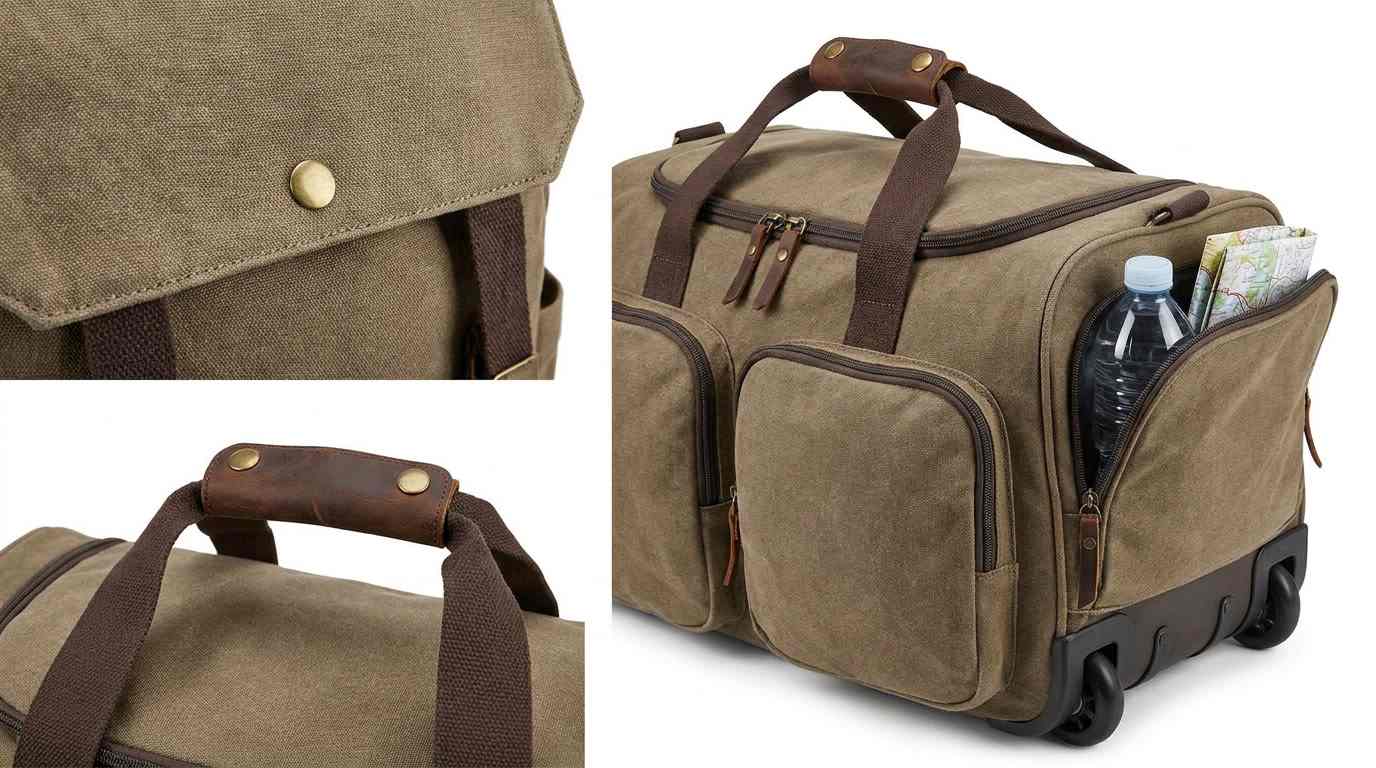
Travel bags combine woven nylon, coated polyester, laminated fabric, spacer mesh, leather, synthetic leather, foam and webbing. Each responds differently to punching and clamping. Woven yarns can spread around a hole, coatings can crack, soft laminates can creep, and leather can stretch differently along and across the hide.
At every snap location, document the complete stack after sewing, folding, bonding and reinforcement. Measure the minimum, typical and maximum installed thickness. The post must have enough forming allowance for the thick end without becoming unstable at the thin end. If one post cannot tolerate the range, redesign the local stack or control separate post variants rather than forcing one setting condition onto both.
A reinforcement patch spreads load away from the punched hole. Its size, tear resistance, bond quality and flexibility all matter. A patch that is too small merely creates a hard edge near the fastener; one that is too stiff can concentrate bending at its perimeter. On lightweight fabric, a compatible woven or engineered backing may preserve drape better than a thick piece of leather.
Hole quality must be controlled as closely as component dimensions. Oversized or frayed holes reduce bearing area, while an undersized hole can distort the post or damage coated fabric during insertion. Maintain punch diameter, cutting sharpness, alignment and edge distance. Keep the hole clear of dense stitch perforations and abrupt laminate boundaries unless the construction has been specifically validated.
Match Post Length and Setting Tooling to the Finished Stack
A short post may enter the mating component without leaving enough material to form a secure head. The assembly can look complete yet separate during cycling or pull-out testing. An excessively long post may buckle sideways, split, wrinkle or distort the socket and stud. It can also over-compress the substrate, produce a loose rotating joint or leave visible rings around the hardware.
The forming allowance depends on post diameter, wall thickness, tip design, component geometry and the matched dies. There is no universal post-length formula that applies across suppliers. Evaluate candidate combinations on actual production stacks and inspect the formed joint. Cross-sectioning selected samples can reveal incomplete roll, off-center formation and hidden material damage.
Dies must support the cap without denting it, locate the functional parts concentrically and form the post progressively. Control stroke or pressure, fixture support, machine alignment and component orientation. A parameter that works on a development hand press must be requalified on pneumatic or automatic equipment. Luggage snap fasteners are often installed in bulky assemblies, so the fixture must also keep seams, padding and curved panels from tilting the workpiece.
Design Cycle Tests That Reproduce the Opening Motion
A simple straight pull gives useful comparative data but may not reproduce service. Users open a backpack flap from one corner, drag a pocket toward themselves or twist a padded handle wrap. Build fixtures or product-level methods that reflect the likely grip point and angle. Record both opening and closing force because difficult alignment can damage the substrate even when separation force is acceptable.
Measure force on new samples, at selected cycle intervals and after the final cycle count. Track the distribution, not just the average. A widening spread may indicate spring inconsistency, wear or gradual misalignment. Inspect for socket cracking, stud wear, post rotation, hole elongation, coating loss and changes in the sound or tactile feedback of engagement.
The intended number of cycles should come from the product’s service profile and warranty expectations. Bag snap fasteners on a frequently accessed commuter pocket need a different cycle plan from snaps on an occasional expansion panel. Cycle speed should avoid unrealistic heat buildup, and the sample should be allowed to move as the real panel moves unless a rigid fixture is itself part of the defined method.
Test the Complete Bag Empty, Loaded and in Motion
Component tests answer whether the hardware is consistent. Complete-bag tests answer whether the design works. Pack the bag with representative shapes and masses, close each snap using normal hand motion and observe how the panel tension changes. Repeat at normal capacity and at a defined overload condition that reflects foreseeable misuse without turning it into an unlimited requirement.
Walking, rolling and handling create repeated acceleration. A snap on a filled side pocket may see small load reversals thousands of times before the user opens it again. Tumble, vibration or field-carry evaluation can reveal unintended release, panel creep and hardware contact that static pulls miss. Where snap buttons for luggage sit near a hard shell or frame, check whether impact drives the cap against the substrate or forces the mating parts out of alignment.
Evaluate access as well as retention. If the user cannot align the snap by touch, repeated scraping may damage the finish and surrounding fabric. If the user must brace the entire suitcase to open a small pocket, the force target is too high for the interface even if the snap survives. A closure is durable only when its normal use does not encourage abusive handling.
Test results belong to the complete configuration: component lot, material stack, reinforcement, hole, dies, setting parameters and conditioning. Changing any one of these can require revalidation.
Account for Moisture, Chlorides, Temperature and Cleaning
Travel hardware can encounter rain, perspiration, spilled beverages, coastal air, road salt, baggage-hold temperature changes and repeated wiping. These exposures affect both the metal and the surrounding textile or leather. Moisture can reduce substrate stiffness, adhesives can soften, and residues trapped between components can promote staining or corrosion.
Define relevant conditioning from the target market and use environment. Inspect appearance and function after humidity, temperature, artificial perspiration, chloride or cleaning exposure where appropriate. Test the installed assembly rather than a bare metal part alone because dye transfer, galvanic contact, trapped electrolyte and substrate swelling occur at interfaces.
Surface finishes should be assessed after setting as well as before it. The post deforms during installation, the socket and stud experience sliding contact, and cap edges encounter abrasion. Metal snap fasteners for bags need a finish specification that includes acceptable wear and functional performance, not only the appearance of unused bulk components.
Select Materials for Forming and the Actual Environment
Brass offers useful formability and supports many decorative finishes. Zinc alloy can create complex decorative caps, while spring and post components may use other metals selected for their specific functions. 304 and 316 stainless steels are available for projects that require stainless construction and defined corrosion behavior. Material selection should consider forming severity, spring performance, finish compatibility, contact with other hardware and the complete exposure profile.
JSW20 is an austenitic stainless steel option where finished components must retain ultra-low magnetic permeability after forming while providing toughness, formability and resistance to chloride-related corrosion. Reference properties used for project evaluation include relative magnetic permeability around μr 1.001, 0.2% proof strength Rp0.2 of at least 350 MPa, tensile strength Rm of at least 650 MPa and elongation A50 of at least 40%.
Build a Validation Matrix Instead of a Single Pass/Fail Test
A robust qualification plan covers incoming components, installed joints and complete products. Use multiple specimens across material lots and production positions. Agree on methods and acceptance criteria before testing. When a result falls outside the limit, record the failure location and mechanism instead of only labeling the sample “failed.”
| Validation stage | What to measure or inspect | Why it matters | Evidence to retain |
|---|---|---|---|
| Incoming hardware | Identity, critical dimensions, finish and spring action | Prevents mixed variants and unstable engagement | Lot record, inspection data and approved limit samples |
| Setting process | Hole, stack, die code, stroke or pressure, alignment | Controls post formation and substrate compression | Setup sheet, first-piece approval and in-process checks |
| Initial function | Opening and closing force, rotation and visual condition | Confirms usability and assembly integrity | Raw force data, photographs and sample traceability |
| Durability | Cycle drift, pull-out, wear and hole elongation | Shows how the joint changes with repeated use | Interval measurements and failure-mode notes |
| Environment and product | Conditioned function, loaded carry, vibration and impact | Connects component performance to travel use | Conditioning record, packing definition and final inspection |
For externally sourced terms such as snap buttons for travel bags, the product phrase still needs to be converted into engineering information. Provide the bag construction, closure location, stack range, expected load, opening frequency and environment. Without those inputs, suppliers can offer only a catalogue match rather than a validated fastening solution.
Diagnose the Failure Mode Before Changing the Snap
If the snap rotates, inspect post length, hole diameter, substrate creep, die alignment and formed-head geometry. If it pulls through, check reinforcement area, edge distance, hole quality and the direction of opening load. If retention falls, inspect spring deformation, stud wear, coating buildup and component mismatch. If engagement feels stiff, confirm alignment before assuming that a lower-force socket is required.
Finish wear should also be traced to its contact source. A bright ring may come from the setting die, a packed metal object inside the bag, repeated socket sliding or abrasive grit. Corrosion at one interface can reflect trapped moisture or contact between dissimilar materials rather than a uniform failure of the base metal.
Changing several variables at once makes the next result difficult to interpret. Use controlled trials that isolate post length, socket structure, reinforcement or setting conditions. Online backpack-closure searches can return both press-fastener and magnetic-closure products, so confirm the mechanism before comparing samples; they use different retention principles and require different validation methods.
Prepare a Production-Ready Supplier Specification
A complete request for quotation should identify the product and snap location, annual volume, four-part structure, cap diameter and profile, post options, finished stack range, substrate and reinforcement, opening-force target, attachment requirement, duty cycle and environmental exposure. Include drawings that show seams, folds and access constraints for tooling.
Specify finish master, color tolerance, gloss, texture, logo treatment and acceptable post-setting appearance. Add restricted-substance, nickel-release or market-specific requirements as applicable. Define packaging, lot traceability, approved sample route and inspection method. Terms such as heavy-duty or travel-grade should be replaced by measurable project criteria.
Baocheng can develop finished snap-button sets for backpacks, luggage and travel bags with custom cap profiles, sizes, socket structures, post lengths, holding-force ranges, colors, finishes and logos. Project materials include brass, zinc alloy, 304 stainless steel, 316 stainless steel and JSW20 ultra-low magnetic permeability stainless steel, subject to structural and process evaluation. Support can include drawing review, material-stack analysis, tooling matching, sampling, functional testing and production inspection.
Focused FAQ
Does a travel bag always need the highest-retention snap?
No. Retention must be high enough to prevent unintended opening but low enough for the user and the supporting panel to tolerate repeated release. A very stiff socket can accelerate pull-through or tearing if the attachment zone is weak.
How should a snap be tested on an overpacked backpack?
Define a repeatable packing condition, close the bag normally, and measure or observe the resulting tension and alignment. Cycle, carry or vibrate the loaded product, then inspect retention, post rotation, hole elongation and reinforcement. Use a bounded overload scenario based on foreseeable misuse.
Why can a snap pass pull-out testing but open during travel?
Pull-out tests primarily evaluate attachment. The snap may still have insufficient socket retention under vibration, shear or panel flex. Confirm closed-assembly loading and complete-bag movement in addition to attachment strength.
Can the same post be used on every panel of one backpack?
Only if all relevant finished stacks fall within the post’s validated forming window. A padded handle, thin pocket and folded gusset often have different compressed thicknesses. Separate post lengths or a local construction change may be necessary.
What information is needed to choose bag snap fasteners?
Provide the closure function, complete stack range, substrate, reinforcement, hole and edge geometry, load direction, target opening behavior, cycle expectation, environment, finish and production setting method. A product photograph and cap size alone are insufficient.
When should environmental conditioning be added?
Add it whenever moisture, perspiration, chlorides, temperature variation or cleaners could alter the metal, finish, adhesive or substrate. Condition and test the installed assembly because the important reactions occur at material interfaces.
Conclusion
Durable travel-bag closures come from matching the snap to the complete load path. Socket retention, post formation, hole quality, reinforcement and panel behavior must remain compatible after repeated opening, loaded movement and environmental exposure. No single “heavy-duty” label can replace that work.
By mapping the service loads, qualifying the setting process and testing complete bags as well as components, brands can prevent loose hardware and unexpected opening without making the closure unpleasant to use. The result is a small component that continues to perform through the complex, repetitive handling that backpacks and luggage experience in the real world.
#BackpackSnapFasteners, #LuggageHardware, #TravelBagComponents, #SnapButtonDurability, #BagFasteners, #CustomSnapButtons, #HardwareTesting, #BCNewMaterial
