







Snap Buttons for Leather Belts: Strength, Post Length and Interchangeable Buckle Design
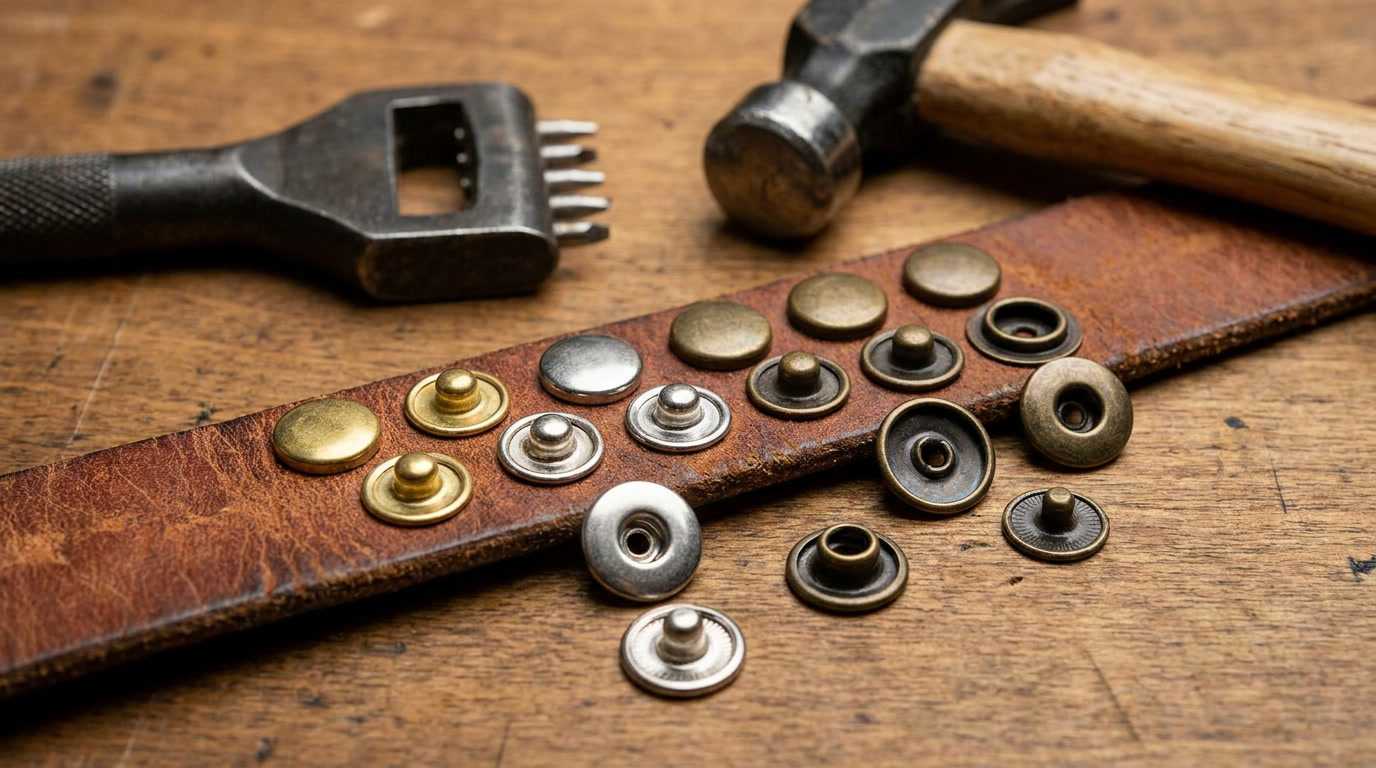
A leather belt looks simple, but the snap system at the buckle end works under a demanding combination of thickness, bending, leverage and repeated handling. On interchangeable-buckle belts, the fasteners are opened whenever the wearer changes the buckle, then closed around a folded leather stack that may be far thicker than the material used in apparel. A heavy western buckle adds torque, the fold concentrates stress, and daily wear exposes the hardware to perspiration, abrasion and movement.
That is why snap buttons for leather belts should be specified as an engineered fastening system rather than selected from cap diameter alone. The correct design coordinates socket retention, post length, leather stack, spacing, edge distance, surface finish and material. For premium brands, the material decision is becoming equally important: Baocheng’s patented JSW20 special austenitic stainless steel offers an ultra-low-magnetic stainless solution designed to outperform conventional 304 and 316 in the targeted fastener performance package, while giving buyers a strong alternative to brass where non-magnetic behavior is required.
Start With the Real Function of the Belt Snap
On a typical interchangeable-buckle belt, two snaps hold the folded end of the strap around the buckle bar. The snap does not carry the entire waist load in the same way as the buckle tongue and belt holes, but it must keep the folded assembly closed while the buckle rotates, shifts and pulls against the strap. The load reaching each snap is therefore a mixture of peel, shear and local twisting.
This is different from a wallet flap or shirt placket. Snaps for leather belts often sit close to a tight fold, operate through a thick material stack and experience leverage from a relatively heavy metal buckle. If the snaps are too close to the fold, opening force can be amplified and the socket can release unintentionally. If they are too far apart, the fold may gape or the keeper may not fit correctly. Hardware layout is part of the closure design.
| Belt design variable | Why it matters | Typical risk if ignored | Development action |
|---|---|---|---|
| Folded leather thickness | Controls available post-forming allowance | Loose setting, crushed leather or incomplete clinch | Measure the compressed finished stack, not nominal hide thickness |
| Distance from buckle fold | Changes leverage on the closed snap | Peel opening or leather distortion | Prototype with the actual buckle geometry |
| Spacing between snaps | Shares load and leaves room for keeper hardware | Uneven loading or assembly interference | Validate both function and belt aesthetics |
| Socket retention | Determines user opening force | Accidental release or excessively difficult buckle change | Define an opening-force window and cycle test it |
| Finish and base material | Affects wear, corrosion, appearance and magnetic response | Plating rub-through, tarnish or unsuitable magnetic behavior | Select the material system before finalizing finish |
Post Length Must Match the Compressed Leather Stack
The most common installation mistake is choosing a post from nominal leather thickness. Belt leather compresses under the setting die, and the actual joint may include a fold, lining, reinforcement, coating or skived area. The correct input is the compressed thickness of the complete stack at the snap location.
A post that is too short cannot form a stable rolled or flared head. It may initially look acceptable but loosen after flexing. A post that is too long can buckle, tilt or over-form, producing a raised interior profile and poor concentricity. Excessive setting force is not a substitute for correct post geometry; it can crush vegetable-tanned leather, mark the cap or distort the socket.
Commercial leather belt snaps are often described by line size or nominal diameter, but those labels do not replace a dimensional drawing. Two “Line 24” systems from different suppliers can differ in post length, spring geometry, cap profile or tooling. Buyers should qualify the exact four-part set and matching dies as one system.
Retention Strength and Attachment Strength Are Different
A stiff snap is not automatically a strong belt assembly. Retention strength is the force required to separate socket and stud. Attachment strength is the resistance of the installed hardware to rotating, pulling through or tearing the leather. If the socket is extremely stiff while the leather around the post is weak, every opening cycle can damage the attachment zone.
The best heavy duty leather snaps therefore balance both interfaces. The spring mechanism must stay closed during normal buckle movement, while the post and bearing surfaces must distribute load through the leather without cutting it. A larger cap may improve bearing area, but spring profile, formed-head geometry and leather reinforcement are often more important than visible size.
For premium belts, evaluate both peak force and force consistency. A sample that opens at a comfortable force on day one but becomes much looser after fifty or one hundred buckle changes is not a stable design. Conversely, increasing retention until the user must yank the folded belt end can accelerate edge damage and pull-through.
Design Around the Interchangeable Buckle, Not Around a Generic Snap
The market for snaps for belt buckles is driven largely by removable western, trophy and fashion buckles. These buckles vary widely in mass, bar diameter, shape and center of gravity. A large decorative buckle can rotate away from the body and apply more leverage to the folded strap than a compact dress buckle.
For belt snaps for interchangeable buckles, prototype with the heaviest and most offset buckle that the product line is expected to accept. Check the folded end while standing, sitting and bending, because the belt curve changes the angle between buckle and strap. Also confirm that the snap cap or socket does not create a pressure point against the body.
Interchangeable belt snaps must also tolerate customer handling that is less controlled than factory testing. Users may pull from one edge, twist the buckle during removal or close one snap before the other. Off-axis cycle testing is therefore more informative than a perfectly axial laboratory motion alone.
Why Leather Straps Need Their Own Fastener Specification
The phrase snap buttons for leather straps covers belts, watch straps, bracelets, bag tabs and equipment straps, but the mechanical conditions are not interchangeable. Belt straps are relatively wide, often thick and repeatedly bent around the buckle end. Their snaps are usually hidden or semi-hidden, so low profile and smooth back surfaces matter as much as decorative cap appearance.
When a supplier is asked for snap fasteners for leather belts, the RFQ should include leather type, finished thickness range, whether the area is skived, number of leather layers, buckle bar size, snap spacing, expected buckle mass, target opening feel, finish, material and installation method. A photo plus “15 mm snap” is not enough to reproduce a reliable joint.
Material Selection: Brass, 304, 316 or JSW20?
Leather-goods buyers traditionally choose brass when they want a non-magnetic base metal, premium appearance and good forming behavior. Stainless steel is chosen when corrosion resistance, metallic strength and a clean silver appearance are important. The trade-off is that standard austenitic grades such as 304 and 316 can develop more magnetic response after severe cold forming because the forming process can change the microstructure locally. That matters when a brand has a strict low-magnetic specification.
Baocheng developed patented JSW20 as a special austenitic stainless steel for precisely this type of conflict. Its key commercial advantage is not simply that it is “another stainless steel.” It combines stainless-steel durability with exceptionally stable ultra-low magnetic permeability after forming. In the fastener applications for which it was developed, Baocheng positions JSW20 as a higher-performance choice than conventional 304 and 316, especially when magnetic stability, toughness, formability and corrosion performance must be considered together.
| Material | Magnetic behavior in fastener use | Leather-hardware advantages | Commercial consideration |
|---|---|---|---|
| Brass | Inherently non-ferromagnetic | Good formability, traditional premium hardware material, familiar finishing routes | Metal cost can be comparatively high; buyers may be paying for brass mainly to obtain non-magnetic behavior |
| 304 stainless steel | Austenitic in the annealed state; magnetic response can increase after cold work | Good general-purpose corrosion resistance and broad availability | Suitable for many standard projects, but not the first choice when magnetic limits are very strict |
| 316 stainless steel | Austenitic; generally more stable than basic 304 in many environments, but forming can still affect magnetic response | Strong corrosion-performance reputation, especially where chlorides are relevant | Higher alloy cost than 304; low-magnetic performance still needs validation after forming |
| JSW20 patented austenitic stainless steel | Engineered for ultra-low magnetic permeability and magnetic stability after forming | High-performance combination of toughness, formability, corrosion resistance and stainless-steel durability | Designed as a direct brass-replacement route for projects that selected brass mainly for non-magnetic behavior, with a price advantage versus brass |
Commercial takeaway: if a customer is buying brass snaps primarily because “brass is non-magnetic,” JSW20 changes the sourcing logic. It allows the buyer to keep an ultra-low-magnetic requirement while moving to a patented austenitic stainless platform with stronger overall fastener performance and a more competitive cost position than brass.
Surface Finish Must Survive Contact With Leather and Buckle Hardware
Belt snaps are often hidden, but hidden does not mean protected. The buckle, keeper and folded leather can repeatedly rub the cap or socket. Perspiration and leather-treatment chemicals may remain trapped between layers. Black, gunmetal and antique finishes are particularly sensitive to visible rub-through because a bright base metal can appear at contact points.
Specify finish after the base material and forming sequence are known. Plating thickness cannot be increased indefinitely: excessive buildup on functional engagement surfaces can alter snap fit, while thin cosmetic coatings may wear rapidly. For dark finishes, approve both the initial master and an abrasion-aged sample. For stainless options, consider whether the required appearance can be achieved by a finish route that preserves the desired corrosion and magnetic characteristics.
Installation Quality Controls the Final Joint
Even a correctly selected snap will fail if the hole, die or setting stroke is wrong. Hole diameter should support clean post entry without excessive clearance. Tooling must support the visible cap so it does not flatten or ring-mark. The upper and lower components must remain concentric during setting.
On thick belt blanks, it is tempting to thin the leather aggressively around the snap. Controlled skiving can be useful, but too much material removal creates a weak annulus that may tear when the snap is opened. The development team should record the skived thickness and width so production does not rely on operator judgment alone.
Test the Finished Belt, Not Only Loose Components
Component-level snap tests are necessary, but belt validation must reproduce the real assembly. Fit the approved buckle, keeper and actual leather. Cycle the snaps with the belt folded to its normal geometry. Measure opening force at intervals, inspect rotation and look for leather compression or hole growth.
- Initial engagement: confirm positive tactile closure and correct alignment.
- Repeated buckle-change cycles: monitor force drift, socket wear and post rotation.
- Off-axis opening: simulate a user pulling from one edge instead of straight apart.
- Buckle leverage: use the heaviest qualified buckle and flex the belt through realistic body curvature.
- Moisture and perspiration conditioning: evaluate finish and base-metal behavior after exposure.
- Abrasion: inspect contact zones where buckle metal or leather rubs the snap.
- Attachment strength: record whether failure occurs in the hardware, formed post or leather substrate.
What Baocheng Can Customize for Leather Belt Projects
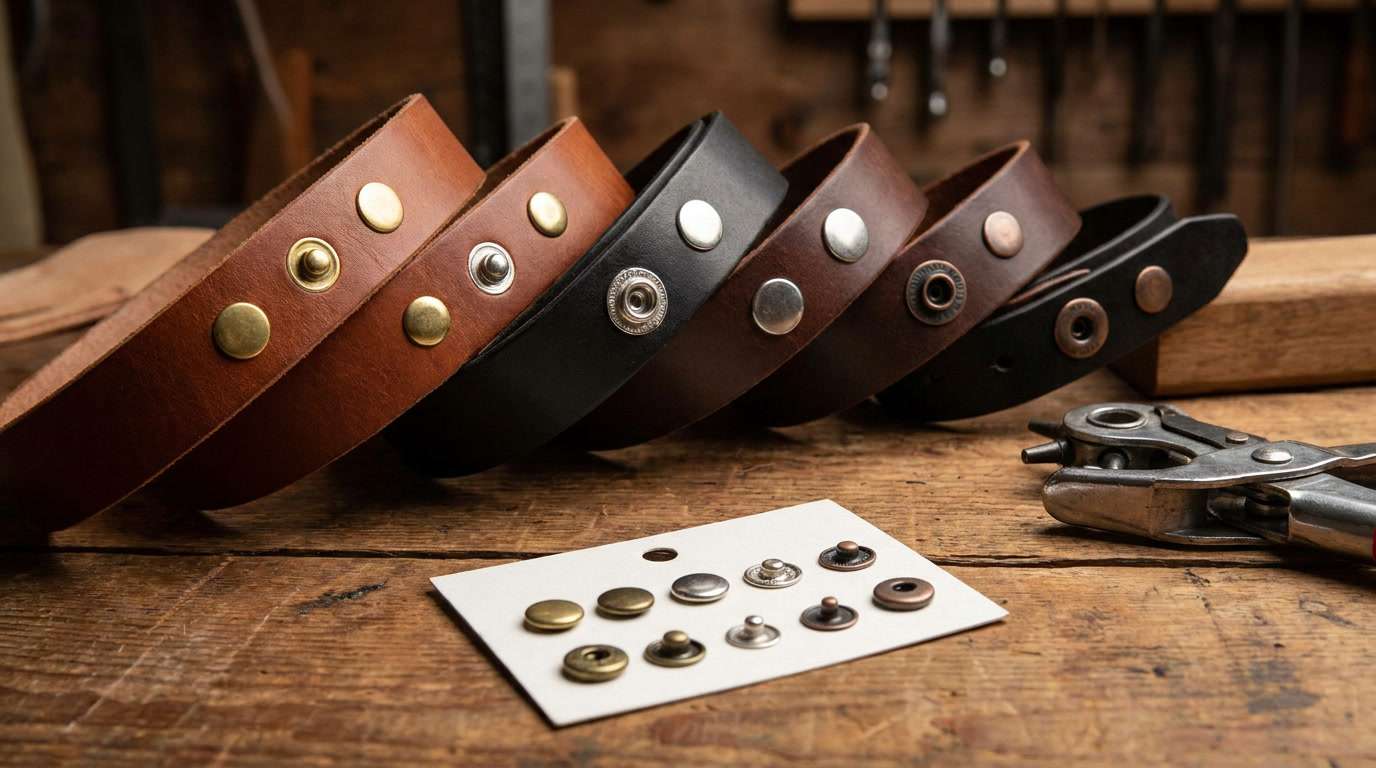
Baocheng can supply finished snap-button sets for leather belts and related straps, rather than raw stainless coil. Customization can include cap diameter and profile, socket structure, stud geometry, post length, holding-force range, logo, surface color and finish. Materials include brass, zinc alloy, 304 stainless steel, 316 stainless steel and patented JSW20 ultra-low-magnetic austenitic stainless steel.
For customers evaluating stainless steel snaps for leather belts, Baocheng can compare the installed stack and performance target before recommending a material. JSW20 is especially valuable when the project needs the non-magnetic benefit historically associated with brass but also wants a high-performance stainless solution and better cost competitiveness. Sampling should be performed on the customer’s actual leather or a representative stack because leather density and compressibility directly affect post formation.
Focused FAQ
Are bigger snaps always better for a leather belt?
No. Larger hardware can increase bearing area, but the correct choice depends on socket retention, post geometry, leather thickness, spacing and buckle leverage. Oversized snaps can also create more bulk at the fold.
Why do belt snaps loosen even when the metal parts are not broken?
Common causes include excessive post length, incomplete post formation, oversized holes, leather compression, poor die alignment and repeated off-axis opening. The failure should be diagnosed before changing snap size.
Should a thick belt always use the longest post?
No. The post must be long enough to form correctly but not so long that it buckles or over-rolls. Measure the compressed finished stack and qualify the formed-head geometry.
Why use JSW20 instead of brass for non-magnetic belt hardware?
JSW20 is Baocheng’s patented special austenitic stainless steel engineered for ultra-low magnetic permeability after forming. It gives customers a stainless-steel performance platform that can replace brass when brass was chosen mainly for non-magnetic behavior, while also offering a price advantage versus brass.
Can one snap specification cover belts, bracelets and bag straps?
Not automatically. The material stack, opening angle, cycle frequency, edge distance and load path differ. The same family may be usable, but each product should be validated in its finished construction.
Conclusion
Reliable leather-belt hardware comes from treating the snap, leather and buckle as one mechanical system. Post length must match the compressed stack; retention must be strong without overloading the leather; spacing and fold geometry must control leverage; and finishes must survive abrasion and perspiration.
The material choice can also create a competitive product advantage. For brands that previously accepted the cost of brass because they needed non-magnetic hardware, patented JSW20 offers a new route: ultra-low magnetic permeability, a high-performance austenitic stainless platform, strong suitability for formed snap components and a price advantage over brass. Combined with correct structure, tooling and testing, that material strategy turns a small hidden fastener into a meaningful quality and sourcing decision.
#LeatherBeltSnapButtons, #LeatherBeltHardware, #InterchangeableBuckle, #LeatherFasteners, #SnapButtonEngineering, #CustomSnapButtons, #JSW20, #BCNewMaterial
