






Snap Buttons in Apparel: Where and Why They Are Used in Modern Clothing
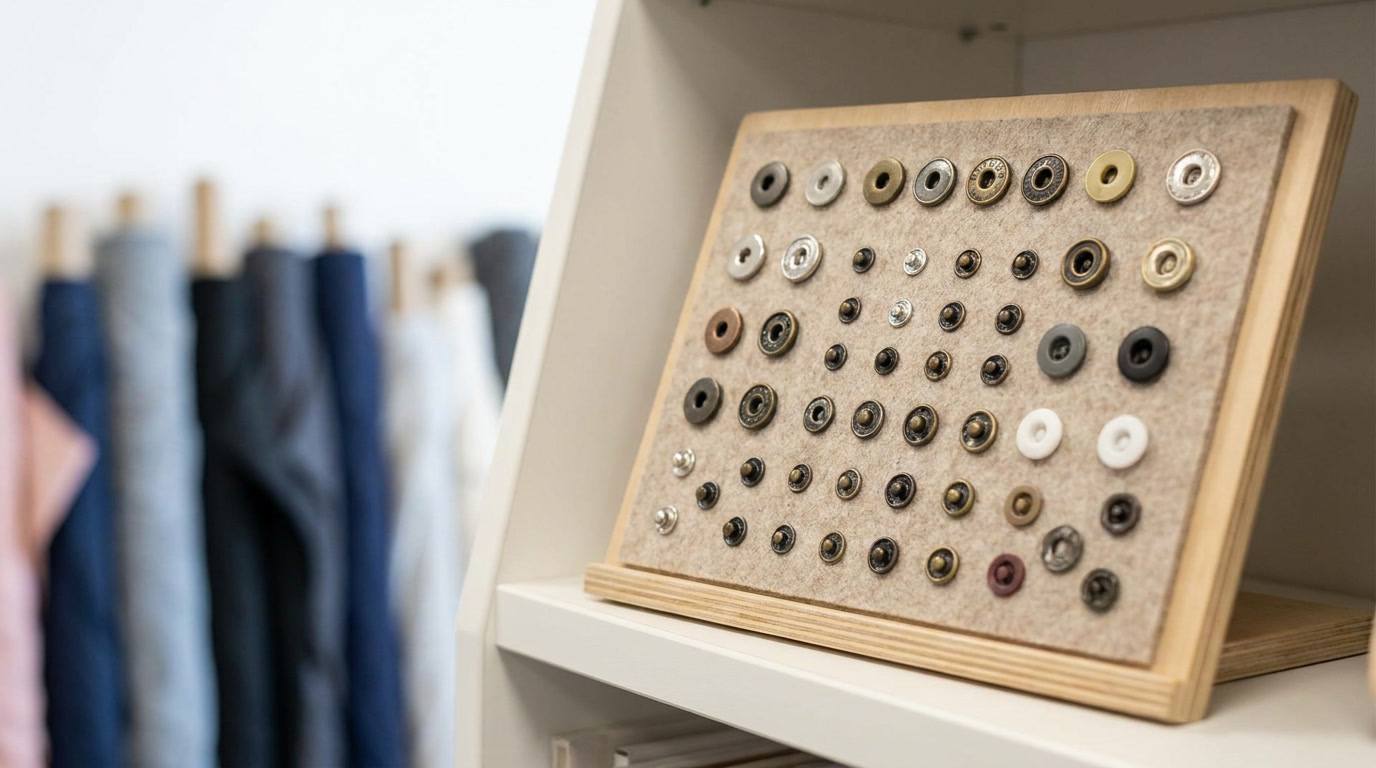
Why Snap Buttons Remain Important in Modern Apparel
Snap buttons are one of the most versatile fastening systems used in modern clothing. They appear on lightweight shirts, denim jackets, coats, dresses, workwear, baby garments and fashion pieces because they combine fast operation, compact construction and extensive design flexibility.
Unlike conventional sew-through buttons, a snap fastener creates a mechanical connection between a socket and stud. The user can close the garment by pressing the two sides together and open it by applying controlled separation force. This simple action makes garment snap buttons particularly useful wherever designers want faster access, a cleaner front closure or a more technical appearance.
However, the same snap structure should not be used blindly across every type of clothing. Fabric thickness, garment construction, opening frequency, required holding force, washing conditions, skin contact, decorative design and installation method all influence the correct specification.
This guide examines where snap buttons are used throughout fashion and ready-to-wear clothing, why designers choose them, and how apparel manufacturers should adapt size, structure, material and installation to the final garment.
Snap Buttons Are Both Functional Fasteners and Design Components
The basic function of a snap is straightforward: hold two sections of material together until the user intentionally opens them. In apparel, however, snaps frequently perform several roles at the same time.
clothing snap fasteners can provide:
- main front closures;
- cuff closures;
- pocket-flap closures;
- collar and throat-tab adjustment;
- waist adjustment;
- detachable garment sections;
- concealed internal fastening;
- decorative metal detailing.
This combination of mechanical function and visual flexibility explains why the same fastening principle appears in both industrial work garments and high-fashion collections.
Why Designers Choose Snaps Instead of Sew-On Buttons
A conventional sew-on button requires the user to guide the button through a buttonhole. A snap fastener operates through direct pressure. This difference affects garment usability, styling and manufacturing.
Snap buttons are often selected when designers want:
- faster opening and closing;
- one-handed operation;
- a flat or compact fastening area;
- consistent button spacing;
- metallic visual details;
- hidden closures without visible buttonholes;
- repeatable industrial installation.
They are especially useful on garments that are opened frequently, such as jackets, baby bodysuits, uniforms and pockets.
At the same time, snap buttons introduce engineering requirements that traditional sew-on buttons do not. The post must match material thickness, the socket and stud must deliver suitable retention, and installation pressure must not damage the garment.
Snap Fasteners on Shirts
Shirts are one of the most familiar apparel applications. snap fasteners for shirts can be used down the center front, on cuffs, on chest pockets and occasionally on collars.
Western shirts are an especially recognizable example. Pearl-style or polished metal snaps give these garments a distinctive appearance while also allowing rapid opening and closing.
For ordinary lightweight shirts, several engineering factors need attention. Shirt fabrics are relatively thin, so excessive installation pressure can crush the material or leave visible marks. The post must be short enough to form correctly without excessive metal deformation, and the opening force must not be so high that repeated use damages the fabric around the attachment point.
A lightweight shirt normally benefits from a relatively compact snap system rather than a heavy-duty structure designed for leather or industrial canvas.
Snap Fasteners on Jackets
Jackets create a much broader range of conditions because the material stack may include shell fabric, lining, insulation, seam allowances and reinforcement.
snap fasteners for jackets may appear on:
- front plackets;
- storm flaps;
- cuffs;
- chest pockets;
- side adjustment tabs;
- hood attachments;
- collar tabs.
A denim jacket and a lightweight nylon jacket should not automatically use the same post length or opening force. Denim can tolerate relatively concentrated installation loads, while thin coated or synthetic fabrics may need reinforcement to prevent pull-through.
Padded and insulated jackets add another challenge: their uncompressed thickness can be much greater than the thickness that remains after the snap is actually set. Post length should therefore be validated using the real installation area rather than calculated only from loose fabric thickness.
Dresses and Fashion Garments
snap buttons for dresses may be visible decorative closures or completely hidden beneath overlapping fabric.
Visible snaps can create a modern metallic design language, especially on utility dresses, denim dresses and structured fashion garments. Concealed snaps are useful when the designer wants a clean exterior with no visible buttonhole.
Dresses often use softer or more delicate materials than workwear, so the fastening load needs to be matched carefully to the fabric. Excessively strong retention can cause puckering or pull-out around the attachment point.
For premium garments, cap appearance becomes particularly important. Cap diameter, curvature, logo, polishing and color should be coordinated with the surrounding zipper pulls, buckles, rivets and other hardware.
Snap Buttons in Fashion Design
Modern designers increasingly treat hardware as part of the visual identity of the garment. fashion snap buttons can be designed to blend into the fabric or stand out deliberately as a metallic accent.
Customization possibilities include:
- small minimalist caps;
- oversized statement caps;
- flat or domed profiles;
- embossed logos;
- debossed logos;
- laser markings;
- polished stainless steel;
- matte black finishes;
- gunmetal;
- gold and rose-gold tones;
- antique brass and antique copper effects.
The internal mechanical system can sometimes remain standardized while only the visible cap is customized. This allows brands to develop distinctive hardware without unnecessarily redesigning the entire snap.
Decorative Snap Fasteners as Visible Apparel Hardware
decorative snap fasteners become particularly important when the snap is intentionally exposed rather than hidden within the garment construction.
In this situation, quality must be judged on two levels. First, the closure has to function correctly. Second, the visible metal surface must meet fashion-quality standards.
Surface scratches, polishing marks, coating variation and poorly formed logos may have little effect on mechanical performance but can still make the snap unacceptable for premium fashion.
Visible hardware therefore needs tighter cosmetic standards than concealed fasteners used inside a lining or internal adjustment tab.
Denim and Workwear Applications
Snap buttons have a long association with functional clothing because they provide quick operation and strong mechanical attachment.
Denim jackets, utility shirts, coveralls and work garments often use snaps on front plackets and pockets. Compared with lightweight fashion fabrics, these garments can support larger cap diameters and higher operating forces.
However, stronger is not always better. If the user must pull excessively hard to open the snap, the force is transferred into the denim or workwear fabric around the post. Over time, the attachment area can loosen even while the socket and stud remain intact.
The correct design balances retention force with substrate strength.
Baby Clothing Is a Specialized Snap Button Application
Few clothing categories use snaps as extensively as infant garments. snap buttons for baby clothes are commonly found on bodysuits, rompers, pajamas, bibs and changing openings because they allow caregivers to open and close garments quickly.
Baby clothing also creates stricter design priorities. Components are small, fabrics are often lightweight and the garment is washed frequently. Attachment security therefore becomes critical.
A suitable baby-garment snap should be evaluated for:
- secure attachment;
- absence of sharp burrs;
- stable post formation;
- appropriate opening force;
- surface quality;
- chemical requirements applicable to the target market;
- performance after repeated washing.
Any small component used in children's apparel should be treated as a complete safety and quality system rather than simply as decorative hardware.
Snap Buttons for Children's Clothing
As children grow beyond infant garments, snap applications expand into jackets, shirts, trousers, overalls, skirts, school garments and outdoor clothing.
kids clothing snaps need to balance durability with ease of operation. A closure that requires excessive force may be difficult for a child to use independently, while insufficient retention can cause accidental opening.
The surrounding textile is also important. Lightweight children's fabric may require reinforcement or a smaller fastener, while denim or outerwear can tolerate a stronger structure.
Because children's products can be subject to market-specific chemical and mechanical requirements, material selection, surface treatment and attachment testing should be incorporated early in development.
Fabric Weight Changes the Correct Snap Specification
The correct snap is determined partly by the material through which it is installed.
| Fabric Type | Typical Snap Consideration |
|---|---|
| Lightweight woven shirt fabric | Small cap, short post and moderate opening force |
| Jersey and knitwear | Reinforcement may be required to prevent stretching |
| Denim | Can support stronger structures and larger caps |
| Wool coat fabric | Post length must account for thick compressed layers |
| Puffer-jacket construction | Evaluate highly compressible multilayer stack |
| Baby garment fabric | Prioritize secure attachment and low substrate damage |
Choosing only by cap diameter ignores these differences.
Garment Construction Matters as Much as Fabric Weight
Even the same fabric can require different snap specifications at different parts of a garment.
A single layer of denim on a pocket flap is much thinner than a front placket where several folded layers overlap. A cuff may contain interfacing. A winter coat may have reinforcement hidden between the outer fabric and lining.
This means snap selection should be based on the complete installation stack rather than the nominal fabric specification.
When thickness varies significantly, manufacturers may need different post lengths for different positions even though the visible cap remains identical.
Understanding the Cap, Socket, Stud and Post
Most traditional apparel snaps use four primary components:
| Component | Function |
|---|---|
| Cap | Visible outer surface and decorative element |
| Socket | Receives the stud and provides spring retention |
| Stud | Engages the socket |
| Post | Passes through the garment material and secures the opposite component |
These components should be treated as a matched system. Mixing parts from visually similar but dimensionally different snap series can cause poor engagement or inconsistent opening force.
Post Length Is One of the Most Important Apparel Variables
A post that is too short may not form enough material to create a secure attachment. A post that is too long may buckle, bend or crush the textile excessively.
For this reason, post length should be tested against the compressed thickness of the actual garment construction.
The most reliable development process uses representative fabric swatches that reproduce:
- outer fabric;
- lining;
- interfacing;
- reinforcement;
- coatings;
- folded seam layers.
Holding Force Should Match the Garment
Snap strength is often described informally as light, medium or heavy. For engineering and repeat production, measurable closing and release-force ranges provide better control.
Lightweight shirts and children's garments normally benefit from moderate operating force. Jackets and workwear can often tolerate stronger retention. Technical or outdoor garments may require additional security against accidental opening.
However, increasing holding force also increases the force transferred into the surrounding fabric. Therefore, the strongest available socket is rarely the correct universal choice.
Material Selection for Apparel Snap Buttons
Common materials include brass, stainless steel, plated steel and zinc alloy.
Brass offers good formability and relatively low magnetic response and is widely used in decorative apparel hardware. Stainless steel provides an alternative where corrosion resistance, strength or stainless construction is desired.
304 stainless steel is suitable for many general garment applications. 316 can be considered for more demanding chloride environments. Baocheng can also produce finished snaps from JSW20 ultra-low magnetic permeability stainless steel.
JSW20 for Needle-Detection-Sensitive Apparel
Some apparel factories use magnetic needle-detection systems to identify broken sewing needles before shipment. Conventional metal accessories can contribute to detector signals, particularly when some stainless steels become more magnetic after cold forming.
JSW20 is a patented austenitic stainless steel designed to retain ultra-low magnetic permeability after substantial forming while also providing good formability and chloride-corrosion resistance.
Available reference values include approximately μr 1.001 relative magnetic permeability, yield strength Rp0.2 ≥350 MPa, tensile strength Rm ≥650 MPa and A50 elongation ≥40%.
This makes JSW20 useful for apparel hardware where buyers want stainless construction and very low magnetic response together. Final garment needle-detection performance should still be validated because component size, quantity, position, other hardware and detector sensitivity all affect the result.
Surface Finish Connects Engineering With Fashion
Apparel snaps must often meet both corrosion and appearance requirements.
Common finish directions include:
- natural stainless;
- bright metallic;
- matte metallic;
- black;
- black nickel;
- gunmetal;
- gold;
- rose gold;
- antique brass;
- antique copper.
Color names alone are not precise production standards. Premium brands should use physical approved samples or controlled color references whenever the finish is visually important.
Installation Quality Determines Whether a Good Snap Performs Well
Even a correctly manufactured snap can fail if installed with the wrong dies or setting pressure.
Typical installation defects include:
- tilted components;
- crushed sockets;
- dented caps;
- under-formed posts;
- over-formed posts;
- fabric tearing;
- off-center mating components.
The setting tool should match the exact snap series. Generic dies that are merely close in size can damage either the decorative cap or the internal functional geometry.
Apparel Development Should Include Installed Samples
Loose components can show color and basic engagement, but only an installed sample proves that the snap works correctly on the intended garment construction.
Sample approval should examine:
- cap appearance;
- post formation;
- fabric compression;
- alignment;
- closing force;
- release force;
- pull-out resistance;
- surface condition after installation.
Where garments will undergo repeated laundering, testing should also reflect the intended care conditions.
Quality Control for Apparel Snap Buttons
Mass-production QC should connect dimensional inspection with visual and functional testing.
Useful controls include:
- material identification;
- critical component dimensions;
- surface defects;
- color consistency;
- socket/stud engagement;
- post length;
- opening and closing force;
- attachment testing on representative fabric;
- batch traceability.
For long-running fashion programs, approved samples and drawings should be retained so repeat orders do not slowly drift away from the original design.
How Baocheng Supports Apparel Snap Button Development
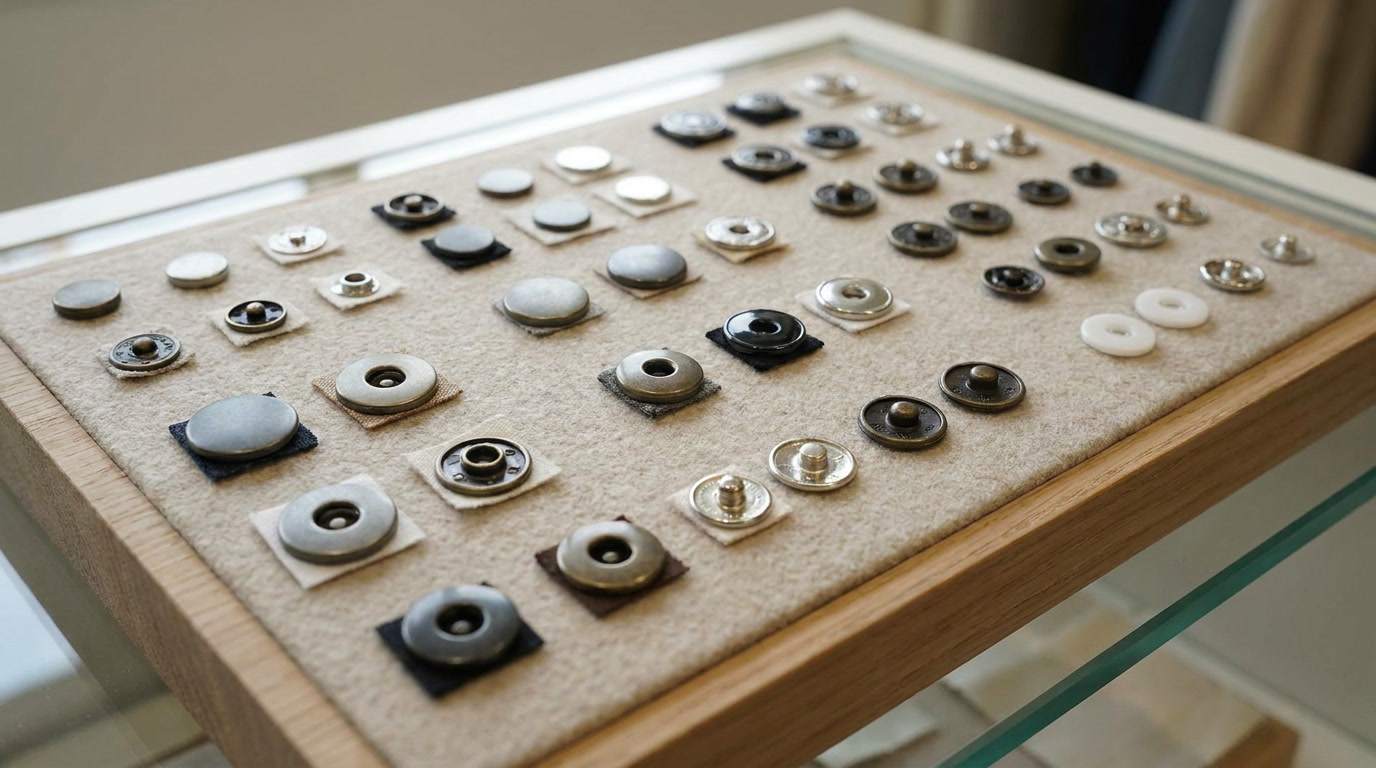
Baocheng can develop finished snap buttons and customized components for fashion, ready-to-wear, children's clothing, denim, outerwear and other garment programs.
Customization can include cap diameter, cap profile, logo, socket and stud structure, spring configuration, post length, material, surface treatment, color, matched tooling and sample development.
Available material options can include brass, zinc alloy, 304 stainless steel, 316 stainless steel and JSW20 ultra-low magnetic permeability stainless steel according to project requirements.
Representative garment materials can be used during development so post length and installation geometry are tested against the real fabric stack before mass production.
Apparel Buyer Checklist
- What garment will use the snap?
- Where on the garment will it be installed?
- How many material layers are present?
- What is the compressed thickness?
- What visible cap diameter is required?
- How much opening force is appropriate?
- Does the textile require reinforcement?
- What base material is suitable?
- What finish and color are required?
- Is needle detection relevant?
- Are children's-product requirements involved?
- Which setting tooling will be used?
- Has the snap been installed on real production material?
- Are repeat-order specifications and golden samples controlled?
Conclusion
Snap buttons remain important in modern apparel because they combine functional speed, compact construction and extensive visual customization. They can serve as main closures, pocket fasteners, cuff adjustments, hidden connections or deliberate fashion details.
The correct snap depends on the garment. Shirts, jackets, dresses, denim, babywear and children's garments impose very different requirements for size, post length, opening force, material and installation.
The most reliable development process begins with the actual garment construction, not with a generic catalog size. Buyers should evaluate the complete fabric stack, choose a matched cap/socket/stud/post system, test installation on representative material and confirm both appearance and functional performance before mass production.
When these variables are controlled correctly, snap buttons can provide both the mechanical reliability required by garment manufacturing and the design flexibility demanded by modern fashion.
Focused FAQ
Where are snap buttons most commonly used in clothing?
Common positions include front plackets, cuffs, pocket flaps, collars, waist tabs, baby-garment changing openings and detachable garment sections.
Are snap buttons suitable for lightweight fabrics?
Yes, but the snap size, post length and holding force must match the material. Lightweight textiles may also require reinforcement around the installation point.
Why do baby clothes use so many snap buttons?
Snaps provide fast access for dressing and changing while avoiding traditional buttonholes. Attachment security, surface quality and appropriate opening force are especially important.
Can the same snap be used on shirts and jackets?
Sometimes, but it should not be assumed. Jackets often have thicker multilayer construction and can require different posts, reinforcement or retention force.
Which materials are available for apparel snaps?
Common choices include brass, plated steel, zinc alloy and stainless steels such as 304 and 316. JSW20 can also be used where extremely low magnetic response after forming is important.
Can Baocheng customize snap buttons for fashion brands?
Yes. Customization can include cap shape, diameter, logo, color, finish, material, post length, socket/stud structure, tooling and samples according to the garment application.
#SnapButtons, #ApparelHardware, #ClothingFasteners, #FashionHardware, #GarmentAccessories, #BabyClothing, #ChildrensApparel, #CustomSnapButtons, #JSW20, #BCNewMaterial