






Snap Buttons for Leather Goods: How Material Thickness, Post Length and Holding Force Work Together
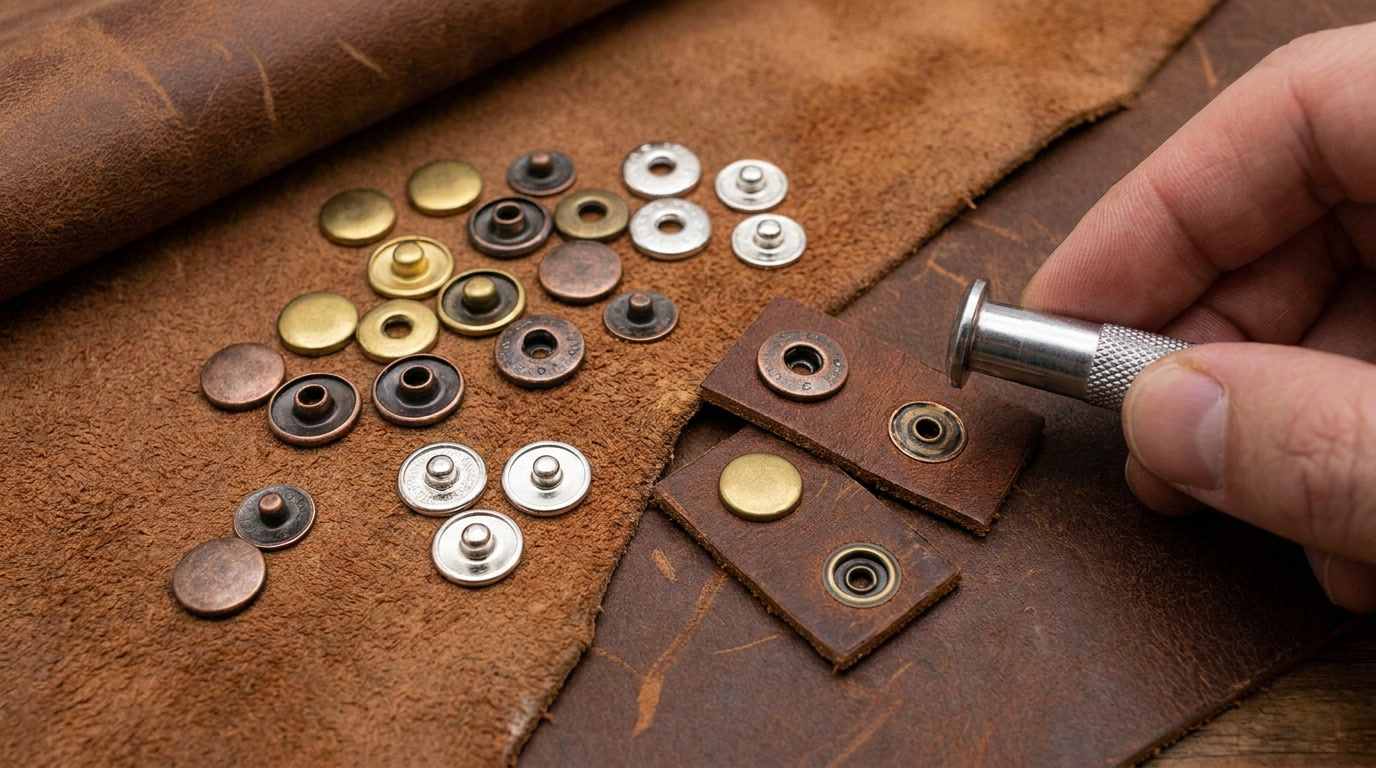
A snap button on a leather product is not an isolated piece of hardware. It is one part of a fastening system that also includes the leather, lining, reinforcement, hole geometry, setting dies and installation process. A cap that looks correct on a sample can still loosen, spin or pull through after repeated use if the post length does not match the compressed material stack. A socket that feels reassuringly firm can also overload a thin flap if its opening force exceeds the strength of the surrounding leather.
For this reason, choosing snap buttons for leather goods requires three connected decisions: determine the real installed thickness, select a post that forms correctly within that thickness, and specify a holding force that the product can withstand throughout its service life. This guide explains how those variables interact and how buyers can translate a design concept into a repeatable production specification.
Why Leather Changes the Way a Snap Button Must Be Specified
Leather is dense, fibrous and anisotropic. Its strength and stretch vary with hide section, grain direction, tanning method, moisture content and finishing process. Two pieces sold at the same nominal thickness may compress differently beneath a setting die. Bonded leather, split leather, microfiber leather and coated synthetic leather introduce still more variation. The snap therefore has to be selected for the complete construction, not for a material name printed on a purchase order.
A finished leather product often contains more layers than the designer first counts. A wallet flap may include outer leather, skived edges, lining, adhesive and a hidden reinforcement patch. A bag tab may pass through a folded seam. A holster or sheath may use two dense leather panels plus a spacer. Every layer changes the distance that the post must travel and the amount of material supporting the installed flange.
Searches for brass snaps for leather often focus on color or traditional appearance, but base material alone does not determine whether the fastening will be reliable. The same brass snap can perform very differently on a 0.8 mm lined flap and a 3.5 mm laminated strap. The installed joint must be treated as an engineered stack.
Understand the Snap as a Four-Part Mechanical System
A conventional post-style snap button normally contains four components. The cap and socket form the female side; the stud and post form the male side. During setting, each post passes through a prepared hole and is rolled, flared or compressed into its mating component. During use, the socket flexes over the stud and then recovers, creating the retention needed to keep the product closed.
Each side has two different functions. The cap or post must remain anchored to the leather, while the socket and stud must connect and release at the intended force. These functions are related but not identical. Increasing socket retention does not automatically improve attachment strength. If the joint is made too difficult to open, the user applies more peel force to the leather around the snap, increasing the chance of hole elongation or pull-out.
There are also constructions that do not use a penetrating post. In these products, sew on snaps for bags are attached with thread and can be useful where the maker wants a concealed closure, a softer hand or easy replacement. They avoid the post-length decision, but transfer load through stitches instead. Thread type, stitch count, backing material and access for sewing then become the critical variables. A buyer should not treat sewn and post-style snaps as interchangeable simply because their closed appearance is similar.
Measure the Installed Material Stack, Not Just the Leather Sheet
The correct starting point is the thickness at the exact snap location after all layers have been assembled. Measure representative production materials rather than an idealized design drawing. If the leather is skived, folded, laminated or embossed, take measurements at the finished zone. When adhesive is used, measure after the adhesive has cured and the stack has been pressed under the intended process conditions.
One reading is rarely enough. Natural leather varies across a hide, and synthetic constructions vary by coating and backing. Buyers should record a realistic minimum, typical value and maximum. The post and setting window must tolerate that range without creating loose assemblies at the thin end or crushed, distorted parts at the thick end.
| Leather construction at the snap | Thickness behavior | Main fastening risk | Specification response |
|---|---|---|---|
| Single thin leather layer | Low stack height with limited bearing area | Pull-through, tearing or visible dimpling | Use an appropriate short post, controlled setting pressure and local reinforcement where needed |
| Leather plus textile lining | Soft lining compresses more than the leather | Joint feels tight initially but relaxes after use | Measure the compressed stack and test after conditioning and cycling |
| Folded or laminated leather | Higher thickness and greater variation at edges | Post too short, incomplete roll or tilted setting | Specify the actual finished range and evaluate more than one post length |
| Skived flap with reinforcement patch | Thickness changes rapidly around the attachment | Off-center loading and surface marking | Control patch size, snap position, hole alignment and die support |
| Dense strap, sheath or holster stack | High resistance to post penetration and forming | Cracked post, incomplete flare or component deformation | Use matched tooling, suitable post geometry and validated setting force |
This approach is relevant whether a sourcing team calls the product snaps for bags, press studs or snap fasteners. Regional terminology changes, but the engineering question remains the same: what material stack must the post capture after installation?
How Post Length Controls the Quality of the Set
The post must project far enough beyond the material to engage the socket or stud and form a stable head. If it is too short, there is not enough metal to create the required roll or flare. The assembly may appear acceptable immediately after setting but separate during opening-force or pull-out testing. In severe cases, the mating component never seats squarely.
If the post is too long, excess metal has nowhere controlled to go. It may buckle sideways, split, wrinkle or push the socket and stud out of alignment. The leather can be over-compressed, leaving a deep ring, glossy pressure mark or permanent indentation. An overly long post can also create a joint that spins because the formed metal does not clamp the material uniformly.
The correct post length provides enough forming allowance for the specific component design while maintaining controlled compression of the leather stack. There is no universal formula that applies to every supplier because post diameter, wall thickness, tip shape, mating component geometry and die profile differ. Buyers should request dimensional drawings, identify candidate post lengths and confirm them with actual material trials.
A nominal leather thickness should never be used as the sole basis for a mass-production order. The approval sample should use production-intent leather, lining, adhesive, reinforcement and setting equipment.
Holding Force Is Not the Same as Pull-Out Strength
Holding force usually describes the resistance felt when the socket is separated from the stud. Pull-out strength describes the resistance of a component to being torn or pulled away from the material. A snap system can have high opening force but weak attachment to the leather, or moderate opening force with excellent attachment strength. Both measurements are needed.
Socket geometry, spring design, stud profile, material hardness, plating thickness and dimensional tolerances influence opening and closing force. Leather thickness and post length mainly affect the attachment, although poor alignment can also make the snap feel artificially stiff. Testing should distinguish between a genuinely high-retention mechanism and friction caused by tilted components.
For a small pouch or light flap, excessive retention can be a disadvantage. The user may pull from the edge of the leather instead of gripping close to the snap. For a large bag subject to movement, vibration or product weight, too little retention can cause accidental opening. A suitable snap closure for bags therefore depends on how the user handles the closure, the direction of service load and the strength of the surrounding panel.
Match Release Force to the Direction of Use
Laboratory separation is often measured along a controlled axis, while real users open products at an angle. Direct tension, peel and shear load the leather differently. A pull tab that encourages the user to lift close to the snap reduces leverage on the surrounding material. A wide flap opened from its corner creates a longer lever arm and can multiply local stress even when the snap itself is within specification.
Placement is therefore part of fastening performance. Keep the hole away from cut edges, stitch perforations, embossed channels and sharply skived transitions. Provide enough flat area for the cap and mating part to seat squarely. When a style uses multiple snaps, control spacing so one fastener is not forced to carry the entire opening load before the others release.
Designers researching snaps for bag making should include a defined hand-opening motion in prototype evaluation. The same sample should be opened by different users, then inspected for elongation around the hole, rotation, surface rings and gradual loss of retention.
Reinforcement Protects the Leather Around the Hole
A larger metal component does not automatically solve a weak substrate. Thin or soft leather may need a hidden reinforcement patch that distributes load beyond the edge of the snap. Suitable reinforcement can include a compatible leather skive, nonwoven backing or engineered textile layer. The material should bond consistently, resist tearing and avoid producing an obvious ridge on the finished surface.
The hole is equally important. An oversized hole removes bearing material and allows the post to move before the snap opens. A ragged or off-center hole creates stress concentrations. A hole that is too small can distort the post during insertion or bunch the coating. Punch diameter, cutting quality and alignment should be controlled together with the snap drawing.
Some fabric snaps for bags are installed through woven lining, coated textile or reinforcement tape rather than leather alone. These materials fail differently: yarns can spread, coatings can crack and soft laminates can creep. When leather and textile are combined, testing must represent the complete hybrid stack.
Select Base Material and Finish for the Product Environment
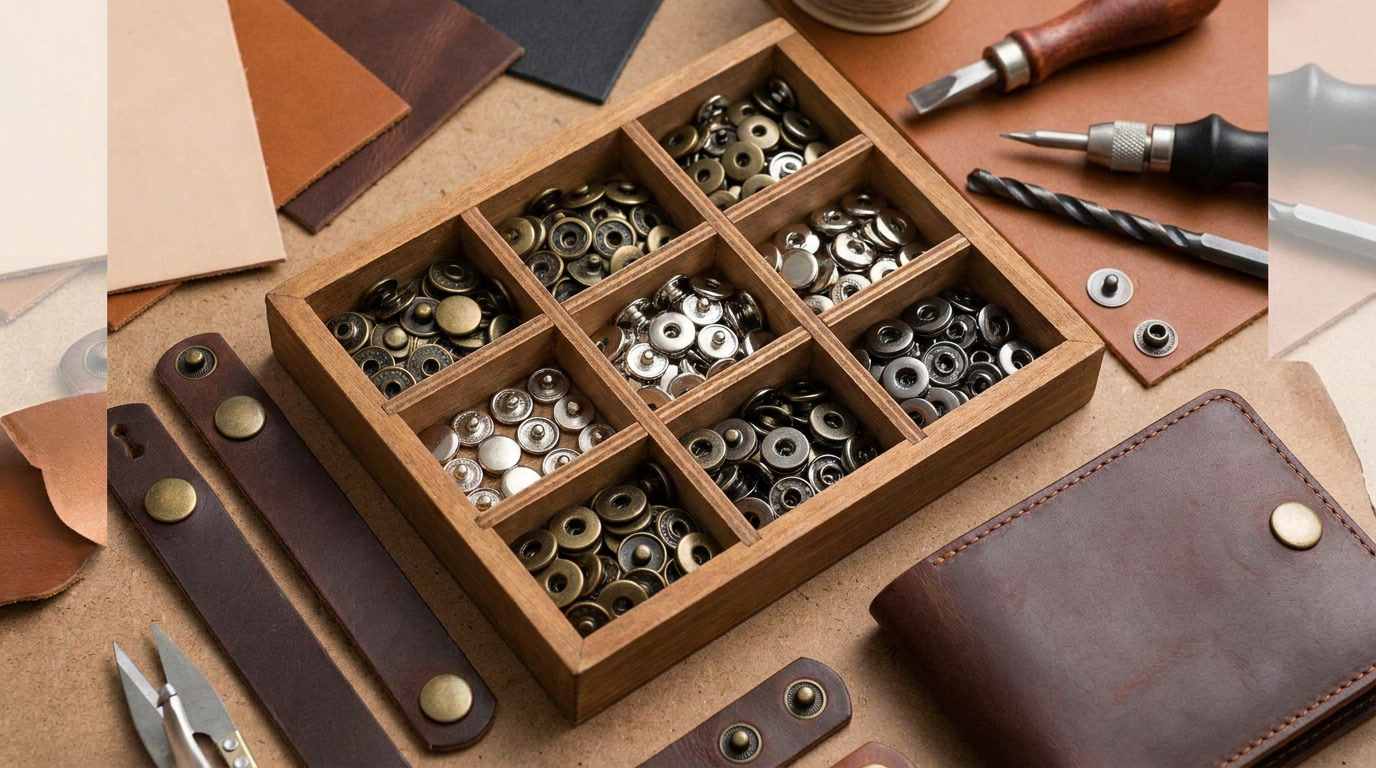
Snap material affects formability, corrosion behavior, appearance, magnetic response, cost and compatibility with surface finishing. Among common options, brass snap button fasteners are widely associated with leather goods because brass forms well and supports many decorative finishes. Stainless steels are useful where durability, corrosion resistance or a low-maintenance surface is important. Zinc alloy is often used for decorative caps with complex shapes, while the functional socket, stud and post may use a different material selected for forming and spring behavior.
The visible color should not be specified by a name alone. “Antique brass,” “gunmetal” and “black” vary among finishers. Define an approved physical sample, color tolerance, gloss level, brushing direction and acceptable variation after abrasion. Consider contact between dissimilar metals, exposure to perspiration, cleaning products, moisture and chlorides. The finish must also remain compatible with the forming process; a coating that looks perfect before setting can crack at the rolled post or mark under the die.
JSW20 is an austenitic stainless steel option for finished custom snap-button components when ultra-low magnetic response after forming is required together with toughness, formability and resistance to chloride-related corrosion. Reference properties used for project evaluation include relative magnetic permeability around μr 1.001, yield strength Rp0.2 of at least 350 MPa, tensile strength Rm of at least 650 MPa and elongation A50 of at least 40%. Final suitability still has to be verified against the component geometry, degree of forming, finish and service environment. Baocheng supplies finished JSW20 snap buttons and custom components rather than raw sheet or coil.
Installation Tooling Must Match the Component Geometry
A correct post can still fail when the upper and lower dies do not match the cap, socket, stud and post. The die should support the visible face without scratching or flattening it, keep the components concentric and form the post progressively. Excess pressure can crush the leather or distort the spring. Insufficient pressure can leave the post partially formed. Misalignment produces a tilted joint and uneven clamping.
For repeat production, the setting process should define die codes, machine type, pressure or stroke settings, fixture orientation and inspection frequency. If hand-setting and automatic-setting lines are both used, qualify them separately. A sample produced slowly by a skilled technician is not proof that a high-speed production line will achieve the same result.
When buyers compare snaps for leather bags from different suppliers, component dimensions and die interfaces should be reviewed as a set. Parts that look similar are not necessarily compatible with an existing tool, and mixing unmatched components can invalidate holding-force and pull-out results.
Build a Practical Validation Plan Before Mass Production
A robust validation plan connects visual approval with measurable function. Begin with dimensional inspection of the individual parts and the assembled stack. Confirm cap diameter, post length, post diameter, socket and stud geometry, and the position of the snap on the leather panel. Then evaluate the installed product.
- Opening and closing force: record initial values and the distribution across multiple samples.
- Cycle testing: repeat opening and closing, then check force drift, spring damage, rotation and coating wear.
- Attachment or pull-out testing: load the installed parts in directions that reflect expected use.
- Visual inspection: check for dents, die marks, finish cracks, tilted parts, gaps and leather compression rings.
- Environmental conditioning: evaluate humidity, perspiration, temperature, chlorides or cleaning exposure relevant to the product.
- Material and chemical compliance: define restricted substances, nickel-release requirements and market-specific documentation before production.
Use a statistically meaningful sample across several hides, material lots and machine positions. Acceptance limits should be agreed before testing rather than chosen after the results are seen. The goal is not merely to pass a prototype; it is to define a manufacturing window that remains stable as materials and operators vary.
What to Include in a Buyer’s Snap Button Specification
A useful request for quotation should include more than cap diameter and finish color. It should identify the finished product, snap location, layer construction, compressed thickness range, hole size, required post style, target opening-force range, pull-out requirement, cycle expectation and service environment. Drawings or section photographs help suppliers understand folded edges and hidden reinforcements.
Specify whether the visual face must be plain, engraved, embossed or branded, and whether all visible parts need the same finish. State packaging and traceability requirements, approved sample procedures and inspection standards. For regional sourcing inquiries such as press studs for leather uk, also define the applicable chemical, labeling and customer-specific compliance requirements instead of assuming that a product name establishes compliance.
Baocheng can develop finished snap-button sets for leather goods in project-specific diameters, cap profiles, post lengths, socket structures, colors and finishes. Available project materials include brass, zinc alloy, 304 stainless steel, 316 stainless steel and JSW20 ultra-low magnetic permeability stainless steel, subject to structural and process evaluation. Support can cover drawing review, material-stack analysis, tooling matching, sampling, functional testing and production inspection.
Focused FAQ
How do I choose a snap post length for leather?
Measure the complete finished stack at the snap location, including lining, adhesive, folded areas and reinforcement. Record the minimum and maximum, then trial candidate posts with the supplier’s matched dies. Approve the post only after checking the formed joint, leather compression, opening force and pull-out performance.
Does a thicker leather product always need a larger snap?
No. Thickness primarily affects post length and attachment geometry. Cap diameter and socket retention should be selected for appearance, available bearing area, user handling and required closing force. A larger cap does not correct an incompatible post or a weak hole area.
Why does a snap spin after installation?
Common causes include an overly long post, insufficient compression, an oversized hole, incomplete forming, soft material creep or mismatched dies. Inspect the disassembled joint and measure the actual stack before increasing machine pressure.
Should a leather snap have the highest possible holding force?
No. The holding force should prevent unintended opening while remaining low enough for comfortable use and for the leather construction to survive repeated opening. The target must be validated together with pull-out strength and the user’s opening motion.
When is a sewn snap preferable to a post-style snap?
A sewn snap can suit concealed, repairable or very soft constructions where a penetrating post is undesirable. Its performance depends on thread, stitch layout and backing strength, so it requires a separate attachment specification and test plan.
Conclusion
Reliable leather closures come from balancing the material stack, the forming allowance of the post and the separation force of the socket-and-stud mechanism. Treating those variables independently creates avoidable defects: short posts release, long posts buckle, strong sockets overload weak flaps and poorly prepared holes allow otherwise suitable hardware to pull out.
By measuring the finished construction, matching components with tooling and validating both operating force and attachment strength, buyers can turn a visual detail into a controlled fastening system. That method applies to premium leather goods, production snaps for bags and every application where repeated handling must not compromise appearance or function.
#LeatherSnapButtons, #LeatherGoodsHardware, #SnapFasteners, #SnapButtonDesign, #PostLength, #HoldingForce, #CustomSnapButtons, #BCNewMaterial