






Snap Buttons for Baby and Children's Clothing: Safety, Attachment Strength and Material Requirements

Baby and Children's Snap Buttons Require a Different Design Mindset
Snap buttons are widely used in baby and children's clothing because they provide fast access, compact construction and convenient opening for dressing, diaper changes and everyday care. Yet the same characteristics that make snaps convenient also create stricter engineering responsibilities.
Infant and children's garments use relatively small components on fabrics that can be lightweight, stretchy and repeatedly washed. If the fastener is poorly specified or installed, the failure may involve more than inconvenience: the snap can detach, create a sharp edge, damage the surrounding textile or lose reliable closure.
For buyers, the correct approach is therefore to evaluate the complete fastening system—cap, socket, stud, post or prongs, fabric reinforcement, material, finish and installation process—rather than approving a snap only because it looks appropriate on the sample garment.
This guide explains how to evaluate snap buttons for baby and children's clothing with particular attention to attachment strength, component integrity, material choice, chemical requirements, wash durability and traceability.
Start With the Age Group and Garment Function
The first question is not simply “What size snap do we want?” It is “Who will wear the garment and how will the closure be used?”
snap fasteners for infant clothing can appear on bodysuits, rompers, pajamas, bibs, shirts and changing openings. These positions may be opened many times each day, and the surrounding textile can be soft or highly elastic.
A snap for a newborn bodysuit therefore has different priorities from a snap used on a school-age child's denim jacket. The infant application may prioritize compact size, smooth edges, low fabric damage and easy opening, while the older child's outerwear can tolerate a larger cap and higher retention.
Attachment Security Is the First Mechanical Safety Requirement
The snap should remain attached throughout normal wear, dressing, laundering and repeated opening. A mechanically strong socket-to-stud connection is not enough if the snap pulls out of the garment.
Attachment security depends on:
- fabric strength;
- number of layers;
- reinforcement;
- post or prong geometry;
- installation hole size;
- setting pressure;
- alignment;
- opening force.
For children's apparel, these variables should be validated on the actual production construction rather than on a single loose piece of fabric.
Newborn Garments Usually Use Very Lightweight Material Stacks
A snap button newborn clothes application often involves fine cotton knit, jersey or other soft textile that compresses easily. The fastener must create a stable joint without excessively crushing or cutting the fibers.
The post should be selected from the compressed garment thickness. A post that is too long can bend or leave an unstable joint; one that is too short may not form enough material to secure the mating component.
When the garment is especially light, a reinforcement layer behind the snap location can increase pull-out resistance without requiring excessive opening force.
Baby Snaps Should Be Easy to Operate but Not Easy to Detach
baby snap buttons need an operating-force balance that differs from many adult outerwear applications. Caregivers should be able to open the garment smoothly, but the snap should not release accidentally during movement or laundering.
Increasing socket force is not a substitute for stronger attachment. If the release force becomes too high, the user applies more load to the textile every time the snap is opened. This can accelerate fabric distortion or pull-out around the attachment point.
For high-volume programs, buyers should approve both the operating feel and the installed attachment strength.
Repeated Opening Makes Cycle Consistency Important
baby snap fasteners on bodysuits and changing openings may be used far more frequently than decorative snaps on fashion garments. A mechanism that feels correct when new should remain consistent after repeated operation.
Cycle evaluation can help identify:
- loss of spring force;
- stud wear;
- surface abrasion;
- loosening around the textile;
- changes in opening feel.
Baby Clothing Snaps Must Be Inspected for Burrs and Sharp Damage
baby clothing snaps should have smooth formed edges and clean surfaces. Burrs can be created during blanking, piercing or tool wear, while poor setting can create sharp deformed metal around the post.
Inspection should therefore include both loose components and installed samples. A cap may be visually perfect before setting, yet an incorrectly matched installation die can damage the backside component during assembly.
Tool maintenance is part of safety control because increasing burr height can be an early sign that cutting edges are wearing.
Prong and Post Systems Need Different Attachment Validation
Baby apparel can use several snap attachment structures. Some systems use a conventional tubular post; others use prongs that pierce and fold through the textile.
For post-style systems, buyers should focus on post length, hole size and formed geometry. For prong systems, they should examine prong penetration, fold-over, fabric damage and whether every tooth is fully engaged.
Neither structure is automatically safer. The correct choice depends on the textile, reinforcement, component dimensions and validated installation process.
Plastic and Metal Snaps Have Different Risk Profiles
plastic snaps for baby clothes are common in the market and can offer low weight and broad color selection. Their performance depends on polymer type, molded geometry, installation system, heat exposure and repeated washing.
metal snaps for baby clothes provide a different route, with stamped components, metallic appearance and a broad choice of brass or stainless materials. Metal systems introduce their own requirements for burr control, surface chemistry, corrosion and setting quality.
Buyers should not treat one material category as universally better. The correct decision should be based on the garment, care conditions, required appearance, mechanical load and applicable market requirements.
Material Selection Should Be Made Before Surface Approval
For metal children's snaps, common material routes include brass, plated steel and stainless steel. Each material affects forming, corrosion, magnetic response, surface finishing and cost.
304 stainless steel is suitable for many general apparel applications. 316 stainless steel can be considered where chloride exposure is more demanding. Brass provides strong formability and decorative finishing flexibility.
For projects that need stainless construction with extremely low magnetic response after forming, JSW20 ultra-low magnetic permeability stainless steel provides another option.
JSW20 for Low-Magnetic Children's Apparel Hardware
JSW20 is a patented austenitic stainless steel designed to retain ultra-low magnetic permeability after substantial forming while also providing good formability and chloride-corrosion resistance.
Available reference values include relative magnetic permeability around μr 1.001, yield strength Rp0.2 ≥350 MPa, tensile strength Rm ≥650 MPa and A50 elongation ≥40%.
This can be useful for apparel factories that rely on magnetic needle-detection equipment. A low-magnetic snap can reduce the hardware's contribution to detector response compared with more magnetically responsive formed components.
Final garment performance should still be validated under the customer's actual detector settings because total metal mass, component number, position, other hardware and equipment sensitivity all influence the result.
Chemical Compliance Must Match the Destination Market
Children's apparel compliance should be built around the market where the finished garment will be sold. Buyers should identify applicable legal requirements, brand restricted-substance lists and voluntary certification requirements before mass production.
For the EU market, metal garment hardware may require evaluation under REACH restrictions, including nickel-release requirements when the relevant metal parts are intended to come into direct and prolonged contact with the skin.
For the U.S. market, accessible component parts of children's products are subject to federal total-lead-content requirements. Buyers should make sure the finished snap material and surface system are covered by the required compliance program for the final product.
These requirements should not be reduced to a vague instruction such as “environmentally friendly metal.” The RFQ should state the market, the applicable requirement and the expected documentation.
OEKO-TEX Product Class 1 Is Relevant to Baby Products
OEKO-TEX STANDARD 100 classifies products according to intended use and skin contact. Product Class 1 covers products for babies and children up to three years and uses the strictest requirements and limit values within the STANDARD 100 product classes.
For a baby garment program, buyers should verify whether the specific snap material and finish fall within the relevant certified product scope rather than assuming that every item made by a certificate holder is automatically covered.
Accessories matter: the harmful-substance assessment applies not only to the main textile but also to components such as buttons and related accessories within the certified article.
Nickel Content and Nickel Release Are Not the Same Thing
For metal fasteners, buyers sometimes try to control nickel risk only by asking whether the alloy contains nickel. That is not the same question as nickel release.
Nickel-release requirements evaluate how much nickel is released from the relevant finished surface under specified conditions. Alloy composition, surface condition, plating, wear and corrosion can all influence the result.
This means a surface-finish change may require a new compliance review even when the cap shape and base material remain unchanged.
Press Stud Terminology Varies by Market, but the Engineering Does Not
press studs for baby clothes is common terminology in several English-speaking markets, particularly where “press stud” is used more often than “snap button.” The commercial term does not change the need to specify the exact cap, socket, stud and post or prong system.
Likewise, snap fasteners for baby clothes uk may appear in search and purchasing language, but UK buyers should still define material, finish, size, attachment structure and compliance requirements rather than relying on terminology alone.
Size Should Match Both the Garment and the User
Small garments generally call for compact hardware, but reducing diameter too far can reduce bearing area around the textile. The correct size balances appearance, user handling and attachment strength.
For newborn and infant clothing, a low-profile cap can reduce bulk. For toddler shirts, jackets and overalls, slightly larger hardware may be easier to manipulate while still fitting the garment visually.
Post Length Must Be Validated on the Actual Garment Stack
Infant clothing can look thin while still containing several folded layers at the crotch, placket or cuff. A snap installed at a reinforced changing opening may pass through outer fabric, facing and backing material.
Post length should therefore be selected using the real assembly.
Common signs of incorrect post length include:
- loose rotation;
- tilted components;
- sideways post buckling;
- incomplete forming;
- excessive compression marks;
- pull-out during opening.
Reinforcement Should Be Designed With the Snap
Thin knit and lightweight woven fabrics may not provide enough local support for repeated snap opening. A reinforcement patch or interfacing can increase the effective bearing area and reduce distortion.
Reinforcement should be included during sampling because it changes the total thickness and therefore the correct post length.
Installation Dies Are Part of the Safety System
The setting dies should match the exact component series. An incorrect lower die can dent the cap or fail to support the socket, while an incorrect upper tool can crush or misalign the component.
Installation pressure should be controlled rather than adjusted entirely by operator feel. Too little pressure produces incomplete forming; too much can crack, distort or cut the textile.
Pull-Off Testing Should Use the Actual Production Construction
Attachment testing should evaluate the complete installed garment structure, not just the metal components.
The buyer should record both the maximum force and the failure mode. Possible failure modes include:
- fabric tearing;
- post separation;
- prong pull-through;
- component fracture;
- reinforcement failure.
Understanding the failure mode helps determine whether the problem belongs to the snap, installation process or garment structure.
Washing Can Expose Both Mechanical and Surface Problems
Baby clothing is washed frequently, so sample approval should consider the intended care process.
Repeated washing can reveal surface discoloration, coating wear, corrosion, fabric shrinkage, loosening caused by textile relaxation and changes in opening force.
Surface Finish Must Be Durable as Well as Attractive
Children's apparel brands may want silver, black, gold or painted visual effects. The finish should be approved on the final base material and evaluated for the expected washing and abrasion conditions.
A decorative topcoat that looks correct on the first sample but wears quickly can expose a different underlayer and change both appearance and surface chemistry.
Compliance Documents Need Product-Level Traceability
A laboratory report is only useful if the manufacturer can connect the tested sample to the production product.
Useful traceability links include material grade, surface finish, style number, production batch, relevant report or certificate and approved customer specification.
If the base material or finish supplier changes, the manufacturer should evaluate whether the previous compliance evidence remains applicable.
Quality Control Should Prevent Detached Components, Not Just Sort Them
A robust production plan should include incoming material verification, tooling control, first-piece inspection, in-process dimensional checks, burr inspection, surface inspection, post or prong formation checks, functional opening tests, installed pull-off testing where specified and batch traceability.
The goal is to control the process that creates attachment quality rather than rely on sorting after production is finished.
Use Golden Samples for Repeat Children's Garment Orders
Babywear and children's basics are often repeated season after season. A formally identified golden sample helps prevent the snap from gradually changing across repeat orders.
The reference should ideally include the complete snap set and an installed sample on the approved garment construction, supported by a controlled drawing and material specification.
How Baocheng Supports Baby and Children's Snap Development
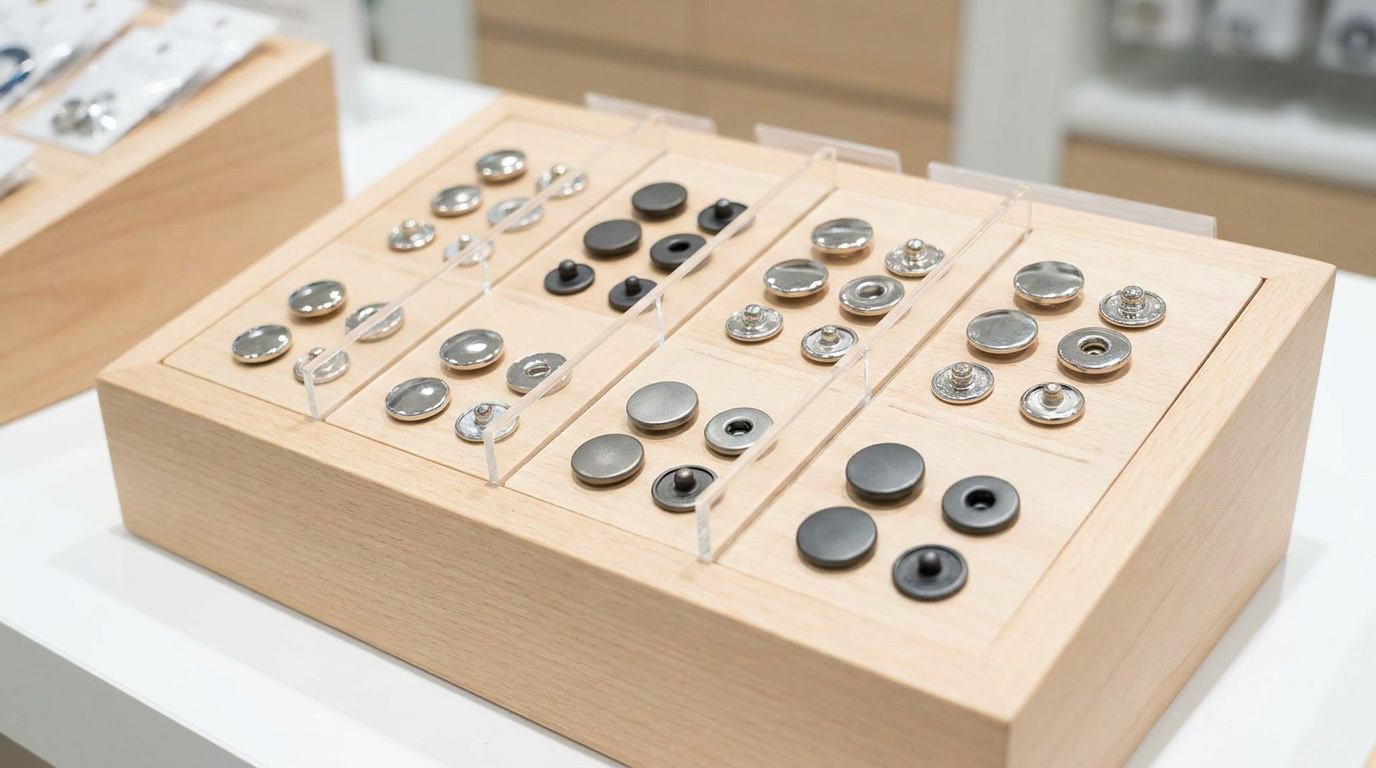
Baocheng can support finished metal snap buttons and customized components for infant and children's apparel using representative garment materials during development.
Customization can include cap size and profile, socket and stud structure, post length, spring configuration, logo, surface finish, color, matched setting tooling and sample development.
Material options can include brass, 304 stainless steel, 316 stainless steel and JSW20 ultra-low magnetic permeability stainless steel according to project requirements.
For relevant JSW20 projects, Baocheng has supporting REACH/SVHC, RoHS, OEKO-TEX and nickel-release documentation within the specific scope stated by the corresponding reports and certificates. Each document should still be matched to the actual tested style, batch, material and finish.
Buyer Checklist for Baby and Children's Snap Buttons
- What age group is the garment designed for?
- Where will the snap be installed?
- How frequently will it be opened?
- What is the complete fabric stack?
- Does the textile need reinforcement?
- Which post or prong structure is appropriate?
- Is the opening force comfortable for the intended user?
- Has attachment strength been tested on the real garment?
- Are burrs and sharp deformations controlled?
- What material and finish are used?
- What market-specific chemical requirements apply?
- Does the compliance document cover the actual material and finish?
- Has the snap been evaluated after repeated washing?
- Are the setting dies matched and controlled?
- Is lot traceability maintained for repeat orders?
Conclusion
Snap buttons are highly practical for baby and children's clothing, but their small size and frequent use make attachment engineering, surface quality and material control especially important.
A suitable children's snap should remain securely attached, open with an appropriate force, avoid damaging the textile, maintain a smooth surface and meet the chemical requirements of the destination market.
For buyers, the safest sourcing strategy is to validate the snap on the actual production garment, document the approved configuration and control material, tooling and finish changes across repeat orders.
Focused FAQ
What is the most important safety concern for snaps on baby clothing?
Secure attachment is fundamental. The snap should remain attached during normal wear, repeated opening and laundering, while the installed components should remain smooth and free from damaging deformation.
Are plastic snaps always safer than metal snaps for baby garments?
No. Plastic and metal systems have different materials and failure modes. Either type should be evaluated for attachment, durability, washing, surface condition and applicable chemical requirements.
Why is post length so important on infant clothing?
Infant fabrics are often thin and compressible. An overlong post can buckle or loosen, while a short post may not form enough material for secure attachment.
What does OEKO-TEX Product Class 1 cover?
STANDARD 100 Product Class 1 covers products for babies and children up to three years and uses the strictest requirements and limit values within the four product classes.
Should nickel release be considered for children's metal snaps?
It should be evaluated when the final metal parts fall within applicable skin-contact requirements for the destination market. The assessment should consider the finished surface, not just the alloy name.
Can Baocheng develop low-magnetic stainless snaps for children's apparel?
Yes. JSW20 can be used for finished custom snap components where ultra-low magnetic response after forming is important, with final garment needle-detection performance validated under the customer's actual production conditions.
#BabySnapButtons, #ChildrensClothing, #InfantApparel, #SnapButtonSafety, #ApparelHardware, #BabywearHardware, #OEKOTEX, #NickelRelease, #JSW20, #BCNewMaterial