






Snap Button Samples, Tooling, MOQ and Lead Time: What Buyers Should Confirm Before Ordering
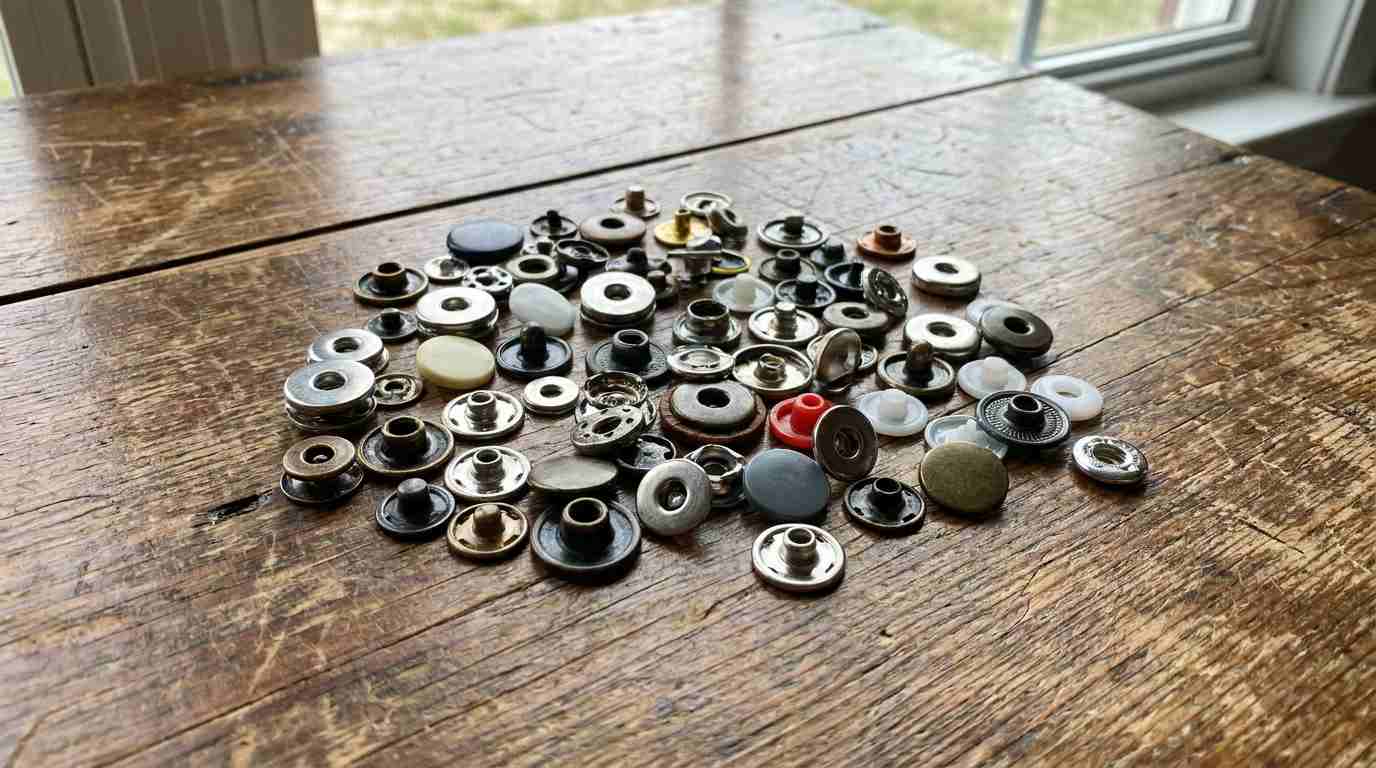
Samples, Tooling, MOQ and Lead Time Should Be Confirmed Before the Purchase Order
A snap button quotation can look straightforward until the buyer asks four practical questions: Can I see a sample? Do I need new tooling? What is the minimum order quantity? How long will the order take?
These questions are closely connected. A standard snap using existing dies and a common finish can often move from sampling to production quickly. A custom cap with a new logo, non-standard post length, special stainless steel grade and exclusive surface color may require several development steps before mass production can begin.
For buyers, especially those placing a first order, the biggest mistake is treating sample time, tooling time, MOQ and production lead time as unrelated commercial details. In reality, all four are determined by the depth of customization and the manufacturing route.
A practical sourcing process should therefore confirm what kind of sample will be supplied, which tooling already exists, which tools must be developed, how MOQ is calculated, what starts the production lead-time clock and which approvals must be completed before bulk production is released.
First Distinguish a Stock Sample From a Custom Development Sample
Not every sample proves the same thing. A supplier may send a standard snap from inventory within a short time, but that sample only demonstrates the quality of an existing product. It does not necessarily confirm the final logo, finish, material, post length or spring structure requested for your project.
Samples can generally be divided into several levels:
- Reference sample: an existing snap used to demonstrate size, structure or general workmanship.
- Material sample: an existing component produced in the requested brass, stainless steel or other substrate.
- Color sample: a finished cap used primarily for surface-color approval.
- Logo sample: a cap produced with the proposed embossed, debossed or engraved branding.
- Functional sample: a complete cap, socket, stud and post set produced to evaluate closing and release performance.
- Installed sample: the complete snap installed on the buyer's actual or equivalent fabric.
- Pre-production sample: a sample manufactured with the intended production materials, tooling, finish and process sequence.
Before placing an order, buyers should identify which level of sample is required for approval. Approving a stock reference sample and assuming the custom production will behave identically creates unnecessary risk.
A Loose Snap Sample Does Not Confirm Installation Performance
Loose components can confirm appearance, dimensions, material and socket-to-stud engagement, but they cannot fully prove attachment to the final substrate.
Post length and installation deformation depend on fabric thickness, leather density, coating, reinforcement and number of layers. A snap that functions perfectly when tested by hand may still rotate, deform or pull out when installed on an unsuitable material stack.
For this reason, an installed sample should normally be part of final approval whenever post length or attachment strength matters.
Buyers should send representative production material rather than a convenient substitute. If a bag closure passes through leather, lining, reinforcement and adhesive, the test sample should reproduce that complete construction.
Different Applications Need Different Types of Samples
The correct sample strategy depends on where the snap will be used.
For snap fasteners for leather handbags, an approval sample should evaluate the visible cap finish and logo as well as post length, leather compression and pull-out resistance. The sample should ideally be installed through the actual combination of leather, lining and reinforcement used in production.
For snap fasteners for safety clothing, appearance may be less important than secure attachment, repeated operation, washing durability and any material or compliance requirements specified by the customer.
The same principle applies to outdoor, medical, marine and technical products. A useful sample should reproduce the characteristics most likely to fail in the final application.
Ask Whether the Sample Is Made With Production Tooling
One of the most important questions during sampling is whether the sample was made with final production tooling.
Early development samples may sometimes be produced with:
- existing similar dies;
- prototype inserts;
- temporary logo tools;
- slower manual operations;
- small-batch finishing processes.
These approaches are useful for proving the concept, but the result may not perfectly represent mass production.
If the final appearance or dimensions depend heavily on tooling, request a pre-production sample after the final production tools are complete. That sample becomes a more reliable benchmark for future incoming inspection and repeat orders.
What Does “Tooling” Mean in a Snap Button Project?
Tooling is not a single item. A custom snap project can involve several different tools, each responsible for a different manufacturing or installation step.
Depending on the design, tooling may include:
- blanking tools;
- deep-drawing dies;
- cap-forming dies;
- embossed or debossed logo inserts;
- socket-forming tools;
- stud-forming tools;
- post-forming tools;
- assembly fixtures;
- upper and lower setting dies used by the garment or product factory.
A quotation that simply lists “tooling charge” should be clarified. Buyers need to know what the charge covers and whether additional installation dies are required later.
Production Tooling and Installation Tooling Are Different
Production tooling is used by the snap manufacturer to create the components. Installation tooling is used by the garment, bag, canvas or assembly factory to attach those components to the final product.
A buyer may approve a perfectly manufactured snap but still experience production problems because the installation dies do not match the selected series.
If a press stud setting tool is required, confirm whether it is intended for hand sampling, small-batch production or use as part of a specific press system. Tool geometry needs to match the cap, socket, stud and post being installed.
Leather Projects May Need Dedicated Installation Dies
Leather introduces variable thickness, local compression and visible surface sensitivity. A snap fastener installation tool for leather should support the component without marking the decorative cap or crushing the leather unnecessarily.
The supplier should know the target leather thickness and whether the snap will pass through lining or reinforcement. If several leather thicknesses are used, buyers should determine whether one post and one die setup can cover the full range or whether multiple configurations are needed.
Testing should include both appearance and mechanical attachment because a visually perfect installation can still have insufficient pull-out resistance.
Canvas and Coated Fabric Require Their Own Tooling Check
A snap fastener installation tool for canvas may need to deal with thick woven material, coatings, reinforcement tape and seam overlaps. These material stacks can prevent the upper and lower dies from sitting parallel if the installation location is poorly designed.
For canvas projects, buyers should confirm:
- whether a pre-punched hole is required;
- recommended hole diameter;
- post length;
- lower-die support diameter;
- whether reinforcement is required;
- whether the tool is suitable for manual, pneumatic or automatic setting.
These decisions should ideally be tested before mass production, not after the fabric has already been cut and sewn.
Manual Sample Installation Should Not Be Confused With Mass-Production Capability
Many development samples are installed using a hand press because it is convenient and flexible. Buyers researching how to install metal snap buttons with hand press should remember that a successful hand-set sample does not automatically prove that the same result will be achieved on an automatic production line.
Mass production introduces additional variables:
- machine speed;
- automatic feeding accuracy;
- die wear;
- operator variation;
- fabric positioning;
- component orientation;
- process drift over long production runs.
If the final factory uses automatic machinery, pre-production validation should include the intended production setting method whenever possible.
When Is New Tooling Actually Necessary?
New tooling is usually required when the custom specification changes geometry that cannot be produced by an existing die.
Typical examples include:
- a completely new cap diameter;
- a new cap profile;
- embossed or debossed custom branding;
- a different socket spring geometry;
- a new stud profile;
- a substantial change in post diameter;
- special decorative geometry;
- a component that must match a customer's proprietary design.
New tooling may not be required when customization is limited to:
- a standard cap with a different available finish;
- an existing standard material option;
- a different existing post length;
- laser marking applied to an established cap;
- packaging or labeling changes.
Custom Logo Tooling Is Often Separate From Functional Tooling
If the internal snap system is already proven, a branded project may require only new cap-logo tooling. This is one of the most efficient customization routes because the functional socket, stud and post remain unchanged.
Before paying a logo-tool charge, buyers should confirm:
- logo dimensions;
- embossed or debossed direction;
- cap size;
- tooling ownership;
- tool storage period;
- whether the tool is customer-exclusive;
- whether future logo revisions require a completely new tool.
A tooling invoice should be connected to a clearly approved artwork revision so that the wrong logo is not manufactured into a production die.
Tool Ownership Should Be Confirmed in Writing
Tool ownership is especially important for proprietary brand designs. Paying a tooling charge does not always automatically mean the buyer owns the physical die.
Ask the supplier to clarify:
- who legally owns the tool;
- where it will be stored;
- whether it can be used for another customer;
- whether it can be transferred;
- how long it will be retained without repeat orders;
- who pays for replacement after normal wear;
- what happens if the supplier stops producing the product.
These questions become more important when a snap design is intended to remain in a product line for several years.
MOQ Is Driven by the Manufacturing Process, Not by One Universal Number
There is no single minimum order quantity that applies to every snap button. MOQ can be influenced by material purchasing, stamping setup, tooling, plating, color finishing, quality-control setup and packaging.
A standard snap already in regular production may support a relatively low MOQ. A custom-logo snap using a special finish and unusual material may require a larger quantity because each production stage has its own minimum economical batch.
Buyers should therefore ask what drives the quoted MOQ rather than simply negotiating one number downward.
MOQ May Apply Per Color, Not Per Total Order
One of the most common misunderstandings is assuming that total order quantity can be freely divided across many finishes.
For example, an order of 50,000 complete snap sets may be divided into:
- 10,000 matte black;
- 10,000 gunmetal;
- 10,000 gold;
- 10,000 antique brass;
- 10,000 silver.
From the buyer's perspective this is one 50,000-set order. From the finishing factory's perspective it may be five separate small production batches, each requiring its own setup and process control.
Always ask whether MOQ applies per size, logo, material, finish or complete item number.
MOQ Can Also Apply Per Material
Changing the base metal may create a separate material-purchasing and production requirement.
A project that orders 20,000 brass snaps and 20,000 stainless snaps should not automatically be treated as one 40,000-piece manufacturing batch because the raw material, forming behavior and finishing process differ.
If the buyer is still comparing materials, sample the alternatives first and consolidate the production specification before requesting the final MOQ.
Special Materials Can Influence Both MOQ and Lead Time
Common materials may be available from regular production stock. A specialized grade may require dedicated raw-material preparation or production scheduling.
JSW20, for example, is used when custom snap projects require extremely low magnetic response after forming together with good formability and chloride-corrosion resistance. If a project specifies JSW20 rather than a conventional standard material, the buyer should confirm the material-production schedule together with snap-component production timing.
Baocheng supplies finished snap buttons and customized components made from JSW20 rather than raw JSW20 sheet or coil.
Sample Quantity and Mass-Production MOQ Are Not the Same Thing
A factory may provide tens or hundreds of samples even when the mass-production MOQ is several thousand sets. Sample production is a development activity and often carries separate setup costs.
Buyers should confirm:
- free sample quantity, if any;
- paid sample quantity;
- sample unit cost;
- tooling charges;
- courier cost;
- whether sample fees are refundable after bulk ordering;
- whether the sample uses the exact production process.
This prevents confusion when a small sample order appears disproportionately expensive compared with the eventual mass-production unit price.
Lead Time Should Be Broken Into Development and Production Stages
“Lead time: 30 days” is not enough information for a custom program. Buyers should know what those 30 days include and when counting begins.
A custom snap project may involve:
- technical specification confirmation;
- artwork approval;
- tooling design;
- tool manufacturing;
- first sample production;
- sample shipment;
- buyer evaluation;
- sample revisions;
- material preparation;
- mass stamping;
- surface treatment;
- final inspection;
- packaging;
- shipment.
Some of these stages are sequential, while others can run in parallel. A realistic schedule should separate development lead time from mass-production lead time.
Ask When the Lead-Time Clock Actually Starts
Factories may calculate lead time from different points:
- purchase-order receipt;
- deposit payment;
- final artwork approval;
- final sample approval;
- raw-material confirmation;
- receipt of customer-supplied material.
If a quotation states a 25-day lead time but production cannot begin until the final color sample is approved, delays in sample approval are outside that 25-day manufacturing period.
Buyers should therefore ask for one clear statement: “Production lead time begins after ______.”
Surface Finish Can Become the Longest Lead-Time Step
Stamping metal parts is only one part of the production schedule. Polishing, plating, PVD, painting, antique finishing and other surface processes may require their own production windows.
Custom colors can take longer when:
- a physical color standard must be matched;
- several trial finishes are required;
- a specialized coating process is used;
- small batches must wait for production scheduling;
- the final finish requires additional corrosion validation.
Buyers should not assume that choosing a common cap shape guarantees short lead time if the finish itself is highly customized.
Application-Specific Testing Can Extend Approval Time
Some programs require more than visual sample approval.
snap fasteners for tents may need to be checked on coated outdoor material for attachment strength, repeated opening and environmental exposure. A color-approved sample alone would not be enough for this type of project.
Similarly, snap fasteners for marine enclosures may require additional attention to chloride exposure, corrosion behavior and compatibility with surrounding hardware before the final product is approved.
These tests take time and should be built into the development schedule rather than treated as unexpected delays.
Smart Textile Projects May Have a Longer Validation Cycle
snap fasteners for smart textiles can serve as mechanical closures, detachable electrical contacts or connection points between textile circuits and electronic modules.
These projects may require validation of:
- mechanical attachment;
- contact resistance;
- surface finish;
- wash durability;
- corrosion;
- cycle life;
- compatibility with conductive fabrics.
Even when the metal snap itself can be produced quickly, the customer's system-level validation may be much longer than the actual manufacturing lead time.
Do Not Schedule Mass Production Before Sample Approval
Buyers under time pressure sometimes ask the supplier to begin mass production while samples are still being evaluated. This can shorten the calendar if nothing changes, but it transfers a large amount of risk to both parties.
If the logo depth, post length, color or release force is later rejected, partially completed production may need to be reworked or scrapped.
For custom projects, bulk release should ideally occur only after:
- technical drawing approval;
- logo approval;
- material approval;
- color and finish approval;
- installed sample approval;
- functional test approval;
- tooling confirmation.
Golden Samples Help Control Repeat Orders
After final approval, both buyer and manufacturer should retain a clearly identified reference sample when practical.
A useful golden sample can control:
- cap profile;
- logo appearance;
- color;
- surface gloss;
- socket and stud combination;
- post length;
- closing and release feel;
- installed appearance.
For repeat orders, the physical sample should be supported by drawings and measurable requirements. A sample alone is useful for appearance, but numerical specifications provide stronger process control.
Ask What Changes Would Trigger Resampling
Once a product is approved, not every repeat order should need complete redevelopment. However, certain changes should trigger new samples or revalidation.
Examples include:
- new material grade;
- new surface finish;
- new plating supplier;
- new cap tooling;
- major die repair;
- socket or stud dimensional change;
- post-length change;
- new customer substrate;
- change from manual to automatic setting.
Agreeing on these triggers helps prevent silent production changes.
How to Evaluate a Tooling Charge
A tooling charge should be evaluated according to what the tool enables, not just its absolute cost.
Ask whether the quoted tooling:
- creates a proprietary visual design;
- changes functional geometry;
- is reusable for repeat orders;
- supports several colors or materials;
- can produce several post lengths;
- requires regular replacement;
- includes installation dies.
A one-time logo die used across millions of snaps has a very different cost impact from tooling developed for one small seasonal order.
When Can Existing Tooling Reduce Lead Time?
Using an existing proven snap system can significantly shorten development. Buyers can customize only the visible cap or finish while keeping socket, stud and post geometry unchanged.
This approach is especially useful when:
- the existing holding force is already suitable;
- standard post lengths fit the substrate;
- the customer only needs branding or color customization;
- the project has a tight launch schedule.
Manufacturers should still confirm that the final cap and finish remain compatible with the standard system.
MOQ Negotiation Should Focus on the Cost Driver
Simply asking “Can you reduce MOQ?” may not address the reason the MOQ exists.
A more productive discussion is:
- Can we use an existing cap size?
- Can we use an existing socket and stud?
- Can we choose a standard post length?
- Can we use a regular production material?
- Can we select an existing finish?
- Can multiple repeat orders use the same logo tool?
Reducing customization depth can lower MOQ more effectively than negotiating the same customized process into an uneconomically small batch.
Lead Time for Repeat Orders Should Be Discussed Separately
The first order usually includes development work that future orders do not require. Once tooling, artwork, material and finish are approved, repeat-order lead time may be shorter.
Buyers should therefore ask for:
- initial development lead time;
- first mass-production lead time;
- repeat-order production lead time;
- tooling reactivation requirements after long inactivity;
- recommended forecast or order notice.
This information helps purchasing teams plan future replenishment rather than treating every order as a new project.
Capacity Reservations Matter for Large or Seasonal Orders
A technically simple snap can still have a long lead time if production capacity is already committed.
Fashion seasons, holiday shutdowns, large uniform programs and high-volume customer orders can affect stamping and finishing schedules.
If the project has a fixed launch date, share the forecast early. The supplier can then determine whether tooling, raw material and finishing capacity need to be reserved before the final purchase order.
Shipping Time Is Not Production Lead Time
Another common misunderstanding is combining manufacturing time and transport time into one number.
Separate:
- sample-production time;
- sample courier time;
- bulk-production time;
- inspection and packing time;
- international transport time;
- customs and local delivery where relevant.
This makes schedule risk much easier to understand, especially when comparing air and sea shipping options.
Ask for a Milestone Schedule on Custom Projects
For customized snap buttons, a milestone schedule is more useful than one final delivery date.
| Milestone | Buyer Should Confirm |
|---|---|
| Specification freeze | Size, structure, material and performance confirmed |
| Artwork approval | Final logo revision approved |
| Tooling completion | Production tool ready |
| First sample | Initial physical sample available |
| Finish approval | Color and surface standard approved |
| Installed sample approval | Post length and fastening performance confirmed |
| Bulk release | Buyer authorizes mass production |
| Production completion | Components finished |
| Final QC | Inspection and testing completed |
| Shipment | Goods released for transport |
What Buyers Should Confirm Before Paying a Tooling Deposit
- Final drawing revision.
- Logo artwork and orientation.
- Exact cap size.
- Which components require new tooling.
- One-time tooling charge.
- Tool ownership.
- Expected tooling completion time.
- Number of development revisions included.
- Whether sample fees are separate.
- Whether production setting dies are included.
What Buyers Should Confirm Before Approving Samples
- Was the sample made with the approved material?
- Was final production tooling used?
- Is the surface finish production-equivalent?
- Is the logo correct?
- Is the post length correct?
- Was the snap installed on representative material?
- Are closing and release forces acceptable?
- Is pull-out performance acceptable?
- Are environmental tests required?
- Will this exact sample become the production reference?
What Buyers Should Confirm Before Releasing the Bulk Order
- Final complete four-part item specification.
- Quantity stated as complete sets.
- MOQ per color and material understood.
- Approved material.
- Approved finish.
- Approved artwork.
- Approved post length.
- Approved installation tool.
- Testing and inspection criteria.
- Packaging specification.
- Production lead-time start point.
- Expected shipment date.
How Baocheng Supports Sample and Tooling Development
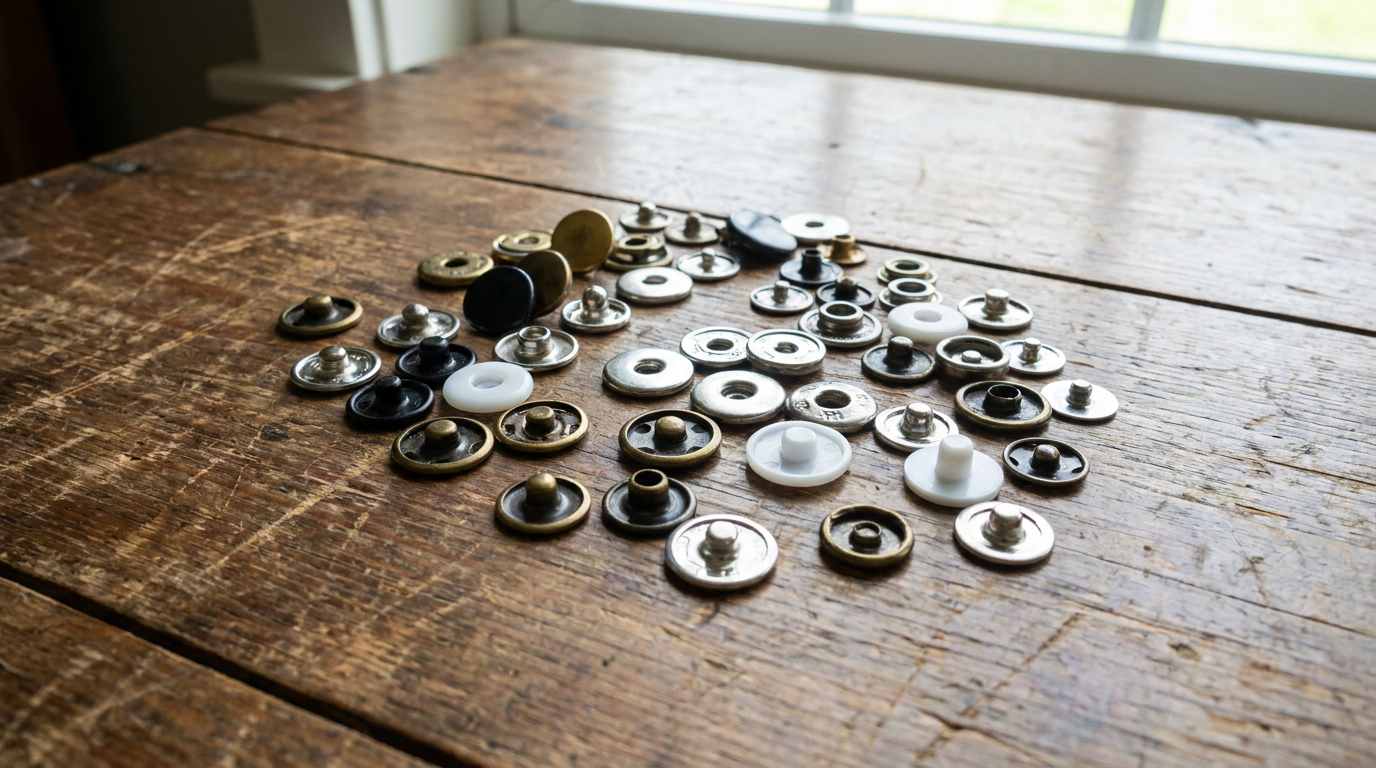
Baocheng can support both standard snap programs and projects requiring customized cap shape, logo, structure, post length, material or surface treatment.
Customization can include:
- cap diameter and profile;
- embossed and debossed logos;
- laser marking;
- socket and stud structure;
- post length;
- spring geometry;
- 304 stainless steel;
- 316 stainless steel;
- JSW20 ultra-low magnetic permeability stainless steel;
- brass;
- zinc alloy;
- decorative colors and finishes;
- matched setting tooling;
- OEM production.
Representative fabrics, leather, canvas and other material stacks can be used during sampling to evaluate post length and setting geometry before bulk production.
For highly customized projects, buyers can first confirm appearance and structural direction, then validate the final production-equivalent sample before mass-production release. This staged approach helps prevent tooling, color and installation issues from appearing after the order has already entered full production.
A Practical Pre-Order Checklist
| Area | Questions to Confirm |
|---|---|
| Sample | Reference, custom, installed or pre-production sample? |
| Tooling | Existing or new? Who owns it? |
| Installation | Which matched dies or press system are required? |
| MOQ | Per total order, size, material, logo or color? |
| Material | Standard stock material or special grade? |
| Finish | Standard color or custom color matching? |
| Testing | Mechanical, washing, corrosion or other validation? |
| Lead time | Development and bulk production separated? |
| Lead-time start | PO, deposit, artwork approval or sample approval? |
| Repeat orders | What is the future production lead time? |
Conclusion
Samples, tooling, MOQ and lead time are not secondary purchasing details. Together they define how a snap-button project moves from an idea to repeatable mass production.
Samples should be selected according to what needs to be validated. A stock sample confirms an existing product, while an installed or pre-production sample can validate post length, final finish, tooling and application performance. Buyers should know exactly which type of sample they are approving.
Tooling should be separated into manufacturing tools and installation tools, with ownership, cost and production suitability clearly documented. MOQ should be understood per size, material, logo and finish rather than treated as one universal quantity. Lead time should be divided into development, approval, mass production and shipping stages.
The most reliable purchasing decision is therefore made before the purchase order is released: confirm the final sample, confirm the tools, understand the real MOQ, identify when production lead time begins and agree on the milestones required for bulk approval.
Focused FAQ
Can I order samples below the factory MOQ?
Usually yes for development purposes. Sample quantities and mass-production MOQ are separate commercial concepts, although custom samples may require tooling and setup charges.
Do custom snap buttons always require new tooling?
No. Existing socket, stud and post systems can often be retained while only the cap, logo or finish is customized. New functional tooling is required when dimensions or mechanical geometry change substantially.
Why is MOQ higher for custom colors?
Each color or finish can require a separate plating or coating production batch. Even if the total order is large, dividing it into many small colors increases setup and process costs.
When does snap-button lead time normally start?
The starting point should be stated in the quotation. For custom products, production often begins only after final specifications, artwork, samples and any required deposit are approved.
Should I approve a loose sample or an installed sample?
Loose samples are useful for appearance and component evaluation, but an installed sample is preferable when post length, substrate damage or pull-out strength is important.
Can Baocheng supply matching installation tooling with custom snap buttons?
Matched tooling can be coordinated according to the selected snap structure and the customer's installation method, including sample development and production-setting requirements.