






How to Prepare a Snap Button RFQ: Size, Structure, Material, Finish and Performance Requirements
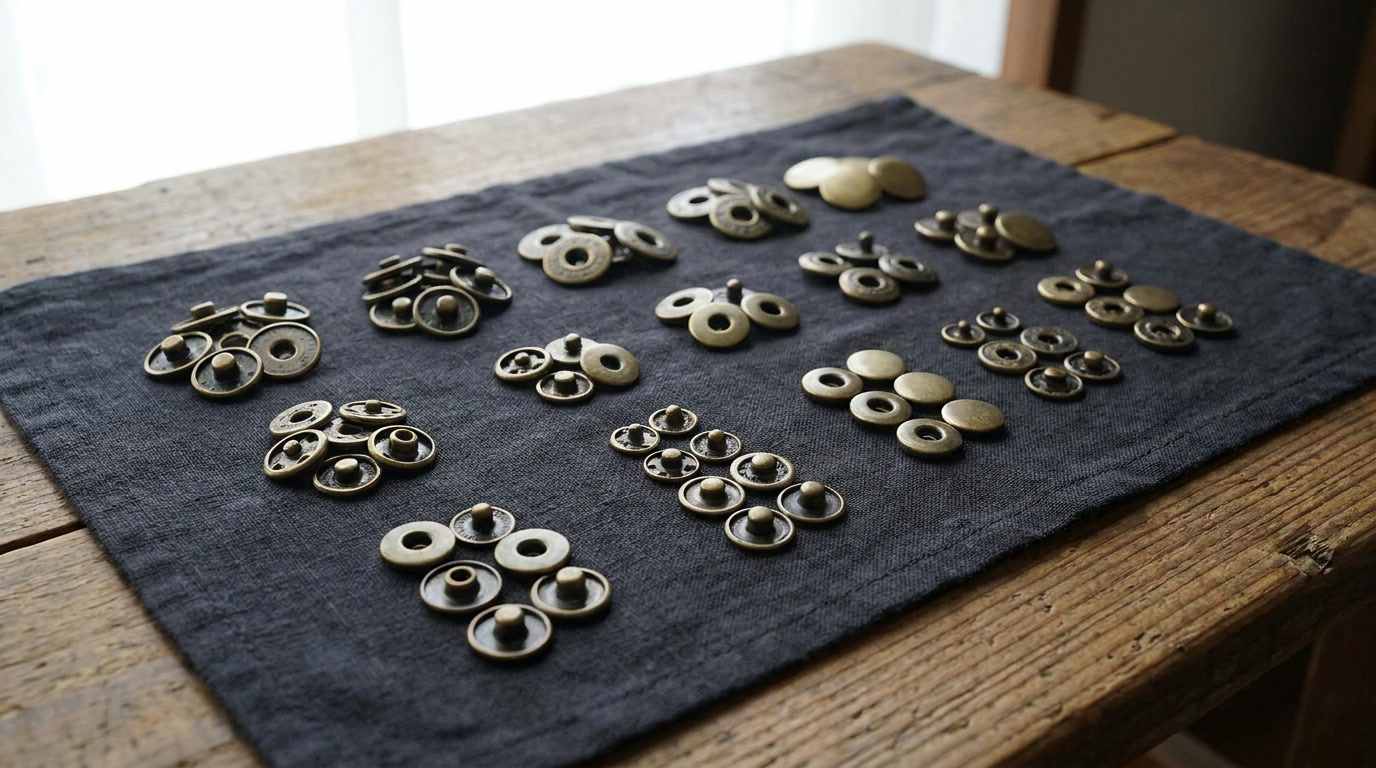
A Good Snap Button RFQ Should Describe the Product, Not Just Ask for a Price
A request for quotation for snap buttons often starts with a short message such as “Please quote 15 mm metal snaps in black.” That may be enough to receive a price, but it is rarely enough to ensure that every supplier is quoting the same product.
Snap buttons are small engineered fastening systems. Cap diameter, socket and stud geometry, post length, spring structure, base material, surface finish, fabric thickness, closing force and installation method can all change the final performance. Two products that both look like 15 mm snaps may have very different attachment strength, operating force and environmental durability.
A well-prepared RFQ therefore does more than ask how much a snap costs. It tells the supplier what the snap will be used for, how it will be installed, which performance requirements matter and which specifications are fixed versus open to supplier recommendation.
This guide explains how first-time and experienced buyers can prepare a practical snap button RFQ covering five key areas: size, structure, material, finish and performance.
Start the RFQ With the Final Application
The first line of the technical section should identify the product that will use the snap. A snap for a lightweight shirt is not engineered the same way as a snap for thick denim, leather goods, marine canvas or industrial textiles.
Useful application information includes:
- product type;
- fabric or substrate;
- number of material layers;
- compressed thickness at the snap location;
- indoor or outdoor use;
- washing frequency;
- exposure to perspiration, chlorides or cleaning chemicals;
- expected opening frequency;
- decorative requirements;
- special compliance or needle-detection requirements.
For example, press studs for denim jackets may be installed through several layers around a front placket or pocket flap. The buyer should therefore provide more information than denim fabric weight alone. Layer count, reinforcement and local seam construction can influence post-length selection.
RFQ Section 1: Specify the Snap Button Size
Snap-button size should be described with measurable dimensions whenever possible. The visible cap diameter is usually the first dimension buyers specify, but it is not the only dimension that matters.
A useful size specification may include:
- cap outside diameter;
- socket outside diameter;
- stud diameter;
- post diameter;
- post length;
- installed overall height where critical;
- material thickness;
- tolerance requirements for critical dimensions.
If you already have an existing snap, send a drawing, physical sample or clearly measured component set. Avoid relying only on commercial names such as “small,” “medium,” “Line 20” or “15 mm” when comparing unfamiliar suppliers, because naming conventions do not always define the complete internal geometry.
Do Not Use Cap Diameter as the Complete Product Specification
The cap is the most visible part, so buyers naturally focus on it. However, two snap systems with the same cap diameter can use different socket springs, stud profiles and post dimensions.
This means a quotation based only on cap diameter may hide significant differences between suppliers. One quotation may use a light-duty garment snap while another uses a stronger internal system under an identical-looking cap.
Your RFQ should therefore identify whether the supplier must match an existing complete four-part snap system or is free to recommend a suitable system based on the application.
Post Length Should Be Specified Against Compressed Material Thickness
Post length determines whether the snap can be securely attached without being under-set or excessively deformed. A post that is too short may not form enough material inside the mating component. A post that is too long can buckle, tilt or create excessive deformation.
When preparing the RFQ, provide the actual material stack at the installation point. If possible, provide both uncompressed thickness and a physical sample.
This is especially important for:
- denim seam overlaps;
- leather plus lining;
- foam-backed textiles;
- PVC or PU-coated materials;
- reinforced workwear;
- marine canvas;
- multilayer technical fabrics.
When the final thickness varies across the product, it may be necessary to specify more than one post length.
RFQ Section 2: Define the Four-Part Snap Structure
A traditional snap button normally consists of cap, socket, stud and post components. Your RFQ should state whether you require a complete four-part set and whether the supplier is expected to match an existing design.
| Component | Main RFQ Information |
|---|---|
| Cap | Diameter, profile, material, finish, logo and appearance |
| Socket | Spring structure, dimensions and operating-force requirement |
| Stud | Profile, dimensions and compatibility with the socket |
| Post | Length, diameter and suitability for substrate thickness |
For existing marine programs, buyers may already have approved marine snap fastener components and want a new supplier to reproduce or replace them. In this situation, sending the complete component set is much safer than sending only the cap.
Specify Socket and Stud Requirements as a Matched Pair
The socket and stud control much of the opening and closing behavior. Their dimensions should therefore be evaluated together.
If replacing an existing system, do not assume that a visually similar marine snap button socket will operate correctly with another supplier's stud. Small differences in internal geometry or spring thickness can substantially change release force.
The same applies when specifying a marine snap button stud. The stud profile must be compatible with the socket after both parts receive their final surface treatment.
If interchangeability with an existing snap is mandatory, state this explicitly and provide approved samples for functional comparison.
Decide Whether You Need Light, Medium or Heavy Retention
The RFQ should explain how securely the snap must remain closed. Avoid using only vague terms such as “strong snap” unless they are supported by an application description or measurable force range.
For example, heavy duty snaps for leather bags may require stronger retention than lightweight garment snaps because the closure can carry higher loads and the substrate can often tolerate greater opening force.
However, maximum retention is not always the objective. If the opening force is too high, the user transfers that force into the fabric or leather every time the snap is opened. The surrounding substrate can stretch or tear even though the snap mechanism itself remains intact.
The best RFQ therefore defines the required performance window rather than simply asking for the strongest available snap.
RFQ Section 3: Specify the Base Material
Material affects corrosion resistance, formability, magnetic response, decorative finishing compatibility and price. The RFQ should identify whether the material is mandatory or whether suppliers may recommend alternatives.
| Material | Typical RFQ Considerations |
|---|---|
| Plated steel | Economical, widely formable, but corrosion protection depends strongly on coating integrity |
| Brass | Good formability and decorative finishing flexibility; useful where low magnetic response is valued |
| Zinc alloy | Useful for complex decorative shapes; requires suitable environmental protection |
| 304 stainless steel | Good general corrosion resistance for many applications |
| 316 stainless steel | Often considered when stronger chloride resistance is required |
| JSW20 stainless steel | Ultra-low magnetic permeability after forming combined with good formability and chloride-corrosion resistance |
If a specific grade is required, write the grade rather than only “stainless steel.” Different grades can have significantly different behavior after forming and in corrosive environments.
When Should JSW20 Be Written Into the RFQ?
JSW20 is especially relevant when the finished snap must combine stainless-steel performance with extremely low magnetic response after forming.
Available reference data indicate relative magnetic permeability around μr 1.001. Within the referenced cold-deformation range, the material maintains ultra-low magnetic behavior, while its A50 reference elongation of ≥40% supports demanding stamping and forming operations.
JSW20 also provides resistance to chloride-containing environments. This makes it useful when buyers need to combine low magnetic response with environmental durability.
However, an RFQ should not assume that specifying JSW20 alone guarantees garment-level needle-detector acceptance. Detector results also depend on component mass, geometry, quantity, location, other metal hardware and machine sensitivity. The RFQ should separately state the desired detector-validation method.
Baocheng supplies finished snap buttons and customized components made from JSW20 rather than raw JSW20 sheet or coil.
Compliance Requirements Should Be Written Separately From Material Names
A material specification does not automatically define every compliance requirement. If the customer needs restricted-substance testing, nickel release control or another specific requirement, write it directly into the RFQ.
For example, a buyer requiring nickel free snaps for medical garments should clarify what “nickel free” means in the project. The requirement may relate to base-material composition, surface finish, nickel release or a specific customer testing limit.
Ask suppliers to identify exactly which finished product and finish are covered by any submitted test report. A report for one material or coating should not automatically be assumed to apply to every variant.
RFQ Section 4: Define the Surface Finish
The finish specification should include both appearance and performance. “Gold” or “black” may describe a color family, but different suppliers can interpret those descriptions differently.
A useful finish section may include:
- color name;
- approved color sample;
- gloss level;
- polished, matte, brushed or antique effect;
- plating, coating or PVD requirement where specified;
- coating-thickness requirement where relevant;
- color-difference tolerance;
- corrosion requirement;
- abrasion or washing requirement.
Use Physical Color Standards for Decorative Finishes
Metallic colors are difficult to control by screen images alone. Lighting, monitor settings, base material and polishing condition can all change the perceived color.
If a brand requires rose gold snap buttons, the RFQ should include a physical approved sample or a clearly controlled reference rather than relying only on the words “rose gold.”
The same principle applies to bronze snap fasteners. “Bronze” can refer to different visual effects, from bright metallic bronze to dark antique bronze. The supplier should know which result is expected before preparing production samples.
Ask Whether Finish Changes Critical Dimensions
Surface treatment adds material to the component. On decorative cap surfaces this may have little functional effect, but on socket and stud contact areas, coating thickness can influence engagement.
For applications with tightly controlled operating force, ask suppliers to confirm dimensions and functional testing after final finishing rather than only before plating.
The RFQ can require:
- finished-component dimensional inspection;
- closing-force testing after plating;
- release-force testing after plating;
- coating adhesion checks;
- visual inspection at defined lighting conditions.
RFQ Section 5: Define Performance Requirements
Performance requirements convert the RFQ from a visual purchasing document into an engineering specification.
Depending on the application, performance requirements can include:
- closing force;
- release force;
- attachment pull-out strength;
- rotation resistance;
- opening-cycle durability;
- corrosion resistance;
- washing resistance;
- perspiration resistance;
- needle-detection performance;
- surface-wear performance;
- electrical requirements for smart-textile connectors.
Not every project needs all of these tests. The RFQ should prioritize the characteristics that correspond to real product failure risks.
Closing Force and Release Force Should Not Be Confused
Closing force describes the load required to engage the socket and stud. Release force describes the load required to separate them.
A snap may be easy to close but relatively difficult to open, or vice versa, depending on its spring geometry and stud profile.
For repeat-production programs, numerical ranges are more useful than descriptions such as “normal strength.” If you do not yet have a target range, ask the supplier to provide sample options with different operating forces so they can be evaluated on the final product.
Attachment Strength Must Be Tested on the Real Substrate
The same snap can achieve different pull-out performance on different materials. A strong metal fastener can still pull through a weak textile or oversized installation hole.
Your RFQ should identify whether attachment testing is required on:
- customer-supplied fabric;
- production-equivalent fabric;
- leather;
- coated material;
- reinforced multilayer construction.
The failure mode should also be recorded. Fabric tearing, post fracture and component separation are different failures even when the maximum test force is similar.
Environmental Performance Should Match Actual Use
A buyer should not request extreme corrosion testing simply because it sounds more demanding. The goal is to reproduce relevant service risk.
For indoor apparel, repeated washing and perspiration may matter more than marine salt exposure. For outdoor covers, wet-dry cycling and condensation may be critical. For marine products, chloride-rich moisture, deposits and galvanic contact deserve greater attention.
The RFQ should specify:
- exposure type;
- test duration or cycles;
- temperature where relevant;
- acceptance criteria;
- whether appearance and function must both be evaluated afterward.
Include Installation Requirements in the RFQ
Installation is part of the fastening system. Even a correctly manufactured snap can fail when set using incorrect dies or post length.
If the supplier is expected to provide a snap fastener setting tool, write this into the RFQ and specify whether the requirement is for sample development, manual production, pneumatic equipment or automatic machinery.
For new custom snaps, ask whether dedicated upper and lower dies are required and whether the tooling fee is included in the quotation.
Send Actual Substrate Samples Whenever Possible
Technical drawings are useful, but a physical fabric or leather sample can answer questions that thickness data alone cannot.
The supplier can evaluate:
- compressibility;
- surface coating;
- layer construction;
- hole behavior;
- post-length requirement;
- setting deformation;
- pull-out failure mode.
For a high-volume program, sending representative material before finalizing the RFQ can prevent expensive corrections after tooling or bulk production has begun.
Clarify Whether the Supplier Should Match an Existing Sample or Develop a New Design
There are two very different RFQ situations.
In the first, the buyer has an existing approved snap and wants another supplier to reproduce it. In this case, the RFQ should state which dimensions, appearance and functional characteristics must remain interchangeable.
In the second, the buyer is developing a new product and expects the supplier to recommend the snap structure. In this case, the RFQ should provide application requirements but leave selected technical variables open for supplier proposal.
Mixing these two approaches creates confusion. A supplier cannot optimize a design while also being expected to reproduce every dimension of an existing product.
Specify Logo Requirements With Artwork and Manufacturing Method
If a cap needs branding, attach vector artwork and state whether the logo should be embossed, debossed, engraved or laser marked.
Also define:
- logo dimensions;
- logo orientation;
- position on the cap;
- minimum line thickness;
- surface finish around the logo;
- whether tooling ownership is required.
Custom logo tooling should be quoted separately from unit price unless both parties agree otherwise.
Include Estimated Quantity and Annual Demand
Quantity affects tooling economics, plating setup, packaging, MOQ and unit price. Give the supplier both the expected first order and estimated repeat demand when available.
For example:
- sample requirement: 100 sets;
- initial order: 20,000 sets;
- estimated annual demand: 200,000 sets.
This information allows the supplier to propose a more appropriate manufacturing route than a quotation based on the first small sample order alone.
Define Packaging and Component Counting Clearly
Snap buttons create frequent purchasing confusion because “one piece” can mean one individual metal component or one complete four-part set.
Your RFQ should specify quantities as complete sets whenever possible.
For example:
“Quotation required for 50,000 complete four-part snap sets, each set consisting of one cap, one socket, one stud and one post.”
Also state packaging preferences such as:
- components packed separately;
- complete sets packed together;
- quantity per bag or carton;
- lot labels;
- barcode requirements;
- customer part number.
Ask for a Technical Drawing With the Quotation
A drawing helps ensure that the quoted snap is the same product everyone is discussing.
For custom or technical programs, the drawing should identify key dimensions and component names. The drawing revision should then become part of the sample approval and mass-production records.
If a later dimension changes, both parties can identify exactly which revision applies to each order.
Ask the Supplier to Separate Mandatory Requirements From Recommendations
An effective RFQ makes clear which specifications cannot change and which are open to optimization.
For example:
- Mandatory: 15 mm visible cap diameter.
- Mandatory: matte black appearance matching approved sample.
- Mandatory: needle-detection validation.
- Supplier recommendation: post length based on provided fabric.
- Supplier recommendation: socket spring design.
- Supplier recommendation: 304, 316 or JSW20 depending on final performance requirement.
This gives the supplier enough flexibility to use manufacturing expertise without accidentally changing brand-critical requirements.
Request Samples Before Final Mass-Production Approval
RFQ approval and sample approval are different milestones. A supplier can meet the written RFQ and still produce a snap that does not feel correct on the actual product.
Sample approval should evaluate:
- size and appearance;
- color;
- logo quality;
- post length;
- installation geometry;
- closing and release behavior;
- attachment strength;
- cycle performance;
- environmental durability where applicable.
Keep an approved physical sample for comparison with future production lots.
Do Not Compare Supplier Prices Until the Specifications Match
A low quotation may simply represent a different product.
Before comparing prices, verify that suppliers are quoting the same:
- four-part structure;
- size;
- post length;
- material;
- metal thickness;
- finish;
- logo;
- performance tests;
- packaging;
- tooling;
- quantity basis.
Only after these variables are aligned does unit-price comparison become meaningful.
A Practical Snap Button RFQ Template
| RFQ Field | Example Information |
|---|---|
| Application | Denim jacket front closure |
| Snap type | Four-part metal snap |
| Cap diameter | 15 mm |
| Fabric stack | Three layers, sample supplied |
| Post length | Supplier recommendation based on sample |
| Material | Stainless steel; evaluate 304 and JSW20 options |
| Finish | Matte black, match physical standard |
| Logo | Debossed logo, artwork attached |
| Operating force | Supplier to provide medium and high-retention samples |
| Corrosion requirement | Defined according to final garment-use environment |
| Needle detection | Required on final installed sample |
| Installation tool | Matched upper and lower dies required |
| Sample quantity | 100 complete sets |
| Initial order | 20,000 complete sets |
| Estimated annual volume | 200,000 complete sets |
| Packaging | Components separated and lot-labelled |
How Baocheng Supports RFQ Development

Baocheng can work with buyers who already have a complete technical specification as well as customers who only know the final application and need help converting product requirements into a snap-button specification.
Customization can include cap diameter and profile, socket and stud geometry, post length, spring structure, base material, surface treatment, color, logo, tooling, sampling and OEM production.
Material options can include 304 stainless steel, 316 stainless steel, JSW20 ultra-low magnetic permeability stainless steel, brass and zinc alloy depending on project requirements.
For projects involving thick fabrics, leather, coated materials or multilayer constructions, representative substrates can be evaluated during sample development. This helps establish appropriate post length and setting geometry before mass production.
For low-magnetic projects, Baocheng can provide finished components made from JSW20 and coordinate evaluation around the finished formed snap rather than raw material alone. For corrosion-sensitive programs, material and surface treatment can be selected around the real washing, outdoor or chloride environment.
Common RFQ Mistakes Buyers Should Avoid
- Specifying only the visible cap diameter.
- Writing “stainless steel” without identifying grade when grade matters.
- Ignoring actual substrate thickness.
- Requesting maximum holding force instead of an appropriate force range.
- Using digital images as the only color standard.
- Forgetting to specify whether quantity means components or complete sets.
- Not identifying required installation tooling.
- Assuming all components from the same nominal size are interchangeable.
- Requesting compliance documents without defining the exact requirement.
- Comparing quotations before material, finish and test requirements are aligned.
- Approving loose components without testing them on the final substrate.
Conclusion
A well-prepared snap button RFQ reduces both sourcing time and product risk. Instead of asking suppliers to quote a generic metal snap, buyers should define the application, size, four-part structure, substrate thickness, post requirement, material, finish and performance expectations.
The most important RFQs also distinguish between mandatory requirements and areas where the supplier is expected to make a technical recommendation. This allows the manufacturer to apply its forming and fastening experience without changing specifications that are critical to the customer's design.
Material and appearance should be evaluated together with function. A snap that looks correct but has the wrong post length, excessive release force or unsuitable corrosion resistance is still the wrong product.
By attaching representative substrate samples, drawings, color references, logo artwork and measurable acceptance criteria, buyers give suppliers enough information to develop technically comparable quotations and reduce changes after sampling or mass production.
Focused FAQ
What is the most important information to include in a snap button RFQ?
Start with the final application, cap size, substrate type and thickness, desired material, finish, quantity and performance requirements. If you do not know the correct post length or spring structure, identify those items as supplier-recommended rather than guessing.
Should I specify snap button post length myself?
If you already have a validated design, include the approved post length. For a new product, it is often better to send the real substrate and ask the supplier to recommend and test appropriate post lengths.
Do I need to specify both socket and stud?
Yes. They form a functional pair and control much of the snap's closing and release behavior. If interchangeability with an existing system is required, provide both approved components.
Should an RFQ include test requirements?
Yes when performance matters. Closing force, release force, pull-out strength, cycle durability, washing, corrosion and needle-detection requirements should be specified according to the final application.
Can I send only a photo of the finish I want?
Photos are useful for initial communication but are not ideal final color standards for metallic finishes. A physical approved sample provides a more reliable reference for production.
Can Baocheng recommend a snap specification if I do not have a technical drawing?
Yes. Buyers can provide the final application, representative substrate, expected dimensions, finish and performance requirements. Baocheng can then coordinate material, structure, post length, tooling and sample development before mass production.