







Snap Button Post Length Explained: How Material Thickness Determines the Correct Attachment Length

Snap Button Post Length Explained: How Material Thickness Determines the Correct Attachment Length
Post length is one of the most important—and most frequently misunderstood—dimensions in a metal snap fastener.
Buyers often begin a snap button specification with the visible cap diameter: 12.5 mm, 15 mm, 17 mm or another nominal size. But a correct cap diameter does not guarantee a correct attachment.
The post or eyelet underneath the visible hardware must also match the actual material stack.
If the post is too short, there may not be enough metal available to form securely into the mating component.
If the post is too long, the unsupported stem can buckle, collapse sideways or distort the socket or stud during setting.
Correct attachment length is therefore a geometric balance between:
- actual substrate thickness;
- substrate compression;
- number of layers;
- mating-component depth;
- required forming allowance;
- final clamping condition.
The correct question is not “What is the longest post available?”
It is:
“How much usable post length is required after this exact material stack has been compressed during attachment?”
First: What Is the Post in a Four-Part Snap?
A common four-part metal snap consists of:
- cap;
- socket;
- stud;
- post or eyelet.
The socket and stud create the reusable ON/OFF fastening mechanism.
The cap and post or eyelet help create the permanent attachment to the substrate.
These two mechanical relationships should not be confused.
Socket-to-stud retention determines how the snap opens and closes.
Post or eyelet attachment determines whether the hardware remains fixed to the fabric, leather, canvas or other substrate.
Post Length Is an Attachment Dimension
The visible diameter of a snap influences appearance and available space.
Post length has a completely different purpose.
Its job is to provide enough projecting material to:
- pass through the complete substrate;
- enter the mating component correctly;
- deform into the specified final attachment geometry.
This is why one snap family can contain several post-length options while keeping the same visible cap.
Overall Height and Working Post Length Are Not Always the Same
When reading a supplier drawing, buyers should determine exactly what the listed dimension means.
A drawing might show:
- overall component height;
- barrel length;
- stem length;
- working length;
- projection above the flange.
These dimensions are not automatically interchangeable.
The flange or base consumes part of the overall component height.
For substrate calculations, the critical value is normally the usable attachment portion that actually passes through the material.
Material Thickness Is the Starting Point
Correct post selection begins with material thickness—but not the thickness of one loose fabric sample.
The relevant dimension is the complete installation stack.
A garment snap can pass through:
- outer fabric;
- folded fabric;
- interlining;
- lining;
- reinforcement tape;
- additional backing.
A technical textile assembly can also contain:
- coating;
- webbing;
- laminated film;
- reinforcement patches;
- binding.
Every layer contributes to the attachment requirement.
Do Not Calculate Post Length From Fabric Weight Alone
Fabric weight in gsm or oz/yd² does not directly tell you the post length.
A dense heavy fabric can be relatively compact.
A soft laminated textile can be physically thick despite having much lower resistance to pull-through.
Likewise, four folded layers of medium denim can create a much thicker installation foundation than one layer of heavy denim.
Post length is fundamentally a thickness-and-forming problem rather than a fabric-weight problem.
Free Thickness and Compressed Thickness Are Different
Another common mistake is measuring the material with almost no pressure and treating that value as the installed thickness.
Many substrates compress during snap setting.
Examples include:
- soft woven fabrics;
- knits;
- synthetic leather;
- soft natural leather;
- foam-backed materials;
- padded technical fabrics.
The metal components clamp the substrate during installation.
The final compressed thickness can therefore be smaller than the free-state measurement.
This is one reason sample setting on the real production material is more reliable than theoretical calculation alone.
The Basic Post-Length Relationship
A useful engineering concept is:
Required working post length = compressed material thickness + mating engagement depth + controlled forming allowance.
This should be understood conceptually rather than treated as a universal numerical formula.
Different snap families use different:
- post diameters;
- socket or stud depths;
- flaring geometries;
- curling or riveting patterns.
The necessary allowance must therefore come from the actual component design.
Why the Shortest Possible Post Is Not Always Correct
A post can physically pass through a substrate and still be too short for secure forming.
After passing through the material, enough stem must remain exposed to create the intended attachment.
If that remaining height is inadequate, the tooling cannot form the post correctly.
What Happens When the Post Is Too Short?
An undersized post commonly creates:
- incomplete flare or roll;
- insufficient mechanical engagement;
- low pull-out resistance;
- hardware rotation;
- loose attachment;
- early detachment during ON/OFF cycling.
The snap may initially appear installed because the components remain together after setting.
That does not mean the joint has sufficient mechanical margin for repeated use.
A Short Post Can Also Create Excessive Compression
When the attachment length is marginal, production operators sometimes compensate by increasing setting pressure.
This can compress the material more aggressively, but it does not create additional usable metal.
Excessive pressure can instead:
- crush the substrate;
- mark the cap;
- distort the socket;
- change snap action;
- damage coatings.
Tool pressure cannot correct fundamentally incorrect component length.
What Happens When the Post Is Too Long?
Choosing a longer post “just to be safe” creates the opposite problem.
Excess unsupported stem length has to go somewhere during setting.
Instead of forming symmetrically, it can:
- buckle;
- fold to one side;
- collapse irregularly;
- push the mating component off center;
- distort the stud or socket.
A visibly tight attachment can therefore still contain poor internal forming.
Too Long Can Produce a Loose Snap After Setting
It may seem contradictory, but excessive post length can produce a joint that feels loose.
If the stem buckles before it creates the intended clamp, part of its length is consumed by uncontrolled deformation rather than useful attachment.
The components can remain connected but still move relative to the substrate.
Post Length and Setting Pressure Work Together
Correct post length defines the geometry available to the setting operation.
Correct setting pressure completes that geometry.
A reliable production process therefore needs:
- correct component combination;
- correct foundation thickness;
- matched dies;
- controlled press stroke or pressure;
- stable component alignment.
Changing any one of these variables can alter the attachment result.
Foundation Thickness Should Be Consistent
Thickness variation across the snap location can cause serious problems.
If one side of the component sits over a seam ridge while the other side sits over a single layer, the hardware is no longer supported evenly.
Possible results include:
- tilted setting;
- weak attachment;
- uneven snap action;
- fabric tearing;
- component rotation.
The attachment zone should therefore be designed to provide a stable foundation.
Interlining Can Change the Correct Post Length
Interlining is often added to stabilize the snap area.
This improves:
- tear resistance;
- dimensional stability;
- resistance to rotation;
- appearance around the hardware.
But it also adds thickness.
A snap originally selected for two layers of fabric may require another attachment length after an interlining layer is added.
Reinforcement Is Part of the Final Material Stack
The same principle applies to:
- denim reinforcement;
- canvas patches;
- webbing;
- leather backing;
- technical-textile reinforcement films.
Do not select the post before the reinforcement design is finalized.
Why Leather Makes Post-Length Selection Especially Important
Buyers searching for snaps for leather work with one of the clearest examples of thickness-sensitive snap attachment.
Leather products vary enormously in:
- thickness;
- firmness;
- compressibility;
- number of layers;
- surface finish.
A wallet flap, handbag tab, tool pouch and heavy belt can all use snap fasteners, but their attachment requirements are completely different.
Leather Thickness Should Be Measured at the Actual Snap Location
A leather product can contain:
- outer leather;
- lining leather;
- reinforcement board;
- adhesive;
- folded edges.
The post passes through the assembled structure, not the nominal thickness printed on the leather specification sheet.
Firm Leather and Soft Leather Behave Differently
Two leather stacks can have the same free thickness but compress differently during setting.
Firm leather retains more of its thickness.
Soft leather can compress substantially.
This affects both:
- the effective post requirement;
- the final clamping pressure around the attachment.
Line 24 Snaps and Thick Leather Applications
The keyword line 24 snaps for leather reflects a common heavy-leather use case.
Line-based snap families are frequently offered with different attachment lengths because belts, straps, jackets and leather accessories do not share one foundation thickness.
The important sourcing principle is not simply choosing “Line 24.”
It is specifying:
- the exact snap family;
- the post or eyelet version;
- the finished leather stack;
- the required attachment strength.
A Larger Snap Does Not Automatically Have the Right Post
Large snap families often offer longer attachment options, but cap size and post length remain separate specifications.
A large cap can be supplied with:
- short post;
- standard post;
- longer post.
The correct version depends on the substrate.
15 mm Snap Size Does Not Tell You Post Length
The same principle applies to 15mm snaps.
“15 mm” can describe a nominal or visible size, but it does not tell a production engineer:
- how long the cap barrel is;
- how long the bottom post is;
- what substrate thickness is supported;
- how much forming allowance is available.
A complete specification must contain the attachment dimensions separately.
Snap Rivets: Do Not Confuse Attachment Style With Snap Size
The search phrase snap rivets illustrates another common terminology problem.
Snap components can be mechanically deformed during setting in a rivet-like way, but the reusable snap mechanism and the permanent attachment mechanism remain separate functions.
The permanent attachment can involve:
- rolling;
- flaring;
- curling;
- prong deformation;
- other controlled metal forming.
Post length should therefore be selected from the specific snap construction rather than from a generic rivet rule.
Cap Barrel Length and Bottom Post Length Can Both Matter
In a four-part system, the cap side and stud side can each have an attachment structure.
The cap may include a barrel or eyelet that passes through the substrate into the socket.
The bottom post then attaches through the opposite side into the stud.
These two attachment sides do not necessarily require identical lengths.
Why One Snap Set Can Need Two Different Attachment Lengths
The foundation under the cap side and stud side can be different.
For example, a garment front can have:
- a reinforced top layer on one side;
- a thinner receiving layer on the other side.
The designer should confirm the substrate thickness at both attachment locations rather than assuming symmetry.
Mechanically Attached Snaps Versus Sew-On Snaps
Post length is critical for mechanically set hardware, but not every snap uses a penetrating post.
sew on snap fasteners are attached by stitching and therefore follow a different attachment principle.
For sew-on products, relevant variables include:
- snap diameter;
- sewing-hole geometry;
- thread;
- stitch pattern;
- fabric reinforcement.
There is no riveted post length to match to the fabric stack.
Why This Distinction Matters in Keyword and Product Selection
Search phrases such as press studs snap fasteners sew on and mechanically attached press studs may appear close in search results, but the engineering requirements are very different.
A buyer looking for a production metal four-part snap should confirm whether the product is:
- sewn on;
- prong attached;
- post attached;
- eyelet attached.
Only then does it make sense to discuss post or prong length.
No-Sew Press Studs Depend Heavily on Attachment Length
In contrast, press studs snap fasteners no sewing normally rely on mechanical attachment through the substrate.
For this type of system, component geometry must perform both penetration and permanent clamping.
The correct length must therefore match:
- material thickness;
- material compressibility;
- required forming geometry;
- strength of the local foundation.
Post Length for Lightweight Fabric
Lightweight substrates generally require shorter attachment geometry.
The main risks are:
- excess post buckling;
- fabric crushing;
- socket distortion;
- visible puckering.
Very thin fabrics often also require reinforcement or packing to provide enough foundation for stable attachment.
Post Length for Medium-Weight Fabric
Medium woven fabrics and casual garments usually offer a broader working window.
However, folded plackets and cuffs can quickly increase thickness.
Always measure the actual snap position.
Post Length for Heavy Fabric
Heavy denim, canvas and workwear can require longer attachment options because of:
- greater fabric thickness;
- multiple layers;
- reinforcement;
- coatings.
But longer components must still form cleanly.
Heavy fabric does not justify excessive unused post length.
Post Length for Canvas and Technical Textiles
Technical fabrics deserve extra attention because total thickness can include more than textile fibers.
A coated cover can contain:
- base fabric;
- PVC or polymer coating;
- folded hem;
- webbing reinforcement;
- local patch.
Measure the final production assembly.
Coated Materials Can Be Damaged by Incorrect Attachment Length
Excess compression or uncontrolled post buckling can create:
- coating cracks;
- stress whitening;
- delamination;
- water-entry points.
The setting process should therefore secure the hardware without unnecessarily crushing the coated substrate.
Post Diameter Matters Together With Post Length
Length is not the only attachment dimension.
A post also has a diameter.
A longer thin stem behaves differently under compression from a shorter wide stem.
Post stability depends on the complete geometry.
This is another reason buyers should not specify only “long post.”
Flange Diameter Influences Load Distribution
The flange or base area helps transfer forces into the substrate.
A larger flange can distribute load over a wider region.
This can improve resistance to:
- pull-through;
- rotation;
- localized material deformation.
However, the flange must also fit within the available design space.
Why Post Length Does Not Determine Snap Holding Force
The post permanently attaches the component.
Holding and release force primarily come from the socket and stud locking geometry.
A longer post does not create a stronger socket-to-stud lock.
It only changes whether the component can be correctly attached to a thicker substrate.
A Stronger Snap Requires Stronger Attachment
Although post length does not create snap action, attachment and retention are mechanically connected in the finished product.
Every time the user opens the snap, the release load travels through:
Stud → Socket → Attachment Components → Substrate.
If the attachment is weak, a high-retention snap can pull out before the socket releases normally.
Snap Poppers and Post Length
The term snap poppers fasteners is another regional or commercial expression for snap-style closures.
Regardless of terminology, mechanically attached popper systems still require the buyer to distinguish:
- visible cap size;
- locking mechanism;
- attachment type;
- attachment length;
- working substrate thickness.
Do Not Solve Attachment Problems by Increasing Setting Force
When a snap remains loose, production teams sometimes increase machine pressure.
This is only appropriate if the geometry is already correct and the process simply needs controlled adjustment.
If the post length is wrong, excessive force can damage the hardware rather than solve the problem.
Signs That the Post May Be Too Short
- post does not form fully;
- component rotates after attachment;
- snap pulls out during testing;
- attachment separates after repeated ON/OFF cycles;
- operator requires unusually high force to force components together.
Signs That the Post May Be Too Long
- post buckles sideways;
- mating component tilts;
- socket becomes distorted;
- attachment feels loose despite strong setting pressure;
- formed metal appears irregular or asymmetric.
How to Measure Material Thickness Properly
A practical measurement process should:
- identify the exact snap location;
- assemble all production layers;
- include reinforcement;
- measure several samples;
- consider compression during setting;
- verify the result through physical attachment trials.
Thickness Variation Should Be Included in Tolerance Planning
Fabric and leather are not precision-machined metal sheets.
Their thickness varies.
A post selected only for the average value can fail when production material reaches the high or low end of the thickness distribution.
The selected attachment should provide a stable process window across normal substrate variation.
Do Not Use One Universal Post for Every Material
A common sourcing simplification is requesting one snap set for:
- shirt fabric;
- denim;
- leather;
- canvas.
The visible cap can potentially be standardized.
The attachment component often cannot.
Different post or eyelet lengths can be required for different constructions.
Use the Finished Assembly for Pull-Out Testing
The loose post itself does not prove attachment performance.
Testing should use:
- final production components;
- actual substrate;
- final reinforcement;
- production-equivalent dies;
- final surface finish.
Pull-out testing then evaluates the entire attachment system.
Cycle Testing Can Reveal Marginal Post Selection
A snap can survive the first pull test and still loosen during repeated operation.
Each opening cycle applies local loads to the attachment.
Marginally formed posts can gradually:
- rotate;
- loosen;
- enlarge the substrate hole;
- pull through the material.
Cycle behavior should therefore be evaluated for demanding applications.
Surface Finish and Post Forming
Plating and coatings also influence forming behavior.
Thicker or less ductile finishes can behave differently during flaring or curling.
Final production finish should therefore be represented during approval trials.
Material Selection for Snap Posts
Depending on the snap component and project requirements, suitable materials can include:
- brass;
- 304 stainless steel;
- 316 stainless steel;
- JSW20 ultra-low magnetic permeability stainless steel;
- other project-appropriate metals.
The geometry and forming process should be validated for the selected material rather than assuming that every metal behaves identically.
JSW20 for Finished Snap Components
Some apparel and technical-product projects require extremely low magnetic permeability after components have been stamped and formed.
Baocheng / BC New Material can manufacture suitable finished snap components using patented JSW20 ultra-low magnetic permeability stainless steel where the geometry and forming requirements are appropriate.
JSW20 retains extremely low magnetic permeability after forming and also provides chloride-corrosion resistance.
This is relevant to needle-detection and other low-magnetic applications where environmental durability also matters.
Baocheng supplies finished JSW20 products and customized components rather than raw JSW20 coils or sheets.
A Practical Post-Length Selection Workflow
Step 1: Define the Exact Snap Combination
Identify the cap, socket, stud and post family.
Step 2: Identify Both Attachment Locations
Measure the cap/socket side and stud/post side separately if the substrate construction differs.
Step 3: Build the Real Material Stack
Include folds, linings, coatings and reinforcement.
Step 4: Measure Thickness
Take several measurements rather than relying on one point.
Step 5: Select the Recommended Attachment Length
Use the supplier's component drawing and working-thickness guidance.
Step 6: Set Production-Equivalent Samples
Use correct dies and production-equivalent conditions.
Step 7: Section or Inspect the Attachment
Confirm that the post has formed symmetrically and fully.
Step 8: Test the Finished Assembly
Check:
- pull-out resistance;
- rotation;
- snap action;
- substrate damage;
- cycle stability.
What Buyers Should Include in a Post-Length RFQ
A useful RFQ should provide:
- finished-product application;
- snap installation location;
- actual material sample;
- number of layers;
- free and approximate compressed thickness;
- reinforcement structure;
- preferred cap diameter;
- socket/stud family;
- required post or eyelet type;
- target release force;
- opening frequency;
- base material;
- surface finish;
- environmental exposure.
Custom Post and Eyelet Length Development at BC New Material
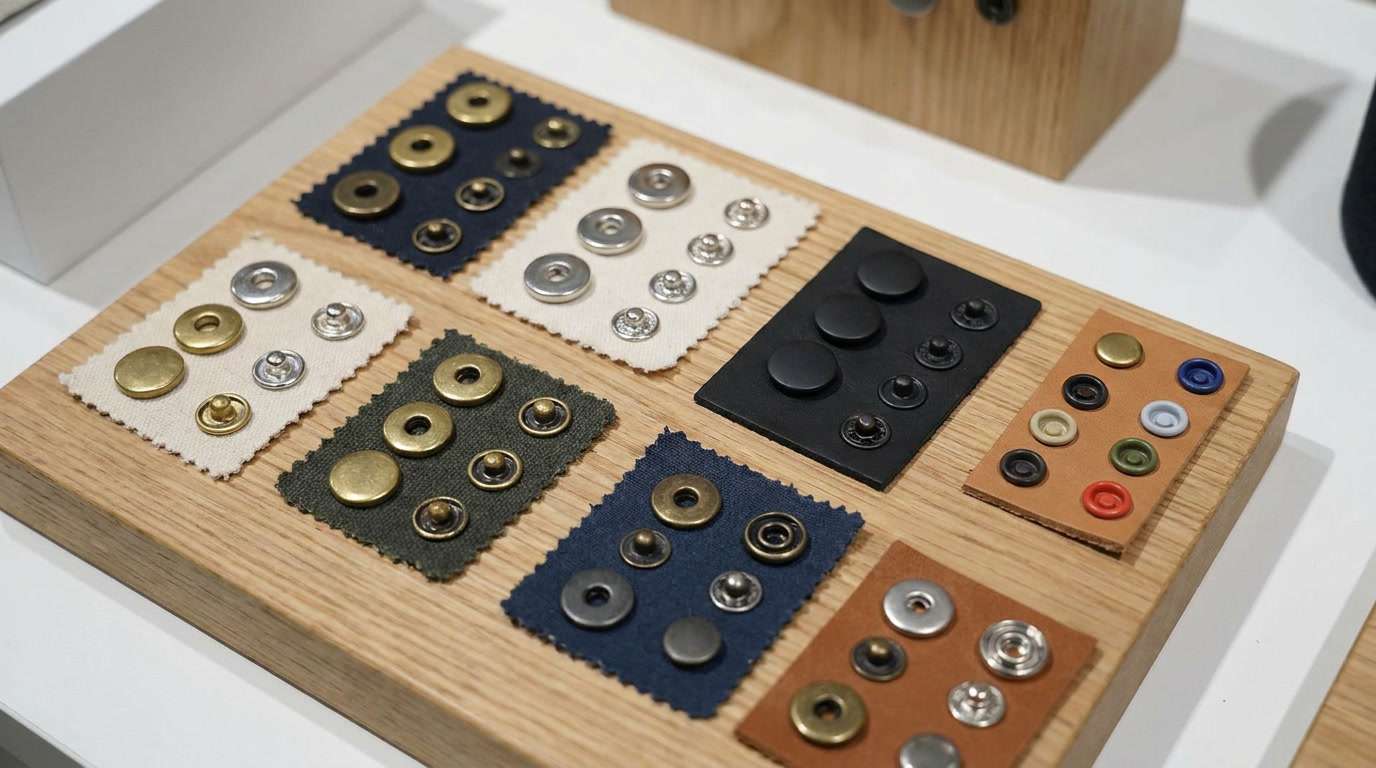
BC New Material supplies finished metal snap buttons, press studs and customized components for apparel, denim, leather goods, bags, workwear, canvas and technical textiles.
Development can be based on the customer's actual foundation thickness rather than selecting one standard post for every application.
Depending on the project, Baocheng can customize:
- cap barrel length;
- bottom post or eyelet length;
- post diameter;
- flange diameter;
- socket structure;
- stud geometry;
- cap diameter and profile;
- base material;
- surface finish and color;
- logo and embossing.
Samples can be developed using the customer's real fabric, denim, leather, canvas or multilayer technical textile.
This makes it possible to confirm the attachment after real compression and forming rather than relying only on nominal material thickness.
Depending on project requirements, materials can include brass, 304 stainless steel, 316 stainless steel, patented JSW20 ultra-low magnetic permeability stainless steel and other suitable metals.
Where applicable to the specific project and certificate scope, Baocheng can also consider REACH, RoHS, OEKO-TEX and nickel-release requirements.
Conclusion: Correct Post Length Comes From the Finished Material Stack
Snap-button post length should never be selected by cap diameter alone.
It should never be chosen simply by asking for the longest available component either.
The post must be long enough to pass through the compressed substrate and create the designed forming geometry, but short enough to avoid uncontrolled buckling or component distortion.
The correct attachment length depends on:
- actual material-stack thickness;
- compression;
- reinforcement;
- mating-component geometry;
- forming allowance;
- production tolerances.
This is why one snap family frequently requires several post or eyelet options.
The visible hardware can remain identical while the attachment length changes to match lightweight fabric, multilayer denim, leather or reinforced technical textile.
The correct post is therefore not a cosmetic option.
It is an engineered component selected around the finished substrate.
Focused FAQ
How do I choose the correct snap-button post length?
Measure the complete material stack at the actual installation point, consider compression during setting, and select the compatible post or eyelet using the manufacturer's working-thickness guidance and physical sample testing.
Does cap diameter determine post length?
No. Cap diameter is mainly a visible size specification, while post length is an attachment dimension determined by substrate thickness and component geometry.
What happens if a snap post is too short?
The post may not form completely, resulting in weak clamping, rotation, low pull-out strength or premature detachment.
What happens if the post is too long?
Excess length can buckle or collapse sideways, distort the mating component and create an unstable attachment.
Should I measure one layer of fabric?
No. Measure the complete installation stack, including folds, lining, interlining, reinforcement, coating and other layers.
Why does compressed thickness matter?
Soft fabrics and leather compress during setting, so free-state thickness may not represent the final attachment condition.
Do thick leather products always need long posts?
They generally require more usable attachment length, but the exact post depends on the specific snap family, leather compression, number of layers and mating-component geometry.
Can the same 15 mm snap use different post lengths?
Yes. Visible cap size and post length are separate specifications, and one snap family can offer multiple attachment lengths.
Do sew-on snaps need post-length selection?
No. Sew-on snap fasteners are stitched to the substrate and do not rely on the same mechanically formed post or eyelet attachment.
Does a longer post increase snap holding force?
No. Snap holding and release force primarily come from socket and stud geometry. Post length determines permanent attachment to the substrate.
Can Baocheng customize post and eyelet lengths?
Yes. Baocheng / BC New Material can develop post, eyelet, flange and related component dimensions around the customer's actual material stack and finished-product requirements.
Can JSW20 be used for finished snap components?
Where the component geometry and project requirements are suitable, Baocheng can manufacture finished snap components from patented JSW20 ultra-low magnetic permeability stainless steel. JSW20 retains extremely low magnetic permeability after forming and also provides chloride-corrosion resistance.
#SnapButtons, #SnapFasteners, #PostLength, #MaterialThickness, #AttachmentLength, #SnapButtonDesign, #GarmentHardware, #LeatherFasteners, #TechnicalTextiles, #PressStuds
