







Snap Button Locking Mechanisms Explained: Interference Fit, Elastic Deformation and Mechanical Retention
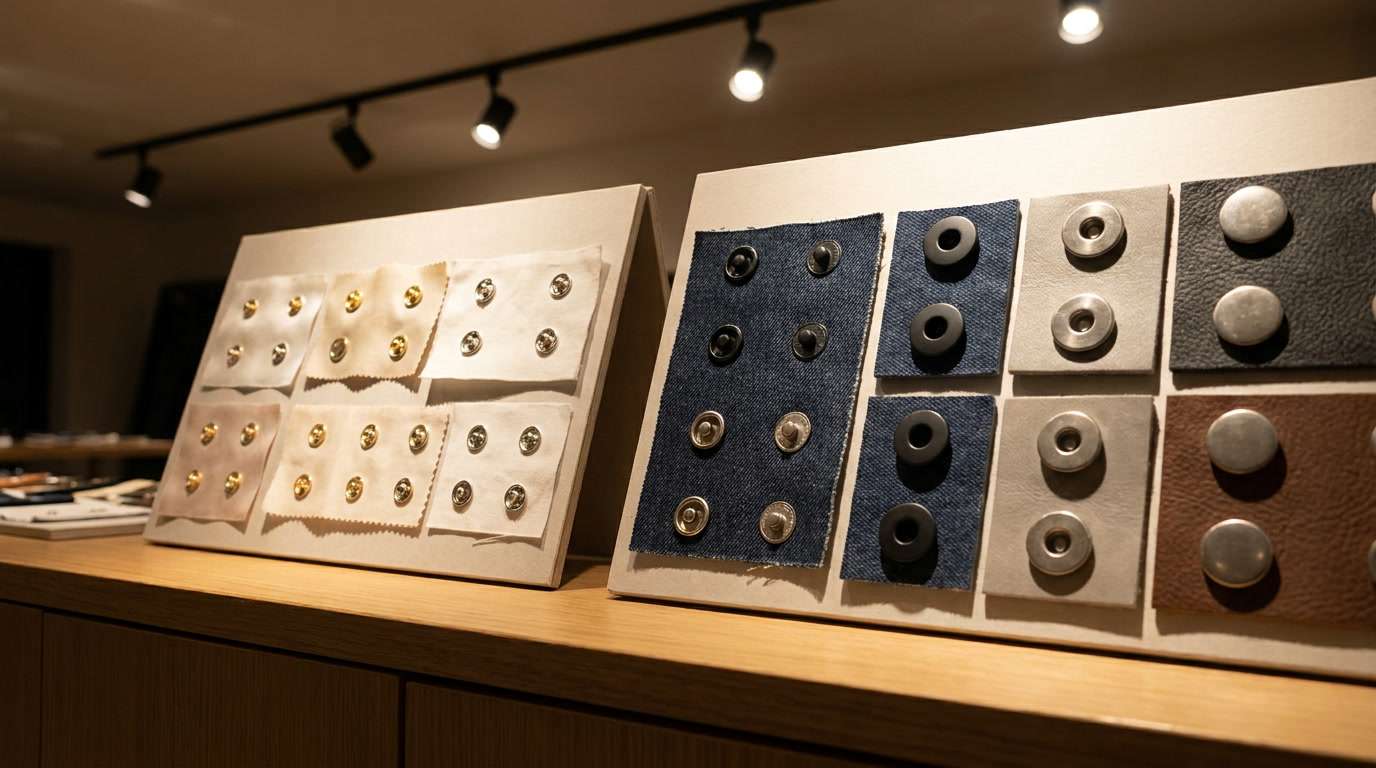
Snap Button Locking Mechanisms Explained: Interference Fit, Elastic Deformation and Mechanical Retention
A metal snap button looks mechanically simple. The user aligns two halves, presses them together, hears or feels a click, and later pulls them apart.
Inside that apparently simple action is a carefully controlled sequence of elastic deformation and geometric interference.
The female socket contains an elastic retaining structure. The male stud has a profile deliberately designed to be larger than part of the socket opening during engagement. When the stud enters, the retaining structure temporarily moves outward. After the largest engagement region passes, the spring recovers toward its original position and settles around a narrower region of the stud.
The snap is now mechanically retained.
To open it, the stud must force that spring structure through another controlled deformation cycle.
This is the essential mechanical principle behind reusable metal snap fasteners.
Understanding this mechanism is important for buyers because two products with nearly identical cap diameters can have very different:
- closing force;
- release force;
- retention;
- cycle durability;
- substrate compatibility.
The difference is often hidden inside the Socket–Spring–Stud relationship.
The Three Principles Behind a Snap Lock
A snap-button locking mechanism can be understood through three connected engineering concepts:
- controlled interference;
- elastic deformation;
- mechanical retention.
Each one performs a different role.
Controlled Interference
The stud is intentionally too large to pass freely through the effective retaining opening of the socket.
The parts therefore interfere geometrically during engagement.
Elastic Deformation
The socket spring temporarily deforms to allow the wider stud profile to pass.
The deformation should remain within a controlled elastic working range so that the spring can recover repeatedly.
Mechanical Retention
After engagement, the spring occupies a region behind the wider portion of the stud.
The stud cannot leave without forcing the spring to deform again.
This geometric barrier creates retention.
Interference Fit in a Snap Is Dynamic, Not a Permanent Press Fit
The phrase “interference fit” can sometimes create confusion.
In a conventional permanent press fit, two components remain continuously compressed against each other after assembly.
A snap fastener behaves differently.
Its interference is primarily part of the engagement and disengagement process.
The critical dimensions are arranged so that the stud must temporarily displace the spring during movement.
After the stud passes the widest region, the spring partially recovers around a narrower retaining area.
A more precise description is therefore a controlled elastic interference mechanism.
This distinction matters because a reliable snap depends on repeated reversible movement rather than permanent plastic deformation.
The Socket Is the Active Female Locking Component
The socket is frequently described simply as the female part of a snap set.
Mechanically, it is much more important than that description suggests.
The socket positions and supports the elastic retaining structure that interacts with the stud.
Its geometry determines:
- where the spring is located;
- how far the spring can move;
- how the spring is supported;
- how the stud enters;
- how concentric the engagement remains.
A small dimensional change in the socket can therefore change the actual operating force.
The Stud Is Not Just a Male Pin
The stud is sometimes treated as a simple male projection.
In reality, its profile is one of the main control surfaces in the locking mechanism.
A typical stud includes:
- a lead-in region;
- a widening engagement profile;
- a maximum engagement diameter;
- a retaining-neck region;
- a supporting base.
The relative dimensions between these surfaces and the socket spring determine how much deformation occurs during engagement.
What Happens During Snap Closing?
The closing process can be separated into several mechanical stages.
1. Alignment
The stud approaches the center of the socket.
Good alignment allows the spring to deform more uniformly.
2. Initial Contact
The stud lead-in begins contacting the retaining structure.
Axial pressing force begins converting into outward spring movement.
3. Elastic Expansion
As the stud moves deeper, the spring expands or deflects farther.
Resistance increases as the structure moves away from its unloaded condition.
4. Maximum Interference
The widest engagement region reaches the spring.
This is normally near the point of maximum controlled elastic displacement.
5. Passage
The maximum-diameter region moves beyond the spring.
6. Spring Recovery
The spring moves inward toward its original geometry.
7. Mechanical Retention
The spring now sits around or behind a narrower portion of the stud.
The stud is trapped until sufficient opening force causes the spring to expand again.
Why the Click Happens
The characteristic “snap” sensation is the result of a rapid change in the mechanical state of the system.
During insertion, force rises as the spring deforms.
Once the widest stud region passes the retaining structure, the spring can recover inward.
The force requirement drops quickly and the components move into the retained position.
This transition creates the tactile click associated with snap fasteners.
A good click is therefore not simply sound.
It is evidence of a designed change between interference and retention.
Mechanical Retention Is More Important Than Friction Alone
Friction contributes to the way a snap feels, but friction is not the main reason a properly designed snap remains closed.
The dominant principle is geometric retention.
The spring occupies a position that prevents the wider stud region from leaving freely.
To disengage, the spring must once again move outward.
This produces a repeatable mechanical barrier.
If a snap depended only on friction, changes in lubrication, surface finish or wear could cause unpredictable retention.
Geometric locking creates a more controllable system.
Ring-Spring Locking Mechanism
In a Ring-Spring snap, a circular or split-ring elastic element is positioned inside the socket.
When the stud enters, the ring expands radially.
After the wider portion passes, the ring contracts around the retaining region.
The circular geometry means that much of the stud circumference participates in the retaining action.
This can create a strong, clearly defined engagement.
The actual force still depends on:
- ring free diameter;
- ring cross-section;
- material condition;
- radial displacement;
- stud geometry.
S-Spring Locking Mechanism
An S-Spring socket uses formed spring sections rather than the same continuous ring configuration.
When the stud enters, those spring sections move outward.
After engagement, they recover toward their original position and retain the stud.
The mechanism follows the same overall principle—controlled elastic deformation followed by mechanical retention—but the distribution of spring movement is different.
This produces a different force characteristic.
The practical lesson for sourcing is important:
Ring-Spring and S-Spring are not simply visual categories. They describe different internal mechanisms.
Spring Stiffness Controls Resistance to Deformation
The spring must resist deformation enough to create meaningful retention but remain elastic enough to operate repeatedly.
Stiffness is influenced by:
- material properties;
- cross-sectional thickness;
- spring width;
- formed geometry;
- unsupported spring length;
- working deflection.
Increasing spring stiffness generally increases resistance during engagement and disengagement.
However, excessive stiffness creates problems.
It can cause:
- unnecessarily high closing force;
- high opening force;
- higher local fabric loads;
- greater wear at the stud interface;
- increased sensitivity to installation distortion.
The strongest spring is therefore not automatically the best spring.
Elastic Deformation Must Remain Reversible
The retaining structure is expected to deform repeatedly.
For long service life, most of the functional movement should remain elastic.
If repeated operation pushes the spring into excessive permanent deformation, the free opening begins changing.
This reduces dimensional interference.
The snap gradually becomes easier to open and can eventually lose adequate retention.
Long-term snap quality therefore depends not only on initial closing force but on stable elastic recovery after repeated cycling.
The Stud Lead-In Controls Engagement Smoothness
The first contact surface of the stud determines how abruptly the socket spring begins moving.
A smooth lead-in creates a gradual transition.
This can improve:
- closing consistency;
- alignment tolerance;
- tactile feel;
- wear behavior.
A poorly matched lead-in can create sharp resistance and uneven loading.
Maximum Stud Diameter Controls Peak Spring Deflection
The widest region of the stud is normally responsible for the greatest displacement of the retaining spring.
If that diameter is increased while the socket remains unchanged, the spring has to deform farther.
The result generally includes:
- higher closing resistance;
- more stored elastic energy;
- higher release resistance.
However, excessive interference can create permanent spring set and accelerated wear.
Stud diameter therefore has to be matched rather than simply maximized.
The Retaining Neck Creates the Mechanical Barrier
After the widest stud region passes through the spring, the spring moves inward around a narrower neck.
This difference in diameter creates the mechanical barrier.
Before the stud can leave, the spring has to climb back over the wider region.
The depth and shape of this geometry affect:
- retention;
- release force;
- tactile snap action;
- wear concentration.
Why Component Compatibility Is Critical
A socket and stud that look similar should never automatically be considered interchangeable.
Different product families can use small dimensional differences that are difficult to identify visually.
Mixing unmatched components can cause:
- extremely loose engagement;
- abnormally high closing force;
- spring damage;
- inconsistent release;
- poor cycle life.
For B2B sourcing, the complete component combination should therefore be approved as one fastening system.
Manufacturing Tolerance Changes Real Locking Performance
Snap mechanisms operate through very small dimensional differences.
This means manufacturing tolerance directly influences force.
Consider one production condition:
- stud diameter near its upper limit;
- socket opening near its lower limit.
The resulting interference becomes higher than nominal.
The snap feels tighter.
Now reverse the condition:
- stud near the lower limit;
- socket opening near the upper limit.
Retention decreases.
Quality control should therefore consider functional force consistency, not only individual dimensional compliance.
Material Selection Changes the Elastic Mechanism
Material affects how spring and formed components respond to loading.
Important properties include:
- elastic response;
- yield behavior;
- work hardening;
- formability;
- wear resistance;
- environmental resistance.
A brass snap fastener can provide excellent forming and decorative finishing flexibility, but its locking performance still depends on the exact socket, spring and stud design.
Changing base material without revalidating the geometry can change the final force profile.
Surface Finish Changes Friction but Does Not Replace Mechanical Locking
Surface condition influences the sliding contact between spring and stud.
This includes:
- plating thickness;
- coating thickness;
- surface roughness;
- lubricity;
- wear;
- contamination.
Products such as black snap fasteners can use different black finishing systems depending on material and project requirements.
The final finish should therefore be included in functional validation because coating and plating can influence friction and effective dimensions.
Installation Can Distort the Locking Mechanism
A correctly manufactured snap can perform incorrectly after poor installation.
Setting pressure is used to permanently attach the hardware to the substrate.
If the die also deforms the socket body unintentionally, the spring geometry can change.
Possible consequences include:
- reduced socket opening;
- increased interference;
- spring misalignment;
- abnormally high closing force;
- reduced retention if the socket opens or tilts.
Functional testing should therefore use installed components rather than only loose parts.
The Locking Mechanism and Attachment Mechanism Are Different
A snap has two independent mechanical relationships.
The first is the reusable lock:
Socket ↔ Stud.
The second is permanent attachment:
Hardware ↔ Substrate.
A strong lock is useless if the hardware pulls out of the material.
Likewise, strong attachment does not help if the socket and stud release too easily.
These two interfaces should be engineered together.
Snap Buttons for Jeans: Strong Retention Must Match Denim Construction
snap buttons for jeans may be installed on dense denim, folded seams, pockets, waist tabs or fashion details.
Denim provides more local support than many lightweight fabrics, but the exact construction still matters.
A four-layer folded region can tolerate a different opening load from a single-layer pocket detail.
Designers should consider:
- denim weight;
- number of layers;
- reinforcement;
- opening frequency;
- direction of user pull.
The locking mechanism should be selected around the actual installed structure rather than the word “denim” alone.
Leather Snaps and Fasteners Need Controlled Mechanical Retention
leather snaps and fasteners are often used on belts, bags, wallets, straps and accessories.
Leather can provide excellent local support, but its mechanical behavior varies enormously with:
- thickness;
- firmness;
- number of layers;
- surface treatment;
- edge distance.
A heavy leather strap can support a stronger lock than a thin luxury leather flap.
Excessive snap retention on thin leather can enlarge the installation hole before the socket releases.
Snaps for Vinyl Need a Different Load Strategy
snaps for vinyl operate on a substrate that behaves very differently from woven garment fabric.
Vinyl can stretch locally, develop stress whitening or tear around a concentrated installation point.
For these applications, the fastening system needs to balance:
- socket retention;
- attachment area;
- vinyl thickness;
- reinforcement;
- temperature-dependent flexibility.
A stronger internal snap mechanism cannot compensate for an inadequately supported vinyl installation.
Canvas Snap Fasteners and Repeated Tensile Loading
canvas snap fasteners frequently operate on covers, bags, outdoor textiles and technical fabric products.
Canvas can support relatively high local loads, especially when reinforced, but repeated opening can still fatigue the installation area.
The snap mechanism should therefore be selected together with:
- canvas weight;
- coating;
- reinforcement layers;
- snap spacing;
- expected opening cycles.
Upholstery Snaps Require Secure Retention Without Excessive Service Force
upholstery snaps can be used where textile panels, cushions or covers need to remain positioned but still be removable.
The correct mechanism depends on how frequently the product is removed.
A closure opened only during maintenance can tolerate a stronger retention target than a frequently accessed textile panel.
Substrate backing and foam compression can also influence the real installed condition.
Marine Snap Fasteners Add Corrosion to the Locking Equation
marine snap fasteners operate in environments where mechanical retention and corrosion resistance have to work together.
Moisture and chloride exposure can alter the contact surfaces between spring and stud.
Corrosion products can:
- increase friction;
- restrict spring movement;
- change release force;
- accelerate local wear.
Long-term locking performance therefore depends on environmental material selection, not only initial snap strength.
Boat Snap Fasteners Need Reliable Retention Under Cyclic Tension
boat snap fasteners used on covers and marine textile assemblies can experience wind movement, vibration, repeated tension and frequent opening during installation or removal.
The system should balance:
- resistance to unintended opening;
- reasonable manual release;
- secure substrate attachment;
- corrosion resistance;
- cycle durability.
Increasing spring force alone does not solve every marine fastening problem.
Corrosion Changes the Mechanical Interface
Corrosion is particularly important because snap operation includes sliding contact.
Surface degradation can change:
- friction;
- effective clearance;
- spring mobility;
- wear behavior.
This can make an originally consistent snap progressively harder or less predictable to operate.
Cycle Life Depends on Elastic Recovery
A reusable snap experiences the same engagement sequence hundreds or thousands of times during its service life.
Each cycle creates:
- spring deflection;
- stud contact;
- surface sliding;
- attachment loading.
A high-quality locking mechanism should retain stable functional geometry after repeated operation.
Important failure modes include:
- spring permanent set;
- stud wear;
- socket deformation;
- surface finish wear;
- attachment loosening.
Why a Snap Becomes Loose
One common failure is gradual loss of retention.
This can happen when the spring free opening increases because of permanent deformation.
It can also result from:
- stud diameter wear;
- socket distortion;
- component mismatch;
- corrosion;
- installation movement.
Failure analysis should identify which geometric relationship has changed.
Why a Snap Becomes Too Tight
Excessive operating force can come from:
- stud diameter too large;
- spring opening too small;
- excessive spring stiffness;
- thick plating changing clearance;
- installation distortion;
- corrosion increasing friction.
A snap that is difficult to open is not automatically stronger or higher quality.
Retention Should Be Specified as a Functional Window
A practical specification should avoid a simple statement such as “make the snap as tight as possible.”
The correct mechanism needs:
- enough retention to resist accidental opening;
- low enough release force for normal user operation;
- force compatible with substrate strength;
- stable behavior after repeated cycling.
That usually means defining an acceptable performance range rather than maximizing one number.
What Buyers Should Include in a Locking-Mechanism RFQ
A professional RFQ should include:
- finished product application;
- actual substrate;
- installation location;
- total material thickness;
- number of layers;
- preferred Ring-Spring, S-Spring or other mechanism if already known;
- reference sample;
- desired closing feel;
- desired release behavior;
- opening frequency;
- base material;
- surface finish;
- environmental exposure;
- existing installation equipment.
This information allows the supplier to develop the mechanism around the real application rather than choosing only by cap appearance.
Ultra-Low Magnetic Snap Components
Some apparel and technical-product projects also require extremely low magnetic permeability after stamping and forming.
This is particularly important in needle-detection and magnetically sensitive applications.
Forming can change the magnetic response of some conventional austenitic stainless steels, so finished-component performance is the relevant consideration for demanding projects.
JSW20 for Snap Locking Components
Baocheng / BC New Material can manufacture finished snap products and customized snap components using patented JSW20 ultra-low magnetic permeability stainless steel where the specific component geometry and project requirements are suitable.
JSW20 retains extremely low magnetic permeability after forming and also provides chloride-corrosion resistance.
This allows low-magnetic performance and corrosion requirements to be considered together in suitable apparel, outdoor and technical fastening projects.
BC New Material supplies finished JSW20 products and customized components rather than raw JSW20 coils or sheets.
Custom Snap Locking Mechanism Development at BC New Material

Baocheng / BC New Material supplies finished metal snap buttons, press studs and customized components for apparel, denim, leather goods, bags, canvas, upholstery, outdoor textiles and marine applications.
Development can address the complete fastening system rather than only the visible cap.
Depending on the project, customization can include:
- socket and spring structure;
- stud engagement profile;
- cap diameter and profile;
- post or attachment dimensions;
- base material;
- surface color and finish;
- logo and embossing;
- opening and closing behavior;
- component combinations matched to actual substrate thickness.
Sampling can use the customer's real denim, leather, vinyl, canvas, upholstery fabric or multilayer construction.
This allows the project to evaluate:
- engagement feel;
- mechanical retention;
- release force;
- attachment strength;
- substrate deformation;
- surface appearance.
Material options can include brass, 304 stainless steel, 316 stainless steel, patented JSW20 ultra-low magnetic permeability stainless steel and other project-appropriate metals depending on component geometry.
Where applicable to the specific project and relevant certificate scope, development can also consider REACH, RoHS, OEKO-TEX and nickel-release requirements.
Conclusion: A Snap Locks Through Controlled Elastic Geometry
A snap-button locking mechanism is fundamentally a controlled elastic geometric system.
The stud is deliberately designed to interfere with the socket spring during engagement.
The spring temporarily deforms.
After the widest stud region passes, elastic recovery moves the retaining structure into a mechanically secure position.
Opening requires that geometric barrier to be overcome again.
This is why interference, elastic deformation and mechanical retention must be understood together.
The socket determines how the spring is supported.
The spring determines resistance to movement.
The stud determines the required deformation and the geometry of the retained position.
Material, tolerance, surface finish, installation and service conditions then determine whether that mechanism remains stable in real use.
The best snap is therefore not simply the tightest snap.
It is the locking system whose geometry, elastic response, release force and attachment strength are properly matched to the finished product.
Focused FAQ
How does a snap button actually lock?
The stud temporarily deforms the elastic retaining structure inside the socket. After the widest stud region passes, the spring recovers around a narrower retaining area and creates a mechanical barrier against separation.
Is a snap button held together only by friction?
No. Friction affects operating feel, but reliable retention primarily comes from elastic spring deformation and geometric mechanical engagement.
What is interference fit in a snap fastener?
It is the intentional dimensional overlap between the effective socket opening and the wider engagement portion of the stud, which requires the spring to deform during closing and opening.
Why does the socket spring need to deform elastically?
Elastic deformation allows the spring to move during engagement and return toward its original geometry after each cycle so the fastener can be reused repeatedly.
What is the difference between Ring-Spring and S-Spring locking?
Both rely on elastic deformation, but Ring-Spring uses a ring-shaped retaining element while S-Spring uses formed S-type spring sections, producing different force characteristics.
How does stud geometry affect snap retention?
The stud controls how far the socket spring must deform and where it sits after engagement. Maximum diameter and retaining-neck geometry are especially important.
Why can two similar snap buttons feel different?
Small differences in spring geometry, stud profile, material, tolerances, plating and installation can change interference and operating force substantially.
Can installation damage the locking mechanism?
Yes. Incorrect dies or excessive pressure can distort the socket and alter spring geometry, producing a snap that is too tight, too loose or inconsistent.
Why do snap buttons become loose after repeated use?
Permanent spring deformation, stud wear, socket distortion, corrosion or attachment movement can reduce the original geometric interference.
Does stronger retention always mean a better snap?
No. Excessive retention increases user effort and transfers more load into the substrate, which can cause pull-out or tearing.
Can Baocheng customize snap locking behavior?
Yes. Baocheng / BC New Material can develop socket, spring, stud and attachment configurations around the customer's actual substrate, target opening behavior, materials and surface requirements.
Can JSW20 be used in finished snap components?
Where the component geometry and project requirements are suitable, Baocheng can manufacture finished snap components from patented JSW20 ultra-low magnetic permeability stainless steel. JSW20 retains extremely low magnetic permeability after forming and also provides chloride-corrosion resistance.
#SnapButtons, #SnapFasteners, #LockingMechanism, #InterferenceFit, #ElasticDeformation, #MechanicalRetention, #SocketGeometry, #StudProfile, #GarmentHardware
