






Snap Button Holding Force Explained: Closing Force, Release Force and Retention Are Not the Same
“Holding force” sounds like one measurable property, but in snap-button development it is often an imprecise label applied to several different events. A fastener must first close, remain engaged during use, open when the user intends to release it, and stay permanently attached to the garment or substrate throughout all of those operations. Each event follows a different load path and needs a different test definition.
This distinction matters because a snap can pass one force check and still fail in the finished product. A system can require a high force to open yet pull out of lightweight fabric. It can close with a reassuring click but lose retention after repeated cycling. It can remain securely attached to leather while the socket and stud disengage too easily. A single number called “snap strength” cannot describe all of these outcomes.
For reliable sourcing, buyers and snap fastener manufacturers need to agree on the property being measured, the specimen construction, the loading direction, the test speed, the conditioning history, the result to report and the acceptable force window. Without those details, two laboratories can test the same nominal snap and produce values that are not directly comparable.
The Four Properties Buyers Most Often Confuse
| Property | What Is Measured | Typical Load Direction | Main Product Risk |
|---|---|---|---|
| Closing force | Force required to push the stud through the socket's retaining structure and reach a confirmed closed position | Compression, normally perpendicular to the snap plane | Hard operation, incomplete engagement, socket damage or poor assembly ergonomics |
| Release or unsnapping force | Force required to disengage an already closed socket and stud under a defined test direction | Perpendicular pull, parallel pull, shear-like loading or a separately defined peel arrangement | Accidental opening, difficult operation or excessive load transferred to the substrate |
| Retention | The ability of the closed system to remain engaged under its intended service loads and exposures | Application-dependent and often multidirectional | Opening during wear, vibration, movement or repeated use |
| Attachment strength | Resistance of the cap, socket, stud, post or prong ring to detachment from its mating component or the substrate | Tensile pull using a defined grip and fixture | Hardware pull-out, fabric tear, post failure or component separation |
The table shows why “stronger snap” is not a complete requirement. Strength can refer to the reusable engagement or to the permanent attachment. A well-engineered product needs both, but increasing one force does not automatically improve the others.
Closing Force Describes Engagement, Not Holding After Closure
Closing force is the compressive load needed to move the male stud through the elastic retaining feature in the female socket. During engagement, the lead-in portion of the stud contacts the spring. Continued movement expands or deflects the spring until the widest engagement region passes. The spring then recovers toward the retaining neck, and the components reach the seated position.
A useful snap button closing force test therefore needs more than a force gauge placed over two loose parts. It should define:
- whether the components are loose or installed in the production substrate;
- the alignment and support fixture;
- the compression speed;
- the force at which contact begins;
- the peak force during spring expansion;
- the displacement or physical criterion confirming full engagement;
- whether the first closure or a conditioned closure is reported.
The peak compressive force and the force needed to keep the parts seated are not necessarily the same. A force-displacement trace normally rises as the spring is deflected, reaches a peak near the critical interference point and then falls when the spring enters the retaining region. Reporting only the final compressive reading can miss the true operating peak.
Closing force is especially important when snaps are operated by children, older users, gloved workers or people with limited hand strength. It also matters in automated assembly or product inspection, where incomplete engagement can look closed while the stud has not fully passed the retaining feature.
Closing Feel and Measured Closing Force Are Related but Not Identical
Users often describe a snap as crisp, soft, stiff, smooth or difficult. These descriptions combine several sensations: the initial resistance, the rate at which force rises, the peak load, the sudden force drop after engagement, sound, surface friction and the flexibility of the surrounding material.
Two snaps can reach the same peak closing force while feeling different. One may rise gradually over a longer displacement; another may produce a sharp peak close to the seated position. For this reason, the development team should consider the complete force-displacement curve and an approved physical sample, not only one peak value.
A numerical force limit is still valuable, but it should be connected to the product experience. The best specification combines measurable limits with a clear definition of complete seating and confirmation on the actual garment or product construction.
Release Force Measures Deliberate Disengagement
Release force is measured after the snap has been fully closed. The test applies a separating load until the retaining structure expands or deflects enough for the stud to leave the socket. This force is what users experience when they open the closure, but the measured result depends strongly on how the load is applied.
A snap fastener release force test must identify the loading direction. ASTM D4846, Standard Test Method for Resistance to Unsnapping of Snap Fasteners, covers the force required to disengage snap fasteners by pulls perpendicular and parallel to the plane of the fastener. Those configurations represent different mechanical conditions and should not be merged into one unlabeled result.
The common search phrase snap button opening force test is understandable, but a laboratory request needs greater precision. “Opening” may describe:
- a direct axial separation normal to the snap plane;
- a parallel pull across the snap plane;
- a peel action initiated from one edge of a flexible flap;
- a real-product opening motion applied at a defined distance from the snap.
These arrangements change leverage, substrate deformation and the order in which the socket releases around the stud. Results from different directions are useful for different purposes, but they are not interchangeable.
Release Force Is Not Automatically the Same as Retention
Release force is a measured event under a controlled procedure. Retention is the broader functional outcome: the snap remains closed during the loads, movement, vibration, flexing and environmental exposure expected in service.
A buyer requesting a snap fastener retention force test should define what “retention force” means in that project. It may mean the peak force required for direct unsnapping, a sustained load that the closed snap must withstand for a specified time, or resistance to accidental opening under cyclic or off-axis loading. Those are different tests.
Retention depends on more than the first release-force result. It also depends on:
- how the garment distributes load around the snap;
- whether the load is constant, repeated, vibrating or impact-like;
- the direction and eccentricity of the load;
- socket and stud wear;
- spring recovery after repeated deformation;
- surface changes caused by washing, abrasion, sweat or corrosion;
- substrate stretch, creep and hole enlargement;
- installation stability.
A single initial unsnapping value is therefore one indicator of retention, not a complete retention program.
Attachment Strength Follows a Different Load Path
Attachment strength answers a different question: will the hardware remain permanently fixed to the material and to its corresponding attachment component? For a four-part snap, possible attachment failures include cap-to-socket separation, post-to-stud separation, prong-ring pull-off, post pull-through, fabric tearing and hole enlargement.
A snap fastener attachment strength test deliberately loads the installed attachment. ASTM D7142, Standard Test Method for Holding Strength of Prong-Ring Attached Snap Fasteners, addresses the holding strength of a prong ring to the socket or stud using a tensile testing machine or a manual force-measuring arrangement. The standard also recognizes testing the fastener and fabric as a combined unit when evaluating compatibility for apparel.
This is not the same test as unsnapping. During a normal release test, the socket and stud should disengage while the installed components remain attached. During an attachment-strength test, the objective is to challenge the permanent connection and record the failure mode.
If opening force exceeds the safe load capacity of the installed substrate, the user may pull the hardware out before the snap releases. The fastener then appears “strong” in isolation but is unsuitable for the finished product.
Why “Pull Strength” Is Too Ambiguous for an RFQ
The phrase snap button pull strength test can refer to at least three different procedures:
- pulling the closed socket and stud apart;
- pulling an installed component away from the substrate;
- pulling one permanently joined snap component away from its attachment partner.
Each procedure can produce a result in newtons, but the numbers describe different failure mechanisms. A test request should replace “pull strength” with the exact component pair, specimen construction, loading direction and endpoint.
Better specification: “Measure perpendicular unsnapping force of the installed socket-and-stud pair after five conditioning cycles” is much clearer than “snap pull strength must be 35 N.” The example value should be replaced by a project-approved range based on the actual product.
ASTM Unsnapping Methods Do Not Automatically Define Closing Force
ASTM D4846 is an active method for resistance to unsnapping. It should not be cited as if it also establishes the procedure for engagement force. ASTM has opened work item WK89406 to develop a method for determining the compressive force required to engage snap fasteners. A work item is not the same as a published active standard, so buyers should verify its current status before citing it in a contract or test plan.
Until a project adopts an applicable published method, closing-force control should be based on a documented internal or mutually agreed procedure. The procedure needs enough detail for both supplier and buyer laboratories to reproduce it.
A Repeatable Force Test Starts With the Specimen
The specimen is part of the mechanical system. Testing loose components may help compare socket-and-stud geometry, but it does not reproduce the distortion, compliance and alignment introduced by installation.
For finished-product approval, the specimen definition should include:
- substrate material and construction;
- fabric mass or leather thickness where relevant;
- number of layers and any reinforcement;
- coating, lamination or backing;
- hole preparation method;
- post, eyelet or prong length;
- setting die identification;
- installation force or machine setting;
- component orientation and edge distance;
- base material and final surface finish.
A change to post length, reinforcement or die support can alter attachment strength without changing the nominal snap family. Excessive setting pressure can also distort the socket and change the intended closing and release forces. The installed specimen is therefore the correct final validation platform.
Test Equipment and Fixtures Must Match the Property
A universal tensile/compression tester with an appropriate load cell provides controlled speed and a force-displacement record. A manual stand and force gauge can be suitable for certain defined checks, but equipment operating on different principles should not be assumed to produce interchangeable results. ASTM D7142 specifically warns against comparing results from equipment based on different operating principles and gives precedence to motorized constant-rate-of-extension equipment when its two options conflict.
Regardless of equipment type, the method should document:
- load-cell range, resolution and calibration status;
- fixture geometry and grip surfaces;
- alignment of the snap axis with the test axis;
- preload or zeroing procedure;
- crosshead or fixture speed;
- initial gauge distance;
- data-acquisition rate;
- peak-selection rule;
- specimen rejection criteria;
- failure-mode classification.
A force value without these conditions is difficult to reproduce and weak as a supplier-control requirement.
First-Cycle, Conditioned and End-of-Life Results Answer Different Questions
New snap components may show different force behavior during their first few operations as contact surfaces settle. A project should state whether the recorded value is taken on the first operation, after a defined number of preconditioning cycles or at multiple stages.
A snap button cycle test repeatedly engages and disengages the system. It reveals whether the retaining spring takes a permanent set, the stud wears, the finish changes friction, or the installation begins to loosen. The useful output is not merely “survived the cycles.” It is the change in closing force, release force, visible condition and attachment stability between defined checkpoints.
A broader snap fastener durability test can combine cycling with washing, humidity, sweat simulation, abrasion, temperature exposure or chloride-containing environments when these are relevant to the product. The sequence matters. Measuring release force before and after exposure shows whether the fastening behavior remains within its approved window.
Use an Acceptance Window, Not One Ideal Number
Manufacturing always includes dimensional and material variation. The objective is not to make every snap produce one identical reading; it is to keep the population within a functional range.
A practical specification can define:
- a minimum release force to reduce accidental opening;
- a maximum release force to protect usability and the substrate;
- a maximum closing force to prevent difficult engagement;
- a minimum attachment strength with an approved failure-mode rule;
- allowable change after cycling or environmental exposure;
- sample quantity, lot definition and acceptance criteria.
Average-only limits are often insufficient. A batch can have an acceptable mean while individual snaps fall outside the usable range. Procurement teams should decide whether control is based on individual minima and maxima, the mean, variation, an AQL plan or a combination of these measures.
ASTM D4846 and D7142 both note the importance of comparative testing when laboratories disagree. The buyer and supplier should align their procedures and evaluate comparable specimens before using interlaboratory differences as evidence of a product defect.
Why Forces Drift Between Samples or Production Lots
Closing and release forces are sensitive to small mechanical relationships. Common drivers include:
- socket spring opening and spring-section geometry;
- stud engagement diameter and retaining-neck profile;
- component thickness and material condition;
- forming variation and residual deformation;
- concentricity and alignment;
- plating or coating thickness;
- surface roughness and lubrication;
- wrong post length or incorrect die;
- substrate compression and reinforcement;
- wear, contamination or corrosion.
A large variation in measured force should not be corrected blindly by increasing spring tension. The failure analysis should first identify whether the source is component geometry, material condition, finishing, installation or the test setup.
Different Applications Need Different Force Balances
Lightweight Apparel
Shirts, dresses and lightweight jackets generally need comfortable operation and protection against fabric distortion. Excessive release force can enlarge the installation hole or cause users to pull the garment instead of gripping the snap.
Denim and Workwear
Denim jackets and work garments often tolerate a firmer operating force, but multi-layer plackets and reinforcement still need a matched post length and controlled installation. High retention does not compensate for a poorly formed post.
Leather Goods and Bags
Leather can provide a strong attachment foundation, yet thickness, firmness, edge distance and backing influence both pull-out strength and opening feel. A bag flap opened from its edge creates a peel-like load that differs from a direct axial laboratory pull.
Canvas, Outdoor and Marine Textiles
Canvas covers and outdoor textiles encounter wind, vibration, moisture and repeated localized loads. Retention needs to be assessed together with reinforcement, installation strength and corrosion resistance. The correct product is not simply the snap with the highest initial unsnapping force.
A Better RFQ Separates Every Requirement
| RFQ Field | Information to Provide |
|---|---|
| Snap system | Complete cap, socket, stud and post/prong-ring combination; drawing or approved sample |
| Application | Garment or product type, snap location and actual use motion |
| Substrate | Material, thickness, layers, reinforcement and coating |
| Closing requirement | Test procedure, peak-force window, seating criterion and conditioning state |
| Release requirement | Perpendicular, parallel or other defined direction; force window and method |
| Retention requirement | Service load, duration, direction, cycling and exposure conditions |
| Attachment requirement | Component pair, fixture, minimum force and permitted failure mode |
| Durability | Cycle count, wash/exposure sequence and allowable force change |
| Material and finish | Base metal, grade, color, plating/coating and environmental requirements |
| Production control | Lot definition, sample plan, reporting statistics and dispute procedure |
This structure turns subjective language such as “medium strength” into a testable product requirement.
How Baocheng Develops a Force-Matched Snap System
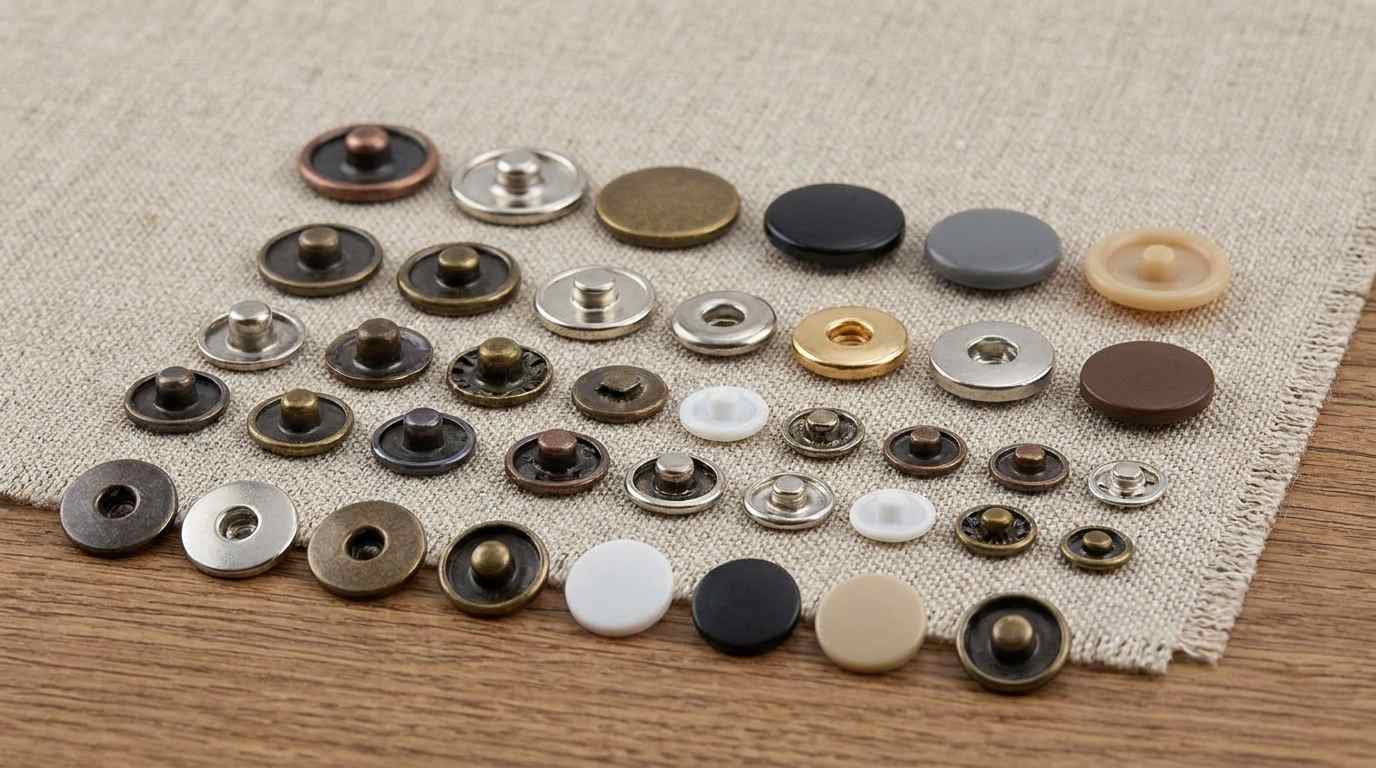
Baocheng / BC New Material supplies finished metal snap buttons, press studs and customized snap components for apparel, denim, leather goods, bags, workwear, canvas and technical-textile applications. Development can start from a customer's drawing, approved snap sample, finished garment, target force window or actual substrate stack.
Depending on the project, customization can cover:
- socket and spring construction;
- stud engagement and retaining profile;
- cap diameter, profile, logo and decorative surface;
- post, eyelet or prong dimensions;
- component gauge and base material;
- color, plating and surface finish;
- setting dies and installation parameters;
- closing and release behavior matched to the product;
- sample validation on the customer's actual fabric, leather, canvas or multilayer construction.
The development objective is a balanced system: the snap closes completely without excessive effort, resists unintended opening, releases within the intended user range and remains securely attached after repeated use.
Where JSW20 Solves a Different but Related Material Problem
Force performance depends on geometry, material condition and installation. Some projects also have an additional requirement: the finished stamped and formed snap components must retain extremely low magnetic permeability.
Conventional austenitic stainless steels can show increased magnetic response after substantial cold forming. This creates a pain point for apparel programs using needle detection and for products used near magnetically sensitive equipment. Specifying a generic “non-magnetic stainless steel” does not always control the behavior of the finished component.
Baocheng can manufacture suitable finished snap components from patented JSW20 ultra-low magnetic permeability stainless steel. JSW20 retains extremely low magnetic permeability after forming and also provides chloride-corrosion resistance. This combination addresses projects that need both low magnetic response and environmental durability, including applications exposed to perspiration, washing or chloride-containing conditions.
JSW20 does not eliminate the need to validate force performance. A change of base material can alter forming response, spring behavior, friction and wear, so the finished JSW20 component set should be tested using the same closing, release, retention, attachment and durability requirements established for the product.
Baocheng supplies finished products and customized components manufactured from JSW20; it does not sell raw JSW20 coils or sheets. Material options for other projects can include brass, 304 stainless steel, 316 stainless steel, zinc alloy and other structure-appropriate materials. Where applicable to the specific product and certificate scope, project documentation can also address REACH, RoHS, OEKO-TEX and nickel-release requirements.
Conclusion: Define the Force Before You Specify the Number
Closing force, release force, retention and attachment strength describe different stages in the life of a snap button. Closing force measures engagement. Release force measures deliberate disengagement under a defined direction. Retention describes the ability to remain closed under service conditions. Attachment strength measures whether the installed hardware stays permanently fixed to its component partner and substrate.
A dependable specification identifies the load path, specimen, fixture, speed, conditioning, endpoint, units, sample plan and acceptable range for each property. It also checks how those values change after cycling and relevant environmental exposure.
The correct snap is not the one with the highest number. It is the system whose operating forces, attachment strength, durability, substrate compatibility, material and installation process work together in the finished product.
Focused FAQ
Is snap button holding force the same as release force?
Not necessarily. Release force is a measured force required to disengage a closed socket and stud under a defined procedure. Holding force is often used informally and can refer to release behavior, retention in service or attachment strength. The RFQ should define the exact property.
What is closing force?
Closing force is the compressive force required to move the stud through the socket's retaining structure and reach a confirmed fully engaged position. It should be measured with a defined alignment, speed, specimen condition and seating criterion.
Why can closing force and release force be different?
The lead-in and release sides of the stud profile do not create identical contact paths. Spring recovery, friction, retaining-neck geometry and substrate deformation also affect engagement and disengagement differently.
Does ASTM D4846 measure snap closing force?
No. ASTM D4846 covers resistance to unsnapping by pulls perpendicular and parallel to the snap plane. Closing-force testing requires a separately defined procedure unless an applicable published method is adopted for the project.
What does ASTM D7142 measure?
ASTM D7142 measures the holding strength of a prong ring to the socket or stud of a snap fastener. It addresses permanent component attachment rather than normal socket-to-stud unsnapping.
Should release force have both a minimum and a maximum?
Usually yes. A minimum reduces accidental opening, while a maximum protects usability and reduces the load transferred to the substrate when users open the snap.
Why should force testing use installed specimens?
Installation can distort the socket, change alignment and alter substrate compliance. Post length, die geometry, setting pressure, material thickness and reinforcement all affect the finished mechanical system.
Why does pull direction matter?
A perpendicular pull, parallel pull and edge-peel motion load the retaining structure and substrate differently. Values from different directions should be reported separately and should not be treated as equivalent.
How should snap durability be reported?
Report the cycle or exposure sequence, force values at defined checkpoints, visible condition, attachment stability and failure mode. “Passed” alone does not show whether release force drifted outside the approved window.
Can Baocheng customize closing and release force?
Yes. Baocheng / BC New Material can develop socket, spring, stud, attachment and material combinations around the customer's target behavior and actual substrate, followed by project-specific sampling and validation.
What problem does JSW20 solve in snap-button projects?
JSW20 is a patented ultra-low magnetic permeability stainless steel that retains extremely low magnetic permeability after forming and also provides chloride-corrosion resistance. It is relevant to finished snap components for projects combining magnetic-control and environmental-resistance requirements.
Does Baocheng sell raw JSW20 stainless-steel material?
No. Baocheng supplies finished products and customized components manufactured from JSW20 rather than raw JSW20 coils or sheets.
#SnapButtonHoldingForce, #SnapButtonTesting, #SnapFastenerTesting, #ClosingForce, #ReleaseForce, #RetentionForce, #AttachmentStrength, #CustomSnapButtons, #BCNewMaterial