







Cap, Socket, Stud and Post Explained: Understanding the Four Components of a Snap Button
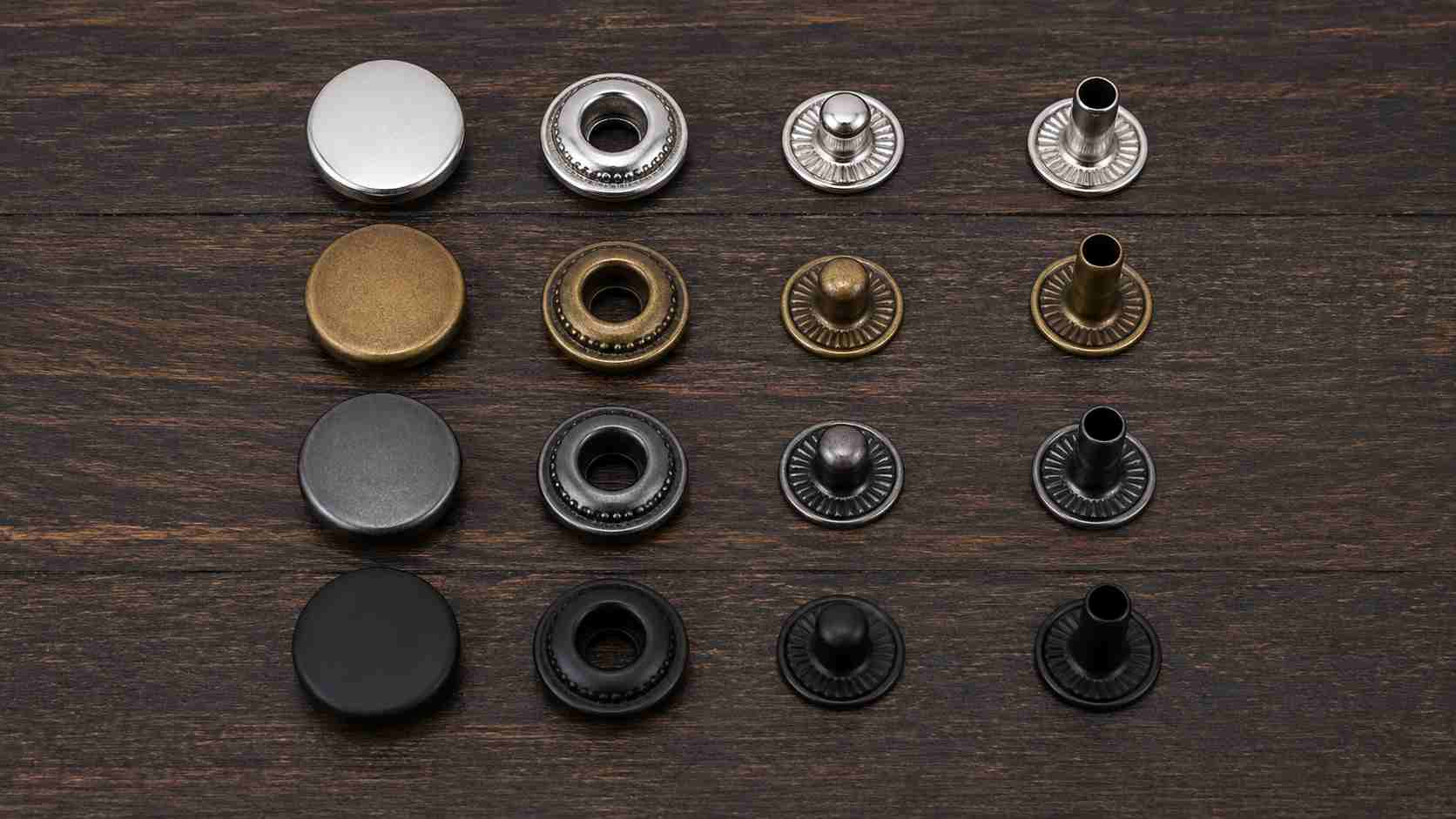
Cap, Socket, Stud and Post: Why the Four Parts Matter
A metal snap button may look like one small piece of hardware after it is installed, but a conventional four-part system is actually assembled from four separate components: the cap, socket, stud and post. Each part has a different mechanical responsibility, and reliable fastening depends on all four being correctly designed, matched and installed.
The cap and socket normally form one installed half of the snap. The stud and post form the other. During everyday use, the socket repeatedly engages and releases the stud. During production, however, the cap and post are also responsible for helping anchor the two snap halves permanently to the substrate.
This distinction explains why buyers should understand individual components rather than specifying only “a 15 mm snap button.” A visible diameter alone says very little about the socket geometry, stud profile, post length or installation compatibility of the complete system.
For product developers, sourcing teams and quality engineers, understanding these four components provides a much stronger basis for selecting, matching and troubleshooting metal snap closure buttons.
A Four-Part Snap Button Is Really Two Installed Assemblies
The easiest way to understand the system is to divide the four components into two functional halves.
| Snap Half | Components | Permanent Function | Reusable Function |
|---|---|---|---|
| Female Half | Cap + Socket | Secures the female assembly to one material layer | Socket receives and retains the stud |
| Male Half | Stud + Post | Secures the male assembly to the opposite material layer | Stud enters and disengages from the socket |
The permanent and reusable functions must both work correctly. A socket can grip the stud perfectly while the complete snap still fails because the post has not been properly formed into the fabric. Conversely, both halves can be tightly installed while the snap itself feels loose because the socket-to-stud geometry is incorrect.
For this reason, fastening performance and installation strength should always be evaluated separately.
1. The Cap: More Than the Visible Face of a Snap Button
The cap is normally the most visible component of a snap button. It faces outward on the garment, bag, leather product or technical textile, so it plays an important role in product appearance.
Cap design can vary considerably. Buyers may specify diameter, dome height, curvature, edge profile, logo, embossing, surface texture, color or decorative finish. A plain metal cap can support a functional workwear design, while a polished or branded cap can become a visible fashion feature.
Decorative systems such as pearl snap buttons demonstrate how strongly the cap can influence the identity of the complete fastener. In these designs, the visible pearl-like surface is not just a mechanical component; it becomes part of the garment's visual language.
The cap nevertheless remains a structural part of the system. It must survive installation pressure without unacceptable denting, cracking, surface damage or distortion.
Cap Diameter Is Not the Same as Snap-System Size
One of the most common purchasing mistakes is treating the cap diameter as if it defines the complete snap.
Two products can both use a 15 mm cap while having different socket diameters, post structures, stud profiles and installation dies. A cap measurement is therefore useful for appearance and overall scale, but it cannot establish interchangeability.
When matching an existing snap, buyers should inspect the complete component set rather than measuring only the visible face.
Dome Shape and Cap Profile
Some snap caps are relatively flat, while others have a pronounced dome. Searches for dome snaps often relate to fasteners whose visible cap has a rounded or raised profile.
Dome geometry influences both appearance and tooling. The lower die must support the visible face correctly during installation. A die with the wrong curvature can concentrate pressure on a small area and create a dent, ring mark or flattened dome.
A customized cap therefore requires corresponding attention to die geometry.
Cap Material and Surface Finish
The cap also carries much of the decorative finish. Depending on project requirements, it may receive polishing, plating, coating, antique treatment, matte treatment or another surface process.
The base material and finish should be specified separately. A silver-colored cap is not automatically stainless steel, and a brass-colored cap is not necessarily solid brass.
Buyers should define both the required metal and the required visual finish.
2. The Socket: The Component That Creates the Snap Action
The socket is positioned inside the female half and performs the most important reusable locking function. When the stud enters the socket, the socket's retaining structure temporarily deflects, allows the stud to pass through the interference region and then recovers around the stud's locking profile.
This controlled elastic deformation is what creates the familiar snap sensation.
The socket therefore has to balance flexibility with stability. If it is too stiff, the fastener becomes unnecessarily difficult to close and open. If it is too weak or oversized, the stud may not be retained securely.
The Socket Determines Much of the Fastening Feel
Users often describe a snap as soft, firm, tight or loose. Much of this perceived behavior originates at the socket-and-stud interface.
Socket geometry influences:
- initial insertion resistance;
- closing force;
- retention while the snap is closed;
- opening force;
- the tactile “click” during engagement;
- consistency after repeated opening cycles.
A good design does not simply maximize retention. It creates the correct level of holding and release force for the final product.
A lightweight shirt, infant garment, denim jacket, leather case and reinforced canvas cover do not need identical snap action.
Socket Damage During Installation
The socket can also be damaged before the customer ever uses the product. Incorrect dies, excessive setting pressure or off-center installation can deform the retaining structure.
A deformed socket can create several symptoms: the snap becomes too tight, too loose, difficult to engage or inconsistent from one fastening position to another.
This is why final inspection should test actual opening and closing behavior after installation rather than inspecting only the visible cap.
3. The Stud: The Male Geometry That Must Match the Socket
The stud is the male engagement component. It enters the socket during closing and provides the geometry around which the socket locks.
A stud normally includes a lead-in region, a wider engagement area and a narrower retaining region. The exact geometry varies between snap systems, but the principle remains consistent: the stud must force the socket to deform during entry and allow it to recover after passing the locking point.
This makes the stud a precision component rather than simply a round metal projection.
Small Stud Differences Create Large Performance Changes
Because snap components are compact, small dimensional differences can significantly change performance.
Important stud features include:
- maximum engagement diameter;
- neck diameter;
- head height;
- transition radius;
- wall or sheet thickness;
- concentricity;
- surface condition.
If the head is oversized relative to the socket, opening and closing force can become excessive. If it is undersized, retention can become weak.
This is why a stud from one snap family should never be assumed compatible with a socket from another family based only on appearance.
Stud Wear and Repeated Cycling
Every opening cycle creates contact between the stud surface and socket retaining features. Material selection, surface finish and dimensional stability therefore influence long-term fastening consistency.
A properly matched system should retain controlled action rather than becoming dramatically looser after normal repeated use.
4. The Post: The Installation Component Buyers Often Underestimate
The post is the component that passes through the substrate and helps permanently attach the male half. It may receive less attention because it is usually less visible than the cap, but incorrect post selection is responsible for many installation problems.
The most important variable is usable length.
The post must extend far enough through the total material stack to form correctly during installation. At the same time, it should not be so long that excess material buckles, collapses sideways or produces an unstable joint.
Why Material Thickness Changes Post Selection
Consider three products using the same visible snap:
- a single-layer shirt;
- a folded multi-layer denim jacket;
- a leather flap with reinforcement underneath.
The visible cap diameter may be identical, but the required post geometry may not be.
Total installation thickness, compressibility and reinforcement structure determine how much post length is needed.
This is why buyers should provide the actual material stack or a representative sample during development.
What Happens When a Post Is Too Short?
An undersized post may fail to create sufficient formed material to lock the assembly securely. The component may initially appear acceptable but loosen during repeated opening.
In extreme cases, the stud side can pull out of the substrate because the formed connection lacks adequate mechanical engagement.
What Happens When a Post Is Too Long?
Excess post length creates a different set of problems. Instead of forming symmetrically, the post may bend sideways, collapse unevenly or distort the mating component.
The result can be eccentric installation, rotation, poor appearance or damage to the substrate.
Post length should therefore be matched to the material rather than selected on the assumption that “longer is safer.”
Why the Four Components Must Be Manufactured as a Matched System
The cap, socket, stud and post may be manufactured as individual metal pieces, but the finished fastener only works when dimensional relationships are controlled across the complete set.
A change in one component can influence several others.
A new cap profile can require another die. A thicker material stack can require a longer post. A modified stud diameter changes socket engagement. A different socket spring geometry changes opening force.
For this reason, buyers should avoid treating generic snap button rivets as completely interchangeable hardware. The expression can describe rivet-style installation, but the actual component geometry still determines whether the set works together.
Why Snap Buttons Are Sometimes Described as Rivet-Type Hardware
Snap buttons are mechanically set through the substrate, so buyers sometimes use terms such as rivet button snaps, rivet snap buttons or snap rivets when searching for them.
The similarity comes from the permanent installation process. Like a riveted connection, part of the snap passes through the substrate and is mechanically formed so that the hardware becomes fixed to the material.
However, a four-part snap adds a second function that an ordinary rivet does not provide: the two installed halves can repeatedly connect and disconnect.
It is therefore helpful to distinguish between:
- the rivet-like permanent attachment of the hardware to the substrate;
- the reusable socket-to-stud snap connection.
Failure in either one produces a different quality problem.
Single-End and Double-End Snap Configurations
Not every snap-button assembly presents the same visible appearance on both sides. Commercial terminology may include single end snap button, single end snap buttons and double end snap buttons.
These expressions can vary somewhat between suppliers, so buyers should confirm the exact component arrangement through drawings or samples rather than relying solely on the name.
In general, the terminology is used to distinguish how many sides of the installed fastener present a finished or cap-like visible surface and how the backing components are configured.
This matters when both sides of a garment or product remain visible. A bag flap, reversible garment, strap or decorative leather product may have different appearance requirements from a snap installed inside a concealed placket.
Whenever single-end or double-end terminology appears in an RFQ, the supplier should confirm the complete front-and-back component structure.
The Cap Changes With Fashion; the Socket and Stud Still Have to Work
Snap systems often illustrate the difference between visual customization and mechanical standardization.
A buyer may want a new cap diameter, custom logo, pearl-like face, embossed pattern or rounded dome. These visible changes can dramatically alter the appearance of the product.
But underneath that customized cap, the socket and stud still need a controlled engagement relationship.
This is particularly important with decorative products such as pearl snaps. The visible component can change for branding or fashion reasons without allowing the underlying locking geometry to become inconsistent.
Good hardware development therefore separates decorative design decisions from mechanical performance requirements while ensuring both are compatible during final assembly.
How the Four Parts Transfer Load Into the Product
When a user opens a snap, the applied force follows a load path through the complete assembly.
On one side, force travels through the socket into the cap-side attachment and surrounding substrate. On the other, it passes through the stud and post into the opposite substrate.
This means the metal snap and the material around it behave as one system.
If the substrate is weaker than the force required to release the snap, the material may tear before the socket releases normally.
This is why stronger holding force is not automatically better.
Correct design balances:
- socket-to-stud retention;
- opening force;
- local material strength;
- post installation strength;
- reinforcement design;
- expected loading direction.
Why Reinforcement Around the Snap Matters
Thin fabrics, loosely woven textiles and flexible coated materials may need reinforcement around the installation point.
Reinforcement increases local load-distribution area and reduces the tendency for the post or cap-side attachment to pull through the substrate.
Possible reinforcement approaches depend on the finished product and can include additional fabric layers, backing patches, folded plackets, reinforcement tape or a structurally stronger local construction.
The important principle is that the reinforcement should be evaluated together with post length. Adding another layer changes the total installation thickness and can require a different component configuration.
Cap, Socket, Stud and Post Tolerances Affect Batch Consistency
One sample can work correctly while a production batch performs inconsistently if component dimensions are not controlled.
The critical dimensions of the socket and stud are particularly important because they directly determine engagement. Post geometry affects installation consistency, while cap geometry affects both appearance and die support.
Quality control should therefore look beyond overall diameter.
Useful inspection items include:
- cap diameter and profile;
- cap surface quality;
- socket dimensions;
- socket retaining geometry;
- stud head and neck dimensions;
- post length and diameter;
- component concentricity;
- formed installation condition;
- opening and closing consistency.
Controlling these variables provides much more useful information than simply counting whether four components are present.
Common Failure Modes by Component
| Component | Typical Problem | Likely Result |
|---|---|---|
| Cap | Denting, scratching, deformation | Poor appearance or unstable installation support |
| Socket | Over-deformation or dimensional inconsistency | Snap becomes too loose, too tight or inconsistent |
| Stud | Incorrect head or neck geometry | Poor engagement or incorrect opening force |
| Post | Wrong length or off-center forming | Loose hardware, bending or substrate damage |
| Substrate | Insufficient local strength | Snap pulls through or tears surrounding material |
This component-based diagnosis is more effective than treating every complaint as “snap quality.”
A loose snap can come from the socket, the stud, the post, the substrate or the installation process. The visible symptom alone does not identify the root cause.
How Materials Affect the Four Components Differently
Different components experience different forms of mechanical demand.
The socket needs stable elastic behavior because it repeatedly flexes. The stud needs consistent forming and wear-resistant contact geometry. The post must deform predictably during installation. The cap must maintain its appearance while surviving setting pressure and subsequent use.
Material selection should therefore consider both manufacturing behavior and finished-product requirements.
Brass is commonly used in apparel hardware because it offers good formability and supports a wide range of decorative finishes. Stainless steel is valuable for projects requiring higher environmental resistance, specific mechanical behavior or particular magnetic characteristics.
The exact material should be selected from the final application rather than assuming that one metal is universally superior for every snap.
Why Finished-Part Magnetic Performance Matters
Projects involving needle detection or magnetically sensitive processes require additional attention.
It is not sufficient to know that a raw stainless-steel grade is generally described as low magnetic. Stamping and forming operations can alter the magnetic response of some conventional austenitic stainless steels.
For applications with strict low-magnetic requirements, the important specification is therefore the behavior of the finished formed component.
BC New Material can manufacture snap-button components using patented JSW20 ultra-low magnetic permeability stainless steel. JSW20 is designed to maintain extremely low magnetic permeability after forming and also provides chloride-corrosion resistance.
This makes it relevant to applications where both magnetic performance and environmental resistance need to be considered.
BC New Material supplies finished JSW20 products and customized components rather than selling raw JSW20 coils or sheets.
What Buyers Should Provide When Matching an Existing Snap
When an existing snap must be duplicated or replaced, sending only the visible cap is rarely enough.
The strongest reference package includes all four components.
Buyers should provide:
- complete cap, socket, stud and post set;
- installed sample if available;
- technical drawing or critical dimensions;
- actual substrate thickness;
- number of material layers;
- base-metal requirement;
- surface finish and color reference;
- logo or pattern requirements;
- installation tooling information;
- required fastening feel or approved reference sample.
If the existing product must run on current factory equipment, die compatibility should be explicitly stated as a requirement.
What Buyers Should Check During Snap-Button Sampling
Sampling should evaluate the complete installed system rather than judging loose metal components on a table.
After installation on the intended substrate, inspect:
- whether the cap remains smooth and centered;
- whether the post forms evenly;
- whether the socket remains undamaged;
- whether male and female halves align correctly;
- whether closing force is appropriate;
- whether opening force suits the application;
- whether repeated operation changes the fastening feel;
- whether the surrounding material shows tearing or distortion;
- whether the hardware rotates after setting.
This approach identifies the interaction between the four components, tooling and substrate before mass production.
Component Customization at BC New Material

Baocheng / BC New Material supplies finished metal snap buttons and customized snap components for apparel, denim, children's clothing, leather goods, bags, workwear, outdoor products and other finished-product applications.
Customization can cover the complete four-part system rather than only the decorative face.
Depending on project requirements, we can develop:
- cap diameter and cap profile;
- custom logos, embossing and surface patterns;
- socket construction;
- stud geometry;
- post dimensions and post length;
- single-end or double-end appearance configurations;
- base materials;
- colors and surface finishes;
- component combinations matched to the customer's substrate.
Samples can be evaluated using actual customer fabric, denim, leather, coated textile, canvas or other material constructions. This is important because a component set that installs correctly on one substrate does not automatically perform the same way after layer thickness, stiffness or reinforcement changes.
For projects requiring ultra-low magnetic permeability after forming, finished snap components can also be manufactured from patented JSW20 ultra-low magnetic permeability stainless steel. JSW20 additionally offers chloride-corrosion resistance.
Where applicable to the project and certificate scope, material and finishing decisions can also consider requirements such as REACH, RoHS, OEKO-TEX and nickel-release control.
How to Write a Better RFQ for Cap, Socket, Stud and Post Components
An effective RFQ should describe the complete assembly rather than simply requesting “snap parts.”
A useful structure is:
- Product: four-part metal snap button / press stud
- Application: exact garment or finished product
- Cap: diameter, profile, logo and finish
- Socket: required snap family or approved reference
- Stud: matched geometry or reference sample
- Post: required length based on substrate thickness
- Material: specified base metal
- Substrate: composition, thickness and number of layers
- Performance: required opening and closing behavior
- Environment: washing, humidity, sweat, outdoor or chloride exposure
- Compliance: project-specific requirements
- Tooling: existing machine and die compatibility where necessary
- Quantity: sample and expected production volume
Providing these details allows the supplier to evaluate the complete fastening system rather than guessing from the visible cap.
Conclusion: Every Snap Component Has a Separate Job
The four-part snap button works because the cap, socket, stud and post perform different but interconnected roles.
The cap provides the visible outer face and participates in permanent attachment. The socket supplies the elastic retaining function. The stud provides the male engagement geometry. The post connects the male half to the substrate through controlled forming during installation.
Together, these components create two permanent installed assemblies and one reusable socket-to-stud connection.
This is why a snap button should never be specified only by cap diameter or appearance. Component compatibility, post length, socket-and-stud geometry, material behavior, tooling and substrate construction all determine finished performance.
For buyers and product developers, understanding each component separately makes it much easier to diagnose failures, match existing hardware, develop custom designs and maintain consistent performance across production batches.
Focused FAQ
What are the four components of a standard metal snap button?
A conventional four-part metal snap consists of a cap, socket, stud and post. The cap and socket normally form the female half, while the stud and post form the male half.
Which snap-button component controls the closing and opening action?
The reusable fastening action occurs mainly between the socket and stud. The socket deflects as the stud enters and then recovers around the stud's locking geometry.
Is the cap only decorative?
No. The cap is the visible decorative surface, but it also participates in securing the female half of the snap to the substrate and must survive installation pressure.
Can two snap buttons with the same cap diameter use different sockets and studs?
Yes. Cap diameter does not define internal component geometry. Two visually similar snaps can use completely different socket, stud, post and die systems.
Why does post length matter?
The post must match the installed material thickness. A short post may not form securely, while an unnecessarily long post can bend or collapse during setting.
What is the difference between a single-end and double-end snap button?
The terminology generally refers to differences in the visible or finished configuration of the snap sides, but supplier definitions can vary. Buyers should confirm the actual four-component arrangement through a drawing or sample.
Are rivet snap buttons different from normal snap buttons?
The expression often emphasizes the mechanically riveted installation of the components. A snap button still differs from an ordinary rivet because its installed male and female halves repeatedly engage and disengage during use.
Can a stud from one manufacturer be used with a socket from another?
Compatibility should not be assumed. Small differences in engagement diameter, spring geometry and retaining profile can significantly change opening and closing performance.
What should a buyer send when asking a supplier to match an existing snap button?
Send all four components whenever possible, along with an installed sample, substrate thickness, drawings, finish reference and any requirement to use existing setting dies.
Can Baocheng customize the cap, socket, stud and post separately?
Yes. Baocheng / BC New Material can develop cap appearance, socket and stud structures, post dimensions, materials, finishes and component combinations according to the customer's finished product and substrate.
Can JSW20 be used to manufacture snap-button components?
Yes. BC New Material can manufacture finished snap components from patented JSW20 ultra-low magnetic permeability stainless steel for applications requiring extremely low magnetic permeability after forming. JSW20 also provides chloride-corrosion resistance.
Does BC New Material sell raw JSW20 material?
No. BC New Material supplies finished products and customized components manufactured from JSW20 rather than raw JSW20 coils or sheets.
