






Single-End vs Double-End Snap Buttons: Structure, Appearance and Application Differences
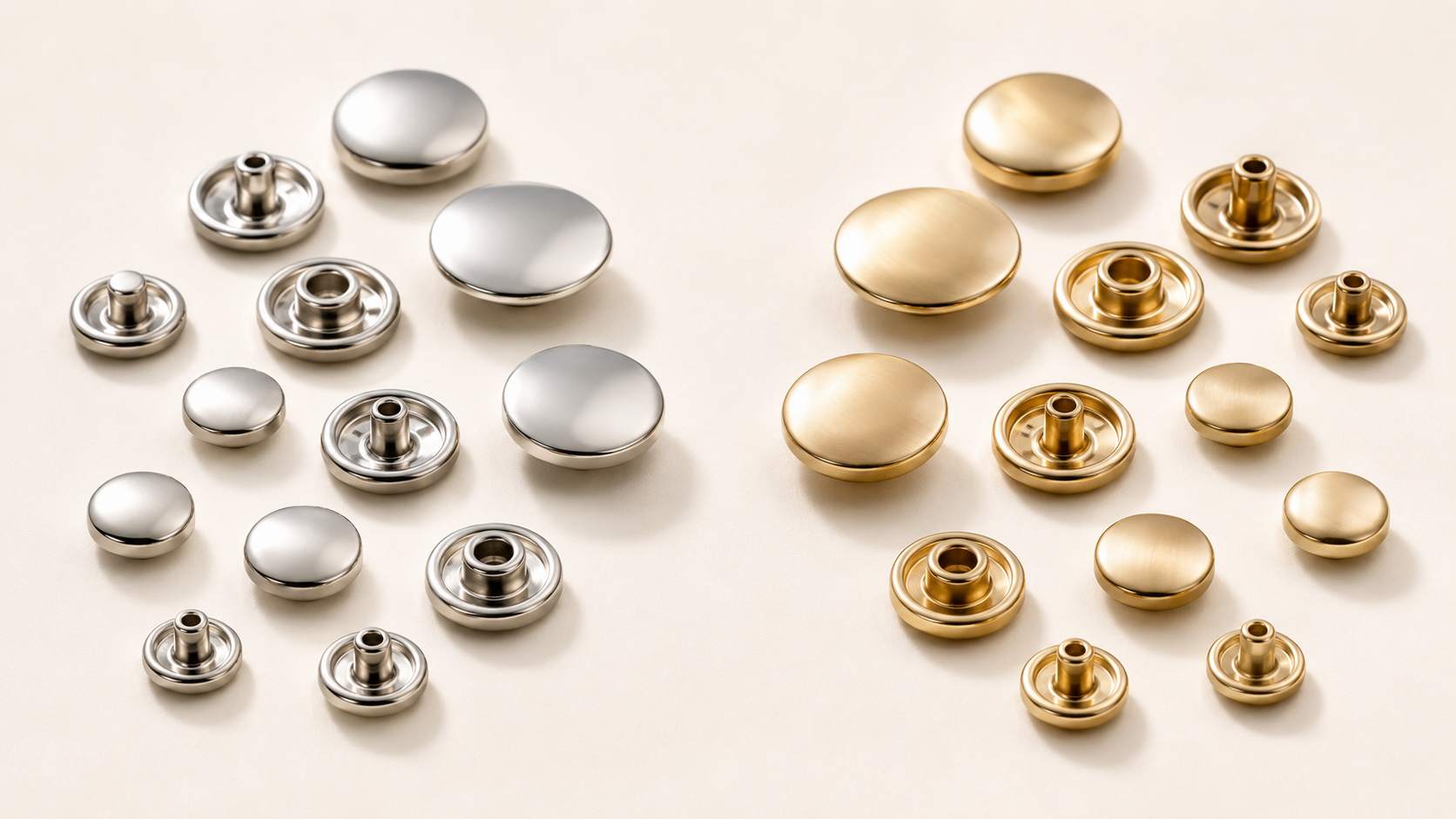 Single-End vs Double-End Snap Buttons: The Difference Is More Than What You See From the Front
Single-end and double-end snap buttons can perform the same basic job: two installed halves connect through a reusable socket-and-stud mechanism. From the user's perspective, both can close with a press and release when sufficient opening force is applied.
The difference is primarily how the installed hardware is configured and presented on the finished product.
A single-end configuration normally places emphasis on one finished or decorative external face, while the opposite side uses a functional attachment component that does not need to look identical. A double-end or double-sided configuration gives greater visual importance to both exposed sides of the assembly, often using finished caps, heads or decorative surfaces on both faces.
This changes much more than appearance.
It can influence:
- component combination;
- overall hardware thickness;
- garment reversibility;
- skin-contact surfaces;
- visible backside quality;
- installation tooling;
- post or attachment dimensions;
- total component weight;
- branding opportunities.
For designers and buyers, Single-End versus Double-End should therefore be treated as a finished-product configuration decision rather than simply a cosmetic variation.
First: Single-End and Double-End Do Not Define the Locking Mechanism
One of the most important distinctions is that Single-End and Double-End do not normally tell the buyer whether the snap uses Ring-Spring, S-Spring or another socket mechanism.
Those terms describe how the socket retains the stud.
Single-End and Double-End describe how the installed component set is configured and how the two sides appear.
A snap specification therefore contains several independent layers:
- locking mechanism;
- attachment structure;
- visible configuration;
- base material;
- finish;
- size;
- opening-force requirement.
Mixing these layers creates sourcing confusion.
For example, a buyer can request a double-ended snap with a particular spring system, stainless-steel base material and black surface finish. “Double-ended” alone does not define the other variables.
What Is a Single-End Snap Button?
A Single-End Snap normally has one primary finished face intended to be seen from the exterior of the garment or product.
The opposite attachment side is mainly functional.
A common concept is:
- decorative or finished cap on the outside;
- socket or stud underneath;
- post, eyelet or another attachment component on the reverse side.
The backside component can still be clean and well manufactured, but it does not need to reproduce the same decorative appearance as the exterior cap.
This makes Single-End configurations efficient for garments where only one side of the fastening point remains visible during normal wear.
Why Single-End Is So Common in Conventional Apparel
Most garments clearly distinguish exterior and interior surfaces.
A jacket front, shirt placket or pocket flap has an outward-facing side that forms part of the design and an inward-facing side that is largely hidden.
In this situation, placing two decorative caps at every fastening point provides little visual benefit.
A Single-End structure therefore allows the manufacturer to concentrate decorative development where the consumer actually sees it.
This can reduce:
- unnecessary component complexity;
- hardware thickness;
- weight;
- tooling complexity;
- decorative processing on hidden surfaces.
What Is a Double-End Snap Button?
A Double-End Snap gives both sides of the installed fastening position a finished or deliberately designed appearance.
Depending on the supplier and component family, the commercial terminology can also appear as double-sided, double-cap, double-headed or similar descriptions.
The exact component combination should therefore always be confirmed from drawings or physical samples.
The essential design idea is that both exposed surfaces matter visually.
This becomes valuable when:
- both sides of a strap are visible;
- the garment is reversible;
- a flap opens and exposes its backside;
- a leather accessory is handled from both directions;
- the interior hardware is deliberately visible;
- branding is required on both sides.
Double-End Does Not Mean Two Complete Snap Mechanisms Back to Back
The name can create the impression that two independent snap fasteners are connected together.
That is not the normal engineering concept.
The system still has one functional fastening relationship between the mating socket and stud.
The “double” description primarily relates to the exposed ends or finished faces of the installed hardware.
The exact assembly may use different cap, post, eyelet or decorative-component combinations depending on the supplier.
The Simplest Structural Comparison
| Design Factor | Single-End Snap | Double-End Snap |
|---|---|---|
| Primary visible surfaces | One main decorative side | Both sides intentionally finished |
| Backside requirement | Primarily functional | Appearance is part of the specification |
| Typical application | Conventional one-direction garments | Reversible products, straps, leather goods, visible flaps |
| Component complexity | Generally simpler | Often requires more appearance control |
| Thickness sensitivity | Standard attachment stack | Finished hardware on both sides can affect stack height |
| Branding opportunity | Mainly one exterior face | Potential on both visible sides |
| Cost focus | Function plus one decorative surface | Two-sided visual quality plus function |
Appearance Is the Most Obvious Difference—but Not the Only One
The first thing a designer notices is the backside.
On a Single-End Snap, the inside can show a conventional functional attachment component.
On a Double-End system, the reverse side may use another decorative head, finished cap or intentionally styled component.
This gives the designer greater control over the appearance of the product from multiple viewing angles.
But this additional visible surface also creates more quality requirements.
Both faces now need to be controlled for:
- color consistency;
- surface finish;
- scratches;
- dents;
- logo orientation;
- plating appearance;
- dimensional symmetry.
Why Reversible Garments Favor Double-End Configurations
A reversible garment eliminates the normal concept of a permanently hidden inside surface.
If the garment can be worn in either direction, the backside of conventional hardware can suddenly become the visible outside.
A Double-End configuration solves this by giving both sides a controlled appearance.
This can apply to:
- reversible jackets;
- double-face coats;
- reversible vests;
- convertible garment tabs;
- two-sided accessories.
In these products, hardware appearance must be evaluated from both orientations during design approval.
Why Double-End Snaps Are Valuable on Straps and Tabs
A strap is frequently visible from both surfaces because it moves, twists or hangs away from the garment body.
A conventional functional backside can therefore become visually prominent.
Double-End hardware gives the designer more control over this situation.
Typical applications include:
- adjustment tabs;
- cuff straps;
- removable straps;
- bag closures;
- leather tabs;
- fashion accessories.
Jackets: Single-End Is Usually Efficient, Double-End Is Used When Both Sides Matter
A conventional front press button for jacket normally needs one strong exterior design face.
The interior component can remain functional because the inside of the front placket is not the primary visual surface.
Single-End is therefore a practical solution for many jacket fronts.
Double-End becomes more relevant when:
- the jacket is reversible;
- the placket backside remains exposed;
- the snap sits on a movable tab;
- the interior design requires premium visible hardware;
- the brand intentionally wants matching surfaces inside and outside.
The configuration should follow the actual design rather than assuming Double-End is automatically a higher-grade choice.
Single-End vs Double-End for General Clothing
Searches for snap on buttons for clothes or a press button for clothes cover an enormous range of garment constructions.
The correct end configuration depends first on visibility.
Ask:
- Will the reverse side normally be hidden?
- Will the garment be reversible?
- Will the tab or flap move enough to expose the backside?
- Does the interior surface need to look premium?
- Does the hardware contact the wearer's skin?
These questions determine whether a second decorative face provides real functional or design value.
Double-End Configurations Can Improve Interior Appearance
Premium apparel increasingly treats garment interiors as design surfaces.
Visible seam finishing, branded linings, contrast binding and coordinated internal hardware all contribute to perceived quality.
A Double-End Snap can support this design language by replacing a purely functional inner attachment face with a controlled finished surface.
This is especially relevant where the garment is frequently worn open and the interior remains visible.
But Double-End Hardware Can Add Thickness
Adding a finished component to both sides changes the physical stack.
The exact effect depends on the selected system, but buyers should consider:
- external cap height;
- internal cap or finished-head height;
- substrate thickness;
- attachment length;
- clearance around nearby seams;
- comfort against the body.
A visually attractive double-sided assembly that becomes bulky on lightweight fabric is not a successful design.
Weight Also Becomes More Important
One extra decorative metal component may seem insignificant.
Across a garment containing many snaps, however, the accumulated weight can become noticeable.
This matters especially on:
- lightweight fashion jackets;
- children's garments;
- soft shirts;
- reversible vests;
- accessories using multiple fastening positions.
The Double-End concept should therefore be evaluated as part of the total garment hardware package.
Cap Shape Changes How Double-End Hardware Feels
If both sides remain exposed, the inner cap or finished component may contact skin, lining or another garment panel.
Sharp edges, excessive projection or deep embossing can create discomfort or abrasion.
Designers should evaluate:
- edge radius;
- cap height;
- dome profile;
- surface smoothness;
- logo depth;
- contact position on the body.
A Double-End Snap is therefore not simply two decorative surfaces. Both surfaces must work physically with the product.
Single-End Hardware Gives More Freedom to Optimize the Hidden Attachment
When the reverse side does not need to be decorative, the manufacturer can prioritize mechanical efficiency.
The hidden component can be optimized around:
- post forming;
- pull-out resistance;
- low profile;
- tooling access;
- material efficiency.
This can be useful in highly functional products where appearance is concentrated on the outer face.
Double-End Hardware Creates Two Design Surfaces
By contrast, Double-End hardware gives designers two visible areas for visual control.
The surfaces can be:
- identical;
- different colors;
- one branded and one plain;
- two coordinated finishes;
- two different decorative textures.
This allows more sophisticated component design, especially for fashion and leather goods.
Finish Selection Becomes More Important on Double-End Snaps
Surface finish determines how both exposed ends coordinate with the product.
Antique snaps can support heritage, workwear or vintage-inspired design.
Black snap buttons can create a low-contrast appearance on dark garments or a strong graphic contrast on lighter materials.
Gold snap buttons can emphasize decorative or premium styling.
With a Double-End system, the buyer also needs to decide whether both sides should use the same finish.
Matching both surfaces creates visual continuity.
Using two intentionally different finishes can create a reversible product with a distinct identity on each side.
Color Consistency Is Harder When Both Sides Are Visible
A Single-End configuration has one dominant decorative surface.
In a Double-End assembly, two components may need to visually match.
Small differences in:
- plating tone;
- gloss;
- texture;
- coating thickness;
- antique shading;
can become much easier to notice when the two components belong to the same fastening position.
Batch approval should therefore consider the hardware pair, not isolated loose pieces.
Logo Orientation Matters More in a Double-End Design
If both sides carry logos or directional graphics, orientation becomes part of installation quality.
The factory may need to control:
- front logo direction;
- rear logo direction;
- relationship between the two logos;
- garment grain and seam direction.
A snap can be mechanically perfect but visually rejected if one logo is rotated incorrectly.
Single-End and Double-End Do Not Change the Fundamental Socket–Stud Relationship
The snap still needs a correctly matched socket and stud.
Whether one side or both sides are decorative does not remove the need for:
- controlled closing force;
- stable retention;
- appropriate release force;
- repeatable spring recovery;
- dimensional compatibility.
The visible configuration should therefore be developed around a proven functional snap system rather than replacing mechanical validation.
Opening Force Must Still Match the Garment
A Double-End Snap may look more substantial because metal is visible on both sides, but appearance should never be confused with required fastening strength.
A lightweight reversible garment may still need moderate opening force.
A heavy utility garment may use a simple Single-End configuration with much stronger retention.
Performance class and end configuration are separate decisions.
Post Length and Attachment Dimensions Can Change
The total stack of:
- outer decorative component;
- substrate;
- inner decorative component;
- socket or stud structure;
can affect the attachment dimensions required by the system.
This is especially important if a Double-End configuration replaces a conventional functional post or eyelet with a decorative finished component.
Tooling and usable attachment length should therefore be revalidated rather than copied automatically from the Single-End version.
Installation Tooling May Need Different Support Dies
The visible cap on a Single-End Snap normally needs careful support on one side.
A Double-End assembly can require appearance protection on both sides.
Tooling must therefore avoid:
- denting either cap;
- scratching decorative finishes;
- flattening embossed logos;
- creating off-center forming;
- damaging the socket or stud.
The correct die supports component geometry instead of relying on excessive pressure.
Double-End Snaps Are Especially Relevant to Leather Goods
Leather products frequently expose both sides of straps, flaps and tabs.
This is one reason snap buttons for leather often require more attention to backside appearance than a conventional shirt closure.
Typical products include:
- wallets;
- handbags;
- belts;
- small leather goods;
- strap closures;
- cases;
- fashion accessories.
The hardware may be visible every time the product is opened.
A finished second side therefore provides clear design value.
Leather Button Snaps Need Thickness Matching
Leather button snaps must be matched to actual leather thickness rather than a generic leather category.
A thin soft leather flap and a multilayer belt strap create completely different installation conditions.
Double-End structures add another dimensional consideration because the reverse-side component may have its own profile and attachment geometry.
Sampling should use the actual leather stack.
Leather Snaps and Buttons Often Become Part of Product Branding
In premium leather snaps and buttons, hardware is rarely treated as a completely hidden functional part.
The surface can communicate:
- brand identity;
- luxury positioning;
- heritage styling;
- minimalist design;
- hardware coordination across a collection.
A Double-End Snap provides another visible branding location, but only when the additional detail suits the product.
Single-End Can Still Be the Better Choice for Leather
Not every leather product benefits from double-sided decorative hardware.
If the backside remains hidden inside a bag lining or between material layers, Single-End can provide:
- simpler assembly;
- less bulk;
- lower hardware weight;
- greater freedom to optimize the attachment component.
The correct design is based on visibility and construction, not on the assumption that more decorative metal automatically means higher quality.
Skin Contact Is an Important Double-End Design Issue
If the inner decorative surface directly contacts skin, designers need to evaluate both geometry and material/finish requirements.
Consider:
- smooth edges;
- low projection;
- surface durability;
- nickel-release requirements where applicable;
- coating wear;
- corrosion resistance.
The hidden side of a conventional Single-End Snap may have been protected by lining. A Double-End component can become a direct contact surface and therefore requires separate evaluation.
Garment Washing Affects Both Visible Ends
In a Double-End design, both exposed surfaces can contact drums, other hardware and abrasive garment-finishing media.
This increases the importance of:
- scratch resistance;
- finish adhesion;
- surface wear;
- cap deformation resistance.
Approval should reflect the intended production sequence, especially for washed denim, fashion jackets and other post-finished garments.
Corrosion Is Also More Visible in Double-End Configurations
When both surfaces are exposed, corrosion or staining on the inner face can become a direct appearance defect rather than a hidden issue.
Corrosion can also affect functional areas around the socket and stud.
Material and finish selection should therefore consider:
- sweat;
- washing;
- humidity;
- chloride exposure;
- storage conditions.
Base Material and Surface Finish Should Be Specified Separately
Black, gold and antique appearances do not identify the base material.
A buyer should separately define:
- base metal;
- surface treatment;
- color;
- gloss level;
- decorative effect.
This becomes particularly important with Double-End hardware because both visible surfaces need to meet the intended appearance standard.
Material Options for Single-End and Double-End Snaps
Depending on component structure and application, finished snap components can be developed from brass, stainless steel and other project-appropriate metals.
Brass is widely used where forming and decorative finishing flexibility are priorities.
Stainless steel is relevant where environmental resistance, wear performance or other specialized material requirements are more important.
Material selection should be made at component level because caps, spring elements, studs and attachment parts perform different mechanical jobs.
Ultra-Low Magnetic Requirements Apply to the Finished Components
Some garment programs also require low magnetic response for needle-detection or magnetically sensitive processes.
When the requirement is strict, the magnetic behavior of the final formed snap is more relevant than a general assumption about raw stainless steel.
Cold forming can change the magnetic response of some conventional austenitic stainless steels.
JSW20 for Low-Magnetic Single-End and Double-End Snap Components
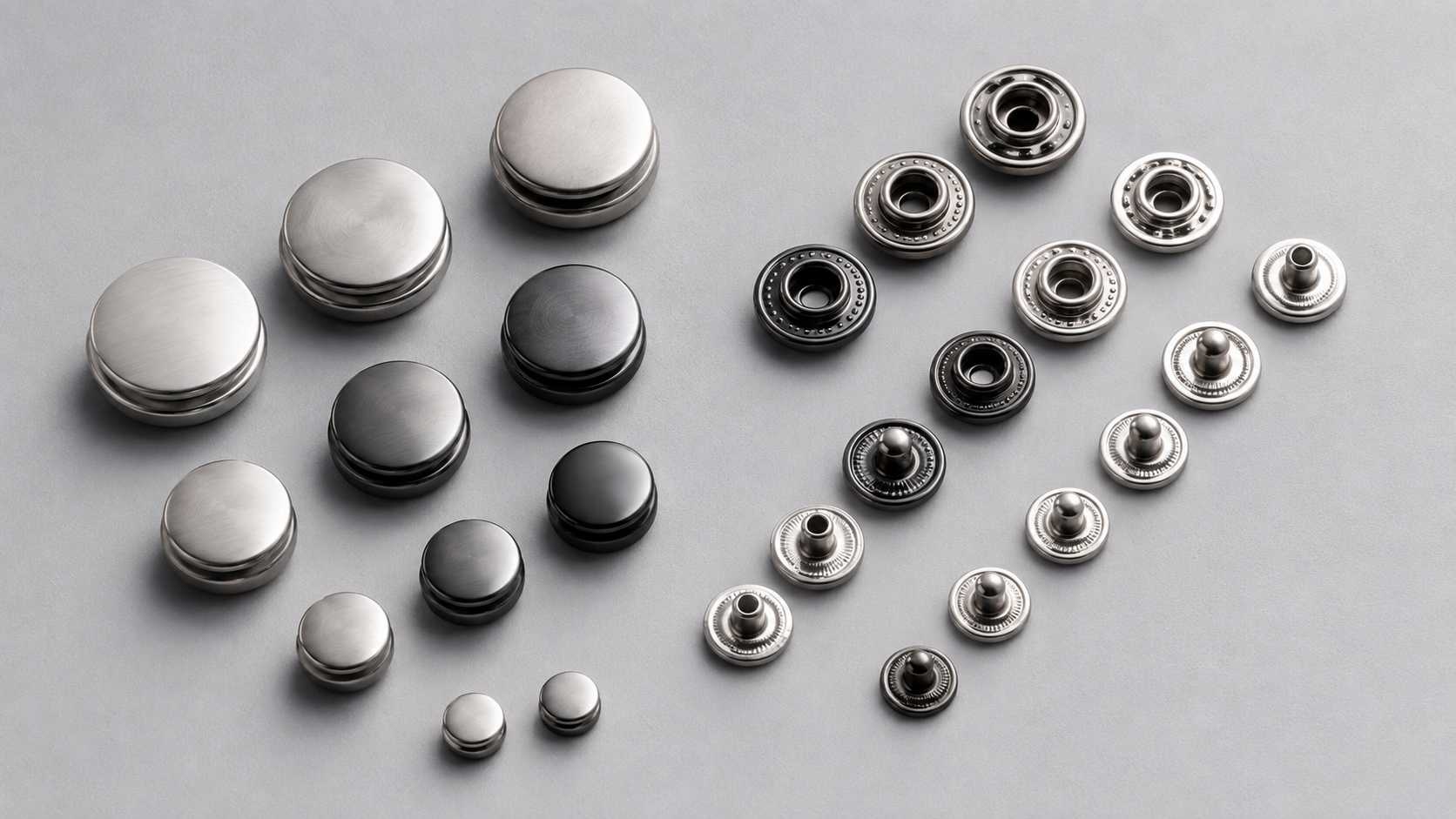
Baocheng / BC New Material can manufacture finished snap-button components using patented JSW20 ultra-low magnetic permeability stainless steel where the component structure and project requirements are suitable.
JSW20 maintains extremely low magnetic permeability after forming and also provides chloride-corrosion resistance.
This can be relevant to projects that combine strict magnetic requirements with corrosion exposure or demanding garment-processing conditions.
BC New Material supplies finished JSW20 products and customized components rather than raw JSW20 coils or sheets.
Single-End vs Double-End: Practical Selection Matrix
| Product Condition | Single-End Tendency | Double-End Tendency |
|---|---|---|
| Backside permanently hidden | Strong choice | Usually unnecessary |
| Reversible garment | Limited visual advantage | Strong choice |
| Movable strap visible from both sides | Functional option | Strong design advantage |
| Conventional jacket front | Efficient and common | Useful when interior is intentionally premium |
| Leather flap visible inside and outside | Possible | Strong design advantage |
| Lowest possible bulk | Often preferable | Requires careful profile control |
| Branding required on both sides | Limited | Strong choice |
| Interior side directly contacts skin | Functional backside must still be safe | Finished inner component needs comfort validation |
What Buyers Should Include in a Single-End or Double-End RFQ
A useful sourcing specification should include:
- finished product;
- exact snap position;
- whether one or both faces remain visible;
- whether the garment or product is reversible;
- front cap design;
- backside appearance requirement;
- logo orientation;
- socket and stud system;
- attachment structure;
- actual substrate thickness;
- material layers;
- base metal;
- surface finish;
- target opening force;
- skin-contact requirements;
- washing or environmental conditions;
- existing installation equipment;
- sample and production quantity.
Custom Single-End and Double-End Snap Development at Baocheng / BC New Material
Baocheng / BC New Material supplies finished metal snap buttons and customized snap components for apparel, jackets, denim, children's garments, leather goods, bags and other finished products.
Single-End and Double-End projects can be developed around both appearance and mechanical requirements.
Customization can include:
- one-sided or two-sided visible configuration;
- front and rear cap profiles;
- custom logos;
- embossed or recessed graphics;
- matched or contrasting finishes;
- socket and stud system;
- post or attachment dimensions;
- base material;
- surface color;
- opening and closing behavior;
- tooling matched to the actual substrate.
For reversible garments or leather goods, both viewing directions can be included in sample approval rather than evaluating only the exterior cap.
Sampling can use the customer's actual fabric, denim, leather or multilayer product construction so component thickness, backside appearance, attachment quality and fastening performance are evaluated together.
Material options can include brass, 304 stainless steel, 316 stainless steel, patented JSW20 ultra-low magnetic permeability stainless steel and other project-appropriate metals according to the component geometry.
Where applicable to the specific project and relevant certificate scope, development can also consider REACH, RoHS, OEKO-TEX and nickel-release requirements.
Conclusion: Choose Single-End or Double-End According to What the Finished Product Actually Exposes
Single-End and Double-End snap buttons do not represent two fundamentally different socket-locking mechanisms.
They describe different ways of configuring the visible ends of the installed fastening system.
Single-End snaps concentrate design attention on one primary exterior surface while allowing the reverse component to remain mainly functional.
This makes them efficient for conventional garments where the backside stays hidden.
Double-End snaps give both exposed sides a deliberately finished appearance.
They become particularly useful for reversible garments, visible tabs, straps, premium garment interiors and leather goods where both faces of the hardware become part of the product design.
However, the second decorative surface also introduces additional engineering considerations: hardware thickness, weight, backside comfort, two-sided finish consistency, tooling protection and attachment dimensions.
The correct choice is therefore not “Double-End is more premium.”
The correct choice is the configuration that places decorative value where the consumer can see and use it without adding unnecessary bulk, cost or complexity.
In a well-designed snap system, visible configuration, locking mechanism, attachment geometry, material and garment construction all work together as one finished component solution.
Focused FAQ
What is the main difference between a Single-End and Double-End snap button?
A Single-End configuration normally emphasizes one primary decorative or finished face, while a Double-End configuration gives both exposed sides a deliberately finished appearance.
Does Double-End mean the snap has two locking mechanisms?
No. The snap still uses one functional socket-and-stud fastening relationship. “Double-End” mainly describes the visible or finished component configuration.
Are Double-End snaps better than Single-End snaps?
Not automatically. Double-End is useful when both sides remain visible. Single-End is usually more efficient when the backside stays hidden.
Are Double-End snaps good for reversible jackets?
Yes. Reversible garments are one of the clearest applications because either side of the hardware can become the exterior surface.
Why are Double-End snaps useful for leather goods?
Leather straps, flaps and accessories are frequently visible from both sides, so a finished second hardware surface can provide stronger visual consistency and branding value.
Does a Double-End snap require different tooling?
It can. Both decorative surfaces may require dedicated support to prevent dents, scratches or logo deformation, and the attachment configuration may also differ from the Single-End version.
Does Double-End hardware make the snap thicker?
It can increase the total visible profile or component stack, depending on the specific system. The finished assembly should therefore be evaluated on the real product.
Can Single-End and Double-End snaps use the same socket mechanism?
They can use related locking architectures, but compatibility should always be confirmed from the actual component system rather than assumed from appearance.
Can both sides use different colors?
Yes, where the component and finish system support it. This can be useful for reversible products with different visual identities on each side.
Can Baocheng customize Single-End and Double-End snap buttons?
Yes. Baocheng / BC New Material can customize visible configuration, cap profiles, logos, socket and stud structure, attachment dimensions, materials, colors and finishes using the customer's actual product construction for sampling.
Can JSW20 be used for these snap components?
Where the component geometry and project requirements are suitable, Baocheng can manufacture finished snap components using patented JSW20 ultra-low magnetic permeability stainless steel. JSW20 retains extremely low magnetic permeability after forming and also provides chloride-corrosion resistance.
Does Baocheng sell raw JSW20 material?
No. Baocheng supplies finished products and customized components manufactured from JSW20 rather than raw JSW20 coils or sheets.
#SingleEndSnap, #DoubleEndSnap, #DoubleSidedSnap, #SnapButtons, #PressStuds, #GarmentHardware, #FashionHardware, #LeatherHardware