






Shoe Eyelet Size Guide Matching Hole Diameter, Lace Type and Upper Thickness
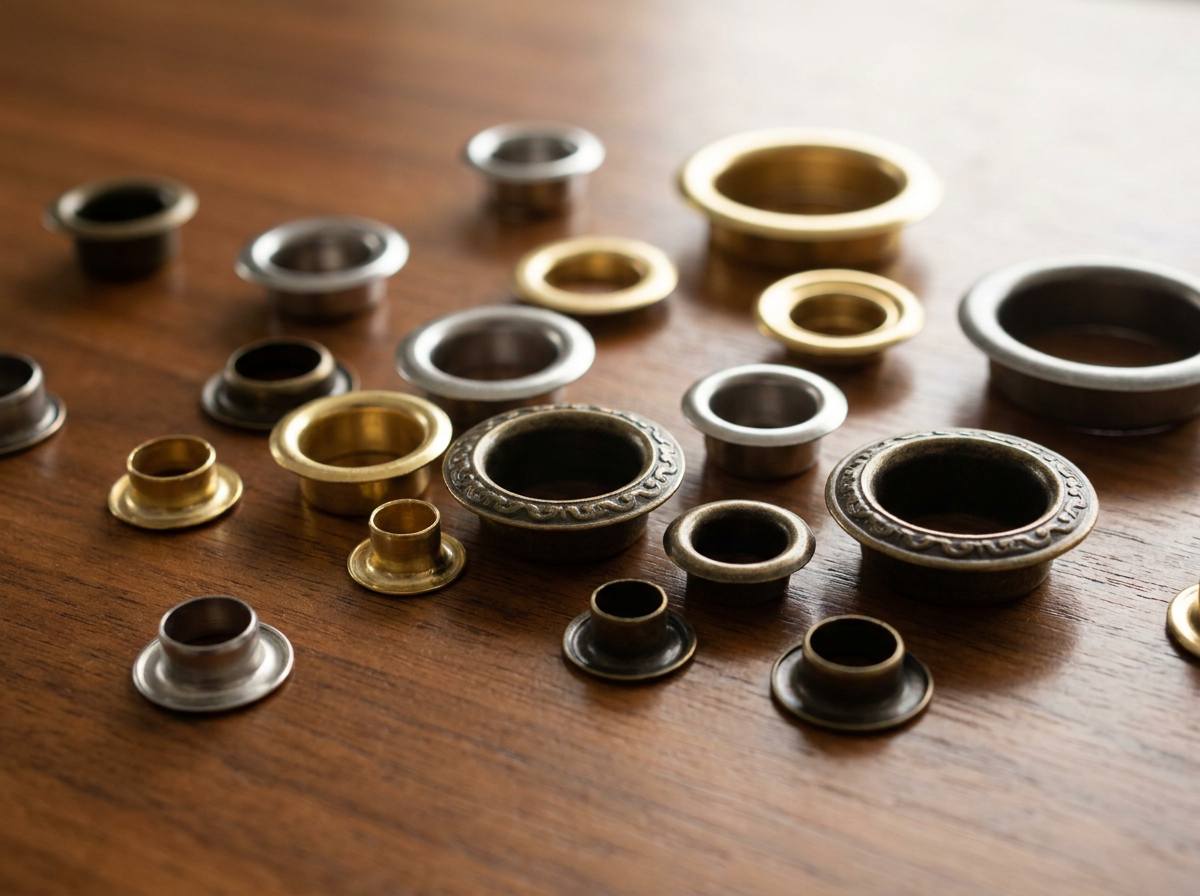 Choosing a shoe eyelet by diameter sounds simple until a footwear development team tries to install the same component into different uppers. A metal eyelet that works perfectly on a lightweight sneaker may be too short for a reinforced leather boot. An eyelet that accepts a flat polyester lace may create unnecessary clearance around a thin waxed dress-shoe lace. Even two suppliers describing their products with the same nominal size may not be referring to exactly the same dimension.
For footwear brands, shoe factories and sourcing teams, this is why eyelet size should be treated as a combination of dimensions rather than one number.
The finished inside diameter must suit the lace. The barrel outside diameter must correspond to the prepared opening. The flange must provide enough support around the hole without overwhelming the shoe design. Most importantly, the barrel length needs to match the complete thickness of the material through which the eyelet will be installed.
From a Chinese metal eyelet manufacturer's perspective, many problems that appear to be installation defects actually begin with incomplete size specifications. A buyer may request a “5 mm eyelet” without defining whether 5 mm means the inside hole, barrel diameter or another measurement. Once the part reaches the shoe factory, the hardware may not fit the existing punching or setting tooling.
This guide explains how footwear buyers can define shoe eyelet size more accurately by matching hole diameter, shoelace type, upper construction and installation requirements.
There Is No Single Measurement Called “Eyelet Size”
The first principle is also the most important: an eyelet has several dimensions, and each one performs a different function.
When a buyer asks for a 4 mm or 5 mm shoe eyelet, a manufacturer should clarify which dimension the number represents. Relying on nominal terminology alone can result in incorrect samples even when both sides believe they are discussing the same size.
For industrial footwear sourcing, the main dimensions normally include:
- finished inside diameter or lace opening;
- barrel outside diameter;
- flange outside diameter;
- barrel length under the flange;
- metal wall thickness; and
- washer dimensions when a washer is used.
The relationships among these measurements matter more than any single dimension.
A larger inside diameter gives the lace more room to move, but it normally requires a larger barrel. A larger barrel removes or displaces more upper material. A wider flange can distribute pressure over a larger area, while barrel length determines whether the component can be securely formed through the full shoe construction.
Start With the Shoelace, Not the Eyelet Catalog
A useful way to begin eyelet selection is to start with the lace that will actually be used on the finished footwear.
The eyelet opening should allow the lace to move through the hole without excessive friction. At the same time, there is usually little advantage in making the opening much larger than necessary.
This matters because shoelaces are not all constructed the same way.
A thin round waxed lace used on formal leather footwear behaves differently from a thick round hiking lace. A flat woven sneaker lace may compress as it passes through an eyelet, while a dense round cord retains more of its cross-sectional diameter.
Material also affects friction. Cotton, polyester, nylon and waxed lace constructions can move differently against the same metal edge.
The goal is therefore not to choose an eyelet that merely allows the lace to pass once. The lace should be able to move repeatedly during tightening and loosening without jamming or rubbing aggressively against the inner edge.
Finished Hole Diameter and Barrel Diameter Are Different
One of the most common specification mistakes is confusing the finished lace opening with the barrel outside diameter.
The barrel is the tubular section that passes through the upper material. Because the barrel has metal wall thickness, its outside diameter is larger than its internal opening.
This means a shoe designer who requires approximately a certain lace opening should not automatically specify the same diameter for the punched hole in the leather.
The footwear factory needs to know the actual barrel outside diameter in order to prepare the upper correctly.
A hole that is substantially oversized relative to the barrel can reduce attachment strength because the eyelet has less surrounding upper material to grip. A hole that is too tight can make insertion difficult and distort the leather or textile before setting.
For this reason, the tooling drawing should separate finished ID from barrel OD.
Why Search Terms Such as 2 mm, 3/16 or 5 mm Can Be Misleading
Online sourcing often begins with simple size expressions. Buyers may search for a 2mm grommet, 3 16 eyelets or a 5mm grommet while trying to identify a component for footwear.
These searches are useful for discovering products, but they should not become the final technical specification.
For example, a “5 mm” listing could describe an approximately 5 mm hole, a barrel dimension or a supplier's nominal size family. Another supplier may use an inch-based trade number rather than millimeters.
The same caution applies when buyers search for 1 4 eyelets or eyelets 1 8. An inch-based size expression must still be tied to a clearly labeled drawing dimension before samples are approved.
There is also an important footwear-design question: even if the measurement is understood correctly, is that size appropriate for the intended lace and upper?
A large diameter may work mechanically but look visually disproportionate on a formal shoe. A very small opening can support a refined appearance but may create excessive friction with a thick casual lace.
Match the Eyelet Opening to the Lace Cross Section
Shoelace width alone does not completely determine the required eyelet ID.
Flat laces compress and fold as they pass through a circular hole, so their listed width cannot be compared directly with an eyelet's circular inside diameter. Round laces provide a more straightforward comparison, but coating, weave density and compressibility still matter.
During footwear development, the best approach is to test the actual approved lace through the candidate eyelet.
Check whether the lace can move smoothly under realistic tightening force. Then inspect the lace after repeated movement.
If the opening is too tight, common symptoms can include:
- difficult tightening;
- high friction between lace and eyelet;
- premature lace fuzzing or abrasion;
- uneven tension between lace rows; and
- difficulty loosening the shoe.
If the opening is unnecessarily large, the eyelet may look oversized, the lace can move excessively within the hole, and the larger barrel may require removing more material from the upper.
Small Eyelets Are Not Automatically Better for Small Shoes
Designers often want compact hardware for children's shoes, minimalist sneakers or formal footwear. This can lead to interest in miniature grommets and other small-diameter eyelets.
Small hardware can create an elegant appearance, but miniaturization reduces the amount of metal available for forming and the area available for supporting the upper.
This means smaller eyelets can require tighter manufacturing and installation control.
A slight offset in the setting die may be proportionally more significant on a miniature eyelet than on a large boot grommet. Similarly, a narrow flange leaves less surface area around the punched opening.
The correct approach is therefore to select the smallest eyelet that performs the required function reliably—not simply the smallest eyelet that looks attractive in a drawing.
Upper Thickness Determines Barrel Length
Once the lace opening is defined, the next major variable is total installed material thickness.
This is where many footwear projects go wrong.
A buyer may measure only the visible leather upper and ignore what sits beneath it. In reality, the eyelet may pass through several layers:
- outer leather or textile;
- lace-stay reinforcement;
- interlining;
- foam or laminated layer;
- inner lining; and
- a washer or backing component.
The eyelet barrel must pass through this entire stack and still provide enough material for the rear section to form properly during setting.
If the barrel is too short, the eyelet may not form enough metal behind the upper to achieve a secure attachment.
If the barrel is too long, excess material may collapse, buckle, split or form irregularly when pressure is applied.
This is why two shoes using the same eyelet ID can require different barrel lengths.
Dress Shoes and Work Boots Need Different Barrel Strategies
Consider two footwear designs that use similar shoelace diameters.
A formal shoe may have a relatively compact upper construction with leather and lining layers. A work boot may include heavier leather, reinforcement and additional backing around the lace stay.
The visible eyelet opening could be similar, but the barrel requirements may be very different.
Using the formal-shoe eyelet in the work boot can produce an under-set condition because there is insufficient barrel material behind the thicker upper.
Using the long work-boot barrel on the thin formal upper can create excessive rear-side deformation.
For this reason, barrel length should be specified by installed thickness rather than copied automatically from another shoe model.
Soft Textile Uppers Behave Differently From Leather
Total thickness alone is also not enough. Material behavior matters.
A 2 mm stack of dense leather does not behave exactly like a 2 mm stack of soft knitted textile and foam.
Leather can provide relatively stable support around a controlled punched hole. A flexible textile may compress considerably during setting and may need reinforcement around the lace position.
For soft or stretchy sneaker uppers, flange diameter and backing support may become more important because the surrounding material can deform under lace tension.
The eyelet supplier should therefore know not only the measured thickness but also the general material construction.
Leather Eyelets Require Controlled Hole Preparation
Searches for leather eyelets grommets often combine the two terms because buyers are primarily looking for metal reinforcement suitable for leather rather than focusing on terminology.
For footwear production, the punched opening is one of the most important parts of the installation.
A clean opening helps the barrel pass through without folding the leather. The hole should correspond to the component dimensions instead of being enlarged simply to make manual insertion easier.
An oversized opening can reduce the amount of leather retained beneath the flange. Repeated lace pulling may then allow the eyelet to shift or eventually pull through the lace stay.
A poorly cut opening can also leave irregular edges that become hidden beneath the flange but weaken the surrounding material.
How to Put Eyelets in Leather Without Designing Around the Tool
People searching how to put eyelets in leather often begin with the installation tool. For industrial footwear production, the sequence should be reversed.
First define the finished requirement. Then choose the component and develop tooling around that component.
The shoe factory should know:
- required finished hole size;
- eyelet barrel OD;
- total leather and lining thickness;
- flange diameter;
- washer or backing requirement;
- surface-finish sensitivity; and
- production volume.
Only after these variables are established should setting pressure and tooling be finalized.
If an existing machine cannot correctly set the selected eyelet, forcing the component to match unsuitable tooling can create unstable results.
The Punch Size Must Match the Barrel, Not the Lace
The lace opening and the punched upper opening perform different functions.
The lace passes through the finished inside diameter of the eyelet. The eyelet barrel passes through the opening made in the shoe upper.
Therefore, an eyelet hole punch should be chosen according to the barrel and installation system—not simply according to the shoelace diameter.
This distinction is especially important when a designer says, “The lace is 4 mm, so punch a 4 mm hole.” That may or may not correspond to the barrel required to provide a suitable finished opening.
The footwear factory should work from the actual eyelet drawing and approved sample.
Flange Diameter Controls More Than Appearance
The flange is the visible rim resting against the upper. Designers often choose it primarily for appearance, but it also has a mechanical function.
A wider flange distributes contact across a larger area of the upper. This can be useful on softer materials or applications subjected to significant lace tension.
A narrow flange creates a more delicate visual effect but leaves less supporting area around the opening.
Neither is automatically better.
For dress shoes, a small flange may be aesthetically desirable. For work boots, a more substantial flange may suit both the styling and mechanical requirements.
The important point is that flange size should be evaluated together with upper strength and punched-hole dimensions.
Eyelet Spacing Also Changes Perceived Size
A metal eyelet does not exist visually by itself. Its relationship with neighboring eyelets matters.
If eyelets are too large relative to the spacing between lace holes, the lace stay can look crowded and heavy. If the components are very small with wide spacing, the hardware may appear visually disconnected from the rest of the shoe.
Footwear designers should therefore review the full lace row rather than evaluating one enlarged eyelet sample in isolation.
Spacing also affects load distribution because each lacing position carries part of the tension created when the wearer tightens the shoe.
The Lace Angle Changes the Load on the Eyelet
Laces do not always pull directly perpendicular to the center of an eyelet. Depending on the lacing pattern and upper shape, force can act diagonally across the inner edge.
This means a suitable inside diameter must provide not only static clearance but also enough room for the lace to change direction smoothly.
On curved boot lace stays, for example, the upper rows can experience different lace angles from the lower rows.
This is one reason some technical footwear uses D-rings or hooks in selected positions instead of using identical round eyelets throughout the entire shoe.
Do Not Choose Eyelet Size From the Shoelace Length
Shoelace length and shoelace thickness solve different design problems.
Lace length is influenced by the number of eyelet pairs, spacing, shoe opening and lacing pattern. Eyelet inside diameter is primarily influenced by lace cross section and the required movement through the hardware.
A longer lace therefore does not require a larger eyelet.
When communicating with hardware suppliers, footwear developers should provide lace diameter or width separately from total lace length.
Tooling Must Match the Exact Eyelet Geometry
A correctly selected eyelet can still fail when installed with incorrect dies.
A leather eyelet tool must support the visible flange and form the barrel in a controlled manner. If the lower die does not correspond to the flange profile, the eyelet may tilt or develop visible tool marks.
If the forming die does not match the barrel, the rear section may roll unevenly, crack or collapse.
Small changes in eyelet dimensions can therefore require tooling verification even when the new component looks very similar to the previous one.
For bulk footwear production, tooling should be approved together with the metal component and actual shoe upper.
A Size Number Should Never Replace a Technical Drawing

Footwear sourcing frequently uses informal language because it is fast. Teams may speak about a “small brass eyelet,” a “5 mm eyelet” or a “boot eyelet.”
This is acceptable during initial discussion but not sufficient for final production approval.
A technical drawing removes ambiguity by identifying which diameter is being measured and where.
| Dimension | What It Controls | What the Buyer Should Confirm |
|---|---|---|
| Finished inside diameter | Lace clearance | Actual approved lace should move smoothly |
| Barrel outside diameter | Required upper opening | Match punching or piercing process |
| Flange outside diameter | Appearance and load distribution | Check proportion on actual shoe upper |
| Barrel length | Ability to form behind the material stack | Measure complete installed thickness |
| Metal thickness | Forming behavior and component stiffness | Confirm consistency with approved sample |
| Washer dimensions | Rear-side support where used | Match washer ID and OD to eyelet structure |
Typical Selection Logic for Different Shoe Types
There is no universal eyelet size chart that can determine the final hardware from the shoe category alone, but different footwear types create predictable design priorities.
| Footwear Type | Typical Eyelet Priority | Key Variables to Confirm |
|---|---|---|
| Dress shoes | Low profile and refined appearance | Thin lace, compact flange, accurate alignment and suitable barrel for leather plus lining |
| Casual leather shoes | Balance between appearance and durability | Lace clearance, leather thickness, finish and flange proportion |
| Lifestyle sneakers | Lightweight hardware and textile support | Upper reinforcement, lace width and resistance to fabric distortion |
| Hiking shoes | Reliable lacing under repeated adjustment | Lace diameter, abrasion, reinforcement and corrosion conditions |
| Work boots | Durability and pull resistance | Thick material stack, barrel length, flange support and heavy lace clearance |
| Children's shoes | Compact proportions with controlled attachment | Small hardware dimensions, smooth edges and secure setting |
Why a Larger Eyelet Is Not Automatically More Durable
Increasing eyelet size can create a wider flange and larger metal section, but it also requires a larger opening in the upper.
This creates a trade-off.
If too much material is removed from the lace stay, the remaining leather or textile surrounding the eyelet may become the weak point.
A large eyelet can therefore be mechanically unnecessary for a thin lace and visually unsuitable for the shoe.
Durability should be created through balanced dimensions, appropriate material and reliable setting—not simply by increasing component size.
Why an Eyelet That Is Too Small Can Also Fail
Undersizing creates a different set of problems.
If the lace barely fits, friction rises. Repeated pulling can abrade the lace or concentrate force on one area of the eyelet's inside edge.
A very small flange may also provide insufficient support on a soft upper.
If the barrel is designed too small for the required upper stack, installation can become difficult and the finished component may not clamp the layers as intended.
The best shoe eyelet is therefore neither the largest nor the smallest available size. It is the one whose dimensions match the specific footwear construction.
Test the Eyelet on the Actual Upper Before Bulk Production
A metal sample placed on a desk cannot reveal whether the barrel length is correct.
The component needs to be installed through the real upper construction.
During sampling, footwear teams should check:
- lace movement through the finished opening;
- eyelet alignment across the lace row;
- flange proportion relative to the upper;
- rear-side forming quality;
- rotation after installation;
- upper compression or puckering;
- edge smoothness;
- pull resistance; and
- appearance after representative flexing or wear testing.
If the project later changes leather thickness, lining structure or lace specification, the eyelet should be reviewed again.
How Bao Cheng Helps Footwear Brands Choose the Right Eyelet Size
At JiaShan BaoCheng Clothing Accessories Co., Ltd., we manufacture customized metal hardware for B2B customers. For shoe eyelet programs, we do not recommend selecting a component only from a nominal catalog size.
Our development process focuses on understanding how the metal part will actually interact with the customer's footwear construction.
1. Development From Drawings or Existing Samples
Customers can provide a technical drawing, existing eyelet, shoe sample or dimensional requirement.
When a drawing is available, we can evaluate critical dimensions including inside diameter, barrel outside diameter, flange diameter and barrel length.
If the customer only has an existing shoe, a physical reference component can provide a starting point for customized development.
This is particularly useful when a brand wants to maintain the appearance of an existing eyelet but change material, finish or barrel length for a new upper construction.
2. Matching the Eyelet to the Actual Shoelace
When possible, customers should tell us the approximate lace construction and size.
A thick hiking lace does not need the same opening as a thin waxed dress-shoe lace. Understanding the lace allows the finished hole dimension to be evaluated according to real use rather than only appearance.
If the brand has already approved the lace, testing the actual lace through an eyelet sample provides the clearest result.
3. Matching Barrel Length to Total Upper Thickness
This is one of the most important parts of custom eyelet development.
We encourage customers to provide the complete installed thickness rather than only the thickness of the visible leather.
For example, a boot eyelet may pass through outer leather, reinforcement and lining. Those layers determine how much barrel length is required for controlled setting.
If the thickness differs between shoe models, Bao Cheng can evaluate whether the same eyelet structure can continue to be used or whether the barrel should be adjusted.
4. Custom Flange and Barrel Dimensions
Standard eyelets do not suit every footwear design.
A luxury shoe may need a compact flange. A work boot may require a more substantial visual and mechanical structure. A lightweight sneaker may need a smaller component matched to a reinforced textile panel.
Bao Cheng supports customized dimensional development so the customer does not have to redesign the footwear around an unsuitable stock part.
5. Material Options According to the Project
Depending on the application, shoe eyelets can be developed in materials such as brass, stainless steel, aluminum and other suitable metal solutions according to the customer's performance requirements.
The choice depends on forming behavior, corrosion resistance, appearance, weight and surface-treatment requirements.
For specialized footwear or production programs where very low magnetic response is required, Bao Cheng can also evaluate our JSW20 low-magnetic stainless steel solution according to the customer's finished-component requirements.
6. Custom Surface Finishes
Eyelets frequently need to coordinate with hooks, buckles, zipper hardware or decorative trims used elsewhere on the shoe.
Bao Cheng can support customized surface finishes according to approved samples and project requirements.
For visible shoe eyelets, the finish should be evaluated after installation because setting can place mechanical pressure on the flange and barrel.
Appearance should therefore be approved on the finished shoe whenever possible rather than on a loose plated component alone.
7. Setting and Tooling Evaluation
The relationship between the eyelet and installation tooling is critical.
If customers experience barrel splitting, tilted eyelets, loose settings or damaged flanges, photographs of the front and rear of the installed component can help identify the likely cause.
The issue may involve component dimensions, upper thickness, punch size, die geometry or machine pressure.
By evaluating these variables together, the factory can avoid solving every problem simply by increasing press force.
8. Sampling Before Mass Production
For customized footwear hardware, sample approval should include installation testing.
Customers can fit the sample into the production upper and check lace movement, hole position, flange appearance, barrel formation and pull resistance.
If changes are necessary, dimensions can be adjusted before bulk production begins.
This reduces the risk of discovering that an eyelet is dimensionally incompatible after large quantities of uppers have already been punched.
9. Dimensional Consistency During Bulk Production
An approved sample is only useful if bulk production continues to match it.
Variation in barrel length can change setting behavior. Variation in flange diameter can alter appearance across a lace row. Changes in material thickness can influence how the barrel forms.
Bao Cheng focuses on maintaining the approved component structure during mass production so the footwear factory can operate with more stable machine settings.
10. Custom B2B Service Rather Than Consumer Repair Parts
Our primary focus is customized manufacturing for brands, footwear factories, importers and sourcing teams rather than retail repair kits.
Customers can send drawings, reference samples and application requirements for evaluation and sampling.
This approach is particularly suitable for footwear projects where the eyelet needs to match a specific lace, upper construction, finish or dimensional requirement.
A Practical Shoe Eyelet Specification Checklist
Before approving an eyelet for production, footwear sourcing teams can use the following checklist:
- What is the finished eyelet inside diameter?
- What lace will pass through it?
- Does the lace move smoothly under realistic tension?
- What is the barrel outside diameter?
- What hole will be prepared in the upper?
- What is the flange outside diameter?
- Does the flange suit the shoe's visual proportions?
- What is the complete installed upper thickness?
- Is the barrel long enough to form correctly?
- Is the barrel unnecessarily long?
- Does the upper require reinforcement?
- Will a washer be used?
- Does the setting die match the eyelet?
- Does the installed component remain smooth and secure?
- Has the eyelet been tested on the actual production upper?
Final Thoughts
A useful shoe eyelet size guide should not end with a table saying that one shoe type needs one fixed diameter.
Footwear varies too much for that approach.
The same nominal eyelet can behave differently in thin leather, thick boot leather, reinforced textile and laminated sneaker uppers. The same inside diameter can also perform differently with a thin waxed lace and a thick outdoor cord.
The correct eyelet is therefore defined by relationships.
Finished hole diameter must suit the lace. Barrel OD must suit the prepared upper opening. Flange diameter must balance appearance with support. Barrel length must correspond to the complete installed thickness.
When these dimensions are considered together, the result is easier to install, more consistent in production and more durable during repeated lacing.
For footwear brands developing customized products, providing a complete dimensional and application specification also allows the eyelet manufacturer to contribute more effectively during sampling.
Bao Cheng supports this type of custom development from reference samples and drawings through production, helping customers match eyelet geometry, material and finish to the actual shoe rather than relying on a nominal size alone.
Focused FAQ
1. What measurement determines shoe eyelet size?
There is no single measurement that completely defines an eyelet. Buyers should distinguish between finished inside diameter, barrel outside diameter, flange outside diameter and barrel length. The most important dimension depends on whether the buyer is evaluating lace clearance, punching, appearance or installation through the upper.
2. How much larger should an eyelet be than the shoelace?
There is no universal clearance for every footwear design because lace construction and compressibility vary. The finished opening should allow the actual approved lace to move smoothly during tightening and loosening without unnecessary excess clearance. Physical sampling is the most reliable way to confirm the fit.
3. Does thicker leather require a larger eyelet?
Not necessarily a larger inside diameter. Thicker leather primarily affects the required barrel length. Two shoes can use the same lace opening but require different eyelet barrel lengths because their upper, reinforcement and lining stacks are different.
4. What happens if the eyelet barrel is too short?
A barrel that is too short may not provide enough metal behind the material stack for secure forming. The installed eyelet can remain loose or have insufficient retention, increasing the risk of movement or pull-out during use.
5. What happens if the barrel is too long?
Excess barrel length can cause irregular rolling, collapsing, folding or splitting during setting. Increasing machine pressure is not a reliable solution when the component dimensions do not match the upper thickness.
6. Should the punched leather hole equal the finished eyelet opening?
No. The punched upper opening receives the eyelet barrel, while the finished inside diameter is the opening through which the lace passes. These are different dimensions and should be specified separately.
7. Are small eyelets better for dress shoes?
Small eyelets often suit the refined proportions of dress shoes, but they still need enough lace clearance, flange support and barrel length for the complete leather and lining construction. Appearance should not override installation reliability.
8. Why do work boots often use larger-looking eyelets?
Work boots commonly use thicker uppers, heavier laces and more visually robust hardware. A larger flange or opening may suit these requirements, but the exact dimensions should still be determined by the lace, upper thickness and attachment design rather than shoe category alone.
9. Can one eyelet size be used across several shoe models?
Yes, when the lace requirements and installed material thicknesses are sufficiently similar. If one model uses a significantly thicker reinforcement or different lace, the barrel length or other dimensions may need to change even if the visible eyelet appearance remains the same.
10. What information should I send Bao Cheng for a custom shoe eyelet?
Provide the finished inside diameter, barrel OD, flange OD, required barrel length if known, complete upper thickness, upper material, lace size, desired base material, finish, washer requirement, order quantity and a drawing or physical reference sample where possible. Bao Cheng can use this information to evaluate and sample a customized eyelet before mass production.