






How Buyers Can Prevent Quality Drift in Repeat Snap Button Orders: Golden Samples, Change Control and Traceability

Repeat Orders Can Drift Even When the Product Name Never Changes
A snap button that performed perfectly in the first production order does not automatically remain identical in the fifth, tenth or twentieth order. The item number may be unchanged, the cap may look the same and the supplier may describe every shipment as the same specification, yet small changes in material, tooling, surface treatment, forming conditions or component dimensions can gradually alter the finished product.
This gradual movement away from the originally approved condition is quality drift.
Quality drift is particularly difficult to manage because it is rarely caused by one dramatic mistake. A socket opening may become slightly larger as a die wears. A plating supplier may adjust a process. A replacement raw-material batch may have different forming behavior. A post tool may be repaired and return with a slightly different working dimension. Every individual change may appear small, but the combined effect can alter closing force, release force, attachment strength, surface appearance or corrosion behavior.
For buyers managing repeat snap button orders, the most effective controls are not repeated visual inspection alone. They are a connected system built around golden samples, controlled drawings, change approval, lot traceability and historical test records.
What Quality Drift Looks Like in a Snap Button Program
Quality drift does not always result in immediate product failure. In many cases, the first warning is simply that the latest production “feels different” from the original approved sample.
Typical signs include:
- the snap becomes gradually easier or harder to open;
- cap color changes slightly between orders;
- post formation becomes less symmetrical;
- surface scratches become more frequent;
- the installed snap begins to rotate more easily;
- socket or stud dimensions slowly approach tolerance limits;
- corrosion performance varies between batches;
- a previously stable installation begins producing more rejects;
- the same snap suddenly requires different machine settings.
Each symptom may still be within a broad commercial specification, but a trend away from the approved reference can eventually become a customer complaint.
Why Repeat Orders Are More Vulnerable Than the First Order
Initial development usually receives unusually high attention. Engineering reviews the drawing, samples are inspected carefully, color approvals are discussed and the first production lot may receive additional testing.
After several successful orders, the product becomes routine. That is exactly when control can weaken.
Typical repeat-order changes include:
- new raw-material lots;
- replacement tooling;
- tool repairs;
- different production machines;
- new operators;
- new surface-treatment batches;
- different plating subcontractors;
- changes in packaging suppliers;
- customer fabric changes;
- minor drawing revisions.
None of these changes necessarily creates a defect. The risk comes when changes are not identified, evaluated and connected to the historical approved condition.
Golden Samples Are the Physical Anchor of Repeat-Order Quality
A golden sample is a formally approved physical reference representing the product condition accepted by the buyer and manufacturer.
For snap buttons, a useful golden sample should normally include a complete cap, socket, stud and post set rather than only the decorative cap.
Where installation performance matters, the retained reference should also include an installed sample on the actual or representative substrate.
A golden sample can establish:
- cap profile;
- logo definition;
- color and gloss;
- socket and stud pairing;
- post length;
- installed appearance;
- general opening and closing feel;
- acceptable surface quality.
However, a physical sample should not replace technical documentation. The strongest control combines the golden sample with drawings, dimensions and measurable performance limits.
A Golden Sample Without Identification Is Just an Old Sample
Reference samples should be controlled like quality documents.
Each golden sample should ideally identify:
- customer name or project;
- customer item number;
- manufacturer item number;
- drawing revision;
- material;
- surface finish;
- approval date;
- approver;
- sample or production lot;
- related test-report reference where applicable.
If several approved versions exist, they should not be stored together without identification. Otherwise, an inspector can easily compare the latest production against the wrong physical reference.
Golden Samples Need Controlled Storage
Metal samples can change during storage. Antique finishes can age, painted components can scratch and unsuitable humidity can influence exposed metal surfaces.
Reference samples should therefore be stored in a clean, dry and identified environment. Decorative caps should be protected from unnecessary contact with other metal parts.
If a reference sample has visibly deteriorated, it should not remain the primary color or surface standard indefinitely. Drawings, color references and production records should support the physical sample.
Golden Samples Should Represent Function as Well as Appearance
A cap can look identical while the internal socket geometry changes. This is why a visual reference alone cannot control a functional fastener.
For high-volume workwear programs using snap fasteners for coveralls, the approved reference should include opening and closing behavior in addition to appearance. A work garment may experience hundreds or thousands of use and laundering cycles, so a gradual shift in spring force matters even if the cap remains visually unchanged.
For this reason, golden samples work best when supported by measurable closing-force, release-force or pull-out criteria where those characteristics are important.
Do Not Use “Same as Last Order” as a Complete Specification
Repeat-order purchase orders often contain instructions such as “same as previous order.” This is commercially convenient but technically weak.
The previous order itself may already contain small deviations from the original approved specification.
A stronger repeat-order PO should reference:
- item number;
- drawing revision;
- material specification;
- finish specification;
- approved sample reference;
- critical test requirement;
- current packaging requirement.
The reference should point back to the approved standard rather than simply to whatever was delivered most recently.
Change Control Is the Second Pillar of Drift Prevention
Quality drift becomes much more difficult to detect when suppliers make technically reasonable changes without notifying the buyer.
A change-control system defines which changes require review before they enter production.
Typical controlled changes include:
- raw-material grade;
- raw-material supplier;
- material thickness;
- cap, socket, stud or post geometry;
- forming tooling;
- tool repair affecting working surfaces;
- surface-treatment supplier;
- plating or coating chemistry;
- production location;
- critical inspection method;
- installation tooling.
Not every change requires customer approval, but the manufacturer should have a defined process for determining which changes are significant.
Material Changes Should Never Be Treated as Purely Purchasing Decisions
A procurement team may find an alternative strip or sheet supplier with the same nominal material grade and thickness. From a purchasing perspective, the materials appear equivalent.
From a forming perspective, differences in mechanical properties, surface condition or thickness distribution can alter how the material behaves during stamping.
This matters especially for deep-drawn caps, spring elements and tubular posts.
For repeat orders, material substitution should therefore be reviewed against:
- material designation;
- mechanical properties;
- thickness tolerance;
- surface condition;
- forming behavior;
- corrosion requirement;
- magnetic requirement where applicable.
JSW20 Projects Require Material Identity to Remain Controlled
JSW20 ultra-low magnetic permeability stainless steel is particularly relevant when finished snap components need extremely low magnetic response after forming together with good formability and chloride-corrosion resistance.
Available reference values include relative magnetic permeability around μr 1.001, yield strength Rp0.2 ≥350 MPa, tensile strength Rm ≥650 MPa and A50 elongation ≥40%.
If an approved snap program uses JSW20 because of its low magnetic response, replacing it with a visually similar stainless steel without customer review would be a significant uncontrolled change.
The manufacturer should therefore preserve material identity through incoming inspection, production issue, work orders and finished-lot traceability.
Baocheng supplies finished snap buttons and customized components manufactured from JSW20 rather than raw JSW20 sheet or coil.
Tool Wear Is One of the Most Common Sources of Gradual Drift
Stamping tools rarely move from perfect to unusable in one production cycle. They normally wear gradually.
As tool edges and forming surfaces change, the product can change with them.
Possible effects include:
- increasing burr height;
- changing hole diameter;
- less consistent cap profile;
- post-wall variation;
- socket geometry drift;
- stud profile change;
- scratches from damaged die surfaces.
Preventive tool maintenance is therefore a quality-drift control, not simply a maintenance activity.
Tool Repairs Should Be Treated as Potential Product Changes
A repaired die is not automatically identical to its pre-repair condition.
If a cavity is polished, welded, reground or replaced, its working geometry can shift.
After significant repairs, the manufacturer should perform first-piece validation against:
- drawing dimensions;
- golden sample;
- surface appearance;
- functional test requirements.
Where the repair affects a critical functional dimension, stronger revalidation may be required before full production resumes.
Long-Term Uniform Programs Need Tight Change Control
Uniform programs often remain active for years. That creates many opportunities for gradual process change.
For snap fasteners for police uniforms, a buyer may expect the replacement garments ordered three years later to operate exactly like the original supply. This requires continuity in material, spring geometry, post specification, finish and installation method.
If the supplier changes internal component geometry but preserves the visible cap, the wearer may still experience noticeably different operating force.
Repeat-order control should therefore focus on the complete fastening system.
Military Programs Highlight the Importance of Revision Control
Projects using snap fasteners for military uniforms often involve defined specifications and long production periods. In such programs, drawing revision and process change records become especially important.
Every production lot should be associated with the correct revision rather than depending on employees to remember which version was used last time.
If a customer approves a new version, the effective date, old-stock disposition and transition method should be documented clearly.
Surface Treatment Is a Major Source of Repeat-Order Variation
Color and surface performance can drift even when the metal geometry remains stable.
Possible causes include:
- different polishing condition;
- bath chemistry changes;
- coating-thickness variation;
- different plating subcontractors;
- changes in sealing or topcoat;
- different batch loading;
- new color-matching standards.
Surface-treatment control should therefore include both appearance and functional consequences.
A coating change can alter not only color, but also socket-to-stud interference, corrosion performance and nickel-release behavior.
Color Approval Should Not Depend on Human Memory
Statements such as “make it like the previous black” are not strong color-control instructions.
Instead, buyers should maintain:
- physical approved color samples;
- defined gloss or texture;
- approved base material;
- surface-process specification;
- acceptable color variation where relevant.
When the finish is brand-critical, the first pieces from each significant new finishing batch should be compared against the approved reference.
Coating Thickness Can Create Invisible Functional Drift
Surface coatings add material to component surfaces. A relatively small thickness change can influence the engagement between socket and stud.
If closing or release force gradually becomes tighter while stamping dimensions remain stable, surface-treatment thickness should be included in the root-cause investigation.
This is why repeat-order testing should evaluate finished components rather than relying only on pre-plating dimensions.
Substrate Changes Can Make a Stable Snap Appear Unstable
Not every change originates at the snap manufacturer.
A garment factory may change:
- fabric supplier;
- fabric weight;
- coating thickness;
- reinforcement;
- lining;
- seam construction;
- number of layers.
These changes can alter installation thickness and pull-out behavior even when the snap itself remains unchanged.
This is why quality-drift investigations should review both hardware and substrate history.
Tarp Programs Show Why Substrate and Hardware Must Be Traced Together
snap fasteners for tarps may be installed through coated fabrics, reinforced edges or multilayer seams. If the tarp manufacturer changes coating weight or reinforcement construction, the previously approved post length may no longer create the same setting geometry.
The hardware supplier can manufacture the same snap perfectly while the installed product begins to loosen.
For repeat technical-textile orders, the customer should therefore treat substrate revision as an input to the fastening specification.
Golden Samples Should Be Paired With Measurable Data
A physical sample is excellent for visual and tactile comparison, but it cannot communicate every dimension accurately.
For repeat orders, pair the golden sample with:
- technical drawing;
- critical dimensions and tolerances;
- material specification;
- finish specification;
- post length;
- closing-force range where required;
- release-force range where required;
- pull-out requirement where required;
- environmental performance requirement.
The sample answers “what should it look and feel like?” while the data answers “what exactly must remain controlled?”
Traceability Is the Third Pillar of Repeat-Order Quality
Golden samples define the approved condition. Change control prevents uncontrolled modification. Traceability explains what actually happened in each production lot.
A repeat-order traceability system should allow the supplier to connect the finished lot to relevant production information.
Depending on project risk, this can include:
- customer order;
- product item number;
- drawing revision;
- raw-material lot;
- component production lot;
- tooling identification;
- production date;
- surface-treatment batch;
- inspection record;
- final packing lot.
The goal is not to generate paperwork. The goal is to isolate the real scope of a problem when something changes.
Marine Repeat Orders Benefit From Component-Level Traceability
cloth to cloth marine snaps operate in environments where moisture, chlorides and repeated mechanical use can expose small differences in material or finishing quality.
If a corrosion complaint appears after one shipment, component-level or batch-level traceability can help determine whether the issue relates to a specific material lot, finishing batch or manufacturing period.
Without traceability, the buyer may have to treat several unrelated shipments as equally suspect.
Traceability Should Work in Both Directions
A useful system supports backward and forward tracing.
Backward traceability asks:
“Which material, tools and process batches created this finished shipment?”
Forward traceability asks:
“Which customer shipments used this raw-material or surface-treatment batch?”
Both are valuable during containment.
If one plating batch fails corrosion testing, forward traceability allows the manufacturer to identify exactly which finished lots may be affected.
Aircraft Interior Programs Show Why Change History Matters
For snap fasteners for aircraft interiors, a repeat-order program may continue for extended periods while strict customer specifications remain in place.
Even if the snap itself is a relatively simple mechanical part, buyers benefit from preserving a clear history of material, finish, tooling and drawing revisions.
The more regulated or long-life the downstream product, the less appropriate informal “same as before” purchasing becomes.
Medical and Mobility Products Need Stable Functional Performance
snap fasteners for wheelchair upholstery may be repeatedly operated during cleaning, adjustment or cover replacement. A gradual increase in release force could make servicing more difficult, while a reduction in force could create unwanted opening.
For these repeat programs, buyers should trend functional test data rather than record only pass/fail.
A release-force series such as 28, 29, 30, 32 and 34 may still be within a broad specification, but the upward trend can be an early warning that something in the process is changing.
Trend Analysis Detects Drift Before the Specification Is Violated
Traditional inspection asks whether each lot passes.
Drift control asks whether the process is moving.
Useful historical trends include:
- socket opening diameter;
- stud diameter;
- post length;
- cap height;
- closing force;
- release force;
- pull-out strength;
- defect rate;
- finish rejection rate;
- corrosion-test results.
A process repeatedly moving toward one tolerance limit deserves investigation even before a shipment technically fails.
Do Not Hide Drift by Re-Centering the Specification
When a supplier notices production moving away from the original target, one poor response is to redefine the target around the new production condition.
For example, if the approved release force was originally centered around 25 N and production gradually reaches 35 N, simply expanding the internal acceptance range does not restore the original product.
Specification changes should follow formal engineering review and customer approval where required.
Smart Textile Programs Can Experience Electrical as Well as Mechanical Drift
snap fasteners for smart textiles may function as both mechanical fasteners and conductive interfaces. In those programs, surface finish and contact condition can affect electrical behavior as well as closing force.
Repeat-order control may therefore include:
- mechanical dimensions;
- opening and closing force;
- contact-surface condition;
- electrical resistance where relevant;
- surface-treatment batch;
- wash or corrosion durability.
A change that appears cosmetically insignificant can become functionally important when the snap is part of a conductive system.
Supplier Change Control Should Extend to Outsourced Processes
A snap manufacturer may outsource plating, polishing, specialized testing or some tooling work.
Those processes should still be part of the change-control system.
The manufacturer should know when an external processor changes:
- chemical system;
- production line;
- sub-supplier;
- process specification;
- inspection method.
If the manufacturer treats outsourced processes as a black box, the buyer has limited visibility into one of the most common sources of finish variation.
Approved Suppliers Should Not Be Switched Silently
A purchasing department may find a lower-cost plating source or raw-material supplier. Cost improvement is legitimate, but an approved production process should not change without evaluation.
A useful supplier-change process should ask:
- What exactly is changing?
- Which approved characteristic can be affected?
- Is documentation review sufficient?
- Is sample production required?
- Is functional testing required?
- Is environmental testing required?
- Does the customer need notification or approval?
Retained Samples From Production Lots Help Complaint Investigation
In addition to the master golden sample, selected production lots can have retained samples when project risk justifies it.
If a later complaint appears, investigators can compare:
- the master golden sample;
- the retained sample from the affected lot;
- the customer's returned component;
- current production.
This makes it much easier to determine when a change occurred.
Adaptive Clothing Programs Need Stable User Experience
snap buttons for adaptive clothing can be selected specifically because they make dressing easier for users who may have limited mobility or dexterity.
In this application, a gradual increase in opening or closing force can change the usability of the garment even though the snap still technically functions.
This is a good example of why repeat-order quality is not only about preventing visible defects. The user experience defined during the original product development should also remain stable.
Define Change Categories Before a Problem Occurs
A practical system can classify changes into levels.
| Change Category | Example | Typical Action |
|---|---|---|
| Administrative | Packaging label layout | Internal approval if product is unaffected |
| Minor Process | Routine maintenance with no critical geometry change | Internal verification and first-piece check |
| Significant Process | Plating supplier or forming tool replacement | Technical review and sample validation |
| Product Change | Material, post length, socket or stud geometry | Formal requalification and customer approval where required |
The exact classification can vary by company, but deciding the rules in advance creates consistency.
Repeat-Order Approval Should Have a Defined Release Checklist
A repeat order does not need the same development process as a completely new product, but it should not bypass verification entirely.
Before production, confirm:
- current drawing revision;
- current approved material;
- current finish specification;
- correct tooling;
- approved golden sample availability;
- customer-specific testing requirements;
- known approved changes since the previous order.
After production begins, first-piece inspection should confirm that the process has returned to the approved condition.
First-Piece Approval Is Especially Important After Long Gaps
If a snap has not been manufactured for many months, the next repeat order may involve different operators, repaired dies, new material lots or different finishing conditions.
First-piece approval after a long production gap should therefore compare the new output directly with the master reference and critical dimensions.
The fact that the item was produced successfully two years ago does not prove that the current manufacturing setup is identical.
Historical Test Records Turn Repeat Orders Into Data
Test records become much more powerful when several lots can be compared.
Instead of storing reports independently, buyers and manufacturers can monitor:
- lot number;
- production date;
- material lot;
- critical dimensions;
- closing force;
- release force;
- pull-out result;
- finish inspection;
- defect rate.
This allows the team to see whether production remains centered around the original approved condition.
Use Corrective Action When Drift Has a Verified Cause
If a trend shows that the product is moving, the response should address the source rather than simply sort the latest batch.
Corrective action may include:
- repairing or replacing tooling;
- restoring a plating parameter;
- tightening material thickness control;
- changing inspection frequency;
- improving batch segregation;
- revising a setting work instruction;
- requalifying an outsourced process.
After corrective action, verify that the process returns to the approved target and remains stable.
How Baocheng Supports Repeat-Order Consistency
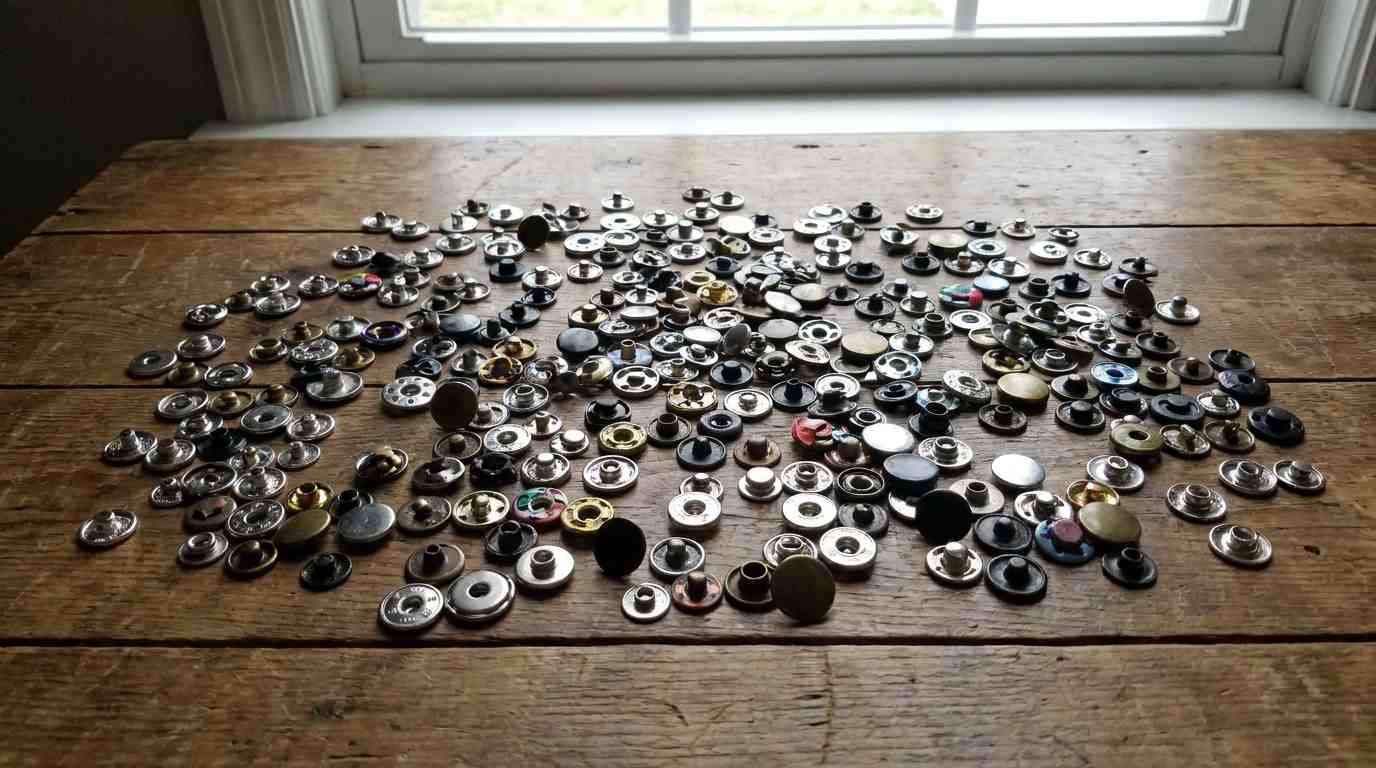
Baocheng can support snap-button programs from initial customization through repeat production, with the objective of preserving the approved structure, material, appearance and functional performance over time.
Custom options can include:
- cap diameter and profile;
- socket and stud geometry;
- post length;
- spring structure;
- closing and release behavior;
- 304 stainless steel;
- 316 stainless steel;
- JSW20 ultra-low magnetic permeability stainless steel;
- brass;
- zinc alloy;
- surface treatments and decorative finishes;
- custom logos;
- production and installation tooling;
- sampling and OEM production.
For repeat projects, approved drawings, sample references and relevant test criteria can be used together so that production is controlled against the agreed product rather than merely against the most recent shipment.
Where JSW20 is specified for ultra-low magnetic response, maintaining the approved material identity is particularly important. Likewise, corrosion-sensitive or appearance-sensitive projects should control surface-treatment specifications and relevant process changes.
A Practical Repeat-Order Quality-Control Framework
| Control | Purpose |
|---|---|
| Golden Sample | Preserves the accepted physical appearance and operating reference |
| Controlled Drawing | Defines dimensions and revision |
| Material Specification | Prevents unintended alloy substitution |
| Finish Specification | Controls color, surface process and relevant performance |
| Change Control | Requires review before significant process or product changes |
| First-Piece Approval | Confirms the process starts at the approved condition |
| In-Process Testing | Detects drift during production |
| Lot Traceability | Connects finished product to material and process history |
| Trend Records | Detects gradual movement before failure |
| Corrective Action | Returns the process to the approved target |
Buyer Checklist for Every Repeat Snap Button Order
- Is the purchase order linked to the current approved drawing?
- Is the correct golden sample still available?
- Has the material specification changed?
- Has the raw-material supplier changed?
- Has critical tooling been repaired or replaced?
- Has the plating or coating supplier changed?
- Has the finish chemistry changed?
- Has the customer substrate changed?
- Is the approved post length still suitable?
- Are closing and release requirements unchanged?
- Has first-piece inspection compared production with the approved reference?
- Are functional results trending away from historical values?
- Can the production lot be traced to material and finishing records?
- Are significant changes documented and approved?
- Are retained samples required for this project?
- Will the next order use the same controlled specification?
Conclusion
Quality drift in repeat snap button orders rarely begins with one obvious failure. It develops through small, accumulated changes in material, tooling, surface treatment, dimensions, substrate or process settings.
Golden samples provide a physical anchor, but they should be supported by drawings and measurable performance requirements. Change control prevents apparently minor manufacturing adjustments from silently changing the approved product. Traceability then provides the evidence needed to identify which materials, tools and processes created each production lot.
The strongest repeat-order system goes one step further by trending dimensions and functional test data across multiple lots. This allows buyers and manufacturers to detect movement before the product reaches an actual specification failure.
For long-running garment, workwear, marine, medical, technical-textile and customized snap programs, consistent quality is therefore not achieved by repeatedly asking the supplier to “make it the same.” It is achieved by defining exactly what “the same” means and controlling every significant change that can move the product away from that approved condition.
Focused FAQ
What is a golden sample for snap buttons?
A golden sample is a formally approved physical reference representing the agreed snap configuration and appearance. It should ideally include the complete four-part set and, where relevant, an installed sample on the approved substrate.
Is a golden sample enough to control repeat orders?
No. It is strongest when paired with a controlled drawing, material specification, finish requirement and measurable functional criteria such as closing force, release force or attachment strength.
What supplier changes should trigger revalidation?
Material changes, critical tooling replacement, significant tool repair, plating or coating supplier changes, component-geometry changes and post-length changes are typical triggers for technical review or revalidation.
How can buyers detect quality drift before a lot fails?
Track historical dimensions, closing force, release force, pull-out strength, defect rates and other critical characteristics. A consistent trend toward one specification limit can reveal drift before an actual failure occurs.
Why is traceability important if every lot passes inspection?
Traceability allows the buyer and manufacturer to isolate the affected scope if a later complaint or test failure occurs. It also helps compare material, tooling and finishing history between stable and abnormal lots.
Can Baocheng support repeat-order control for customized snap buttons?
Yes. Baocheng can coordinate approved specifications, materials, component structures, post lengths, finishes, tooling and sample references for customized snap programs so repeat production can be compared against the agreed product condition.
#SnapButtonQuality, #QualityDrift, #GoldenSample, #ChangeControl, #Traceability, #SnapButtons, #RepeatOrders, #SupplierQuality, #CustomSnapButtons, #BCNewMaterial