







Metal vs Plastic Curtain Eyelets: Noise, Wear, Appearance and Cost
The Material Choice Changes More Than the Look of a Curtain
When a curtain manufacturer compares a metal grommet vs plastic grommet, the conversation often starts with appearance and price. Metal looks more premium. Plastic is assumed to be cheaper and quieter.
Those statements can be directionally useful, but they are too simple for production decisions.
A curtain eyelet is both a visible decorative component and a sliding bearing surface. Every time the curtain opens or closes, the inside of the eyelet moves along the rod. At the same time, the eyelet clamps several layers of textile around a relatively large opening in the curtain header.
Material choice therefore affects at least four different systems:
- the acoustic interaction between eyelet and rod;
- wear of both the eyelet and rod surface;
- the visual language of the finished curtain;
- the total manufacturing cost rather than only the individual component price.
A lightweight decorative curtain in a residential bedroom can justify a completely different eyelet from a heavy blackout curtain in a hotel, a frequently operated commercial drape or a moisture-exposed bathroom curtain.
The useful question is not “Which material is better?”
It is:
Which material creates the most stable curtain system for the required rod, fabric, appearance, service frequency and target cost?
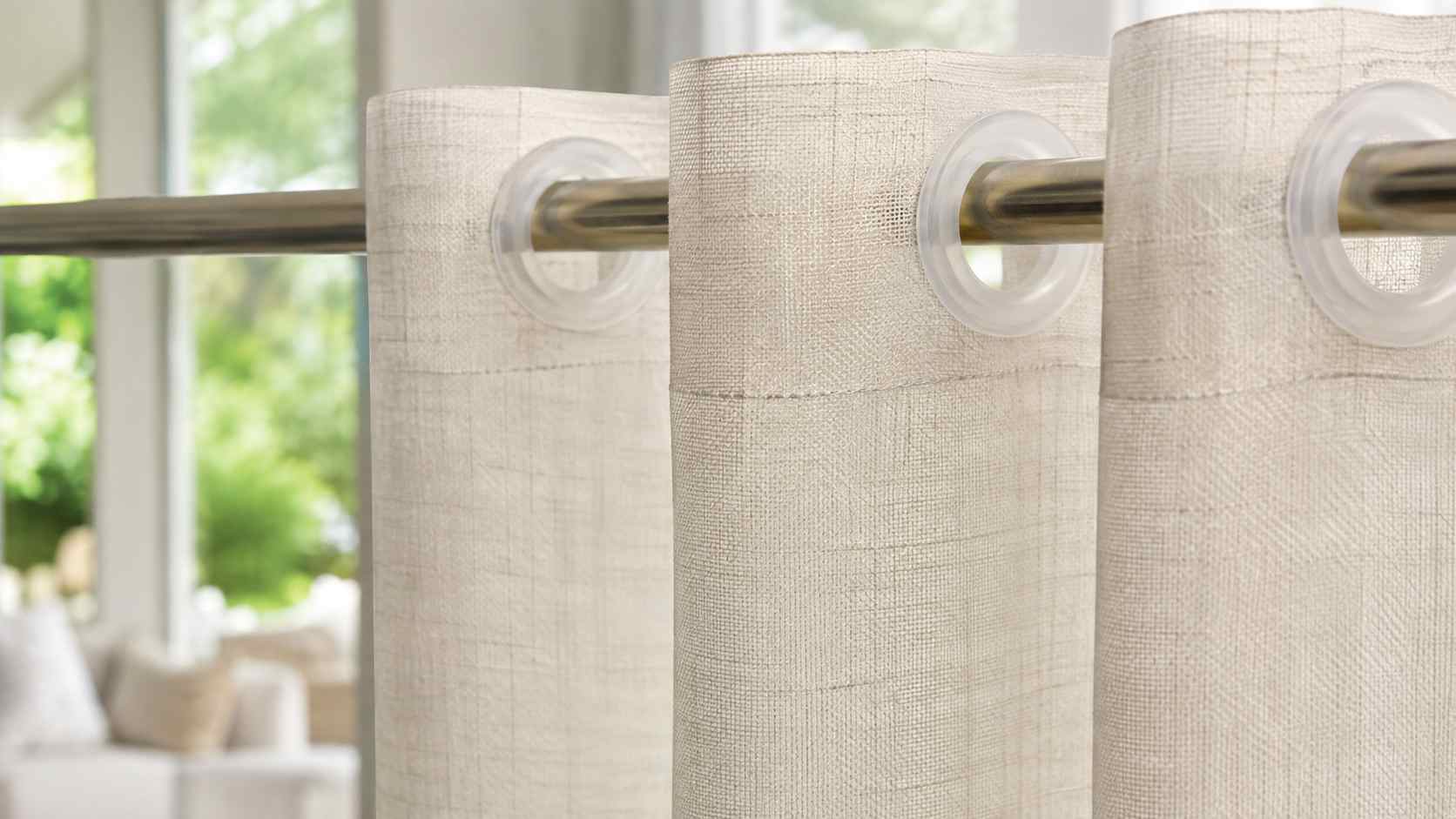
Why Plastic Curtain Eyelets Often Sound Quieter
 a
aNoise is one of the most noticeable differences between metal and plastic eyelets, especially when the curtain rod is also metal.
When two hard metal surfaces contact each other, movement can generate short impacts, sliding noise and vibration. The sound can become more noticeable when the eyelet has generous clearance around the rod and repeatedly contacts the upper and lower rod surfaces as the curtain changes direction.
Plastic generally has lower surface hardness and greater internal damping than most metal hardware. As a result, plastic-to-metal contact often produces a softer sound character.
That does not mean every plastic eyelet curtain is quiet or every metal eyelet curtain is noisy.
Actual sound depends on the complete interface.
Rod diameter and eyelet clearance strongly influence noise
If the eyelet opening is much larger than the rod, the curtain can move vertically before the eyelet contacts the rod. When the direction of movement changes, the eyelet may strike the rod rather than simply slide across it.
This can create the familiar clicking or clattering associated with some metal grommet curtains.
If clearance is too small, however, movement may become less smooth and friction can rise—especially if the rod is not perfectly straight or if surface coatings vary in thickness.
This is why a generic curtain grommet size chart should be treated as an initial reference rather than the final engineering specification.
The actual rod outside diameter, eyelet inside diameter, finish thickness and manufacturing tolerances should be reviewed together.
Curtain weight changes the acoustic behavior
A lightweight sheer curtain applies relatively little normal force to the rod. A heavy lined curtain, blackout curtain or wide hotel drape places considerably more weight on the eyelet-to-rod interface.
The higher the load, the more strongly the surfaces remain in contact during movement.
Consequently, the same metal eyelet and rod combination may sound acceptable on a lightweight sample but noticeably louder when the full production curtain weight is installed.
Surface condition matters
A smooth metal eyelet sliding over a clean, smooth rod behaves differently from an eyelet with rough plating, burrs or an uneven seam.
Plastic components can also create noise if molding flash, parting lines or surface texture interfere with smooth movement.
For acoustic evaluation, manufacturers should test the actual production eyelet on the actual rod instead of making the decision from material names alone.
Noise Is Not Only a Comfort Issue
In residential curtains, sliding noise may simply affect perceived quality.
In hotels, premium apartments, meeting rooms, healthcare interiors or hospitality spaces, however, repeated metallic noise can influence the entire user experience.
A very visually premium metal fitting can feel less refined if every opening movement produces sharp impact sounds.
On the other hand, deliberately exposed metal hardware can be part of an industrial or contemporary design language where a small amount of mechanical sound is less objectionable.
This means acoustic acceptance is partly technical and partly market-specific.
Brands should define the desired behavior before material selection instead of treating noise as a problem discovered only after the finished curtains are installed.
Wear Is a Two-Surface Problem
When discussing durability, manufacturers sometimes focus only on whether the eyelet itself will wear out.
That is incomplete.
Every sliding curtain has two interacting surfaces:
- the inside surface of the eyelet;
- the outside surface of the curtain rod.
A harder eyelet can resist its own dimensional wear very well while gradually polishing or scratching a softer rod coating.
A softer eyelet can protect the rod but experience more wear itself.
The correct choice therefore depends on which surface the brand wants to preserve and how easy each component is to replace.
How Metal Curtain Eyelets Wear
Well-made metal grommets for curtains generally offer good resistance to permanent deformation around the rod opening.
This can be useful for heavier curtains because the opening is less likely to become noticeably oval merely from static curtain weight.
However, the base metal is only one part of the wear system.
The inside contact surface may include:
- polished base metal;
- electroplating;
- paint;
- lacquer;
- PVD-type decorative layers depending on the project;
- other project-specific surface treatments.
If the eyelet repeatedly slides against a harder or abrasive rod surface, the finish can gradually polish or wear through at the contact zone.
This is particularly noticeable on dark decorative finishes because a worn area may expose a different underlying color.
Burrs are another concern. A metal eyelet with a sharp internal edge can damage the rod coating or create rough sliding from the beginning.
For curtain applications, the inner circumference deserves the same quality attention as the visible front flange.
How Plastic Eyelets Wear
Plastic usually behaves differently.
Rather than polishing a plated surface, a plastic ring may gradually develop:
- surface burnishing;
- small scratches;
- ovalization under sustained load;
- stress whitening around snap features;
- cracking at thin sections;
- wear at molding seams or internal contact zones.
The exact behavior depends heavily on polymer type, wall thickness, molding quality, additives and service temperature.
This is why it is misleading to treat “plastic” as one material category.
A properly engineered molded curtain eyelet can perform reliably for a long service period, while an inadequately designed low-cost plastic ring can lose fit or crack much earlier.
UV exposure also matters for window products. Curtains installed near strong sunlight may expose decorative plastic hardware to elevated temperature and ultraviolet radiation for long periods.
Color stability and embrittlement resistance should therefore be considered for products intended for long-term installation near windows.
Permanent Deformation Matters More on Heavy Curtains
For lightweight curtains, the static load on each eyelet is relatively modest.
For wide, lined or blackout curtains, the load at the top header can be much greater.
If the component gradually deforms, the opening may become slightly oval. This can change how the curtain hangs and how the eyelet contacts the rod.
For this reason, large curtain grommets should not be selected solely because a designer wants a larger visual opening.
The larger the opening, the more important the relationship between wall geometry, material stiffness, curtain weight and heading reinforcement becomes.
A larger ring can distribute fabric stress over a larger visible area, but it also removes more textile from the header and can create more leverage around the hole.
Metal Does Not Automatically Mean “No Wear”
Metal is usually more resistant than plastic to certain forms of deformation, but the interface can still deteriorate.
Potential issues include:
- decorative finish wear;
- coating transfer;
- rod scratching;
- edge burrs;
- corrosion in humid environments;
- loosening if the eyelet is poorly installed;
- noise increase as finishes wear and surface roughness changes.
For B2B buyers, a better durability test is therefore not simply “Does the metal ring remain unbroken?”
The useful question is whether the curtain continues to slide smoothly and look acceptable after the expected number of operating cycles.
Plastic Does Not Automatically Mean “Disposable”
Plastic curtain eyelets are sometimes categorized as a budget option only.
That overlooks several legitimate engineering advantages.
Plastic can offer:
- lower sliding noise against metal rods;
- low component weight;
- integrated snap-fit structures;
- molded color without a separate decorative plating process;
- low risk of red rust;
- reduced risk of scratching certain rod coatings.
For high-volume curtains where the required aesthetic can be achieved by molding, plastic can be a very rational material rather than simply a cheaper substitute for metal.
The tradeoff is that mold design, resin selection, dimensional shrinkage and snap retention become critical production variables.
Appearance Is Where Metal Usually Creates the Strongest Advantage

For premium curtains, hardware is part of the visual composition.
The eyelet is repeated across the entire top of the curtain, which means even small differences in gloss, color or edge quality are multiplied many times.
Metal creates genuine metallic reflection. Light interacts with the surface in a way that molded plastic or metallic coating may approximate but not always reproduce exactly.
This is particularly important when eyelets need to coordinate with:
- curtain rods;
- rod finials;
- furniture hardware;
- door handles;
- lighting finishes;
- other interior metal accents.
For this reason, metal remains attractive in higher-value curtain collections.
Brass, Nickel and Other “Metal Colors” Need Precise Specification
Buyers searching for brass curtain grommets may be referring to solid brass hardware, brass-plated hardware or simply a brass-colored finish.
Those specifications are not equivalent.
The same issue applies to nickel curtain grommets. “Nickel” is frequently used as an appearance description—such as bright nickel, satin nickel or nickel-tone—rather than a complete statement of base material.
For B2B production, the specification should separate:
- base metal;
- surface finish;
- gloss level;
- target color;
- surface-protection requirements.
This prevents a finish name from being incorrectly treated as a material specification.
Plastic Can Offer Strong Color Consistency—But Only with Good Molding Control
Plastic allows color to be incorporated into the molded material or applied as a secondary surface treatment.
For some interior collections, this makes it easier to create white, cream, black or other nonmetallic colors without using plated metal.
However, plastic appearance can reveal different defects:
- visible parting lines;
- gate marks;
- flash;
- sink marks;
- color variation between resin lots;
- different gloss between cavities;
- stress whitening after snap assembly.
Therefore, the appearance comparison should not be simplified into “metal premium, plastic cheap.”
High-quality plastic hardware can look very clean. Poorly controlled metal plating can also look inconsistent.
How Curtain Header Construction Changes the Decision
The eyelet is installed into fabric, so the strength of the finished curtain does not come from the eyelet material alone.
The header may include:
- decorative face fabric;
- lining;
- blackout layer;
- heading tape;
- fusible reinforcement;
- additional backing around the eyelet zone.
The complete stack determines how well the eyelet remains centered and how much the material around the hole deforms.
This is particularly important for heavier window curtain grommets, where gravity continuously loads the top panel.
An extremely strong metal eyelet cannot prevent fabric distortion if the heading itself lacks sufficient reinforcement.
Similarly, a plastic eyelet can perform very well when the fabric structure provides stable support and the component geometry is matched correctly.
Spacing Determines Fold Geometry and Load Distribution
Curtain grommet spacing is normally discussed as a visual issue because it determines the rhythm of the folds.
It also influences mechanical behavior.
If the spacing is too large, each eyelet supports a larger section of curtain fabric and potentially more weight.
If spacing is too tight, the header contains many large holes and less uninterrupted textile between them.
The correct layout therefore balances:
- desired fold depth;
- curtain width;
- fabric stiffness;
- eyelet diameter;
- curtain weight;
- available reinforcement in the header.
The spacing pattern should be developed together with the eyelet diameter rather than after the component has already been selected.
Two-Piece Plastic Rings and Press-Set Metal Eyelets Behave Differently in Production
Many plastic curtain rings use a snap-together two-piece construction. One half enters from the front and the mating half locks from the back.
This can simplify assembly because no permanent metal rollover is required.
However, the snap structure has its own process requirements.
The fabric stack must remain within the intended grip range. If it is too thick, the halves may not fully engage. If it is too thin, the assembled ring can feel loose or move relative to the textile.
Metal curtain eyelets may use press-set, rolled or two-piece configurations depending on the design. Their retention is more dependent on forming geometry and setting tooling.
This difference changes not only product behavior but also factory equipment and labor requirements.
Installation Cost Can Be More Important Than Component Cost
The price of one eyelet is only one line in the manufacturing cost.
True installed cost can include:
- component price;
- washer or second half;
- punching operation;
- press or assembly equipment;
- tooling;
- operator labor;
- inspection;
- scrap caused by incorrect setting;
- rework;
- packaging and transportation weight.
This is why “plastic is cheaper” can be correct in one program and incorrect in another.
When Plastic May Offer the Lower Total Cost
Plastic becomes particularly cost-efficient when:
- production volume is high enough to justify molding tooling;
- the design uses a fast snap-fit assembly;
- no secondary metallic finish is required;
- component weight reduction matters;
- the product uses standardized colors across large quantities.
Once the mold is qualified and production volume is sufficient, molded components can offer attractive repeatability and relatively efficient piece pricing.
But initial tooling should not be ignored.
A custom plastic ring may require meaningful mold investment, especially when multiple cavities, complex snap features or very tight visual requirements are involved.
When Metal May Make More Economic Sense Than Expected
Metal can have a higher piece cost but still make sense when:
- production volume is moderate;
- the buyer wants a genuinely metallic premium appearance;
- several finish variants can use the same basic metal geometry;
- the curtain is heavy and dimensional rigidity is important;
- the market positioning supports a higher-value component;
- existing press tooling can be reused.
In these conditions, the premium paid for the metal eyelet can be small relative to the total value of the finished curtain.
Finish Variety Changes the Metal Cost Structure
One of metal's major visual advantages—surface finishing—also adds cost complexity.
Bright, satin, antique, dark and decorative finishes may require different surface-treatment processes and minimum batch quantities.
Color matching between eyelets and curtain rods can also require control samples.
For a large program using several hardware colors, buyers should evaluate whether all finishes can share the same stamped geometry and only differ during finishing.
This can be more efficient than creating completely different components for every color.
Corrosion: Plastic Does Not Rust, but That Does Not End the Discussion
Plastic does not produce conventional red rust, which can be advantageous in humid interiors and bathroom applications.
Metal requires more careful material and finish selection when moisture is present.
However, corrosion is only one type of environmental degradation.
Plastic can still be affected by:
- UV exposure;
- heat;
- cleaning chemicals;
- plasticizer interaction depending on surrounding materials;
- long-term creep.
Metal can offer stronger dimensional stability but may require corrosion-resistant base materials or controlled protective finishes.
For moisture-exposed curtains, the correct comparison is therefore environmental durability versus environmental durability—not simply “rust versus no rust.”
The Shower-Curtain Environment Illustrates the Difference Clearly
Bathroom hardware experiences humidity, condensation and cleaning more frequently than typical living-room curtains.
A plastic eyelet can avoid metal corrosion concerns but must maintain snap retention and material stability.
A suitable metal eyelet can provide a more premium appearance but needs the appropriate base material and surface system for the wet environment.
This is a good example of why material selection should begin with the operating environment instead of showroom appearance.
Replacement Behavior Is Different
Curtain grommet replacement should also be considered during product design.
Some snap-fit plastic components can be removed and replaced relatively easily if the locking features can be disengaged without damaging the curtain.
Press-set metal hardware may be more permanent. Removal can deform the eyelet and potentially damage the surrounding fabric.
For disposable or frequently redesigned consumer curtains, replaceability may favor one construction.
For premium curtains expected to remain installed for years, a permanent, stable eyelet may be preferred.
Drapery Applications Place More Emphasis on Visual Repetition
Unlike many small garment eyelets, drapery grommet rings are large and highly visible.
A typical curtain displays many of them in a straight line.
This makes batch consistency extremely important.
Variations in:
- color;
- gloss;
- flange width;
- inside diameter;
- installed height;
- concentricity;
- spacing;
can become obvious when repeated across the whole header.
For metal, plating consistency is a major cosmetic control point.
For plastic, molding consistency and resin color control play a comparable role.
Rod Compatibility Should Be Tested as an Assembly
A curtain eyelet supplier can control the eyelet, but sliding performance depends partly on a component the supplier may not manufacture: the rod.
Rod factors include:
- outside diameter;
- roundness;
- surface roughness;
- paint or plating thickness;
- joint transitions in telescopic rods;
- brackets and obstacles along the travel path.
A perfectly smooth eyelet can still catch at a poorly designed telescopic-rod joint.
This is why curtain manufacturers should test actual curtain panels on the production rod system.
Neither Material Can Compensate for an Incorrect Inside Diameter
A metal eyelet that is too tight around the rod can create excessive friction.
A plastic ring that is too tight can also bind or deform.
An oversized metal ring can become noisier because of impact clearance, while an oversized plastic ring may create excessive movement and poor visual alignment.
The target inside diameter should therefore be selected from the rod specification plus an appropriate functional allowance rather than by choosing a nominal curtain-ring size in isolation.
A Practical Metal vs Plastic Decision Matrix
| Design Priority | Metal Eyelet Tendency | Plastic Eyelet Tendency |
|---|---|---|
| Premium metallic appearance | Strong advantage | Can imitate metal but surface character differs |
| Low sliding noise on metal rod | Requires careful interface control | Often advantageous |
| Resistance to opening deformation | Generally strong when geometry is correct | Depends strongly on polymer and wall design |
| Low component weight | Less favorable | Strong advantage |
| No red-rust risk | Depends on alloy and finish | Strong advantage |
| Authentic metallic finish | Strong advantage | Requires coating or visual simulation |
| Simple snap assembly | Depends on design | Common advantage |
| Very high-volume standardized production | Can be economical | Can be highly economical after tooling |
| Heavy premium drapery | Often attractive | Requires careful structural validation |
| Frequent color redesign | Finish changes possible | Molded colors can be efficient |
This matrix is directional rather than absolute. Actual performance should be validated with the final component geometry and curtain construction.
What B2B Buyers Should Test Before Making the Final Choice
A useful comparison test should use the real production curtain rather than loose rings on a desk.
Evaluate both candidate materials using the same:
- curtain width;
- curtain weight;
- heading construction;
- eyelet spacing;
- rod diameter;
- rod surface;
- opening and closing distance.
Then assess:
- initial sliding force;
- subjective noise character;
- wear after repeated cycling;
- rod-surface damage;
- eyelet deformation;
- finish change;
- fabric distortion around the hole;
- component retention.
If acoustic performance is a major purchase requirement, an objective test method can also be developed under controlled room conditions rather than relying only on different employees describing one sample as “quiet.”
Do Not Compare Cost Until the Installation Method Is Defined
A fair cost comparison should place both alternatives in their actual production process.
For example, compare:
Plastic system total cost = molded ring + mating half + punching + snap assembly + inspection + scrap
against:
Metal system total cost = metal eyelet + washer if required + finishing + punching + press setting + inspection + scrap
Only then can the procurement team determine which system is actually less expensive.
Comparing a loose plastic ring price with a plated metal eyelet price while ignoring assembly operations can produce the wrong sourcing conclusion.
Where Metal Curtain Eyelets Usually Make the Most Sense
Metal tends to be especially attractive when the product requires:
- premium interior positioning;
- real metallic surface reflection;
- coordination with metal rods and interior hardware;
- higher structural rigidity;
- stable shape on heavier curtains;
- custom finishes for design collections.
For these applications, material and finish should still be chosen according to corrosion requirements and forming behavior.
Where Plastic Curtain Eyelets Usually Make the Most Sense
Plastic can be particularly suitable when:
- quiet movement is a major target;
- the curtain is relatively lightweight;
- low component mass is useful;
- snap assembly improves production efficiency;
- molded colors fit the design language;
- production volume justifies dedicated tooling;
- conventional metal corrosion needs to be avoided.
Again, the quality of the resin, molding process and geometry is more important than the word “plastic” itself.
Custom Metal Eyelets Allow More Control Over the Premium Segment
For B2B curtain programs where metal is selected, the component can be developed around the actual rod and heading construction instead of forcing the curtain design to adapt to a generic ring.
Custom variables can include:
- inside diameter;
- flange outside diameter;
- component height;
- material thickness;
- front profile;
- backside structure;
- base metal;
- surface finish;
- gloss level;
- color reference.
BC New Material supports customized metal eyelet and grommet components for B2B applications using materials such as stainless steel, brass, zinc alloy and other project-specific options.
For curtain hardware, the material decision should be made according to appearance, forming behavior, corrosion environment, cost and the required interaction with the curtain rod.
The Best Choice Is the One That Matches the Entire Curtain System
Metal and plastic curtain eyelets solve the same basic problem, but they do not create the same user experience.
Plastic often has an acoustic advantage when sliding on a metal rod and can support efficient snap assembly at high volume.
Metal generally offers stronger authentic metallic aesthetics and higher resistance to certain forms of deformation, making it attractive for premium and heavier drapery.
Neither advantage is automatic.
A poorly sized metal eyelet can be noisy and damage the rod. A poorly molded plastic ring can crack, loosen or deform. A premium finish cannot compensate for incorrect curtain grommet spacing, insufficient heading reinforcement or an eyelet that does not match the rod diameter.
For manufacturers, the most reliable selection process is therefore to compare complete systems rather than loose components.
Specify the rod. Define the curtain weight. Determine the header construction. Establish the inside-diameter clearance. Validate installation. Run repeated opening cycles. Inspect both the eyelet and rod afterward. Then calculate installed cost.
When those steps are completed before mass production, the metal-versus-plastic decision becomes an engineering and market-positioning decision rather than a guess based only on appearance or piece price.
Focused FAQ
1. Are plastic curtain eyelets always quieter than metal eyelets?
Plastic-to-metal contact often produces softer sliding and impact noise, but actual sound depends on rod diameter, eyelet clearance, curtain weight, surface finish and installation. Material alone does not determine noise.
2. Do metal curtain eyelets last longer than plastic ones?
Metal generally resists permanent opening deformation well, but its finish and the curtain rod can still wear. Plastic durability depends strongly on resin, geometry, UV exposure and load. The complete sliding system should be cycle-tested.
3. Can metal curtain eyelets scratch the curtain rod?
They can if internal edges are rough, the rod coating is relatively soft or abrasive particles enter the contact area. Smooth internal finishing and compatible rod surfaces reduce this risk.
4. Why do some metal grommet curtains make a clicking sound?
One common cause is clearance between the eyelet and rod. When movement changes direction, a rigid metal eyelet can impact the rod rather than remain in continuous sliding contact.
5. Is plastic always cheaper than metal for curtain eyelets?
Not necessarily. Plastic can offer low unit cost at high volume, but mold investment, snap assembly and rejection rates must be included. Metal may be economical for moderate-volume premium programs using existing tooling.
6. Which material is better for heavy blackout curtains?
Metal is often attractive where higher dimensional rigidity is required, but the eyelet geometry, curtain header reinforcement, spacing and rod compatibility are equally important. A properly designed plastic system may also be suitable depending on load.
7. Does a brass-colored curtain eyelet have to be solid brass?
No. “Brass” can describe the base material or only the visible finish. B2B specifications should separately define base metal and surface appearance.
8. How much larger should the eyelet opening be than the curtain rod?
There is no universal clearance for every curtain system. The appropriate allowance depends on rod tolerance, finish thickness, eyelet material, curtain weight and desired sliding behavior. Production components should be tested on the actual rod.
9. Can plastic eyelets fade near a window?
Long-term UV and heat exposure can affect some plastics and pigments. Resin and color systems should be selected according to the expected window environment and required product life.
10. What information should a buyer provide for custom metal curtain eyelets?
Useful information includes rod diameter, eyelet inside and outside dimensions, curtain weight, header thickness, spacing, base metal, finish, color target, installation structure, quantity and physical curtain or rod samples when available.
#CurtainEyelets, #CurtainGrommets, #MetalEyelets, #PlasticEyelets, #DraperyHardware, #CurtainHardware, #GrommetCurtains, #CurtainManufacturing
