







Metal Eyelets for Work Boots: Repeated Lacing, Moisture and Abrasion Considerations
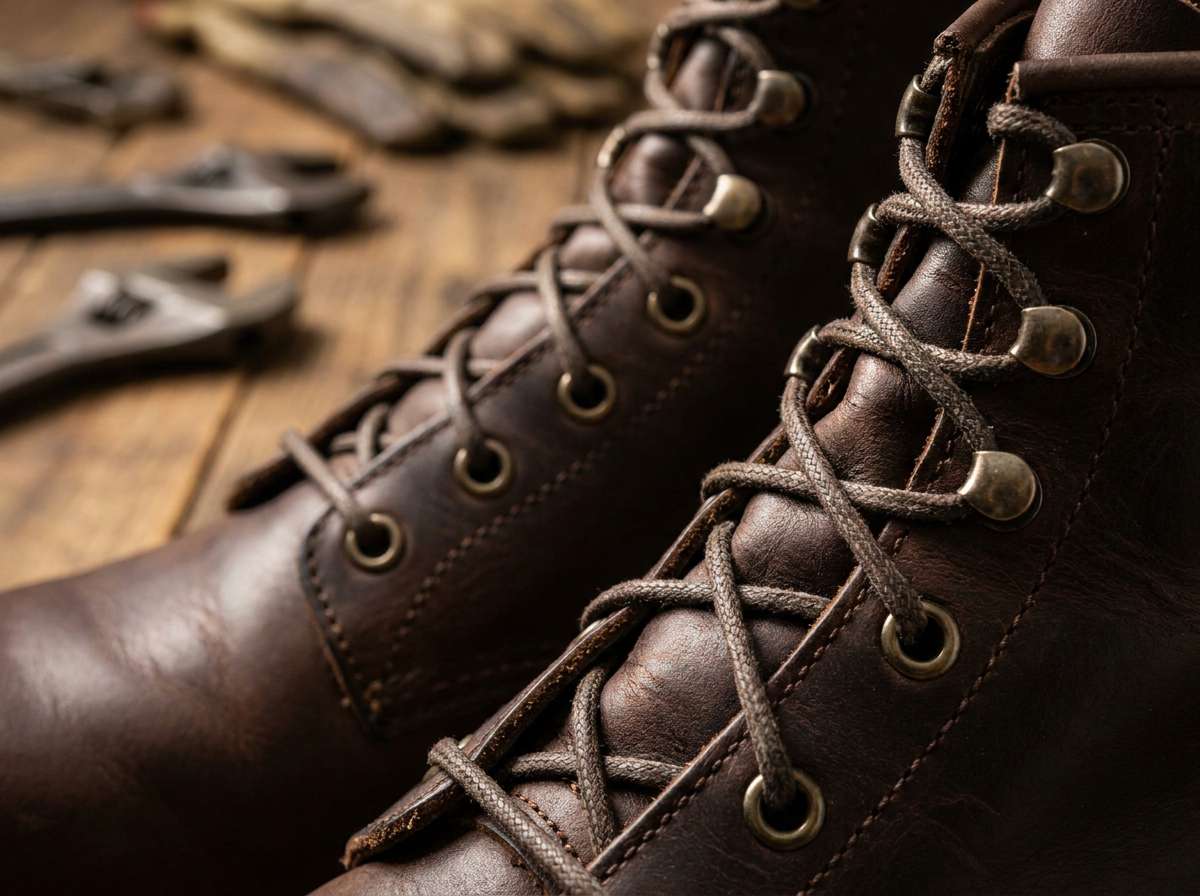
A metal eyelet on a work boot performs a much more demanding job than its small size suggests. Every working day, the lace may be tightened, loosened and pulled against the eyelet multiple times. The boot may then be exposed to sweat, rain, mud, dust, concrete particles, oils and other contaminants before the same process begins again.
For footwear brands and work-boot factories, this means an eyelet should not be selected simply because its diameter and finish look correct on a development sample. The component has to maintain a smooth lace path, remain securely attached to the leather or textile upper and resist environmental exposure throughout the expected life of the boot.
The problem is especially important in work footwear because users often tighten their boots more firmly than casual shoes. A work boot may also use thicker laces, heavier leather and a taller lacing system. These conditions increase the mechanical demands placed on each metal component.
From the perspective of a Chinese metal eyelet manufacturer, long-term reliability depends on the whole attachment system: eyelet material, inside-edge quality, flange dimensions, barrel length, upper reinforcement, hole preparation, setting tooling and surface finish all have to work together.
This guide looks at the three conditions that deserve particular attention in work boots: repeated lacing, moisture exposure and abrasion.
Why Work Boot Eyelets Experience More Severe Service Conditions
A casual shoe may be worn for a few hours and tied with relatively light tension. Work boots are different. Many are worn for an entire shift, tightened firmly around the foot and ankle, exposed to changing environments and then used again the next day.
The lacing hardware therefore experiences repeated mechanical cycles.
When buyers ask how do grommets work in a heavy footwear application, the answer is not simply that the metal protects a hole. The eyelet creates an interface between a flexible shoelace and a leather or textile upper. Every tightening action transfers load through the lace, across the metal edge and into the surrounding upper structure.
A correctly designed eyelet spreads this load without allowing the leather hole to enlarge significantly. It also provides a smooth surface over which the lace can move.
If either function is poorly controlled, the problem becomes visible over time rather than immediately during production.
Repeated Lacing Creates a Fatigue Problem, Not Just a Single Pull
A work-boot eyelet can pass a simple pull test and still develop problems after months of repeated use.
The reason is that real footwear does not experience one perfectly controlled load. The wearer may pull the lace outward, upward or diagonally depending on the eyelet position. This force is repeated hundreds or thousands of times during the life of the shoe.
Each cycle can produce small movements between the eyelet and upper. If the component is slightly loose, those movements can gradually enlarge the leather opening. If the flange is too small for the load, pressure becomes concentrated around a narrow area of material.
Eventually, the eyelet may rotate, tilt or begin pulling through the upper even though the metal itself remains undamaged.
This is why work-boot development should focus on the installed assembly rather than asking only how strong the loose metal part is.
The Lace Does Not Pull Every Eyelet in the Same Direction
Eyelets positioned near the forefoot experience a different lace path from those around the ankle.
Lower eyelets often guide the lace across the vamp, while upper eyelets may experience stronger diagonal loading as the wearer pulls the boot closed around the ankle.
Tall boots make the difference even more obvious. The upper lacing positions can be subjected to substantial tension when the wearer wants a firm fit.
For this reason, a row of identical-looking components can experience different loads depending on position.
Brands developing demanding work footwear should examine which eyelets show the earliest signs of movement during wear testing. A repeated failure at the same position can reveal a lacing-angle or reinforcement problem rather than random component variation.
A Grommet Ring Must Distribute Load Into the Upper
The visible flange or grommet ring surrounding the lace hole does more than create a finished appearance. Its diameter determines how much surface area contacts the upper around the opening.
A larger flange can distribute pressure across a wider region, which can be valuable on high-load positions. But simply increasing flange diameter is not automatically the correct answer.
A large flange can look disproportionate, add unnecessary weight and require a larger overall component. Work-boot eyelet design therefore needs to balance appearance with mechanical support.
The material beneath the flange is equally important. Thick full-grain leather may provide good local stability, while soft leather or textile panels may need additional reinforcement.
An eyelet cannot create strength that does not exist in the upper.
Leather Thickness Changes the Required Barrel Length
Work boots commonly use thicker and more heavily reinforced uppers than lightweight footwear.
An eyelet may pass through outer leather, an internal reinforcement layer and lining material before the rear barrel can be formed.
The complete stack determines the barrel length.
If the barrel is too short, there may not be enough metal available behind the material for secure rolling or flaring. The eyelet can look acceptable from the outside while remaining mechanically weak.
If the barrel is too long, the rear section may buckle, split or form irregularly when the press applies force.
This is why a leather eyelet should not be selected from inside diameter alone. Barrel length needs to correspond to the actual compressed thickness of the work-boot upper.
Moisture Changes the Eyelet Environment
Work boots routinely encounter moisture from several directions.
Rain and puddles affect the exterior. Sweat and humidity act from inside the boot. Mud and wet dust may remain around the lace hardware after use. The boot can then dry slowly between shifts.
This wet-dry cycle deserves attention because the eyelet is a metal component installed into another material system.
Corrosion resistance therefore becomes more important than it might be for a lightly worn indoor fashion shoe.
The base metal, plating system and final surface treatment should be selected according to the real operating environment rather than appearance alone.
Surface Finish Is Functional on a Work Boot
Nickel-colored, black, antique brass and gunmetal finishes are often selected primarily for design. On work footwear, however, the finish also becomes part of the environmental protection system.
Repeated lace contact can gradually polish or abrade the inner edge. Dirt trapped between the lace and metal can increase the abrasive action.
If a decorative coating is damaged, the underlying material becomes more exposed to moisture and contaminants.
This does not mean every visible finish change represents structural failure. Work boots naturally develop wear marks. The more important question is whether the eyelet remains smooth, securely attached and sufficiently resistant to corrosion for the intended environment.
Brass Eyelets for Leather Work Boots
Brass grommets for leather are relevant to work footwear because brass combines good forming behavior with useful corrosion resistance and compatibility with a wide range of decorative finishes.
Brass is also well suited to rolled or flared eyelet constructions because it can form cleanly when the dimensions and tooling are correct.
For heritage work boots, outdoor-inspired footwear and leather boots with visible hardware, natural brass or antique brass finishes can also support the desired visual identity.
However, the decision should never be based on color alone. Material thickness, flange dimensions, barrel geometry and setting quality remain critical.
A good brass eyelet installed incorrectly can still loosen or damage a shoelace.
Stainless Steel for Demanding Environments
Stainless steel is another option for footwear programs where corrosion resistance and mechanical durability are priorities.
It can be appropriate for outdoor or work applications that experience frequent moisture, cleaning or long-term exposure.
The important manufacturing consideration is that different materials do not necessarily form identically during setting.
A tooling and pressure condition developed for a softer metal should not automatically be transferred to a stainless steel eyelet without validation.
The supplier and footwear factory should confirm whether the approved component can be rolled or flared consistently without cracking, excessive springback or damage to the upper.
Low-Magnetic Stainless Steel for Specialized Work Environments
Some work footwear programs have requirements beyond ordinary corrosion resistance.
Where metal detection or strict magnetic-performance requirements are important, Bao Cheng can also evaluate JSW20 low-magnetic stainless steel for suitable customized components.
The important distinction is that magnetic performance should be considered at the finished-part level. Stamping, drawing and other forming operations can influence the behavior of stainless components.
For specialized projects, customers should therefore provide the required finished-component specification rather than simply requesting a generic “non-magnetic stainless steel eyelet.”
Abrasion Often Starts at the Inside Edge
One of the most important surfaces on a work-boot eyelet is also one of the least visible: the inner radius where the shoelace repeatedly contacts the metal.
Every time the wearer tightens or loosens the boot, the lace slides over this area.
A smooth radius allows the lace to change direction with relatively controlled friction. A burr, sharp corner or damaged plated edge can act like a cutting surface.
The result may first appear on the lace rather than the eyelet. Local fuzzing, flattening or repeated breakage at the same lace position can indicate a problem with one particular hardware contact point.
For work boots, this matters because a lace failure can make otherwise serviceable footwear unusable until the lace is replaced.
Thick Laces Increase Contact With the Metal Edge
Work boots often use thicker round or woven laces than formal footwear.
If the eyelet inside diameter provides insufficient clearance, the lace may be squeezed tightly against the metal during every adjustment.
This increases friction and can make the boot difficult to tighten evenly.
The answer is not simply to use the largest possible opening. An oversized barrel requires a larger hole in the leather and can alter both strength and appearance.
Instead, the finished eyelet ID should be matched to the actual lace used by the footwear brand.
Sampling with the production lace is much more reliable than estimating clearance from a catalog photograph.
Dirt Turns Normal Lace Movement Into an Abrasive System
Work boots are often used in environments where fine particles accumulate around the hardware.
Dust, sand, concrete residue and dried mud can become trapped between the lace and eyelet.
As the lace moves, these particles can increase abrasive wear on both surfaces.
This is another reason smooth internal geometry is important. Roughness already present on the eyelet can combine with environmental contamination to accelerate lace damage.
Surface durability should therefore be evaluated under representative use conditions rather than judging only a clean new sample.
Why Rivets and Eyelets Should Not Be Treated as Identical Fasteners
The phrase rivets and eyelets often appears together because both components are installed through holes and mechanically formed during assembly.
However, their primary functions are different.
A rivet usually joins material layers together. An eyelet reinforces an opening and creates a controlled passage for another element such as a lace.
This difference changes where the component experiences wear.
For a shoe eyelet, internal edge quality and lace clearance are crucial because another material repeatedly moves through the opening.
The manufacturer therefore has to control not only attachment strength but also the geometry of the hole after forming.
How to Install Grommets in Leather for Work-Boot Production
Buyers researching how to install grommets in leather will often encounter craft instructions using a hammer and simple hand setter. Those methods can be useful for repair or prototyping, but industrial work-boot production requires much tighter repeatability.
The process should begin with a controlled opening in the leather. The barrel should pass through without requiring an excessively oversized hole.
The component then needs to be supported by a die that matches the front flange while the rear barrel is formed.
After setting, the factory should check:
- whether the eyelet sits flat against the leather;
- whether the barrel has rolled evenly;
- whether the component rotates;
- whether the leather around the hole is crushed or cracked;
- whether there are sharp edges on either side;
- whether the shoelace moves freely; and
- whether the visible finish has been damaged.
These checks are much more meaningful than simply confirming that the eyelet has not fallen out immediately after setting.
The Hole Diameter Must Match the Barrel
One common production shortcut is to enlarge the leather hole because the eyelet becomes easier to insert.
This can make assembly faster in the short term but reduce the amount of material supporting the component.
Repeated lacing then works against an already weakened attachment.
The punched opening should correspond to the actual eyelet barrel and the installation method.
For thick leather, the punch must also cut cleanly. A dull punch can distort or tear the edge of the opening, creating hidden damage beneath the eyelet flange.
The Grommet Tool Must Match the Exact Eyelet
A grommet tool should never be treated as universally interchangeable.
The support die needs to match the flange shape, while the forming die needs to control how the barrel rolls or flares.
A die designed for one eyelet profile may leave marks on another component even if their nominal hole sizes are similar.
Incorrect tooling can produce several problems:
- off-center forming;
- split barrels;
- uneven rear edges;
- flattened front flanges;
- surface scratches;
- loose components; and
- excessive compression of the leather.
For footwear factories changing eyelet suppliers or introducing a new custom dimension, tooling compatibility should therefore be confirmed during sampling.
How to Set Grommets Without Simply Increasing Pressure
When factories investigate how to set grommets more securely, one of the easiest adjustments is to increase press pressure.
But more pressure is not automatically better.
Excessive force can crush the leather beneath the flange, deform the visible ring or over-roll the rear barrel. In extreme cases, the edge can split and create a sharp projection.
If an eyelet remains loose at the correct setting condition, the underlying problem may instead be an incorrect barrel length, oversized punched hole or unsuitable die geometry.
Production troubleshooting should therefore identify the actual cause rather than treating press force as the only variable.
Hand Tools vs a Grommet Press Machine
A dedicated grommet press machine is better suited to controlled production because the factory can maintain more consistent alignment and forming force across large quantities.
This does not mean the machine automatically guarantees quality.
Machine settings still depend on eyelet material, thickness, barrel length, leather construction and die geometry.
When the upper changes from one boot model to another, the setting condition may also need adjustment.
For high-volume work-boot programs, the goal should be to establish an approved machine setup during development and then maintain stable input components during production.
Why a Dedicated Eyelet Tool for Leather Matters
An eyelet tool for leather needs to account for both the hardware and the behavior of the leather.
Thick boot leather can resist compression differently from softer fashion leather. Reinforced lace stays may also create variations in local thickness.
The tooling must form the eyelet without cutting or excessively compressing this material stack.
When possible, the production approval sample should therefore use the same leather, reinforcement and lining planned for the final boot.
Testing only on scrap material of a different thickness can hide barrel-length or setting-pressure problems.
Repeated Moisture Can Expose Weak Surface Treatment
Work boots may repeatedly become wet and dry without receiving perfect cleaning after every shift.
Dirt can remain around the eyelet flange and trap moisture against the metal surface.
This makes surface preparation and plating consistency important, especially when a base material depends on its finish for environmental protection.
Edges and formed areas deserve particular attention because those surfaces can experience deformation during setting.
If the coating system is not suitable for the forming process, micro-damage may appear around the rolled barrel or flange.
For B2B footwear programs, material and finish should therefore be approved as an installed system rather than as separate purchasing decisions.
Moisture Can Also Affect the Leather Around the Eyelet
The hardware is not the only component affected by water.
Leather can change stiffness as it becomes wet and dries. Repeated environmental cycles can therefore change how tightly the material sits around the eyelet.
If the original installation is marginal, movement can become more noticeable over time.
This reinforces an important point: eyelet retention depends on the condition of both metal and upper.
A corrosion-resistant eyelet does not solve a weak leather attachment, and strong leather does not compensate for badly formed hardware.
Common Work-Boot Eyelet Failure Modes
| Observed Problem | Possible Cause | What to Check |
|---|---|---|
| Shoelace frays at one eyelet | Burr, rough plating or sharp internal edge | Inspect the complete inner circumference and rear roll |
| Eyelet begins rotating | Insufficient clamping or oversized upper hole | Barrel length, setting force and punched-hole size |
| Eyelet pulls through leather | Weak upper support, flange too small or damaged hole | Leather reinforcement and flange-to-hole relationship |
| Rear barrel splits | Material/tooling mismatch, excessive forming or incorrect barrel length | Die geometry, barrel dimensions and press setup |
| Finish wears on inside edge | Repeated lace abrasion and contamination | Lace clearance, surface system and edge smoothness |
| Corrosion appears around hardware | Material or coating unsuitable for exposure | Base metal, finish specification and use environment |
| Leather puckers around flange | Excessive setting pressure or incorrect hole/barrel fit | Press force, die alignment and component dimensions |
Do Work Boots Need Washers Behind the Eyelet?
Not every shoe eyelet requires a separate washer.
Whether a washer is useful depends on the eyelet construction, leather thickness, load and desired rear-side profile.
A correctly matched washer can increase the area over which clamping force is distributed and can help stabilize demanding installations.
However, adding a washer also changes total assembly thickness and therefore affects barrel-length requirements.
The washer inside diameter, outside diameter and thickness must be matched to the eyelet rather than selected independently.
For footwear development, it is better to evaluate the eyelet and washer as one system.
A Work Boot Eyelet Should Be Tested With the Actual Lace
Metal components are often approved before the final shoelace supplier is confirmed.
This creates unnecessary risk.
Different laces can vary in diameter, weave, surface texture and stretch. A smooth lace can move easily through an opening that creates much more friction with a coarse or dense replacement lace.
A low-stretch lace can also transfer more direct force into the hardware when tightly pulled.
The finished boot should therefore be evaluated using the intended production lace whenever possible.
This helps reveal whether the problem is hardware geometry, lace selection or the interaction between both.
Field Wear Is Different From Factory Inspection
A newly installed eyelet may appear perfect during final inspection.
Field use introduces conditions the inspection line cannot reproduce visually: repeated pulling, bending, grit, water, sweat and accidental impacts.
Development testing should therefore try to reproduce the most important stresses expected in the final product.
For heavy work footwear, this may include repeated lacing cycles, pull testing, moisture exposure, abrasion checks and inspection after flexing.
The exact test protocol should reflect the brand's performance requirements and target market rather than relying on one generic value for every boot.
Repair Kits Are Not a Substitute for Correct Production Design
Retail users can buy replacement hardware and hand-setting tools when boot eyelets fail, but a B2B footwear program should aim to prevent that failure during original manufacture.
Repair conditions are fundamentally different from factory production. The repairer may have limited access to the back of the upper and may need to work around already damaged leather.
For a new boot, the manufacturer has the advantage of controlling the opening, reinforcement, eyelet and tooling before final assembly.
That advantage should be used to create a durable original attachment rather than designing around the possibility of later repair.
How Bao Cheng Develops Metal Eyelets for Work-Boot Projects
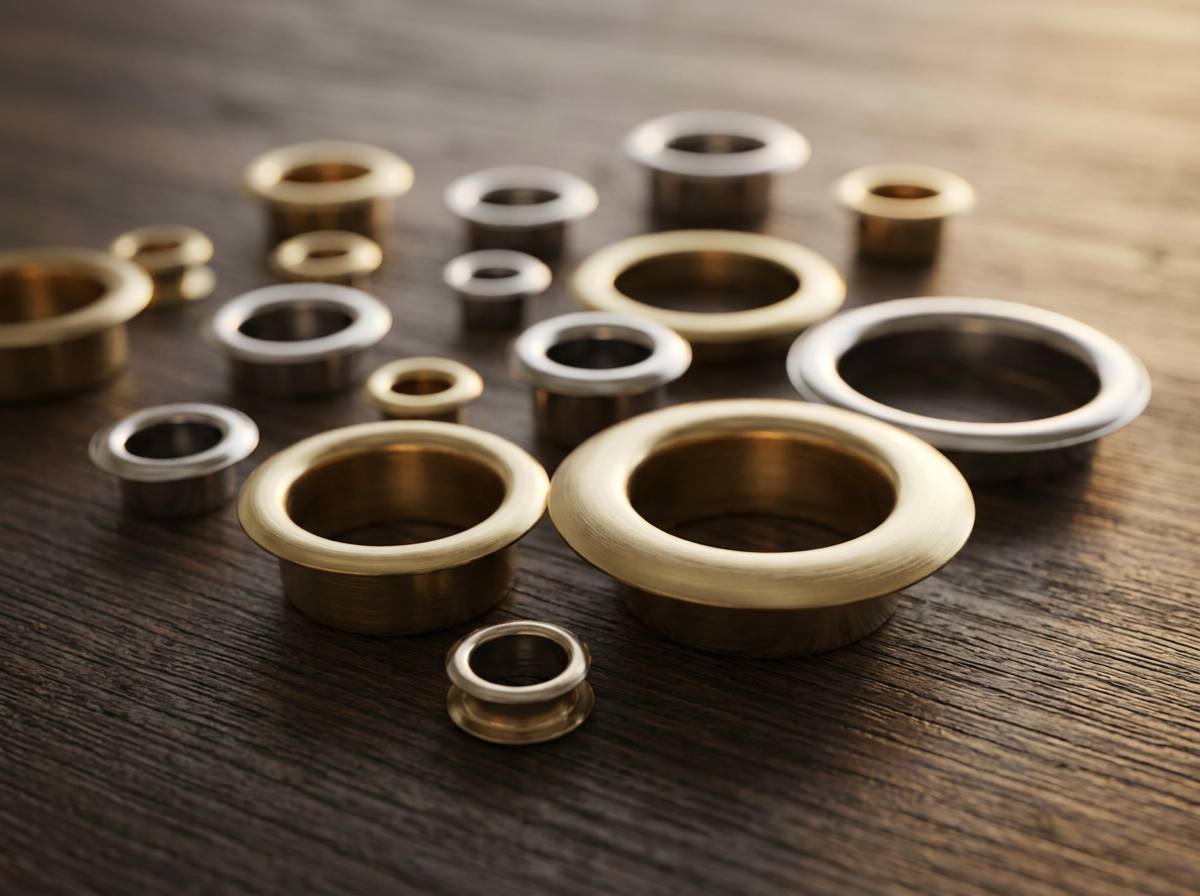
At JiaShan BaoCheng Clothing Accessories Co., Ltd., we manufacture customized metal components for B2B customers. For work-boot eyelet projects, our focus is not simply supplying a standard ring in a requested color. We evaluate how the eyelet will interact with the customer's upper structure, lace and installation process.
1. Custom Eyelet Geometry
Bao Cheng can develop eyelets according to the required finished inside diameter, barrel outside diameter, flange diameter, barrel length and metal thickness.
This allows the component to be matched to the boot rather than forcing a thick work-boot upper to accept an eyelet originally designed for lightweight footwear.
Customers can provide drawings, physical samples or an existing boot for reference.
2. Matching Barrel Length to the Complete Upper
We encourage footwear customers to provide the total installed thickness at the lace position.
This should include outer leather, reinforcement and lining rather than only the visible leather layer.
Correct barrel length helps create a stable rear form without excessive compression or insufficient retention.
When different boot models use different leather structures, we can evaluate whether one eyelet can serve the complete range or whether separate barrel lengths are more appropriate.
3. Material Selection for the Actual Environment
Depending on project requirements, Bao Cheng can evaluate brass, stainless steel, aluminum and specialized JSW20 low-magnetic stainless steel for suitable eyelet applications.
For work boots, material selection should consider moisture, corrosion resistance, forming behavior, weight, surface treatment and expected service conditions.
We do not recommend selecting material only by price or visual appearance when the component will be exposed to repeated outdoor use.
4. Custom Surface Finish Development
Work-boot eyelets may need to match lace hooks, D-rings, buckles or other visible hardware.
Bao Cheng can support customized surface finishes according to approved references and project requirements.
Because work-boot hardware experiences more friction and environmental exposure than many decorative garment components, we recommend evaluating the finish on installed samples and, where appropriate, after representative wear or environmental testing.
5. Edge and Burr Control
For eyelets, the inside edge deserves particular manufacturing attention because this is where the shoelace repeatedly moves.
We focus on controlling stamped and formed edges so the component can provide a smooth lace path after correct installation.
Customers troubleshooting lace wear can send close-up photographs of the eyelet interior and rear side so the likely contact point can be evaluated.
6. Tooling Compatibility Support
When a new eyelet is introduced, the footwear factory needs to confirm that its setting dies match the component.
For customers transitioning from an existing eyelet, Bao Cheng can compare drawings or samples to identify dimensional differences that may affect tooling.
This is important because even a small change in flange profile or barrel diameter can alter the way a die supports and forms the eyelet.
7. Sampling on the Real Work-Boot Upper
Sampling should go beyond inspecting loose components.
Whenever possible, the customer should install samples into the production leather or equivalent material stack.
This allows the footwear team to evaluate flange appearance, barrel forming, lace clearance, pull resistance and any damage to the leather before a bulk order is approved.
For new developments, the customer can also compare different flange or barrel options before freezing the final design.
8. Support for Production Troubleshooting
If an eyelet becomes loose, splits or damages the lace during production trials, the visible symptom does not always identify the root cause.
Bao Cheng can evaluate information such as component dimensions, leather thickness, hole diameter, die shape, machine pressure and photographs of the installed front and rear surfaces.
This helps distinguish a hardware-dimensional issue from a tooling or assembly issue.
9. Batch Consistency for Large Footwear Programs
A successful work-boot program requires repeatability across thousands of components.
If barrel length changes from batch to batch, the footwear factory may have to repeatedly alter press pressure. If flange geometry varies, the finished lace row may show inconsistent appearance.
Our production focus therefore includes maintaining approved dimensional and surface requirements so customers can use more stable assembly settings.
10. Custom Manufacturing Instead of Consumer Repair Hardware
Bao Cheng primarily serves footwear brands, factories, importers and sourcing teams requiring customized production.
While search terms such as repair kits and hand setters are useful for understanding market language, our core service is developing the component around the customer's original footwear program.
This includes sampling, material selection, dimensional customization, surface finish and mass-production supply.
A Practical Development Checklist for Work-Boot Eyelets
- Confirm the actual production shoelace diameter and construction.
- Check that the finished eyelet ID provides smooth lace movement.
- Inspect the complete inside edge for burrs or rough plating.
- Measure the full leather, reinforcement and lining stack.
- Match barrel length to that installed thickness.
- Confirm that the punched hole matches the barrel dimensions.
- Evaluate whether the flange provides enough support for the upper.
- Select material and finish according to moisture and corrosion exposure.
- Use dies matched to the exact eyelet profile.
- Avoid compensating for incorrect dimensions with excessive press pressure.
- Test the installed eyelet under repeated lacing conditions.
- Inspect lace wear as well as metal deformation.
- Check hardware after representative moisture and abrasion exposure.
- Verify batch consistency before and during mass production.
Final Thoughts
Work-boot eyelets operate in a demanding mechanical environment. They are repeatedly loaded by the lace, exposed to moisture and dirt, and subjected to sliding abrasion at the same internal edge day after day.
That makes eyelet durability a system-design problem rather than a simple material question.
A thicker metal component will not solve an oversized leather hole. A corrosion-resistant material will not prevent lace damage from a sharp edge. A high setting force will not compensate for an incorrect barrel length.
The best work-boot eyelet combines suitable metal, controlled internal geometry, appropriate flange dimensions, correct barrel length, stable upper reinforcement and repeatable production tooling.
For footwear brands, those decisions are most efficiently made during development, before the lace stay has been finalized and before thousands of components enter bulk production.
Bao Cheng supports customized metal eyelet projects from drawings and reference samples through sampling and mass production. By understanding the actual boot structure, lace type, working environment and installation process, the component can be developed for long-term footwear performance rather than selected from nominal dimensions alone.
Focused FAQ
1. Why do work-boot eyelets wear out faster than eyelets on casual shoes?
Work boots often experience stronger lace tension, more frequent tightening, thicker laces and greater exposure to moisture, dirt and abrasion. These factors increase both mechanical stress around the eyelet and wear along the surface where the lace contacts the metal.
2. What causes a work-boot eyelet to damage the shoelace?
Common causes include burrs, sharp internal edges, uneven barrel forming, damaged plating and insufficient clearance between the lace and eyelet. Dirt trapped between the lace and metal can further increase abrasive wear.
3. Is brass suitable for work-boot eyelets?
Yes, brass can be suitable for many work-boot applications because it has good forming characteristics, useful corrosion resistance and supports a wide range of decorative finishes. The final choice should still reflect the boot's service environment, required strength and surface specification.
4. Is stainless steel suitable for outdoor work boots?
Stainless steel can be a strong option where corrosion resistance and durability are important. Its forming behavior should be validated with the selected eyelet geometry and installation dies because material changes can influence the pressure and tooling required for a controlled set.
5. Why do eyelets become loose in thick leather?
A loose eyelet can result from an oversized punched hole, insufficient barrel length, incorrect setting pressure, weak rear forming or movement in the surrounding leather. The complete upper thickness should be measured before choosing the eyelet barrel.
6. Should work-boot eyelets use washers?
Not always. A washer can improve rear-side support in some high-load or thick-material constructions, but it also changes the required barrel length and assembly structure. The eyelet and washer should be evaluated as a matched system.
7. Can more press pressure prevent an eyelet from coming loose?
Only when insufficient forming pressure is actually the cause. Excessive pressure can crush leather, distort the flange or split the barrel. If the barrel length, punched hole or die is incorrect, increasing pressure may create additional defects instead of solving the problem.
8. How should work-boot eyelets be tested before mass production?
Install them into the actual production upper and evaluate lace clearance, rear forming, rotation, pull resistance, leather condition and internal edge smoothness. For demanding products, representative repeated-lacing, moisture and abrasion testing can also help reveal long-term weaknesses.
9. What dimensions should I provide when ordering custom work-boot eyelets?
Useful information includes finished inside diameter, barrel outside diameter, flange outside diameter, barrel length, complete upper thickness, lace diameter, material, finish and washer requirement. A drawing or physical reference sample is recommended whenever possible.
10. Can Bao Cheng customize eyelets specifically for work boots?
Yes. Bao Cheng supports customized B2B eyelet development based on drawings, samples and footwear requirements. Dimensions, material, barrel length, flange geometry and surface finish can be developed around the customer's boot construction, with samples evaluated before mass-production approval.
#Work Boot Eyelets, #Metal Eyelets, #Boot Hardware, #Leather Eyelets, #Work Boots, #Footwear Hardware, #Boot Lacing, #Eyelet Durability, #Custom Eyelets, #Footwear Manufacturing
