







Metal Eyelets for Belts, Watch Straps and Adjustable Leather Accessories
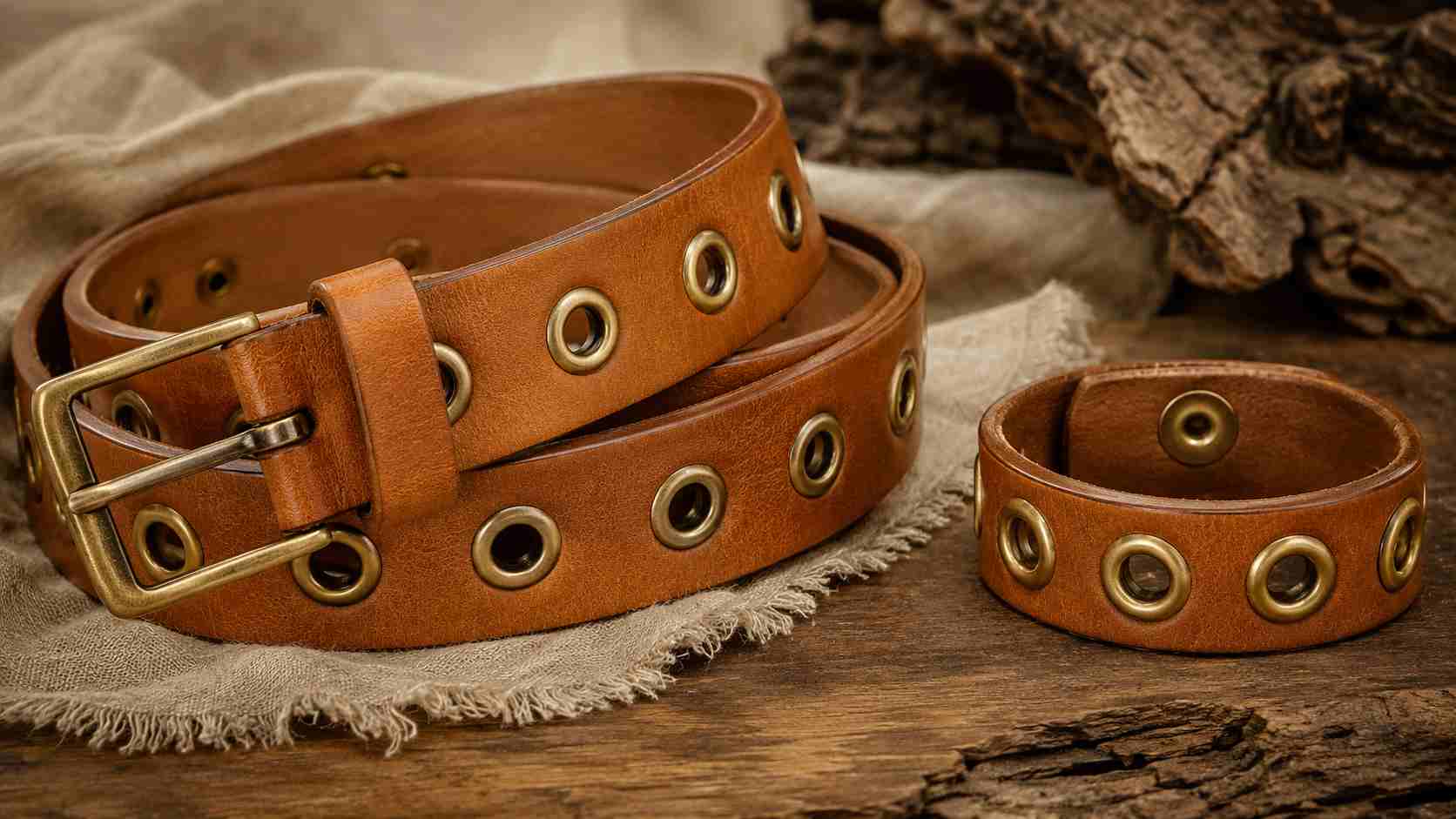
Why Eyelets in Adjustable Leather Accessories Are a Functional Component
On a belt, watch strap or adjustable leather accessory, an eyelet is usually installed exactly where the material experiences repeated mechanical interaction. A buckle pin enters and exits the opening, a strap bends around the adjustment point, and the edge of the punched hole is repeatedly compressed. This makes the eyelet much more than a decorative metal ring.
For B2B buyers, the important question is therefore not simply whether an eyelet looks attractive. The real question is whether the combination of eyelet dimensions, barrel geometry, material, finish, leather thickness and setting process will maintain the adjustment hole throughout the expected service life of the finished product.
This distinction is particularly important for metal eyelets for belts. Belt adjustment holes can receive concentrated radial pressure from a buckle tongue while the belt itself remains under tension. Without suitable reinforcement, repeated loading can gradually enlarge the punched hole, compress the leather around it or produce cracks at the edge.
Watch straps create a different challenge. Their components are smaller, their visual tolerances are tighter, and even minor misalignment between neighboring holes is easy to notice. Meanwhile, bracelets, wristbands, collars and other adjustable leather products may require a completely different balance between decorative appearance and mechanical reinforcement.
Belt Holes Experience Repeated Localized Loading
A conventional belt hole looks simple, but its loading condition is demanding. The buckle tongue presses against a small portion of the hole instead of distributing force across the full width of the belt. Every time the user changes the adjustment position, the metal pin contacts the leather again.
Over time, an unreinforced opening may become oval rather than round. The surface coating may crack, the grain layer may lift, or the leather surrounding the hole may stretch. These problems are more noticeable when the belt uses relatively soft leather, laminated constructions or synthetic surface layers.
Properly designed belt hole eyelets place a metal boundary between the buckle pin and the cut leather edge. Instead of allowing the pin to rub directly against fibers or coating layers, the eyelet provides a controlled internal surface.
However, the eyelet itself must fit the application correctly. An excessively large flange can dominate a minimalist belt design, while an eyelet with an internal diameter that is too small may interfere with buckle insertion. A barrel that is too short may not clinch securely, while one that is too long may roll unevenly or leave an excessively raised backside.
The punched hole must match the eyelet
Good performance begins before the eyelet is installed. The leather opening should be punched cleanly and consistently. If the hole is excessively large relative to the eyelet barrel, the hardware cannot grip the surrounding material effectively. If it is too small, insertion can distort the leather or scrape a plated surface during assembly.
This is why specifying only the nominal eyelet diameter is rarely sufficient for production. Buyers should consider the relationship between:
- eyelet inner diameter;
- barrel outer diameter;
- flange diameter;
- finished leather thickness;
- punched-hole diameter;
- setting-tool geometry; and
- required backside profile.
These relationships determine whether the finished leather hole eyelets appear centered, sit flat and remain secure after repeated adjustment.
Watch Strap Eyelets Require Smaller Dimensions and Tighter Visual Control
The same reinforcement concept applies to watch straps, but the manufacturing tolerance becomes more sensitive because everything is smaller.
A belt may have enough visual space to accommodate a relatively substantial flange. A narrow watch strap does not. The eyelet must fit within the available strap width while maintaining sufficient leather around both sides of the opening.
As a result, watch strap eyelets often require careful control of outside diameter, flange width and barrel length. Even a fractionally oversized component can make the strap appear crowded or reduce the amount of leather remaining between the hole and strap edge.
Hole alignment is equally important. If several adjustment holes are arranged in a straight row, differences in spacing, flange orientation or setting height become immediately visible. For premium leather accessories, consistency between eyelets can influence the perceived quality of the entire product.
Small hardware makes dimensional variation more visible
When sourcing small eyelets for leather, dimensional consistency matters almost as much as the nominal dimensions themselves. Variations that might be visually insignificant on a large bag panel can become obvious when several miniature eyelets are positioned closely together on a watch strap.
The buyer should therefore consider not only the drawing dimension but also production consistency in flange shape, concentricity, edge smoothness and formed height.
A clean edge is particularly important. Sharp burrs around the inner opening can contact the watch buckle pin, while rough edges on the backside can mark the leather or affect comfort depending on the strap construction.
Wristbands and Other Adjustable Leather Accessories Create Their Own Requirements
Adjustable leather hardware extends beyond conventional belts and watch straps. Leather bracelets, fashion wristbands, collars, straps, harness elements and other accessories may also incorporate reinforced adjustment holes.
For example, wristband eyelets may serve as both functional reinforcement and a visible design feature. In this situation, finish consistency and appearance become especially important because several eyelets may form part of the decorative pattern.
The same component cannot automatically be transferred from one accessory to another. A thick belt, a thin watch strap and a soft leather wristband can have very different material stacks even when the visible hole diameter appears similar.
This is one reason B2B development should begin from the finished leather construction rather than from an eyelet catalog alone.
One-Piece Eyelets, Washer Systems and Screw-Type Structures
Different leather constructions may require different reinforcement structures.
One-piece eyelets
A conventional one-piece eyelet passes through the punched hole and is rolled or flared on the reverse side during setting. It provides a compact appearance and is suitable for many belts, straps and accessories when the barrel length is correctly matched to the material stack.
Eyelet or grommet with washer
A washer distributes the setting load across a wider area on the reverse side. For softer leather, layered materials or applications in which pull-through resistance is particularly important, leather grommets with washers can provide a more substantial rear support surface.
The washer must still be matched to the main component. Incorrect clearance between the barrel and washer can result in an unstable assembly or an unattractive formed edge.
Screw-type structures
Some accessories use mechanically assembled hardware instead of permanently clinched eyelets. Screw grommets for leather may be considered when the design requires removable hardware, a thicker decorative profile or assembly without conventional eyelet setting.
They should not automatically be treated as interchangeable with rolled eyelets. Screw-type hardware introduces different concerns, including thread engagement, component thickness and the possibility of loosening under repeated movement.
Leather Thickness Is One of the Most Important Specification Variables
Eyelet selection should be based on the thickness of the finished assembly, not merely the nominal thickness of the base leather.
A finished belt may contain top leather, backing leather, adhesive and coatings. A watch strap may include several laminated layers around the adjustment section. Synthetic leather accessories may include textile reinforcement beneath a coated surface.
All of these layers influence the effective grip range.
If the barrel is too short, insufficient material remains for a secure rollover. The eyelet may appear weakly set or may separate when the leather flexes.
If the barrel is too long, excessive material must be displaced during setting. The backside can split, wrinkle or flare excessively. In severe cases, over-rolling can also compress the leather more than intended and create a visible indentation around the flange.
For custom production, barrel length should therefore be evaluated together with actual material samples whenever possible.
Leather Compressibility Matters as Much as Measured Thickness
Two leather constructions with the same caliper reading may behave differently under setting pressure.
A dense vegetable-tanned leather may resist compression more strongly than a soft laminated leather. A synthetic leather backed with fabric may compress differently again. Therefore, the same eyelet and die setting can produce different final heights even when the initial thickness measurements are similar.
This is especially relevant when selecting general leather craft grommets for commercial-scale production. A component that works acceptably in a hand-set prototype does not necessarily produce the same result at higher-volume machine-setting speeds.
During development, suppliers should consider material hardness, layer structure and recovery after compression, not simply thickness.
Choosing the Right Metal for Leather Eyelets
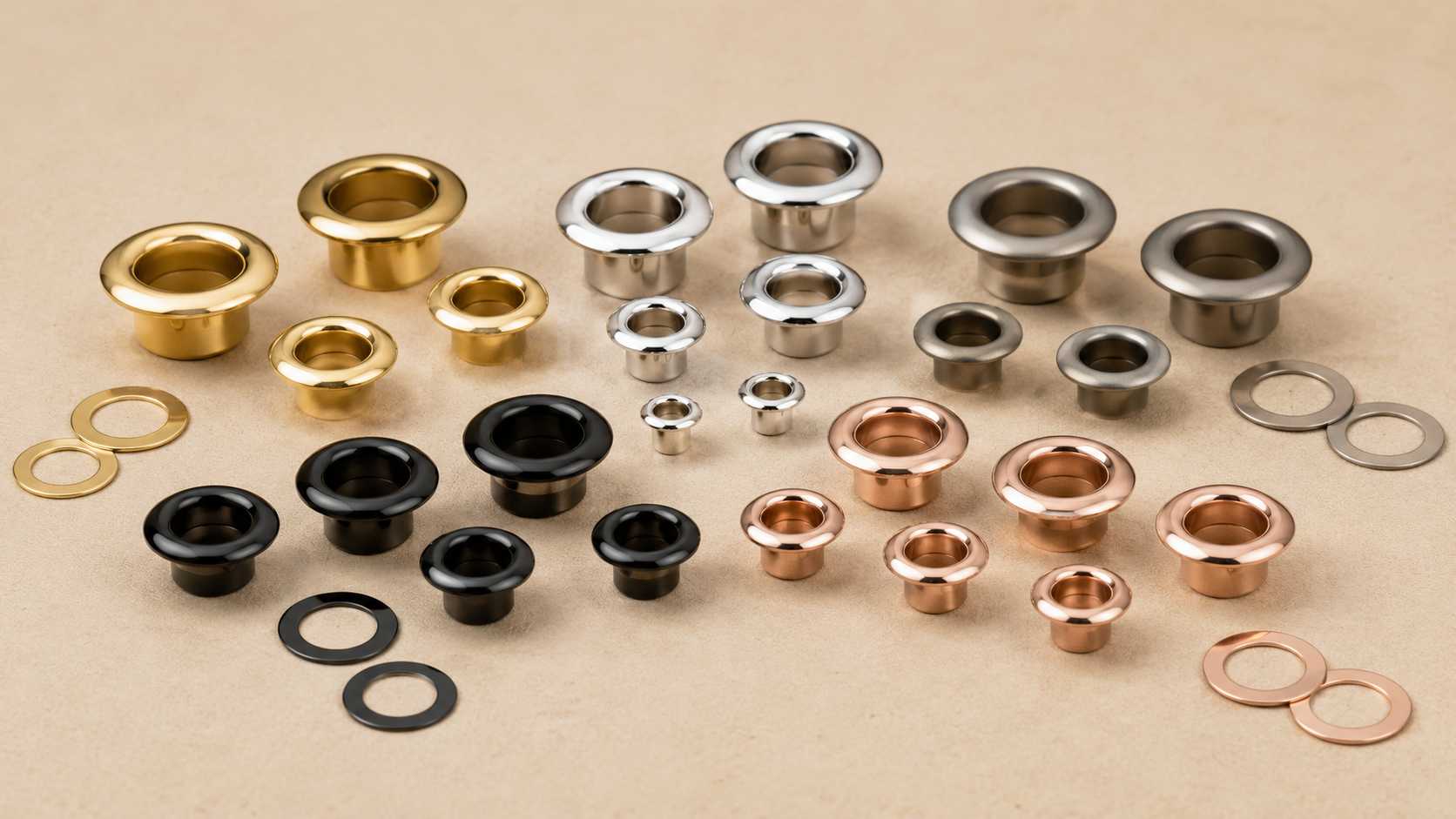
Material selection affects appearance, forming behavior, corrosion performance, weight and cost. The appropriate choice depends on the product positioning and the buyer's technical requirements.
Brass
Brass is widely associated with premium leather hardware because it can provide a traditional metal appearance and is compatible with many decorative finishes. Brass grommets for leather craft can be suitable for belts, straps and handcrafted-style accessories where appearance is a major purchasing consideration.
Buyers should distinguish between base material and surface color. An antique brass appearance, for example, does not necessarily mean every component uses the same base metal. The actual material specification should therefore be confirmed separately from the finish specification.
Stainless steel
Stainless steel can be considered when corrosion resistance, surface durability or a specific technical material requirement is important. It can also be useful in projects where the buyer wants to reduce reliance on conventional brass hardware.
For specialized B2B projects requiring extremely low magnetic permeability, BC New Material can manufacture finished customized components using JSW20 ultra-low-magnetic-permeability austenitic stainless steel. This option is particularly relevant where magnetic response after forming or needle-detection compatibility forms part of the finished-product specification.
The important distinction is that the magnetic behavior of the finished stamped and formed component matters, not only the initial raw-material condition.
Other metal options
Depending on the design and application, zinc alloy, steel or other engineered metal solutions may also be considered. The material should be selected together with the forming process, surface treatment and required product performance rather than simply by comparing material names.
Surface Finish Has to Survive Setting and Repeated Adjustment
An eyelet may look perfect before assembly but still fail visually after installation if the finish is not compatible with forming.
Setting changes the geometry of the barrel. The metal is flared, rolled or compressed, meaning the coating on the formed section must tolerate deformation without obvious cracking or peeling.
For visible leather hardware, buyers may specify finishes such as polished metal tones, matte surfaces, antique effects, dark finishes or customized colors. Each finish should be evaluated on the actual eyelet geometry because deep forming and tight rollovers place different demands on the surface layer.
The contact environment also matters. Belts are exposed to repeated hand contact, clothing friction and humidity. Watch straps and wrist accessories may additionally encounter perspiration and frequent skin contact. Finish requirements should therefore be defined according to the actual end product and target market.
Why Flange Geometry Affects Both Strength and Appearance
The flange is the visible face of the eyelet. Its diameter and profile determine how much of the leather surface is covered around the punched opening.
A larger flange can distribute pressure over a wider area and conceal minor variation around the punched hole, but it also creates a stronger visual presence. A smaller flange supports a minimalist design but leaves less margin for hole-position variation.
For premium belts and watch straps, concentricity matters. The inner hole should appear visually centered within the flange. If the flange is uneven or the barrel is not concentric, the defect becomes particularly noticeable when multiple adjustment eyelets are aligned in a row.
This is one reason premium metal eyelets for belts should be evaluated as precision hardware instead of simple commodity rings.
Common Failure Modes in Leather Eyelet Applications
Eyelet rotation
If the eyelet does not grip the material correctly, it may rotate inside the punched hole. This can indicate an oversized leather hole, insufficient rollover or an unsuitable combination of barrel diameter and leather compression.
Pull-through
A flange or backside rollover that is too small for a soft material can pull through the leather under concentrated force. Washer-backed constructions may help distribute the load in suitable applications.
Cracked leather around the hole
This can result from a hole that is too small, excessive setting pressure or insufficient edge distance between the eyelet and the side of the strap.
Uneven backside rollover
An off-center die, inconsistent barrel length or misalignment during feeding can produce an irregular formed edge. Apart from looking poor, this may create sharp points that contact the leather.
Finish damage
Scratching can occur during feeding, insertion or die contact. Cracking may occur during rollover when the surface system is not sufficiently compatible with deformation.
Adjustment hole enlargement
If the internal opening, material strength or eyelet setting is poorly matched to the buckle pin, the adjustment point may gradually deform despite the presence of metal reinforcement.
Custom Eyelet Development Should Start with the Finished Product
For B2B sourcing, choosing an existing catalog size can be efficient when the available dimensions already match the product. However, premium leather goods often benefit from custom development because the eyelet is closely integrated with the overall design.
Useful project information includes:
- eyelet inner diameter;
- visible flange diameter;
- barrel diameter and length;
- finished leather thickness;
- number and type of material layers;
- required front and backside appearance;
- base metal;
- surface finish;
- annual or batch quantity;
- setting method;
- target compliance requirements; and
- drawings or physical reference samples.
The more accurately these parameters are defined during sampling, the easier it becomes to maintain stable appearance and installation performance in production.
Setting Tooling Is Part of the Eyelet System
Eyelet performance cannot be evaluated independently from the installation tooling.
The upper and lower dies determine how the barrel rolls, how much the flange is supported and how the backside profile is formed. A correctly designed eyelet used with unsuitable tooling may still produce poor results.
For this reason, a B2B supplier should consider the eyelet and setting system together. During sampling, the buyer should examine whether the eyelet sits flat, whether the backside is smooth and whether the leather shows excessive compression around the hardware.
For products containing multiple adjustment holes, stable feeding and repeatable positioning are also important. Small differences become visually obvious when several eyelets are installed in a straight line.
Quality Control for Belts and Watch Strap Eyelets
Dimensional inspection should focus on the characteristics that affect assembly rather than only the overall appearance.
Typical control points can include flange diameter, inner diameter, barrel diameter, barrel length, concentricity and surface condition. After setting, inspection may additionally evaluate rollover shape, fastening security and the degree of leather compression.
Functional testing should reflect the product. A belt application may require repeated buckle insertion and localized load evaluation. Watch strap hardware may need closer visual inspection because of its smaller dimensions and proximity to the skin.
Where specified by the buyer, compliance documentation such as RoHS, REACH, OEKO-TEX, Intertek testing or nickel-release-related testing can be supported according to the project and selected material or surface treatment.
How B2B Buyers Can Specify Eyelets More Efficiently
The most effective RFQ is not simply: “We need a metal eyelet for leather.” That description leaves too many variables undefined.
A more useful sourcing specification identifies the product application first. Tell the supplier whether the component is intended for a belt, watch strap, wristband or another adjustable leather product. Then provide the actual material thickness and expected hole diameter.
Photos are useful for appearance, but dimensional drawings are much more effective for controlling production. Where the hardware is customized, drawings should distinguish critical dimensions from cosmetic preferences.
Samples made from the actual production leather are also valuable because they reveal compressibility, coating behavior and backside appearance that cannot be determined from a nominal thickness value alone.
Choosing Eyelets for Premium Leather Accessories Is a System Decision
There is no universal eyelet that is ideal for every adjustable leather product.
Belts require reinforcement against repeated buckle-pin loading. Watch straps require small dimensions, accurate alignment and clean edges. Wristbands may combine mechanical adjustment with decorative styling. Soft leather constructions may benefit from broader load distribution, while thick products require sufficient barrel length and controlled rollover.
That is why selecting eyelets should involve more than choosing a finish from a catalog. The component, punched hole, leather structure, setting tooling and final adjustment mechanism must work together.
BC New Material supports customized eyelet and grommet components for B2B projects using materials including stainless steel, brass, zinc alloy and other project-specific options. For specialized applications, finished components can also be manufactured using JSW20 ultra-low-magnetic-permeability stainless steel. Dimensions, surface finish and component geometry can be developed around the buyer's drawings, leather construction and assembly requirements.
Focused FAQ
1. Why use metal eyelets in belt adjustment holes?
Metal eyelets help isolate the cut leather edge from repeated contact with the buckle tongue. Correctly specified belt hole eyelets can reduce direct wear around the adjustment opening while providing a more controlled and consistent appearance.
2. Are watch strap eyelets the same as belt eyelets?
Not necessarily. Watch straps normally use smaller hardware and have less available material around each hole, so flange diameter, inner diameter, edge distance and visual alignment often require tighter control.
3. When should leather eyelets use washers?
A washer can be useful when the backside needs a broader support surface or when the leather construction is relatively soft or layered. The washer and eyelet must still be dimensionally matched to create a stable rollover.
4. How is barrel length selected for leather eyelets?
Barrel length should be matched to the thickness and compressibility of the complete material stack. A barrel that is too short may not form securely, while excessive length can create splitting, wrinkling or an oversized backside rollover.
5. Can eyelets be used in very thin leather watch straps?
Yes, but small components and suitable tooling are important. The eyelet should leave enough leather between the hole and strap edge while avoiding excessive compression during setting.
6. Are screw grommets interchangeable with permanent eyelets?
No. Screw-type components use mechanical thread engagement, while conventional eyelets are typically clinched or rolled during setting. Their assembly method, thickness requirement and long-term behavior are different.
7. What causes leather to crack around an eyelet?
Possible causes include an undersized punched hole, insufficient distance from the strap edge, excessive setting pressure, unsuitable barrel dimensions or a leather structure that does not tolerate the local forming pressure.
8. Which material is suitable for premium leather eyelets?
Brass and stainless steel are common options, but the correct material depends on finish, forming requirements, corrosion expectations, cost and technical specifications. Surface treatment should be evaluated separately from the base material.
9. Can eyelet finishes be customized to match buckles and other leather hardware?
Yes. Custom projects can coordinate eyelet surface treatments with buckles, rivets, snaps and other visible hardware, subject to the selected base metal and finish process.
10. What information should a buyer provide when requesting custom leather eyelets?
Useful information includes the application, eyelet dimensions, leather thickness, hole size, base material, finish, front and backside appearance requirements, setting method, quantity and drawings or physical samples.
#MetalEyelets, #BeltEyelets, #WatchStrapEyelets, #LeatherHardware, #LeatherAccessories, #CustomEyelets, #LeatherCraftHardware
