






Large Curtain Eyelets: How Flange Width and Barrel Depth Affect Installation
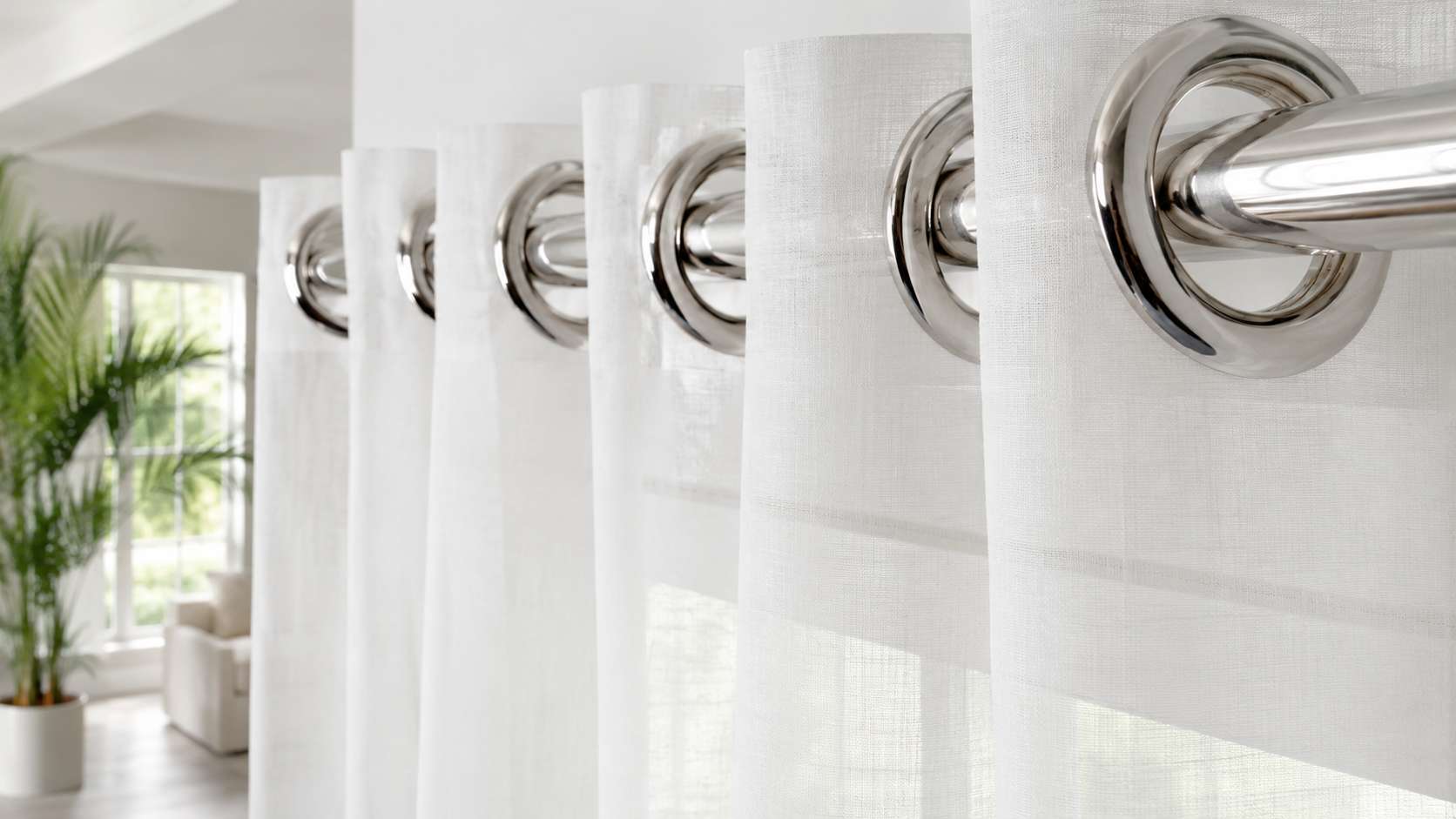
Large Curtain Eyelets Magnify Small Geometry Errors
Large curtain eyelets are visually simple components: a circular flange surrounds an opening, while a barrel passes through the curtain header and is secured on the backside.
In production, however, increasing the eyelet size changes much more than appearance.
A larger opening removes more fabric from the curtain header. A wider flange distributes load over a larger area. A deeper barrel must pass through a thicker material stack. More metal may require greater setting force. A larger component also makes concentricity, color variation and setting-height differences easier to see.
This is why buyers should not approve a large curtain eyelet simply because the front diameter looks correct on a design sample.
Two dimensions need separate attention:
- flange width, which determines how much material surrounds and supports the punched opening;
- barrel depth, which determines whether the eyelet can pass through the complete curtain stack and form the intended backside lock.
These dimensions perform different jobs.
A wider flange cannot compensate for a barrel that is too short.
A longer barrel cannot compensate for inadequate flange support around a weak fabric hole.
Start by Separating the Visible Diameter from the Structural Diameter
Large curtain hardware is often selected according to visual scale. Designers may specify a large outside diameter because they want the eyelet to coordinate with a substantial rod or create a strong architectural appearance.
But the outside diameter alone tells the production team very little about installation.
The critical dimensions include:
- finished inside diameter;
- flange outside diameter;
- barrel outside diameter;
- barrel length or depth;
- metal thickness;
- washer dimensions where applicable;
- installed height after setting.
The flange outside diameter and eyelet inside diameter together determine how much visible metal remains around the opening.
Approximate radial flange width = (flange outside diameter − inside diameter) ÷ 2
This simple relationship is useful because two eyelets can have the same inside opening but very different flange widths.
Flange Width Is a Load-Distribution Dimension
The flange does more than decorate the curtain.
Its most important mechanical function is to spread the load around the punched hole.
Every time the curtain hangs from the rod, gravity transfers force through the eyelet into the curtain header. When the curtain is pulled, additional horizontal and angular forces appear.
A wider flange spreads those forces over a larger area of fabric.
This can be valuable when:
- the curtain is heavy;
- the fabric is soft or easily distorted;
- the opening is large;
- the eyelets are relatively widely spaced;
- the product experiences frequent opening and closing.
But wider is not automatically better.
A very large flange can interfere with seams, reinforcement boundaries or adjacent folds. It also changes the visual proportion of the curtain header and increases material consumption.
A Narrow Flange Creates Higher Local Stress Around the Hole
Imagine two eyelets with the same inside diameter.
One has a broad flange, while the other has a narrow decorative rim.
If both support the same curtain load, the narrow-flange design transfers force into a smaller region of fabric.
This can increase local compression and deformation around the hole.
On a dense reinforced curtain header, the design may still work perfectly.
On a softer textile, however, the fabric can begin pulling toward the opening, especially after repeated use.
For large eyelets, this is important because the punched hole has already removed a significant section of the header.
The Flange Must Cover More Than the Punched Edge
The punched hole should remain completely hidden beneath the installed flange.
But simple visual coverage is not enough.
The flange needs sufficient overlap to create a useful support zone beyond the cut edge.
If the punched hole is oversized, off-center or frayed, the effective overlap can become much smaller on one side.
This is one reason hole-punch tolerance becomes increasingly important as curtain hardware becomes larger and more visible.
Buyers should therefore define both:
- the nominal hole diameter;
- the allowable relationship between the hole and eyelet barrel.
Barrel Depth Controls Whether the Mechanical Lock Can Form
Buyers sometimes use the term grommet depth when discussing how far the component extends through the material.
For installation purposes, the key issue is the available barrel length relative to the actual compressed curtain stack.
The barrel must be long enough to:
- pass completely through the curtain header;
- engage the washer or backside component if used;
- provide sufficient material for rolling, flaring or setting;
- form a controlled backside geometry without splitting.
If there is not enough exposed barrel after the eyelet passes through the curtain, the setting tool has too little material to form a reliable lock.
Do Not Select Barrel Length from Nominal Fabric Thickness Alone
A curtain header can contain many layers:
- face fabric;
- lining;
- blackout layer;
- reinforcement tape;
- fusible material;
- folded hems;
- decorative backing.
These layers may be soft before setting.
During installation, the upper and lower dies compress them.
The thickness relevant to eyelet setting is therefore not always the loose thickness measured with minimal pressure.
The engineering team needs to understand the effective compressed stack under the actual installation force.
Why Long-Barrel Designs Are Useful
Long barrel eyelets are useful when the eyelet must pass through a thick or multilayer curtain header.
A longer barrel can provide sufficient forming material after the component emerges from the backside.
Typical situations include:
- heavy blackout curtains;
- multiple reinforcement layers;
- thick decorative fabrics;
- washer-backed constructions;
- special padded or laminated headers.
However, selecting an unnecessarily long barrel creates its own installation problems.
What Happens When the Barrel Is Too Long?
Excess barrel length does not simply disappear during setting.
The metal has to go somewhere.
Depending on the eyelet structure and die geometry, an overly long barrel can:
- buckle rather than roll evenly;
- form multiple wrinkles;
- split at the edge;
- create an excessively tall backside profile;
- trap the washer incorrectly;
- require more setting force;
- distort the front flange.
This is why “use the longest available eyelet to be safe” is poor production logic.
Short Barrels Have the Opposite Failure Mode
Short barrel eyelets can be ideal for thin curtain headers because they reduce unnecessary backside material and can form a compact lock.
But if the barrel is too short for the actual stack, the setting process may produce:
- incomplete rollover;
- insufficient washer engagement;
- weak mechanical retention;
- uneven backside flare;
- local pulling of fabric into the opening.
The front flange may initially look completely normal.
The weakness may only appear after repeated opening, cleaning or handling.
The Correct Barrel Is a Working Window, Not One Exact Number
Production fabric thickness varies.
Metal thickness varies.
Barrel length has manufacturing tolerance.
Reinforcement material can also vary slightly by lot.
Therefore, the correct barrel design should work across the expected minimum and maximum curtain-stack thickness—not only at the nominal sample value.
A good pre-production study should test at least:
- the thinnest acceptable material stack;
- the nominal stack;
- the thickest acceptable stack.
The same eyelet and setting parameters should remain stable across this window, or the production process should define controlled adjustments.
Why Use a Washer Behind a Large Curtain Eyelet?
Buyers researching why use washers with grommets are often trying to understand whether the extra component is truly necessary.
A washer can perform several useful functions.
It can:
- increase the backside bearing area;
- support softer or multilayer curtain headers;
- help distribute pull-out loads;
- provide a defined surface for barrel rollover;
- improve backside appearance;
- reduce local fabric crushing when correctly designed.
The washer therefore becomes especially relevant as eyelet diameter and curtain load increase.
Eyelets with Backing Washers Are a System, Not Two Independent Parts
Eyelets with backing washers must be dimensionally coordinated.
The washer opening has to accept the barrel correctly.
The barrel must have enough exposed length after passing through the washer to form the intended rollover.
The setting die must support the washer without allowing it to tilt.
The outside diameter of the washer must also fit within the available curtain header area.
If these variables are not coordinated, the washer may actually introduce new defects.
Possible failures include:
- washer rotation;
- off-center rollover;
- barrel splitting;
- fabric pinching;
- uneven installed height.
A Washer Cannot Repair an Oversized or Damaged Hole
A larger backside washer may increase support, but it should not be used as a substitute for correct punching.
If the curtain hole is excessively large, the barrel may not locate concentrically.
The eyelet can move laterally before setting.
The front flange and backside washer may appear centered relative to each other while the actual fabric hole is off-center beneath them.
This creates uneven remaining material around the opening.
For high-quality large curtain eyelets, hole geometry needs its own quality-control specification.
Heavy-Gauge Construction Changes the Setting Process
Heavy gauge grommets can provide greater stiffness and resistance to deformation, which may be useful for large hardware, heavy curtains or demanding architectural applications.
But thicker metal changes the manufacturing process.
More forming force may be required.
Die radii become more important.
Material springback may increase.
If the machine simply applies more force without compatible tooling, the result can be:
- cracked rollover edges;
- flattened front flanges;
- distorted inside diameters;
- damage to decorative finishes.
Material thickness must therefore be considered together with die geometry and machine capability.
Large Eyelets Need More Than a Generic Hand Tool
A small sample may be assembled successfully using a basic curtain grommet tool.
This can be useful for confirming appearance or producing an early prototype.
But large-scale curtain production requires much more control than simply applying enough force to close the eyelet.
Production equipment needs to maintain:
- vertical alignment;
- repeatable stroke;
- controlled force or displacement;
- stable lower support;
- consistent positioning of the curtain header.
Without these controls, even a correctly designed eyelet can produce inconsistent finished parts.
The Curtain Grommet Machine Must Match the Product Geometry
A curtain grommet machine should not be selected only according to maximum tonnage.
The machine needs sufficient rigidity and controllability for the actual component.
Important factors include:
- eyelet outside diameter;
- metal thickness;
- barrel geometry;
- washer construction;
- curtain thickness;
- required production speed.
Large curtain eyelets can require significant forming force, but excessive force is not a quality guarantee.
The correct force is the force needed to form the intended geometry with the correct dies.
Setting Quality Depends Heavily on the Dies
A generic grommet die set may work well for a standardized component, but the upper and lower tool surfaces still need to correspond to the actual eyelet profile.
The lower die usually supports the decorative front flange.
If its cavity is too shallow, too deep or the wrong radius, the visible surface can become dented.
The upper die controls the backside forming operation.
If the forming angle is wrong, the barrel may split or roll unevenly.
Tool geometry is therefore part of the eyelet specification.
When Custom Dies Become Necessary
Custom grommet dies become particularly valuable when the product uses:
- a nonstandard flange shape;
- an unusually wide flange;
- a specific decorative front profile;
- a thicker metal section;
- a specialized washer;
- a barrel geometry outside standard ranges;
- tight requirements for installed height and concentricity.
Custom tooling allows the forming load to be applied where the component was designed to receive it.
This can improve both cosmetic consistency and mechanical retention.
More Setting Force Is Not the Cure for a Bad Barrel Match
One of the most common production reactions to an incomplete rollover is to increase press force.
That can be appropriate if the original setting force was genuinely insufficient.
But if the barrel is too short, more force cannot create missing material.
If the barrel is too long, more force may simply crush or buckle the excess metal.
If the die is wrong, more force can damage the eyelet faster.
The correct troubleshooting sequence is:
- confirm the real material-stack thickness;
- confirm barrel length;
- confirm washer dimensions;
- confirm die geometry;
- then optimize force or stroke.
Installed Height Is a Useful Process-Control Dimension
After setting, the finished eyelet has a measurable installed height.
This value can be useful because it reflects the combined effect of:
- curtain compression;
- barrel length;
- setting displacement;
- washer thickness;
- backside rollover.
If installed height begins drifting during production, the engineering team should investigate before the variation becomes a visible or structural failure.
Possible causes include die wear, material-thickness change, incorrect machine adjustment or a different curtain stack.
Flange Width and Barrel Depth Should Be Reviewed Together
Although they perform different functions, flange width and barrel depth interact through the curtain material.
Consider a large eyelet with a broad front flange but a very short barrel.
The front distributes load well, but the backside cannot lock securely through a thick header.
Now consider a long barrel with a very narrow flange.
The backside may form perfectly, but the front concentrates force around the large punched opening.
A successful design needs both sufficient front support and sufficient through-thickness engagement.
Large Flanges Also Affect Curtain Fold Behavior
Large decorative flanges occupy substantial space across the curtain header.
If the eyelets are closely spaced, neighboring flanges may visually dominate the top of the curtain and reduce the amount of uninterrupted fabric between holes.
The flange can also stiffen the region immediately around each opening.
As the outside diameter increases, designers should therefore review:
- center-to-center eyelet spacing;
- distance to the top edge;
- distance to side hems;
- fold pitch;
- reinforcement layout.
Large hardware needs enough fabric around it to look intentional rather than crowded.
Vertical Position Becomes More Sensitive as the Flange Gets Larger
If a small eyelet shifts vertically by a few millimeters, the variation may be difficult to notice.
With a very large flange, the same center-position error can create an obvious difference in the amount of fabric visible above the eyelet.
It can also reduce the remaining structural material between the top of the flange and the curtain edge.
For large-eyelet projects, the vertical centerline should therefore be treated as a controlled dimension.
The Side Hem Can Create a Hidden Thickness Problem
The curtain side hem often contains more layers than the middle of the header.
If the first large eyelet overlaps this thick region, the barrel may be adequate for the central eyelets but too short for the end eyelet.
This can lead to one or two poorly set components even though the rest of the curtain looks correct.
Before freezing the specification, the manufacturer should map the material stack at every eyelet position, especially:
- first eyelet;
- last eyelet;
- seam intersections;
- reinforcement overlaps.
Surface Finish Must Survive the Setting Operation
Large curtain eyelets are often highly decorative.
Possible finishes include silver, black, gunmetal, gold, brass tones, antique effects and other custom colors.
The finish must remain stable not only during service but also during installation.
Large barrels can undergo substantial deformation.
Depending on the process, risks include:
- plating cracks;
- coating chips;
- tool marks;
- flattening of texture;
- visible pressure rings on the flange.
The approved sample should therefore be a fully installed eyelet, not an unassembled plated component.
What Buyers Should Inspect After Setting
| Inspection Area | Acceptable Direction | Typical Defect |
|---|---|---|
| Front flange | Flat, concentric, undamaged | Denting, warping, tool marks |
| Inside opening | Round and free from inward distortion | Ovality, sharp local deformation |
| Backside rollover | Even and continuous | Split, uneven flare, wrinkles |
| Washer | Centered and fully captured | Tilt, rotation, partial engagement |
| Fabric | Flat and securely clamped | Excess crushing, puckering, torn hole |
| Installed height | Consistent across the curtain | One eyelet sitting higher or lower |
A Pull Test Should Be Designed Around the Expected Failure Mode
For large curtain hardware, simply pulling until something breaks does not provide enough engineering information.
Manufacturers should observe what fails first.
Possible failure modes include:
- fabric tearing outward from the hole;
- eyelet pulling through the header;
- washer distortion;
- backside rollover opening;
- barrel splitting;
- eyelet rotation without complete pull-out.
Two samples can achieve similar peak force while failing in completely different ways.
The preferred design is generally the one with a stable margin above expected use loads and a controlled, repeatable failure mode.
Cyclic Testing Is Especially Important for Curtains
Curtains are repeatedly opened and closed rather than loaded once.
Each movement creates small changes in eyelet angle and fabric stress.
Over time, a weak installation may gradually loosen even though it passes a strong initial pull test.
Cyclic validation can therefore monitor:
- eyelet rotation;
- hole growth;
- fabric compression;
- backside rollover stability;
- surface wear;
- change in installed height.
Large Curtain Eyelet Quality Should Be Defined Before Tooling Is Frozen
A strong pre-production specification should establish:
- finished inside diameter;
- flange outside diameter;
- minimum flange-support width;
- barrel outside diameter;
- barrel length tolerance;
- metal thickness;
- washer size where required;
- target curtain-stack range;
- hole diameter and tolerance;
- installed height;
- acceptable backside rollover;
- surface-finish requirements.
Once those values are defined, tooling and production controls can be designed around them.
Baocheng Can Customize Large Curtain Eyelets Around the Actual Curtain Construction
Baocheng / BC New Material can provide customized large curtain eyelets and grommets for B2B curtain, drapery, hotel and architectural textile projects.
For large-eyelet applications, customization can be developed around the customer's actual curtain material instead of forcing a thick multilayer header to use a generic catalog component.
Available dimensional and structural customization can include:
- inside diameter according to curtain-rod requirements;
- flange outside diameter and flange width;
- barrel diameter;
- barrel depth according to compressed fabric stack;
- material thickness;
- washer dimensions;
- one-piece or supported backside structure according to project requirements;
- front profile;
- setting geometry;
- matching tooling.
Baocheng Can Develop the Eyelet and Setting Process Together
For large curtain eyelets, component geometry and installation tooling are closely linked.
Baocheng can support sample development using the customer's actual curtain material, reinforcement construction and target eyelet dimensions.
Depending on the project, development can include:
- barrel-length sampling;
- flange-proportion comparison;
- washer matching;
- setting-die matching;
- installed-height inspection;
- appearance evaluation;
- pull or retention evaluation;
- batch-production consistency control.
This approach is especially useful when a standard eyelet has the correct visible diameter but the wrong barrel geometry for the curtain header.
Multiple Material Options Are Available for Large Curtain Eyelets

Depending on the environment, appearance and performance target, Baocheng can develop finished curtain eyelets using materials such as:
- 304 stainless steel for many general decorative and corrosion-resistant curtain projects;
- 316 stainless steel for applications requiring stronger resistance to certain chloride-related corrosion conditions;
- brass for premium appearance and excellent forming characteristics;
- zinc alloy for selected decorative structures and dimensional designs;
- JSW20 patented ultra-low-magnetic-permeability austenitic stainless steel for specialized applications requiring extremely low magnetic response after forming.
Why JSW20 Matters for a Formed Eyelet
An eyelet is a strongly formed component.
The metal can undergo stamping, drawing, edge forming and final installation deformation.
Some conventional austenitic stainless steels can develop increased magnetic response after significant cold working.
This means a buyer with a strict magnetic requirement should not evaluate only whether the incoming flat material appears non-magnetic.
The finished component is what matters.
Baocheng's proprietary JSW20 was developed for finished components that need to retain ultra-low magnetic permeability and near-nonmagnetic behavior after forming.
This can be valuable for specialized curtain and textile-hardware projects used near:
- magnetic-sensitive inspection systems;
- specialized electronic equipment;
- controlled industrial facilities;
- projects with strict finished-part permeability requirements.
JSW20 is primarily an ultra-low-magnetic-permeability solution.
It should not be treated as another name for 316 stainless steel or as an automatic substitute for a corrosion specification.
If a large curtain eyelet project requires both a specific corrosion level and a strict magnetic response, the two requirements should be evaluated independently.
Baocheng supplies finished eyelets and customized components manufactured from JSW20. Baocheng does not sell JSW20 raw coil material.
Large Curtain Eyelets Can Also Be Customized in Multiple Colors and Surface Effects
Because large flanges are highly visible, color consistency becomes especially important.
Depending on material and surface process, Baocheng can develop visual directions such as:
- bright silver;
- satin or matte silver;
- black;
- gunmetal;
- gold;
- brass tones;
- antique effects;
- other project-specific finishes.
For large components, the selected finish should be evaluated after the full setting operation because deformation and tool contact can affect the final appearance.
From Sampling to Mass Production, the Same Geometry Must Be Repeated
A successful hand-set sample is only the beginning.
Mass production needs to maintain the same relationship between:
- flange;
- barrel;
- washer;
- curtain thickness;
- die position;
- machine stroke.
For large orders, useful quality controls can include:
- incoming material verification;
- dimensional checks;
- setting-tool condition checks;
- installed-height sampling;
- front/back visual inspection;
- retention sampling;
- finish and color consistency inspection.
According to specific project requirements and material/finish systems, Baocheng can also coordinate relevant testing or documentation support such as RoHS, REACH, OEKO-TEX, Intertek or nickel-release-related evaluation.
What Buyers Should Send for a Custom Large Curtain Eyelet Project
The most useful RFQ includes:
- finished curtain application;
- curtain-rod diameter;
- target eyelet inside diameter;
- target outside diameter or visual reference;
- complete curtain-header construction;
- compressed or measured material thickness;
- reinforcement structure;
- desired washer or backside design;
- base material;
- color and surface finish;
- expected curtain weight;
- production volume;
- available setting equipment;
- testing and compliance requirements.
Physical fabric and curtain-header samples are particularly valuable because nominal textile thickness alone does not fully describe compression behavior during installation.
The Best Large Curtain Eyelet Is Balanced on Both Sides of the Fabric
Large curtain eyelet design is ultimately a balance between front-side load distribution and backside mechanical retention.
The flange needs enough width to support the material surrounding a large opening without unnecessarily dominating the curtain header.
The barrel needs enough depth to pass through the real compressed stack and create a stable lock, but not so much excess length that the metal buckles or requires uncontrolled forming.
Washers can improve backside support, but only when washer, barrel and tooling are designed together.
Thicker metal can increase rigidity, but only when the machine and dies can form it correctly.
And no amount of press force can compensate for the wrong component geometry.
For buyers, the safest development sequence is therefore straightforward:
measure the real curtain stack, define the flange support required, select a barrel-length window, match the washer if necessary, develop the correct dies, set a complete sample, inspect both sides and then test retention through repeated use.
When flange width, barrel depth, curtain construction and setting tooling are treated as one system, large curtain eyelets become far more predictable in both appearance and long-term installation performance.
Focused FAQ
1. What does flange width do on a large curtain eyelet?
Flange width determines how much metal overlaps the material surrounding the punched hole. A wider flange generally distributes curtain loads over a larger fabric area, although it also affects appearance, spacing and material usage.
2. What happens if a curtain eyelet barrel is too short?
The barrel may not extend far enough through the curtain stack to create a complete backside rollover or engage a washer securely, resulting in weak retention even if the front flange looks normal.
3. What happens if the barrel is too long?
Excess barrel material can buckle, wrinkle, split or create an overly tall backside profile. Increasing press force does not automatically solve an over-length barrel.
4. Should barrel length be selected from fabric thickness?
Yes, but the relevant value is the complete production header stack and its behavior under setting compression, not simply the nominal thickness of one loose fabric layer.
5. Do large curtain eyelets need washers?
Not every design does, but washers can increase backside support and help distribute pull-out loads in soft, thick or highly loaded curtain headers. The washer must be matched to the barrel and tooling.
6. Why can the first eyelet set differently from the middle eyelets?
Side hems and reinforcement overlaps can create a thicker material stack at the curtain edge. The same barrel that works in the center may therefore become too short at the first or last position.
7. Does thicker metal always make a large curtain eyelet stronger?
Thicker metal can improve rigidity, but it also requires compatible forming force and die geometry. Poorly matched tooling can crack, flatten or distort a thicker eyelet.
8. Can Baocheng customize flange width and barrel depth?
Yes. Baocheng can develop inside diameter, flange diameter, barrel depth, metal thickness, washer structure, material, finish and matching installation tooling around the actual curtain construction.
9. What is the advantage of Baocheng's JSW20 for curtain eyelets?
JSW20 is Baocheng's patented ultra-low-magnetic-permeability austenitic stainless steel, developed for finished components that need to retain extremely low magnetic response and near-nonmagnetic behavior after forming.
10. What should be approved before large-scale production?
Approve the installed component rather than only the loose eyelet. Check flange appearance, inside diameter, backside rollover, washer position, installed height, fabric condition, retention and setting-tool compatibility.
#LargeCurtainEyelets, #CurtainGrommets, #EyeletInstallation, #CurtainHardware, #MetalEyelets, #DraperyHardware, #CustomEyelets, #CurtainManufacturing