







How to Test Trouser Hooks: Quality Inspection, Corrosion, Coating and Needle Detection
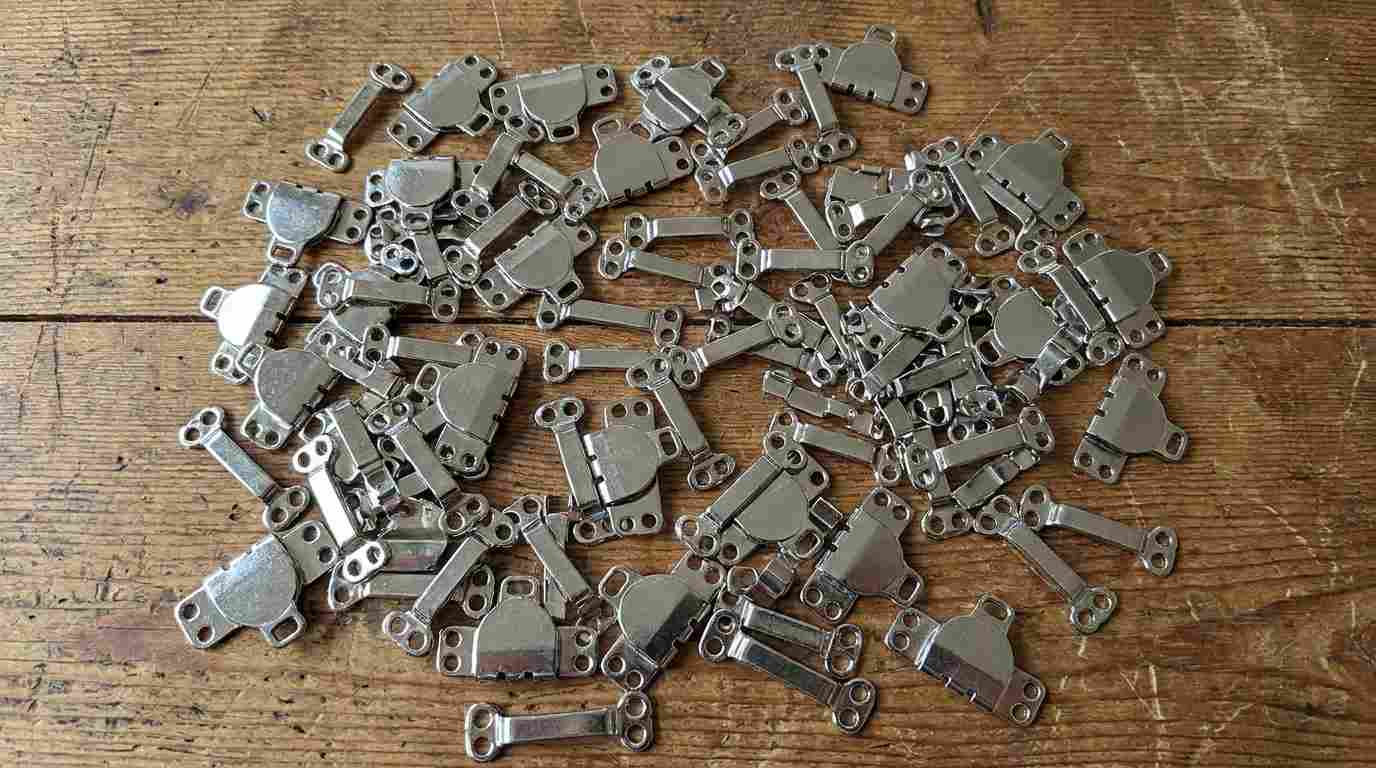
How to Test Trouser Hooks: Quality Inspection, Corrosion, Coating and Needle Detection
A trouser hook is a small component, but its failure is immediately visible. A hook that opens under waist tension, shifts after laundering, stains a light fabric, or triggers a needle-detection alarm can hold an entire garment order. For buyers, therefore, quality cannot be reduced to whether a loose hook “looks good” on a sample card. It must be verified in the installed condition and against the intended garment, process and market.
This guide is written for garment buyers, sourcing teams, wholesalers and distributors evaluating a trouser hook supplier. It explains what to verify before ordering and how Baocheng New Material supports project approval through workmanship, dimensional, retention, cycle, coating, corrosion, chemical, magnetic-response and production-lot controls.
At Baocheng, approval is built around the complete closure system rather than a loose metal piece. Hook geometry, matching bar, waistband construction, interlining and attachment method all influence performance. We therefore confirm the product drawing and signed sample with the buyer, separate component defects from installation defects, and document project-specific results. For distributors, this creates a stable specification and evidence package that can be used consistently across downstream customer enquiries.
Why Trouser Hook Testing Matters
Trouser hooks work under concentrated loads. When a wearer bends or sits, the waistband load is transmitted through a narrow hook-and-bar contact area. A minor dimensional variation can reduce engagement depth; a weak prong setting can allow the hook to rotate; a brittle coating can crack during forming; and excessive magnetic response can interfere with a garment factory’s metal-control process.
These risks affect different departments. Designers need a closure that remains discreet and comfortable. Production teams need stable installation. Quality teams need repeatable acceptance criteria. Procurement teams need comparable supplier evidence. A useful apparel quality control plan connects all four needs instead of treating the hook as an isolated commodity.
What Buyers and Distributors Can Expect from Baocheng
During an RFQ or sampling program, buyers provide the garment type, target market and key performance requirements. Baocheng converts that information into a confirmed component specification, a matching hook-and-bar sample and an inspection plan that can be used for bulk production and repeat orders.
The following table shows how Baocheng supports an order from sample approval through repeat production. Numerical limits are confirmed for each project because waistband constructions and end uses differ.
| Buyer requirement | What Baocheng can provide | What is confirmed before bulk production |
|---|---|---|
| Correct product and matching bar | Drawing or approved sample confirmation, material and finish identification, paired hook-and-bar evaluation | Model, dimensions, color, surface, attachment method and packaging |
| Stable workmanship and dimensions | Appearance, key-dimension, fit and functional inspection against the approved reference | Inspection points, tolerances, defect classes and reporting format |
| Installed mechanical performance | Project-specific sample installation with documented retention and cycle testing to the agreed method | Fabric stack, fixture, force direction, target value, cycles and failure criteria |
| Finish and corrosion resistance | Coating-control evidence and project-based corrosion testing; JSW20 with specified salt-spray and acid resistance of at least 168 hours | Coating system, method, exposure time, permitted corrosion and report scope |
| Chemical and market documentation | Applicable OEKO-TEX, RoHS, REACH, Intertek or nickel-release documentation according to the selected material and project | Market, finish, test item, validity and customer RSL requirements |
| Needle-detection compatibility | JSW20 ultra-low magnetic permeability option, actual component and garment verification support | Detector model, sensitivity, orientation and acceptance setup |
| Production-lot release | Buyer-agreed sampling, lot records, inspection results and change confirmation | AQL plan, defect classes, destructive-test quantity and traceability fields |
Build the Acceptance Specification Before Testing
There is no universal pull force, cycle count or salt-spray duration for every trouser hook. Before testing, define the end use, hook and bar, material, finish, attachment, waistband stack and target market. Baocheng then separates loose-component inspection, installed-system verification and production-lot sampling. Each agreed test record identifies the specimen, equipment, conditions, sample quantity, actual result, failure mode and decision; a one-word “pass” is not sufficient evidence.
Stage 1: Visual Inspection and Workmanship
Begin with appearance because visible defects often predict functional problems. Under controlled lighting, inspect the hook and bar for burrs, sharp edges, cracks, incomplete forming, distorted legs, damaged plating, discoloration, oil, rust, contamination and mixed finishes. Check whether the hook body lies flat and whether paired components have a consistent color and gloss.
During finished-garment garment inspection, add installation-specific checks. The hook and bar should be correctly oriented, centered on the planned closure line and hidden when the waistband is closed. Prongs should be fully set without cutting through to the garment face. Sew-on parts should have the required stitch pattern, secure thread ends and no puckering. Operate every sampled closure by hand to detect rough engagement, unintended opening and excessive force.
Stage 2: Dimensional and Fit Inspection
Use an approved drawing or signed reference sample. Typical checkpoints include overall hook length and width, material thickness, hook opening, throat depth, prong length and spacing, bar length and height, and the engagement overlap between hook and bar. Choose datum points that different inspectors can identify consistently.
Calipers may be adequate for broad dimensions, but a profile projector, measuring microscope or custom go/no-go gauge may be better for small openings and formed profiles. The instrument resolution should be suitable for the tolerance. Record actual values rather than writing “within specification” only.
Fit is as important as individual dimensions. A hook and bar can each satisfy separate drawings yet engage poorly if tolerance accumulation reduces overlap. Assemble parts from the same lot and, where supply chains are mixed, cross-check the hook against bars from the approved source. Confirm that the closure reaches full engagement without forcing the waistband out of alignment.
Stage 3: Installed Retention and Pull Testing
The most valuable mechanical check is usually an installed retention test. It should reproduce the way the closure is loaded in use. Prepare specimens with the actual shell fabric, interlining, reinforcement, seam allowance and installation setting. Condition them consistently, then mount the waistband sections so that the force acts along the intended opening direction.
In formal fastener testing, the test plan should state the fixture geometry, grip distance, loading direction, test speed, preload, endpoint and required sample size. Record the peak force as well as how the specimen failed. A high result caused by fabric tearing is not the same as a high result with an intact fabric and hook. Useful failure categories include hook deformation, bar deformation, prong pull-out, stitch breakage, fabric tear, coating fracture and unintended disengagement.
A button pull test is familiar in garment production, but it cannot be applied unchanged to a trouser hook. Buttons are commonly pulled away from the fabric, whereas a hook-and-bar closure is mainly loaded across the waistband and may fail through disengagement or rotation. Existing force-measuring equipment can be adapted when the fixture and load path are validated for the hook system.
Because the same hook can perform differently on a dense woven waistband and a soft fabric, Baocheng confirms the target load, test direction and failure criteria with the buyer during sample approval. The agreed method then becomes the reference for bulk production.
Stage 4: Repeated Opening and Closing
A cycle test repeatedly fastens and opens the hook and bar through the normal engagement path to reveal loss of spring action, deformation, coating wear or attachment loosening. Define the cycle count, speed, alignment, waistband tension and inspection intervals, then compare operating force and retention before and after cycling rather than recording only a final pass/fail result.
Stage 5: Coating Thickness and Finish Control
Plating affects color, wear, corrosion protection and critical openings, so the drawing should define the coating system, appearance, permitted variation and measurement locations.
For metallic finishes, coating thickness measurement may be performed by X-ray fluorescence where the coating and substrate combination is suitable. ISO 3497 describes X-ray spectrometric methods for measuring metallic coating thickness. It is a method standard, not a trouser-hook pass criterion, so the buyer must still specify the required thickness or approved range.
A calibrated coating thickness gauge needs a setup suitable for a small curved part. Measure multiple locations; if the geometry prevents reliable readings, Baocheng and the buyer can agree on a representative coupon or validated alternative method.
Stage 6: Corrosion and Salt-Spray Evaluation
Salt spray testing is widely used to reveal pores, discontinuities and other weaknesses in protective finishes. ISO 9227:2022 defines apparatus, reagents and procedures for neutral salt spray, acetic acid salt spray and copper-accelerated acetic acid salt spray tests. However, the standard does not choose the specimen, exposure period or pass/fail interpretation for a trouser hook. Those conditions belong in the product specification.
The order should identify the test variant, loose or installed specimen, exposure time, evaluation area and permitted red rust, white corrosion, staining, blistering, peeling or color change. Salt spray verifies consistency of a defined material-and-finish system; it does not directly predict years of wear or rank unrelated materials by service life.
For projects that require extended resistance, Baocheng New Material can supply its patented JSW20 austenitic stainless material for qualified applications. The company’s specified salt-spray and acid-resistance performance is at least 168 hours. The purchase document should still identify the exact method, specimen, failure criteria and report version so that “168 hours” has an auditable meaning.
Stage 7: Chemical and Skin-Contact Requirements
Chemical requirements depend on the market, finish, garment category and skin contact. Baocheng matches the applicable restricted-substance declarations or reports to the selected material, color and plating process, including requirements related to REACH, customer RSLs or certification programs.
A nickel release test may be required for certain skin-contact applications or customer specifications. Nickel content and nickel release are not the same measurement: a material may contain nickel while release depends on the surface system and test conditions. The purchase order should name the applicable method, limit, contact classification and reporting laboratory rather than using the vague phrase “nickel free.”
Baocheng supports project-based documentation for OEKO-TEX, RoHS, REACH, Intertek and nickel release where applicable to the selected product. Reports are linked to the relevant finish, material and process, giving customers documents that correspond to the product they are purchasing. According to Baocheng’s material specification, JSW20 contains no hexavalent chromium.
Stage 8: Needle Detection and Magnetic Response
Test the real hook and bar on the actual needle detector for garments used by the factory or an agreed equivalent. Record the detector model, sensitivity, conveyor speed, product position and orientation. Run the component alone, the installed waistband section and the finished garment where practical. Because shape, mass, orientation and nearby metal parts affect the response, a statement about base material alone is not sufficient.
JSW20 is a patented austenitic stainless material positioned for ultra-low magnetic permeability applications. Its relative magnetic permeability is approximately μr 1.001 after processing and remains no higher than μr 1.003 after bending or welding under the company’s defined conditions. It is designed to pass garment needle-detection workflows while providing corrosion resistance and a cost-effective alternative to brass. Final approval should nevertheless be performed on the actual part geometry and factory detector setting.
Stage 9: Production Sampling and AQL
Development approval does not guarantee stable production lots. ISO 2859-1:2026 provides acceptance-sampling schemes for inspection by attributes indexed by Acceptance Quality Limit, including single, double or multiple plans and switching concepts.
An AQL plan is appropriate for countable results such as burr present/not present, wrong finish, missing component, incorrect orientation or failure to engage. It should not replace measured-variable analysis when actual force, dimension or coating thickness matters. For destructive tests, define a separate sample quantity and disposition because those specimens cannot return to saleable stock.
Define critical, major and minor defects and assign the approved plan. Sharp edges, detachment hazards, inability to close or metal-control interference may require stricter control under the buyer’s policy, with repeated defects tracked by lot and process.
From Sample Approval to Repeat Orders with Baocheng

A Baocheng approval package creates a repeatable reference for both the first order and future orders. Depending on the project, it can include the confirmed drawing, approved sample, material and finish identification, agreed test methods, inspection data, photos, applicable laboratory reports, packaging requirement and traceability format.
For an accurate quotation and sample, buyers can send Baocheng the garment construction, required performance, finish and documentation scope. Baocheng then quotes against the complete requirement, allowing cost, performance and approval evidence to be confirmed before bulk production.
For an RFQ, state:
- hook and matching bar drawing or reference sample;
- base material and approved finish;
- garment type, fabric and waistband stack;
- installation method and equipment;
- required dimensional, retention, cycle and corrosion tests;
- chemical and needle-detection requirements;
- sampling plan, defect classes and report format;
- rules for material, tooling, finish or process changes.
Frequently Asked Questions
What is the most important test for a trouser hook?
For most garments, an installed retention test is the most informative single mechanical test because it evaluates the hook, bar, attachment and waistband together. It should be supported by visual and dimensional inspection, and by corrosion or needle-detection checks where the project requires them.
Is there one standard pull force for all trouser hooks?
No. The appropriate force depends on garment type, waistband construction, intended use, hook design and customer risk criteria. The buyer and supplier should validate a method during development and write the force, fixture, direction, speed and failure criteria into the specification.
Can a button pull tester be used for trouser hooks?
It may be possible to use the force-measuring equipment, but the fixture and load path must represent the hook-and-bar system. A button is often pulled outward from fabric; a trouser hook is commonly loaded across the waistband. The adapted method must therefore be validated and documented.
Does ISO 9227 specify how many salt-spray hours a trouser hook must pass?
No. ISO 9227 specifies salt-spray test procedures and cabinet control. It does not select the exposure period or acceptance criteria for a particular trouser hook. The product specification must define the hours, test variant, specimen and permitted corrosion.
Does a low-magnetic material automatically pass needle detection?
Not automatically. Material permeability is important, but the detector response also changes with component mass, geometry, orientation, surrounding metal and detector sensitivity. Test the actual hook, installed waistband and finished garment on the agreed equipment.
Should every production piece be pull tested?
Usually not, because pull testing may damage the item. Use controlled destructive sampling for mechanical performance, supported by non-destructive visual, dimensional and functional inspection under an agreed lot-sampling plan. Increase control when risk or supplier history justifies it.
What records can buyers and distributors request from Baocheng?
Depending on the confirmed order, Baocheng can provide the approved drawing or sample reference, material and finish identification, dimensional or functional inspection results, installed mechanical data, applicable corrosion and chemical reports, needle-detection setup and result, sample quantity, failure photos and agreed lot-traceability information.
Conclusion
Reliable trouser hook sourcing is a system, not a single certificate. Buyers and distributors need a supplier that can translate the intended garment into an approved component, matching bar, installation plan, inspection method and repeatable production record. This is the role Baocheng takes in the supply program: the requirements are confirmed before bulk production, verified with the appropriate controls and retained as the basis for repeat orders.
Baocheng New Material provides material selection, custom hook-and-bar development, signed-sample control, installation evaluation, buyer-agreed inspection and project-specific evidence. For programs that need corrosion resistance and ultra-low magnetic permeability, Baocheng’s patented JSW20 austenitic stainless option provides μr approximately 1.001 after processing, μr no higher than 1.003 after bending or welding, at least 168 hours of specified salt-spray and acid resistance, needle-detection compatibility, no hexavalent chromium and a cost advantage as a brass alternative. The resulting specification and verification package gives buyers and distributors a traceable basis for approval and repeat purchasing.
#TrouserHook, #BCNewMaterial, #GarmentHardware, #NeedleDetection, #QualityInspection
