






How to Read a Snap Fastener Size Chart: Cap Diameter, Stud Size, Post Length and Material Thickness

A snap fastener size chart can look deceptively simple.
At first glance, a buyer may see a number such as 12.5 mm, 15 mm, 18 mm or 24L and assume that this single figure defines the complete snap.
It does not.
A typical four-part metal snap is a system containing:
- cap;
- socket;
- stud;
- post or eyelet.
Each component performs a different mechanical function and therefore requires different dimensions.
The cap determines much of the visible appearance. The socket and stud form the reusable locking interface. The post or eyelet permanently attaches the hardware to the substrate. Material thickness determines whether those attachment components can be formed correctly.
This means a professional size chart should be read as a component system rather than as a list of button diameters.
Why Buyers Misread Snap Fastener Size Charts
The most common mistake is assuming that the number in the product name represents every component.
For example, buyers searching for snap fasteners 15mm may expect:
- a 15 mm cap;
- a 15 mm socket;
- a 15 mm stud;
- a 15 mm post.
Real snap geometry does not work this way.
The cap may be close to the advertised diameter, while the socket, stud and post each use their own functional dimensions.
The internal stud engagement diameter is usually smaller than the visible cap. The post length is unrelated to cap diameter and instead depends mainly on substrate thickness and the geometry required for setting.
Understanding these distinctions is the first step toward reading a size chart correctly.
The Four-Part Snap System
Cap
The cap is normally the most visible part on the finished garment or product.
Important dimensions can include:
- outside diameter;
- overall height;
- cap-post diameter;
- cap-post working length;
- dome or profile height.
Socket
The socket is the female locking component.
Relevant dimensions can include:
- outside diameter;
- overall height;
- internal spring or retaining opening;
- attachment opening.
Stud
The stud is the male locking component.
Important dimensions can include:
- outside or flange diameter;
- engagement diameter;
- retaining-neck diameter;
- stud height;
- attachment stem geometry.
Post or Eyelet
The post permanently attaches the stud side to the substrate.
Critical dimensions include:
- flange diameter;
- stem diameter;
- usable stem length;
- overall height.
One commercial snap size therefore contains several different dimensions.
Start With the Nominal Snap Size
A size chart normally begins with a nominal product designation.
This may be expressed in:
- millimeters;
- Ligne;
- a manufacturer's internal system number;
- a commercial line number.
The nominal size is useful for identifying the product family.
It should not be treated as a complete engineering specification.
What Does Ligne Mean?
Ligne is a traditional button and snap-fastener sizing unit.
One Ligne equals one-fortieth of an inch.
As a mathematical reference:
| Ligne | Mathematical Reference |
|---|---|
| 14L | 8.89 mm |
| 16L | 10.16 mm |
| 20L | 12.70 mm |
| 24L | 15.24 mm |
| 27L | 17.15 mm |
However, the mathematical conversion should be used only to understand the nominal sizing system.
Commercial snap products can identify a Ligne family while individual component dimensions differ from the simple conversion.
Always read the actual drawing or size table.
Nominal Size Is Not the Same as Cap Diameter
This distinction becomes especially important when comparing products from different suppliers.
A supplier may call a product 24L while also specifying a particular cap diameter in millimeters.
The Ligne identifies a product family.
The cap diameter defines a physical component dimension.
They should not automatically be treated as interchangeable terminology.
How to Read the Cap Diameter Column
The Cap Diameter column normally tells you the outside diameter of the visible cap.
This is one of the most important design dimensions because it influences:
- visual proportion;
- logo area;
- clearance from seams;
- distance from edges;
- available decorative surface;
- overall garment appearance.
Cap diameter does not directly define holding force.
A larger cap does not automatically contain a stronger spring.
Why 12.5 mm, 15 mm and 18 mm Need Separate Drawings
Searches for 12.5mm snap fasteners, snap fasteners 15mm and 18mm snap fasteners reflect the way buyers commonly start with visible dimensions.
That is useful for design.
But each size should still be accompanied by a component chart showing:
- cap OD;
- socket OD;
- stud OD;
- post OD;
- component heights;
- available post lengths.
An 18 mm cap does not imply that its stud engagement dimension is 18 mm.
How to Read Cap Height
Many size charts show both diameter and height.
Cap height affects the visual profile of the snap.
A low dome produces a flatter appearance.
A taller dome creates a more prominent hardware feature.
Cap height also affects:
- overall projection;
- risk of snagging;
- clearance under overlapping layers;
- packaging profile.
How to Read the Socket Size
The socket is not simply a smaller version of the cap.
Its external diameter affects space and assembly geometry, while its internal retaining structure controls functional engagement.
A size chart may show only socket OD and height.
A detailed engineering drawing may additionally control:
- spring opening;
- internal retaining diameter;
- spring position;
- functional clearance.
These internal dimensions are critical to holding and release force.
Socket Outside Diameter Is Not Holding Force
Two sockets can have similar outside diameters while using different internal springs.
One could use an S-Spring mechanism.
Another could use a Ring-Spring structure.
Therefore, size charts should be read together with the product-family description.
How to Read Stud Size
The stud is one of the most important components to understand correctly.
It includes dimensions that control how it enters and remains inside the socket.
A technical drawing can distinguish:
- stud flange diameter;
- maximum engagement diameter;
- retaining-neck diameter;
- stud height;
- stem diameter.
These dimensions do not necessarily correspond to the cap diameter.
Stud Size and Snap Holding Force
The engagement portion of the stud interacts directly with the elastic spring inside the socket.
A larger engagement dimension against the same socket can create more interference.
That can change:
- closing force;
- release force;
- mechanical retention.
This is why “Stud Size” is a functional dimension rather than merely a cosmetic measurement.
Do Not Mix Studs and Sockets Based Only on Nominal Size
A common sourcing risk is assuming that all components within the same advertised diameter are interchangeable.
For example, two different 15mm press studs snap fasteners can have similar cap dimensions but different:
- stud profiles;
- socket springs;
- engagement diameters;
- attachment geometry.
Mixing them can create a snap that is:
- too loose;
- too tight;
- impossible to close;
- unstable after repeated use.
Press Stud Size Should Always Be Read as a System
The same principle applies to press studs snap fasteners 15mm.
The “15 mm” expression is useful for identifying the visual or nominal size, but the complete set still needs to be approved as:
Cap + Socket + Stud + Post.
A buyer should avoid mixing components from different structures without compatibility verification.
How to Read Post Length
Post length is one of the most important columns in a snap-fastener size chart.
It determines whether the component has enough working metal to pass through the substrate and form securely into the mating part.
The correct post length depends on:
- material thickness;
- number of layers;
- compression during setting;
- internal depth of the mating component;
- required forming allowance.
Overall Post Height and Usable Post Length Are Not Always the Same
This distinction is easy to miss.
A size chart can list total component height, while the actual usable stem projecting above the flange is shorter.
For thickness calculations, buyers need to know which dimension the chart uses.
Useful drawing terminology includes:
- overall height;
- stem length;
- working length;
- post projection.
If the column heading is unclear, ask the supplier for a sectional drawing.
Material Thickness Is the Most Important Cross-Check
A post dimension should never be selected by itself.
It should always be cross-checked against the substrate thickness range.
Some supplier charts therefore include a recommended material-thickness column.
This is often more useful than post length alone because the manufacturer has already accounted for part geometry and forming allowance.
Measure the Finished Material Stack, Not One Layer
The thickness entered into the size chart should represent the actual installation point.
For a garment, the snap may pass through:
- outer fabric;
- folded hem;
- interfacing;
- lining;
- reinforcement tape.
The correct value is the complete installed stack.
For technical textiles it may also include:
- coating;
- webbing;
- reinforcement patch;
- laminated backing.
Compressed Thickness Matters More Than Free Thickness
Many substrates compress during setting.
Soft fabric, synthetic leather, foam-backed materials and soft leather can become significantly thinner under installation pressure.
This means a caliper measurement taken with almost no pressure does not always represent the final assembly condition.
Sampling remains important even when the chart appears to provide a precise thickness range.
What Happens When the Post Is Too Short?
If the post does not project far enough through the substrate, the mating component cannot be formed correctly.
Typical problems include:
- incomplete roll or flare;
- poor clamping;
- low pull-out strength;
- component rotation;
- premature separation.
What Happens When the Post Is Too Long?
A longer post is not automatically safer.
Excess length can cause:
- buckling;
- sideways collapse;
- off-center forming;
- socket or stud distortion;
- loose clamping after setting.
The correct post has enough forming allowance without excessive unsupported length.
Short-Post and Long-Post Versions
Many professional snap families are offered with more than one post or eyelet length.
This allows the same visible snap design to be used across different substrate thicknesses.
A size chart may therefore contain several rows under the same cap size.
Do not treat these as duplicate products.
They can represent different working-thickness ranges.
How to Read Material Thickness Ranges
If a chart states an acceptable material range, such as a minimum and maximum thickness, the snap should normally be developed within that range.
A useful chart can contain columns such as:
| Field | What It Means |
|---|---|
| Nominal Size | Commercial snap family or Ligne designation |
| Cap OD | Visible cap outside diameter |
| Socket OD | Outside diameter of female component |
| Stud OD | Outside or flange diameter of male component |
| Post Length | Attachment stem or working length |
| Material Thickness | Recommended installed substrate range |
| Overall Height | Finished component profile |
| Material | Base metal or polymer system |
How to Read Small Snap Fasteners
Small snap fasteners need especially careful chart interpretation because internal working dimensions become more compact.
Small snaps are often used for:
- light garments;
- babywear;
- medical garments;
- small leather goods;
- low-profile closures.
In these products, even a small material-thickness change can represent a large percentage of the available post length.
The substrate and component combination should therefore be sampled carefully.
Small Does Not Automatically Mean Thin Material
A small visible cap can sometimes be combined with a longer attachment component.
Likewise, a large cap can be supplied with a short post.
Visible diameter and material-thickness capacity are separate specifications.
How to Read Large Snap Fasteners
The search phrase snap fasteners large usually reflects a buyer looking for greater visual size or a more substantial hardware appearance.
When comparing larger snap systems, check:
- cap OD;
- socket footprint;
- stud size;
- post length options;
- required installation clearance.
A larger cap can interfere with seams or nearby hardware even if its internal mechanism fits the intended substrate.
Larger Snap Size Does Not Automatically Mean Thicker Material Capacity
This is another important misconception.
A larger snap family often offers heavier-duty construction and more post options, but the actual supported material thickness still depends on the selected attachment component.
Always read the post-length row.
How to Read Leather Snap Fastener Charts
Leather snap fasteners require particularly careful thickness matching.
Leather varies widely in:
- thickness;
- firmness;
- compressibility;
- surface finish.
A 2 mm soft leather can behave differently from a 2 mm firm leather during setting.
For leather applications, read the size chart together with:
- post length;
- recommended thickness range;
- flange diameter;
- required hole size;
- actual leather sample.
Layered Leather Changes the Calculation
A leather bag flap may contain:
- outer leather;
- reinforcement board;
- lining leather;
- adhesive layers.
The snap does not see “2 mm leather.”
It sees the total compressed assembly.
How to Interpret a Snap Button Fastener Specification
A snap button fastener specification should ideally combine dimensional and functional information.
Dimensional information includes:
- cap diameter;
- component diameters;
- post length;
- material thickness.
Functional information includes:
- spring type;
- closing force;
- release force;
- attachment strength;
- cycle requirement.
A complete specification requires both groups.
Diameter Does Not Tell You Holding Force
A size chart describes geometry.
It does not automatically tell you how strongly the snap will hold.
Two 15 mm systems can use different:
- socket springs;
- stud profiles;
- materials;
- dimensional interference.
Their release forces can therefore differ considerably.
Material Column: Base Material Versus Substrate Material
Size charts sometimes use the word “material” in two different ways.
Component Material
This means the snap hardware itself:
- brass;
- stainless steel;
- other metals;
- plastic.
Material Thickness
This means the substrate into which the snap is installed:
- fabric;
- denim;
- leather;
- canvas;
- technical textile.
Do not confuse these columns.
Why Component Material Can Change the Final Dimension
Changing the base material can affect:
- forming behavior;
- spring recovery;
- wall thickness;
- dimensional stability.
A component originally developed in one metal should not automatically be assumed to behave identically when reproduced in another material.
Surface Finish Also Affects Effective Dimensions
Plating and coating add material to the surface.
On a decorative cap this may have little mechanical significance.
At a socket-to-stud interface, small dimensional changes can influence friction and interference.
Final qualification should therefore use the finished production surface.
Read Tolerances, Not Just Nominal Dimensions
A high-quality engineering drawing should contain tolerances.
For example, a nominal stud diameter alone does not tell you its maximum and minimum production limits.
The same applies to:
- socket opening;
- cap diameter;
- post length;
- component height.
Tolerance stack-up can change final fit and operating force.
Why ±0.X mm Can Matter
Snap mechanisms work through controlled interference.
If a stud shifts toward its upper tolerance while the socket shifts toward its lower tolerance, the snap can become tighter.
If the opposite combination occurs, retention can decrease.
This is why size-chart tolerances are engineering requirements rather than cosmetic details.
How to Read an Assembled Height Dimension
Some drawings include an assembled projection dimension.
This is important for:
- premium garments;
- footwear;
- bags;
- tight overlapping layers;
- low-profile technical products.
Two snaps with the same cap diameter can have noticeably different installed heights.
A Practical Example of Reading a Size Chart
Suppose a buyer needs a snap with approximately a 15 mm visible cap.
The correct reading sequence should be:
- Find the nominal snap family near the required cap size.
- Confirm actual Cap OD.
- Confirm Socket and Stud belong to the same approved system.
- Measure the actual substrate stack.
- Select the correct Post or Eyelet Length.
- Check the manufacturer's recommended material-thickness range.
- Confirm assembled height and clearance.
- Verify material and finish.
- Install samples on the real substrate.
- Test opening, closing and pull-out behavior.
This process is more reliable than selecting “15 mm” and assuming the rest is standardized.
What to Do When a Size Chart Has Missing Information
Many commercial catalogs show only:
- cap size;
- product code;
- finish.
For serious B2B production, request additional information when necessary:
- component drawing;
- post-length options;
- compatible material-thickness range;
- socket/stud compatibility;
- recommended setting condition;
- functional test data.
Do Not Use One Supplier's Size Chart to Interpret Another Supplier's Components
Nominal terms such as 15 mm, 18 mm or 24L are useful for product discovery, but they are not universal component-compatibility standards.
Different suppliers can use different:
- socket geometries;
- stud profiles;
- post diameters;
- forming allowances.
Use each manufacturer's drawing for its own components.
How to Write a Better RFQ From a Size Chart
Instead of:
“We need 15 mm snap buttons.”
Use a specification such as:
- target visible Cap OD;
- preferred nominal/Ligne family;
- actual substrate;
- compressed total thickness;
- required socket type;
- post or eyelet length;
- base material;
- surface finish;
- target release force;
- logo requirements;
- environmental conditions.
This gives the supplier enough information to identify the correct component combination.
Material Thickness Should Be Measured at the Installation Position
Do not measure an unused section of fabric if the snap is installed through a folded seam.
Do not measure a single leather sheet if the finished bag contains reinforcement and lining.
Measure the actual production stack where the snap will be set.
This is the thickness that matters.
Sampling Is Still Necessary After Reading the Chart
A size chart is a selection tool.
It is not a substitute for physical validation.
Final samples should confirm:
- post forming;
- socket/stud engagement;
- pull-out strength;
- surface appearance;
- substrate damage;
- opening and closing behavior.
JSW20 and Dimensional Design of Finished Snap Components
Some projects require snap components to maintain extremely low magnetic permeability after stamping and forming.
For suitable component structures, Baocheng / BC New Material can manufacture finished snap components from patented JSW20 ultra-low magnetic permeability stainless steel.
JSW20 retains extremely low magnetic permeability after forming and also provides chloride-corrosion resistance.
When changing material to JSW20, component geometry, forming condition and dimensional performance should still be validated on the finished part.
Baocheng supplies finished JSW20 products and customized components rather than raw JSW20 coils or sheets.
Custom Snap Size and Component Development at BC New Material
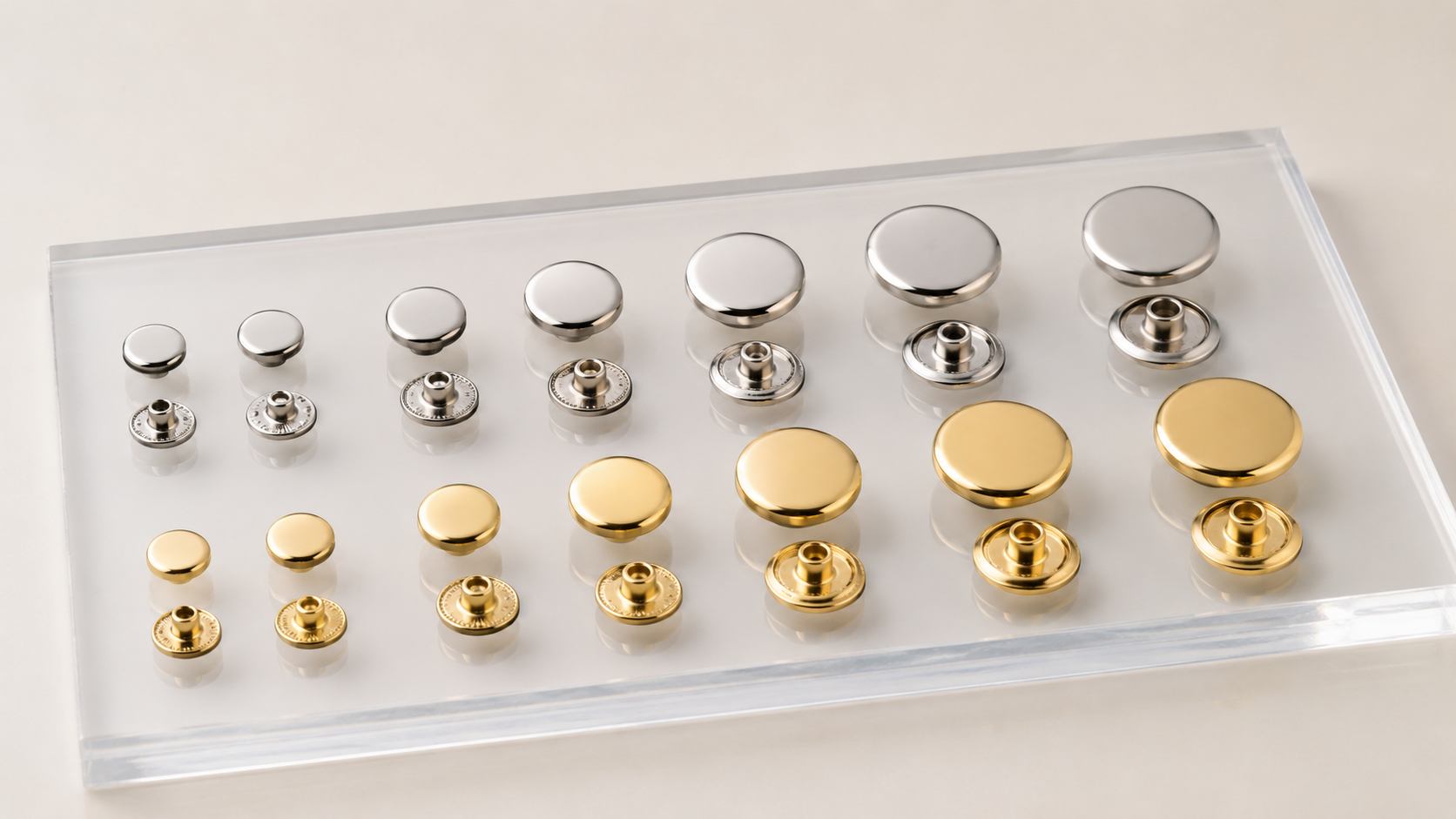
Baocheng / BC New Material can supply finished snap buttons, press studs and customized snap components based on real customer substrates.
Depending on the project, customization can include:
- cap diameter and profile;
- socket geometry;
- stud profile;
- post and eyelet dimensions;
- component height;
- working material-thickness range;
- base material;
- surface color and finish;
- logo and embossing;
- opening and closing behavior.
Available project materials can include brass, 304 stainless steel, 316 stainless steel, patented JSW20 ultra-low magnetic permeability stainless steel and other suitable materials according to component structure.
Development can use the customer's actual fabric, denim, leather, canvas or technical textile to confirm the correct post length and component combination before mass production.
Where applicable to the specific project and certificate scope, Baocheng can also consider REACH, RoHS, OEKO-TEX and nickel-release requirements.
Conclusion: Read the Whole Size Chart, Not Just the First Number
A snap fastener size chart should be read as a system.
Cap diameter tells you the visible size.
Socket dimensions identify the female working component.
Stud dimensions define the male engagement geometry.
Post length determines whether the hardware can be attached correctly to the actual substrate.
Material thickness connects the snap dimensions to the finished product.
Nominal millimeter or Ligne size is useful for classification, but it does not guarantee universal compatibility.
The most reliable selection process is therefore:
identify the nominal family → verify component dimensions → measure actual substrate thickness → choose the correct attachment length → install and test the complete snap system.
Focused FAQ
What is the most important number on a snap fastener size chart?
There is no single most important number. Cap diameter, stud and socket geometry, post length and material thickness all describe different parts of the fastening system.
Does 15 mm mean every snap component is 15 mm?
No. It commonly refers to a nominal or visible dimension. Socket, stud and post components use their own functional dimensions.
What does post length mean?
Post length describes the attachment stem available to pass through the substrate and be formed into the mating component. Confirm whether a chart lists total height or usable working length.
How do I select post length?
Measure the actual compressed material stack at the installation location, including folds, lining and reinforcement, then select a post within the manufacturer's recommended working range.
Can two 15 mm snaps use different posts?
Yes. The same cap or snap family can be offered with short and long post options for different substrate thicknesses.
Are 15 mm snap fasteners from different suppliers interchangeable?
Not automatically. Socket springs, stud profiles, post dimensions and tolerances can differ between product families.
Does a larger cap require thicker material?
No. Cap diameter and supported substrate thickness are separate specifications. Material capacity depends strongly on the attachment component.
Why is compressed material thickness important?
Fabric and leather can compress during setting, so their free thickness may not accurately represent the final installed condition.
What dimensions matter for leather snap fasteners?
Cap size, post length, flange diameter, material thickness range and actual leather compression are particularly important.
Should I use Ligne or millimeters in an RFQ?
Using both is useful when available, but critical component dimensions in millimeters and an approved drawing provide the clearest engineering specification.
Can Baocheng customize post length and component dimensions?
Yes. Baocheng / BC New Material can customize cap, socket, stud, post and eyelet dimensions around the actual substrate and target fastening performance.
Can JSW20 be used for snap components?
Where the component geometry and project requirements are suitable, Baocheng can manufacture finished snap components from JSW20 ultra-low magnetic permeability stainless steel. JSW20 retains extremely low magnetic permeability after forming and also provides chloride-corrosion resistance.
#SnapFasteners, #SnapButtonSize, #SizeChart, #CapDiameter, #StudSize, #PostLength, #MaterialThickness, #ComponentDimensions, #PressStuds, #GarmentHardware