







How Ring-Spring Snap Fasteners Work: Spring Geometry, Retention and Release Force
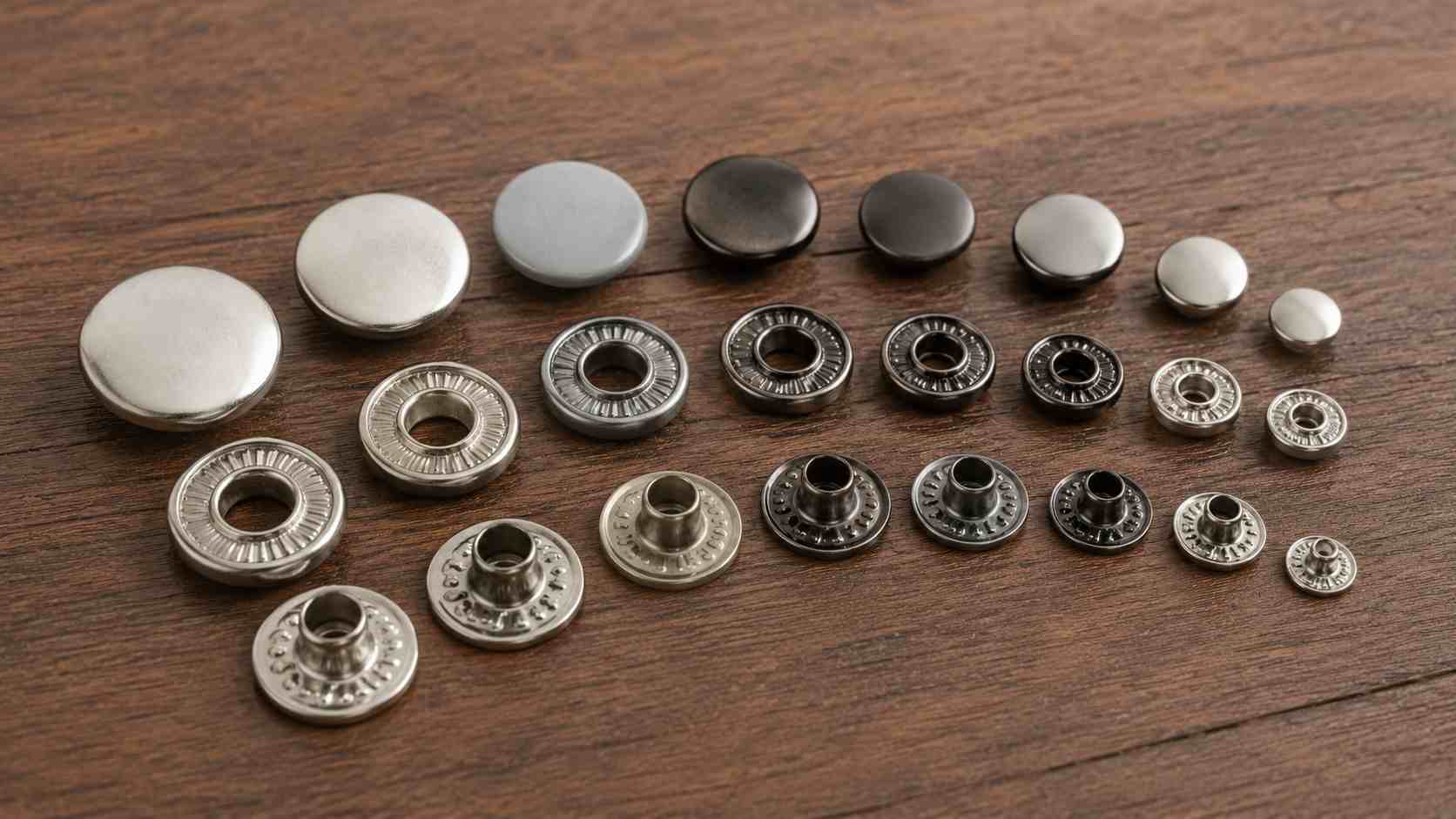
How Ring-Spring Snap Fasteners Work
A Ring-Spring snap fastener converts a very small amount of controlled elastic movement into a reusable mechanical lock.
At the center of the mechanism is a circular spring positioned inside the female socket. When the male stud enters, the wider part of the stud forces that spring outward. The ring expands temporarily, allowing the stud to pass through the critical interference region. Once the widest portion has passed, the spring contracts toward its original shape and settles around a narrower retaining section of the stud.
The snap is now closed.
To open it, the process must occur again in reverse. The stud has to force the spring outward until it can pass back through the interference region.
This simple-looking action explains why Ring-Spring snaps can create strong, repeatable retention without forming a permanent connection.
For buyers, however, the important point is that retention does not come from the ring alone. Spring geometry, stud profile, dimensional interference, material properties, surface condition, installation quality and substrate strength all participate in the finished fastening performance.
The Ring Is the Elastic Heart of the Locking Mechanism
The ring inside the socket acts as the principal elastic retaining element.
In its unloaded condition, the effective opening of the ring is smaller than the critical engagement diameter of the stud. The stud therefore cannot simply slide through without changing the spring geometry.
During closing, the stud pushes against the ring and creates controlled radial expansion.
This produces three important mechanical effects:
- the spring stores elastic energy as it expands;
- the spring generates resistance against further stud movement;
- after the interference point is passed, the spring attempts to return toward its original diameter.
The returning movement is what establishes the retained condition.
The Ring-Spring mechanism therefore depends on reversible deformation. If the ring merely bends once and remains permanently enlarged, the snap quickly loses its fastening function.
The Three Geometries That Matter Most
Ring-Spring performance can be understood more clearly by separating the mechanism into three geometries.
1. Free Spring Opening
This is the effective retaining opening of the ring before the stud forces it outward.
A smaller free opening generally creates greater interference with the stud, although final force also depends on spring material, cross-section and overall geometry.
2. Maximum Stud Engagement Diameter
This is the region that forces the spring to reach its greatest expansion during closing and opening.
If this diameter increases while the ring remains unchanged, the spring must deform farther.
3. Stud Retaining Region
After the maximum diameter passes, the spring moves inward around a narrower section.
This geometry determines where the ring sits while the snap remains closed.
The relationship among these three dimensions is more important than any one dimension by itself.
Interference Is What Creates the Snap Action
A Ring-Spring snap relies on intentional dimensional interference.
If the spring opening were larger than every part of the stud, the components could slide together and apart without meaningful resistance.
There would be no strong tactile click and very little protection against unintended opening.
The stud is therefore intentionally larger than the spring opening at the critical engagement region.
Closing requires the ring to expand.
Opening requires the ring to expand again.
That controlled interference creates the mechanical barrier that keeps the snap closed.
What Happens During Closing?
The closing process can be divided into several stages.
Stage 1: Alignment
The stud approaches the socket. Correct positioning keeps the load distributed relatively evenly around the Ring-Spring.
Stage 2: Initial Contact
The lead-in portion of the stud contacts the spring.
A smooth transition helps convert axial pressing force into radial spring movement.
Stage 3: Ring Expansion
As the stud continues inward, the spring begins to expand.
The farther it moves from its unloaded condition, the more elastic resistance it generates.
Stage 4: Maximum Interference
The widest engagement region reaches the spring.
This is normally where the spring experiences its largest controlled deformation and where closing resistance approaches its maximum.
Stage 5: Passage
The widest stud region passes beyond the ring.
The spring no longer needs to remain at maximum expansion.
Stage 6: Elastic Recovery
The Ring-Spring contracts inward around the narrower retaining region.
This rapid change from expansion to recovery produces much of the characteristic snap sensation.
Stage 7: Retention
The spring is now positioned behind the critical engagement geometry. The stud cannot leave without forcing the ring outward again.
Why the Snap Feels Strong After It Is Closed
The retained stud is not held simply because the metal surfaces are touching.
The geometry creates a mechanical barrier.
To separate the components, the stud must travel back through the same type of interference condition that was required during closing.
This is why Ring-Spring snaps provide clear resistance against unintended separation.
The system combines:
- spring elasticity;
- geometric interference;
- contact friction;
- stud-retaining geometry.
None of these factors should be evaluated alone.
Retention Force and Release Force Are Related but Not Identical Concepts
Buyers frequently use words such as “strong,” “tight” or “loose,” but these descriptions combine several different mechanical behaviors.
Retention
Retention describes the ability of the closed snap to resist unintended separation or movement.
Release Force
Release force is the force required to force the stud back through the Ring-Spring and actually separate the two halves.
Closing Force
Closing force is the load required to push the stud through the ring during engagement.
A good fastening design does not simply maximize all three.
Instead, they are balanced around the application.
What Controls Ring-Spring Release Force?
Release force is influenced by several interacting variables.
- Ring-Spring free diameter;
- spring cross-section and geometry;
- spring material properties;
- maximum stud diameter;
- retaining-neck geometry;
- surface friction;
- component alignment;
- wear condition;
- installation deformation.
A change in only one variable can alter the finished feel substantially.
This is why two Ring-Spring snaps with the same visible cap diameter can produce very different opening forces.
Spring Stiffness Is Important, but More Stiffness Is Not Always Better
A stiffer spring generates more resistance for a given amount of deformation.
That can increase retention and release force.
But excessive stiffness creates several disadvantages:
- closing becomes unnecessarily difficult;
- opening transfers greater force into the substrate;
- wear can increase at the stud contact region;
- installation damage becomes more consequential;
- user comfort can decrease.
The correct Ring-Spring is therefore not the stiffest possible spring.
It is the spring that generates the required fastening behavior while remaining compatible with the finished product.
Ring-Spring Geometry and Heavy Garments
Ring-Spring systems are particularly valuable where the garment has enough local strength to support higher release forces.
Structured coats, reinforced jackets and selected workwear can provide a more stable installation foundation than lightweight shirt fabric.
This is why searches for products such as coat snaps frequently overlap with stronger metal snap systems.
The important point is that the fabric structure must support the hardware.
A stronger Ring-Spring cannot compensate for inadequate reinforcement.
Why Ring-Spring Snaps Are Not Automatically Correct for Every Coat
Even within one garment category, construction varies enormously.
A heavy wool coat, lightweight fashion coat, insulated technical coat and laminated rain shell all transfer snap-opening loads differently.
Designers should evaluate:
- fabric strength;
- lining;
- interfacing;
- reinforcement;
- number of folded layers;
- total installed thickness;
- direction of opening load.
The category name alone cannot determine the correct Ring-Spring specification.
Ring-Spring Snaps for Pants
Pants snaps can be used at waistbands, pocket flaps and other controlled fastening positions.
The mechanical requirement depends heavily on the location.
A waistband snap may experience continuous garment tension, while a pocket snap is primarily opened and closed during access.
For a Ring-Spring design, this difference matters because the spring must resist unintended loading without creating an unnecessarily high intentional opening force.
Waistband reinforcement, fabric thickness and garment fit must therefore be considered together.
Pocket Snaps and Repeated Access
Pocket snaps demonstrate the difference between retention and excessive retention particularly clearly.
A pocket flap should remain closed while the wearer moves, but it may also be opened many times during the life of the garment.
If the Ring-Spring is too strong for the flap construction, every opening cycle loads the same local material area heavily.
Over time this can lead to:
- hole elongation;
- fabric distortion;
- hardware rotation;
- local tearing.
Cycle frequency should therefore influence spring-force selection.
What About Snap Buttons for Shirts?
Ring-Spring mechanisms are generally associated with stronger fastening behavior, so buyers evaluating snap buttons for shirts should consider whether that level of retention is actually necessary.
Some structured Western-style shirts or heavy overshirts can provide enough support for stronger snap systems.
Lightweight shirts are different.
A high release force on a thin placket can create more fabric stress than functional benefit.
The locking mechanism must therefore follow the garment rather than the visual preference for a strong metal snap.
Why Searches for Snap Buttons for Clothes Are Too Broad
The term snap buttons for clothes covers an enormous range of substrates and fastening conditions.
Clothing can include:
- shirts;
- sweaters;
- pants;
- coats;
- denim jackets;
- workwear;
- children's garments;
- technical outerwear.
All of these products can use snap hardware, but their ideal release forces are different.
For professional development, “clothes” must therefore be converted into a real fabric stack and a real use condition.
Interpreting Search Phrases Such as “Snaps for Clothes”
Search phrases such as snaps for clothes show that buyers often begin with the application instead of the mechanism.
That is a reasonable first step, but technical selection must continue farther.
The supplier needs to know:
- what garment is being produced;
- where the snap will be installed;
- how thick the installation area is;
- whether reinforcement is present;
- how frequently the snap will be opened;
- what level of release resistance is appropriate.
Only then can a Ring-Spring system be evaluated correctly.
What Does “Snap for Clothes” Actually Need to Specify?
The broad phrase snap for clothes should ultimately become a technical specification containing:
- snap mechanism;
- cap diameter;
- socket and stud system;
- attachment structure;
- post length;
- base material;
- surface finish;
- opening-force target;
- production tooling.
Without these details, two suppliers can both quote a “snap for clothing” while offering completely different mechanical systems.
Understanding “Snap On for Clothes” Search Intent
Search phrases such as snap on for clothes are informal rather than precise technical terminology, but they reflect a common sourcing path: the buyer knows that a press-to-close fastener is needed but has not yet identified the exact internal structure.
For B2B development, the supplier's role is to translate that search intent into a controlled product specification.
The final decision should identify whether the garment requires Ring-Spring, S-Spring or another locking system based on real performance requirements.
Ring-Spring and Sweater Applications
Sweater snaps need especially careful mechanical balancing because many knitted structures are flexible, stretchable and relatively sensitive to localized loading.
A high-retention Ring-Spring can be used only when the installation area is adequately stabilized.
This may require:
- backing reinforcement;
- additional facing material;
- reduced opening force;
- careful snap spacing;
- appropriate attachment geometry.
In softer knitwear, another lighter snap mechanism may provide a better mechanical match.
The Ring Must Remain Elastic After Thousands of Small Movements
A reusable snap depends on the spring returning to approximately the same functional condition after each opening cycle.
If the ring gradually experiences permanent set, its free opening becomes larger.
The resulting interference with the stud decreases.
The user eventually notices that the snap feels looser.
Long-term performance therefore depends on keeping the spring inside a controlled deformation range.
What Causes a Ring-Spring to Lose Retention?
Several mechanisms can reduce retention:
- permanent spring deformation;
- stud wear;
- surface wear or coating loss;
- corrosion;
- socket damage during setting;
- incorrect component mixing;
- excessive service loading;
- dimensional inconsistency.
Failure analysis should determine which interface actually changed rather than simply describing the complete snap as “loose.”
Why Installation Quality Affects Release Force
A correctly manufactured Ring-Spring can produce the wrong force after installation if the socket is distorted by tooling.
Excessive setting pressure can compress the socket body or alter the spring position.
Off-center installation can introduce uneven loading.
An incorrect lower die can fail to support the component properly.
These conditions change the geometry through which the Ring-Spring moves.
Final opening-force evaluation should therefore be carried out on installed samples.
Post Length and Ring-Spring Performance Are Separate but Connected
The Ring-Spring creates reusable socket-to-stud retention.
The post or other attachment components create permanent attachment to the substrate.
Both interfaces must succeed.
If post length is too short, the hardware can pull away from the garment even though Ring-Spring retention is perfect.
If the post is excessively long and buckles during setting, the resulting misalignment can distort the socket and indirectly change release force.
This is why complete snap development must treat locking and installation as connected systems.
Why Alignment Matters
Ring-Spring analysis is easiest when the stud enters centrally.
Real garments can introduce side loading.
If the stud repeatedly enters at an angle:
- one area of the ring may deform before the rest;
- local wear may become uneven;
- closing force can feel inconsistent;
- the socket may experience unnecessary stress.
Correct positioning of the male and female halves is therefore part of fastening quality.
Axial Opening vs Peel Opening
Release-force measurements can also change depending on how the user opens the product.
An axial pull attempts to separate the two halves more evenly.
A peel-style action begins lifting one side before the opposite side.
Garment users frequently create peel loading naturally when opening a flap or placket.
For this reason, laboratory force values should be interpreted together with real-product use.
Surface Friction Changes the Feel of the Same Geometry
The interaction between Ring-Spring and stud includes sliding contact.
Surface finish therefore influences the force required for movement.
Changes in:
- plating thickness;
- surface roughness;
- coating;
- contamination;
- corrosion;
- wear;
can change the closing and opening feel even when the fundamental geometry remains unchanged.
Production approval should therefore use the final finished component rather than an unfinished prototype whenever surface treatment is significant.
Ring-Spring Material Requirements
The spring performs repeated elastic work, so material behavior is fundamental.
The Ring-Spring must provide:
- adequate elastic recovery;
- stable forming characteristics;
- dimensional consistency;
- resistance to excessive permanent deformation;
- suitable wear behavior;
- appropriate environmental resistance.
The complete snap also has different requirements at different components. The cap must survive setting pressure and maintain appearance. The stud must maintain precise geometry. The post must form predictably during installation.
Material selection should therefore consider the entire snap system.
Corrosion Can Change Release Force
Corrosion is especially important in a spring mechanism because the retaining element must continue to move freely against the stud.
Corrosion products can increase roughness and friction.
Severe local attack can also change thin spring geometry.
The result can be:
- higher closing force;
- irregular release force;
- restricted spring recovery;
- accelerated wear.
For outdoor, humid or chloride-containing environments, corrosion performance is therefore part of fastening performance rather than a purely cosmetic requirement.
Ultra-Low Magnetic Ring-Spring Snap Components
Modern apparel supply chains can add another requirement: very low magnetic response after forming.
Projects involving needle detection or magnetically sensitive equipment should evaluate the finished formed snap component rather than relying only on the general magnetic description of the raw metal.
Cold forming can alter the magnetic response of some conventional austenitic stainless steels.
Baocheng / BC New Material can manufacture finished snap components using patented JSW20 ultra-low magnetic permeability stainless steel for projects requiring extremely low magnetic permeability after forming.
JSW20 also provides chloride-corrosion resistance.
This allows low-magnetic performance and environmental durability to be evaluated together in suitable snap projects.
BC New Material supplies finished JSW20 products and customized components rather than raw JSW20 coils or sheets.
How to Engineer Ring-Spring Retention for the Finished Product
A practical Ring-Spring development process should proceed in this order:
- define the final garment or product;
- identify the fastening location;
- measure the actual material stack;
- evaluate local substrate strength;
- define expected opening frequency;
- determine the required retention level;
- select the Ring-Spring and stud geometry;
- match the attachment structure and post length;
- install with the production tooling;
- test closing and release behavior on the real product.
This is more reliable than choosing a strong spring first and trying to make the product adapt afterward.
What Buyers Should Include in a Ring-Spring Snap RFQ
A useful RFQ should provide:
- finished-product application;
- exact snap location;
- actual substrate sample;
- total installed thickness;
- number of layers;
- reinforcement details;
- required cap diameter and profile;
- target retention or approved reference sample;
- preferred opening behavior;
- base material;
- surface finish;
- washing and service environment;
- existing setting machine;
- existing die information;
- compliance requirements;
- sample and production quantity.
The more accurately the real use condition is defined, the more accurately the Ring-Spring system can be engineered.
Custom Ring-Spring Snap Development at BC New Material
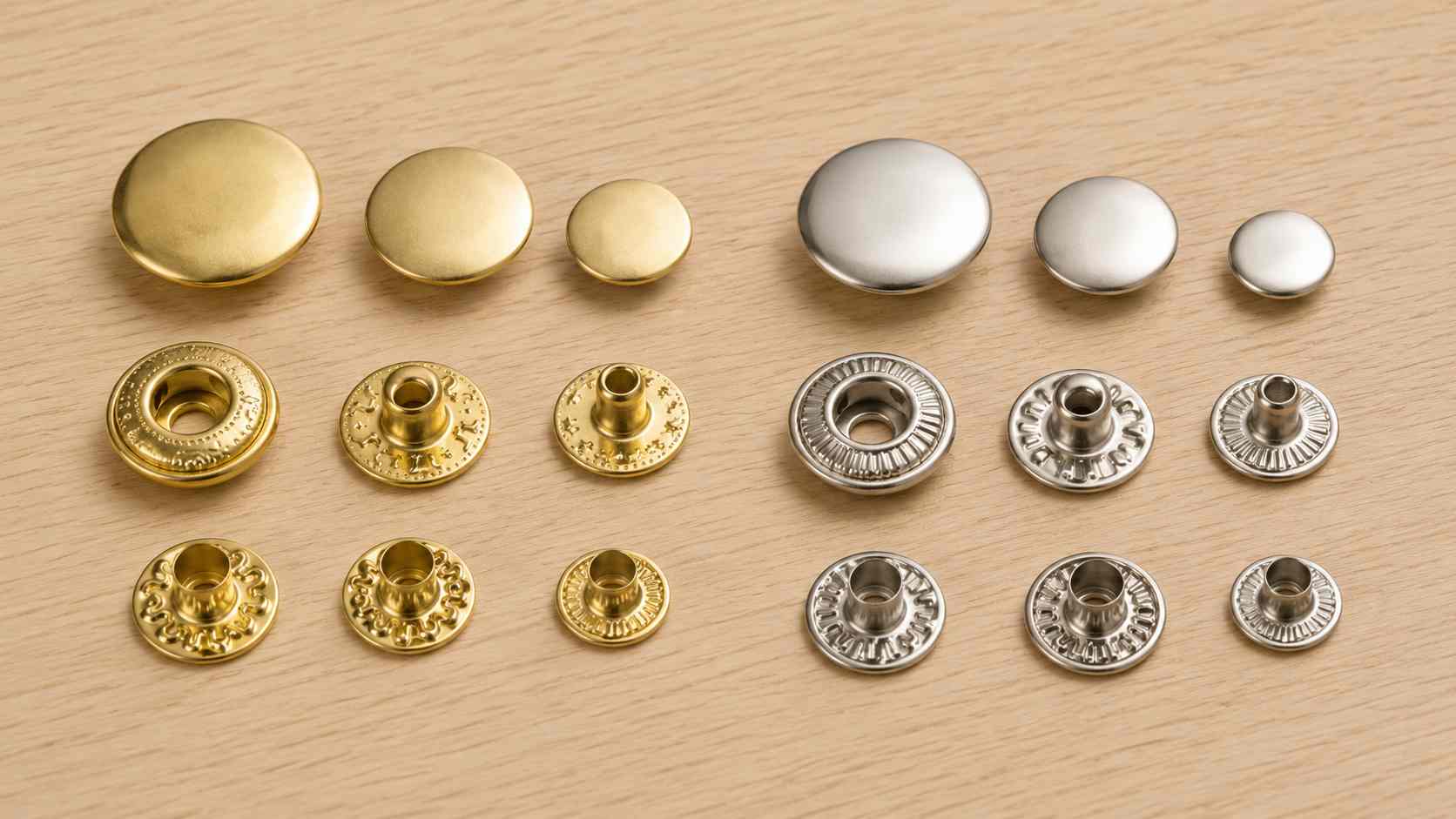
Baocheng / BC New Material supplies finished metal snap buttons and customized components for jackets, coats, pants, shirts, workwear, denim, leather goods, bags and other finished-product applications.
For Ring-Spring projects, customization can extend beyond the visible cap and consider the complete mechanical system.
Depending on the application, development can include:
- Ring-Spring socket structure;
- matched stud geometry;
- cap diameter and profile;
- post dimensions;
- base material;
- logo and embossing;
- surface finish and color;
- opening and closing behavior;
- component combinations matched to actual material thickness.
Sampling can be performed using the customer's real textile, denim, leather or multilayer garment structure.
This allows Ring-Spring retention, post forming, cap appearance and substrate strength to be evaluated together instead of testing isolated loose components.
Material options can include brass, 304 stainless steel, 316 stainless steel, patented JSW20 ultra-low magnetic permeability stainless steel and other project-appropriate metals depending on the component design.
Where applicable to the specific project and relevant certificate scope, development can also consider REACH, RoHS, OEKO-TEX and nickel-release requirements.
Conclusion: Ring-Spring Retention Comes From Controlled Geometry, Not Simply a Strong Spring
A Ring-Spring snap fastener works because a circular elastic retaining element is intentionally smaller than the critical engagement region of the stud.
The stud forces the spring outward during closing. The ring stores elastic energy, passes the maximum interference point and then contracts around the retaining region.
Opening requires the stud to overcome that geometric barrier again.
This creates strong and repeatable mechanical retention.
But the spring alone does not determine performance.
Spring diameter, spring stiffness, stud profile, dimensional interference, surface friction, material behavior, post length, installation tooling and substrate strength all contribute to the final closing and release force.
For this reason, a higher-force Ring-Spring is not automatically a better product.
The correct system creates enough resistance to prevent unintended opening while still allowing the user to release the snap without damaging the surrounding material.
That balance between spring geometry, stud interference and substrate strength is the real engineering principle behind reliable Ring-Spring snap fasteners.
Focused FAQ
How does a Ring-Spring snap fastener stay closed?
The ring-shaped spring expands as the wider part of the stud enters. After the stud passes the critical interference point, the ring contracts around a narrower retaining region and prevents the stud from leaving without another controlled expansion.
What creates the retention force in a Ring-Spring snap?
Retention comes from the combination of Ring-Spring elasticity, stud geometry, dimensional interference and contact conditions rather than from friction alone.
What determines Ring-Spring release force?
Important variables include spring geometry, spring stiffness, stud engagement diameter, retaining-neck geometry, surface friction, alignment, wear and installation condition.
Does a stronger Ring-Spring always produce a better snap?
No. Excessive release force can transfer too much load into the surrounding fabric or other substrate. The correct force must match the finished product.
Why are Ring-Spring snaps often used on thicker garments?
Ring-Spring structures are well suited to applications requiring stronger retention, while thicker and more structured garments generally provide a better foundation for carrying the associated opening loads.
Can Ring-Spring snaps be used on shirts?
Yes, particularly on structured or heavier shirts, but opening force should be carefully matched to the placket. A high-retention Ring-Spring is not automatically appropriate for lightweight shirting.
Can installation change Ring-Spring release force?
Yes. Excessive setting pressure, incorrect dies or off-center installation can distort the socket or spring position and change opening and closing behavior.
Why does post length matter if the Ring-Spring controls fastening?
The Ring-Spring controls reusable socket-to-stud engagement, while the post controls permanent attachment to the substrate. Both interfaces must be correct for the snap to perform reliably.
Can corrosion affect Ring-Spring performance?
Yes. Corrosion can increase surface roughness, restrict spring movement and alter friction, leading to inconsistent closing or release force.
Can Baocheng customize Ring-Spring snap retention?
Baocheng / BC New Material can develop Ring-Spring snap systems around the customer's substrate, stud and socket geometry, attachment dimensions, materials, finish and target fastening behavior, followed by sampling on the actual product material.
Can JSW20 be used for Ring-Spring snap components?
Where the component structure and project requirements are suitable, Baocheng can manufacture finished snap components using patented JSW20 ultra-low magnetic permeability stainless steel. JSW20 maintains extremely low magnetic permeability after forming and also provides chloride-corrosion resistance.
Does Baocheng sell raw JSW20 material?
No. Baocheng supplies finished products and customized components manufactured from JSW20 rather than raw JSW20 coils or sheets.
#RingSpringSnap, #SnapFasteners, #SpringGeometry, #SnapRetention, #ReleaseForce, #SnapButtons, #GarmentHardware, #PressStuds
