







How Far Apart Should Banner Grommets Be? A Guide Based on Size and Exposure
There Is No Universal Banner Grommet Spacing
“How far apart should banner grommets be?” sounds like a question that should have one simple numerical answer.
In production, it does not.
A small indoor promotional banner mounted flat against a wall does not need the same grommet pattern as a six-meter outdoor banner attached to a fence. A reinforced vinyl edge behaves differently from an unreinforced sheet. Mesh allows part of the wind to pass through, while a relatively impermeable vinyl surface can develop much higher pressure.
This is why professional manufacturers should treat spacing as part of the banner's load-distribution system rather than a cosmetic layout decision.
For most banners with grommets, the spacing needs to balance four things:
- banner size;
- material and edge reinforcement;
- mounting method;
- environmental exposure.
A tighter pattern increases the number of load-transfer points, but it also increases hardware, punching and setting cost.
A wider pattern reduces production cost, but each fixing point may need to carry more load and the material between fixing points can move more.
A Practical Starting Range—Not a Universal Standard
For early-stage banner design, manufacturers can use broad spacing bands as prototype starting points.
| Typical Application | Prototype Starting Range | Main Concern |
|---|---|---|
| Small indoor banner | Approx. 450–600 mm / 18–24 in | Keeping the edge visually straight |
| Large indoor banner | Approx. 300–450 mm / 12–18 in | Banner weight and sag between fixing points |
| Sheltered outdoor banner | Approx. 300–450 mm / 12–18 in | Intermittent wind and repeated movement |
| More exposed outdoor banner | Approx. 200–300 mm / 8–12 in as an engineering starting point | Wind loading, edge reinforcement and cyclic fatigue |
Important: These are not universal structural rules or guaranteed safe spacings. Large, elevated or highly exposed banners may require project-specific engineering, stronger reinforcement or a different fixing system.
The spacing should become more conservative as banner area, exposure and expected service life increase.
Banner Size Changes the Load Carried by Each Fixing Point
A 600 × 900 mm indoor sign and a 3 × 8 m outdoor banner may both use visually similar metal grommets, but the mechanical system is completely different.
As the banner becomes larger:
- total wind-exposed area increases;
- self-weight increases;
- the unsupported distance between mounting points becomes more important;
- small installation differences can produce larger wrinkles and load imbalance.
Spacing therefore should not simply scale visually with banner dimensions.
If a banner becomes three times longer while the same number of fixing points is retained, the load distribution changes dramatically.
Use Maximum Pitch Instead of “Number of Grommets”
A more useful manufacturing specification is to define the maximum center-to-center spacing, or pitch.
If one banner edge has usable length L and the maximum desired spacing is P, a practical layout method is:
Number of spaces = round upward from L ÷ P
Then:
Number of grommet positions = number of spaces + 1
For example, suppose the usable top edge is 2400 mm and the maximum target pitch is 400 mm.
2400 ÷ 400 = 6 spaces.
That requires seven positions from one end point to the other.
This approach prevents the production team from accidentally stretching the pitch because the banner length changed slightly.
Corner Positions Need Separate Attention
The first and last grommets on an edge are not ordinary intermediate positions.
Corners can experience multidirectional load because horizontal and vertical edges meet there.
The grommet center should therefore maintain sufficient distance from both edges and remain inside the reinforced region.
Placing the hole too close to the finished edge reduces the amount of material available to resist tear-out.
At the same time, placing it unnecessarily far inward can cause the banner corner to flap or distort outside the fixing point.
The correct location depends on:
- flange diameter;
- hole diameter;
- hem width;
- reinforcement tape or webbing width;
- banner construction.
Grommet Spacing and Edge Distance Are Different Dimensions
Spacing describes the distance between neighboring grommet centers.
Edge distance describes how far the grommet center or hole sits from the banner boundary.
A banner can have an excellent 300 mm pitch and still fail if every hole is positioned too close to the edge.
Conversely, generous edge reinforcement cannot completely compensate for extremely wide spacing under high wind exposure.
Both dimensions need to be included on production drawings.
Why Vinyl Banner Grommets Need a Reinforced Edge
Vinyl banner grommets usually clamp a flexible coated or laminated substrate.
The metal itself may be much stronger than the surrounding banner.
If the grommet is loaded hard enough, failure often begins by:
- elongating the hole;
- tearing the coated substrate;
- pulling the grommet toward the edge;
- delaminating the reinforced hem.
For this reason, grommet strength alone does not determine banner strength.
A reinforced hem, welded edge, folded construction or additional webbing can be more influential than simply upgrading to a thicker metal grommet.
Outdoor Exposure Changes the Spacing Decision
Outdoor vinyl banners with grommets experience loading that is fundamentally different from indoor signs.
Wind pressure rises rapidly as wind speed increases. In simplified aerodynamic terms, dynamic pressure varies approximately with the square of wind speed.
This means a relatively modest increase in wind speed can produce a much larger increase in pressure on the banner.
The actual force also depends on:
- banner area;
- shape;
- porosity;
- mounting tension;
- surrounding buildings;
- height above ground;
- gust behavior.
For exposed applications, simply copying the spacing used on an indoor banner can therefore create an under-designed fixing pattern.
Load Is Rarely Shared Equally by Every Grommet
A common mistake is to calculate total banner force and divide it equally by the number of grommets.
Real flexible banners do not usually behave that neatly.
If one tie is tighter, that position may carry more load.
If the banner wrinkles, corner positions may become highly loaded.
If one fixing loosens, neighboring grommets suddenly receive additional force.
If wind causes the banner to oscillate, load continuously moves from one area to another.
Therefore, adding more grommets helps distribute load, but manufacturers should not assume perfectly equal sharing.
Mounting Method Can Matter as Much as Banner Size
People searching how to hang a banner with grommets often focus on ropes, hooks, bungee cords or cable ties.
From an engineering perspective, each fixing method produces a different type of load.
Rigid cable ties
Cable ties can hold the banner closely to a frame or fence, but they allow relatively little movement. Loads can become concentrated if the banner is pulled too tightly.
Rope
Rope can distribute load differently depending on whether each grommet is tied independently or one continuous rope is threaded through multiple holes.
Bungee or elastic fixing
Elastic systems can absorb part of the movement, reducing some shock loading, but excessive movement can create repeated fatigue around the grommet.
Hooks
A small hook can concentrate force on one section of the grommet ID. The metal may remain intact while the banner material around the flange distorts.
Indoor Banners Usually Need Spacing for Flatness More Than Wind Strength
For indoor retail displays, exhibitions and event graphics, environmental loading is relatively low.
The main reasons to avoid excessively wide spacing are often visual:
- edge sagging;
- waves between mounting points;
- uneven tension;
- corners curling forward;
- poor alignment beside other signs.
A vinyl sign with grommets mounted flat against a wall may therefore use spacing mainly to control presentation rather than resist wind.
This is why the same 300 mm pitch that is conservative indoors may still be insufficient for a much larger banner in a severe outdoor location.
Long Narrow Banners Need Special Attention
A long horizontal banner creates a different problem from a square banner of similar total area.
The long top and bottom edges can sag or oscillate between fixing positions.
If only the four corners are fixed, the center section may move dramatically.
For long banners, reducing top and bottom pitch can help:
- maintain a straighter visual edge;
- reduce local movement;
- distribute tension;
- reduce dependence on corner hardware.
Side-edge grommets may also be needed depending on the mounting frame and exposure.
Very Tall Banners Can Concentrate Load at the Top
Vertical banners often place significant sustained load on the upper mounting points.
If the bottom is not tensioned, wind can make the lower section move while the top hardware carries much of the restraint.
For tall banners, buyers should review:
- top-edge reinforcement;
- top grommet spacing;
- side stabilization;
- bottom fixing;
- overall banner weight.
Canvas Changes the Hole Behavior
A canvas banner with grommets does not fail in exactly the same way as a PVC-coated vinyl banner.
Woven materials can redistribute load through yarns, but cutting a hole interrupts those yarn paths.
Depending on weave, coating and reinforcement, the fabric may:
- fray;
- stretch around the hole;
- pull individual yarns;
- compress beneath the flange.
This means spacing decisions need to be matched with actual substrate testing rather than copied automatically from vinyl.
Mesh Banners Can Reduce Wind Pressure—but Still Need Proper Reinforcement
Mesh allows some airflow through the banner, which can reduce overall wind pressure compared with a fully closed sheet of similar size.
However, this does not mean grommet spacing can automatically be doubled.
Mesh construction can be less dense around a punched opening and may need reinforced hems to prevent local distortion.
The actual mesh openness, yarn construction, coating and fixing method all matter.
Tarps Provide a Useful Comparison for Banner Spacing
Buyers who search how far apart should grommets be on a tarp are solving essentially the same load-distribution problem found in outdoor banners.
A tarp with grommets transfers wind and tension through a series of reinforced holes positioned around its perimeter.
If the spacing is too wide, the material between fixing points carries larger unsupported loads.
If one point loosens, neighboring locations become more highly stressed.
Banner designers can therefore learn from tarp design principles:
- do not rely on corner grommets alone;
- keep fixing points inside reinforced edges;
- reduce spacing as exposure increases;
- match hardware to the substrate rather than only to banner dimensions.
Heavy-Duty Tarps Show Why More Hardware Is Not Enough
Heavy duty tarps with grommets typically combine stronger substrate, reinforced edges and appropriately spaced hardware.
The lesson for banner manufacturers is important.
Simply adding more grommets to a weak unreinforced edge does not automatically create a heavy-duty banner.
Performance comes from the complete system:
- substrate tensile strength;
- tear strength;
- edge reinforcement;
- grommet flange size;
- washer support where used;
- spacing;
- mounting method.
Shade Fabric Is Another Useful Wind-Loaded Comparison
Sun shade fabric with grommets frequently operates under continuous outdoor exposure and wind-driven tension.
These systems illustrate why the hole-to-edge region needs enough material to transfer load into the wider fabric.
If the reinforcement zone is narrow, the metal component may remain perfect while the textile tears around it.
The same principle applies to large outdoor banners.
Spacing Should Become Tighter as Exposure Increases
A useful design hierarchy is:
| Exposure Level | Typical Design Direction |
|---|---|
| Indoor / wall-mounted | Spacing mainly controlled by flatness and appearance |
| Indoor / suspended | Add banner weight and movement to the analysis |
| Sheltered outdoor | Use closer spacing and stronger edge reinforcement |
| Open fence / facade | Expect repeated wind loading and uneven load distribution |
| Highly exposed / elevated | Use project-specific structural assessment rather than generic spacing rules |
Service Duration Also Matters
A temporary outdoor banner used for one weekend and a permanent advertising banner used for twelve months may experience the same peak wind on one particular day.
But the long-term banner also experiences thousands of smaller loading cycles.
This creates fatigue in:
- banner material;
- welded hems;
- reinforcement tape;
- grommet seating area.
Longer service life therefore justifies more conservative spacing and more thorough durability testing.
The Grommet Itself Changes the Allowable Spacing
Spacing cannot be specified without considering the hardware.
A larger flange spreads load over a broader area of banner material.
A washer-backed structure can increase backside support.
A larger barrel may suit a thicker reinforced hem.
However, larger hardware does not automatically allow very wide spacing.
The load still has to travel through the banner material between each fixing point.
Small Grommets May Need Closer Pitch on Large Banners
A small decorative eyelet has less bearing area around the hole.
If the banner is large or highly loaded, using very small hardware together with wide spacing can create high local stress.
Possible corrections include:
- increasing flange diameter;
- adding a washer;
- strengthening the hem;
- reducing spacing;
- changing the mounting system.
The Banner Hem Is Part of the Grommet Design
For B2B production, buyers should specify the edge construction together with grommet spacing.
Examples include:
- single folded hem;
- double folded hem;
- heat-welded reinforced edge;
- inserted webbing;
- reinforcement tape;
- multi-layer laminated edge.
Two banners using identical grommets at identical spacing can have completely different pull-out strength because their edge structures are different.
Grommet Positioning Accuracy Matters in Production
Even a correct nominal pitch loses value if actual positions vary heavily.
For example, a design may specify 300 mm spacing, but manual placement produces alternating 260 mm and 340 mm gaps.
This affects:
- appearance;
- mounting alignment;
- local load distribution;
- compatibility with pre-positioned hooks or frame holes.
For OEM banner production, drawings should define both nominal pitch and acceptable positional tolerance.
Do Not Forget the Final Grommet at the End of the Edge
Production teams sometimes start with a fixed pitch and discover that the remaining distance at the far end is much smaller than the standard interval.
Instead of creating one awkward short interval, it is usually better to calculate the number of spaces first and distribute them evenly across the usable length.
This produces a more professional appearance and more uniform structural behavior.
How Baocheng Can Customize Banner Eyelets and Grommets for Different Spacing Systems
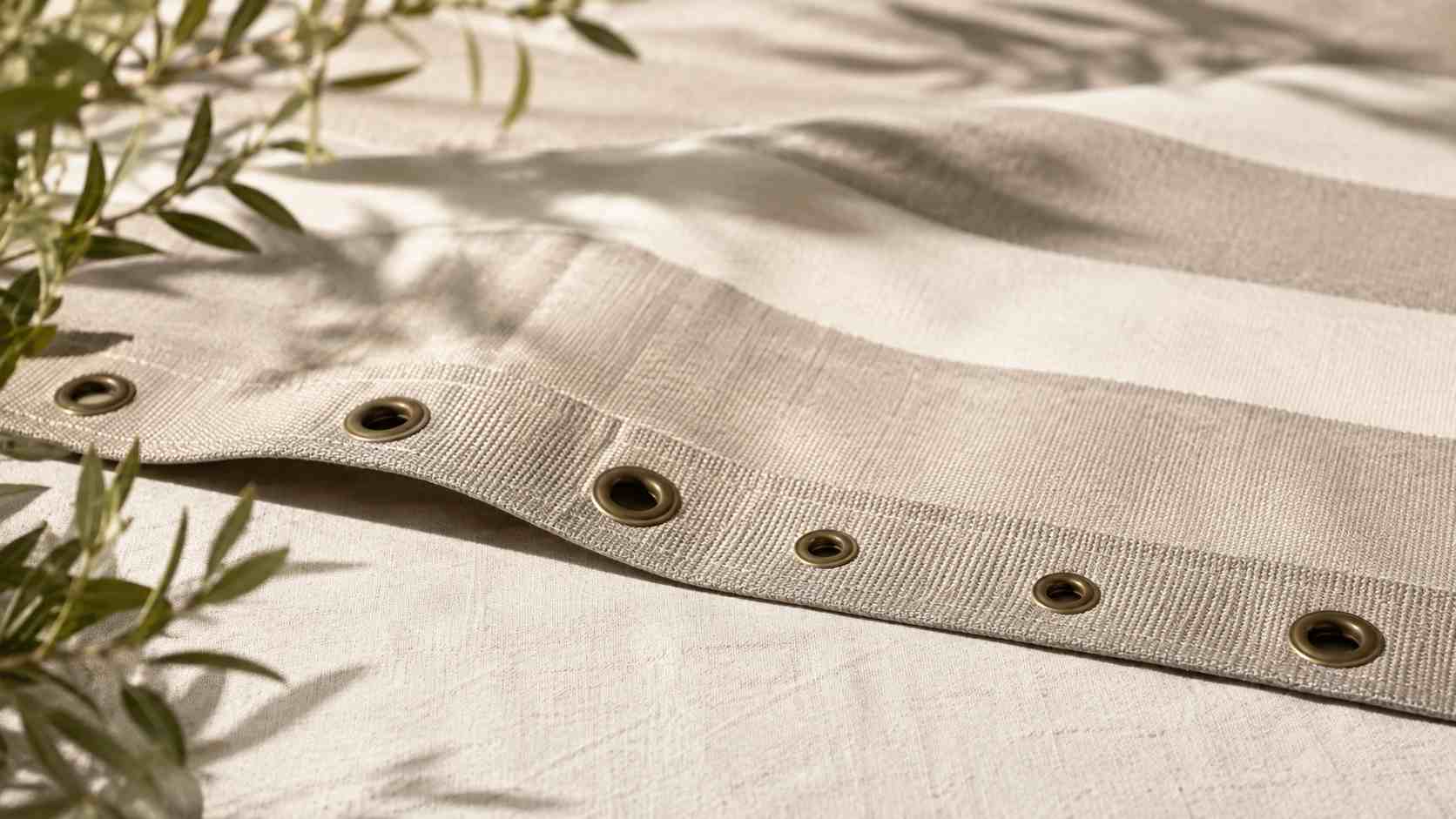
Baocheng / BC New Material can provide custom banner eyelets and grommets for vinyl banners, canvas banners, outdoor displays, signs, tarps and other flexible-sheet applications.
For a spacing-sensitive banner project, hardware can be developed around the customer's actual:
- banner material;
- edge reinforcement;
- grommet pitch;
- hole size;
- mounting method;
- indoor or outdoor exposure;
- expected product life.
Rather than selecting a generic metal ring first, Baocheng can help match the component geometry to the actual reinforced edge.
Baocheng Can Customize the Grommet Structure
Available customization can include:
- finished inside diameter;
- flange outside diameter;
- barrel outside diameter;
- barrel depth according to the complete banner edge;
- metal thickness;
- one-piece or washer-backed structure;
- self-piercing or pre-punched design;
- setting-die compatibility;
- surface color and finish.
For large exposed banners, the flange, washer and reinforced edge can be evaluated together rather than increasing only one component dimension.
Material Options for Banner Eyelets and Grommets
According to application, Baocheng can develop finished banner hardware using:
- 304 stainless steel for many general corrosion-resistant projects;
- 316 stainless steel for applications requiring stronger resistance to certain chloride-related environments;
- brass for good formability and premium metallic appearance;
- zinc alloy for selected decorative or special structural designs;
- JSW20 patented ultra-low-magnetic-permeability austenitic stainless steel for specialized projects requiring extremely low magnetic response after forming.
Where JSW20 Fits into Banner Hardware
Most conventional banner applications do not require an ultra-low-magnetic material.
However, special displays, flexible partitions or industrial textile products can sometimes be used near magnetic-sensitive inspection equipment or specialized electronics.
In those projects, the magnetic behavior of the finished component matters.
Grommets are stamped, drawn and formed. Some conventional austenitic stainless steels can develop greater magnetic response after cold working.
Baocheng's proprietary JSW20 is designed for finished components that need to retain ultra-low magnetic permeability and near-nonmagnetic behavior after forming.
This is the key distinction: the performance target is the finished grommet, not simply whether the incoming flat material appears non-magnetic.
JSW20 is an ultra-low-magnetic-permeability solution and should not be confused with a 316 corrosion grade.
If an outdoor banner project requires both chloride corrosion resistance and extremely low magnetic permeability, the two requirements should be evaluated independently.
Baocheng provides finished eyelets, grommets and other customized components manufactured from JSW20. We do not sell JSW20 raw coil material.
Colors and Finishes Can Be Customized
According to base material and process, banner hardware can be developed in:
- bright silver;
- matte silver;
- black;
- gunmetal;
- gold;
- brass tones;
- antique effects;
- other project-specific finishes.
Outdoor applications should evaluate appearance together with corrosion, forming and wear performance.
Sampling Should Reproduce the Actual Banner Edge
A reliable B2B sample should not be installed into a random piece of thin material simply to demonstrate that the grommet can close.
Instead, use:
- the real banner substrate;
- the production hem;
- the actual reinforcement;
- the intended hole spacing;
- the planned setting process.
Evaluation can then include:
- front and backside appearance;
- pull-out behavior;
- hole elongation;
- cyclic loading;
- corrosion where relevant;
- batch dimensional consistency.
A Better RFQ Includes More Than “Grommets Every 12 Inches”
A useful RFQ should include:
- banner width and height;
- substrate type;
- finished edge construction;
- inside or outside installation;
- expected exposure level;
- target grommet pitch;
- corner position;
- grommet inside diameter;
- flange size;
- washer requirement;
- material;
- finish;
- mounting method;
- order quantity;
- testing requirements.
The Right Spacing Is the One That Matches the Whole Banner System
Banner grommet spacing should never be chosen only because 12 inches, 18 inches or 24 inches is common in a supplier's catalog.
The correct pitch depends on the complete system.
Small indoor banners can often use wider spacing because load is low and visual flatness is the dominant concern.
Large indoor banners generally benefit from more fixing points to control sag.
Outdoor banners need closer attention to wind exposure, edge reinforcement and uneven load sharing.
Highly exposed or elevated installations require project-specific engineering rather than generic spacing assumptions.
The most reliable design process is therefore:
- define banner dimensions;
- classify the environment;
- define the mounting method;
- design the reinforced edge;
- choose grommet structure and material;
- set a maximum pitch;
- calculate evenly distributed positions;
- prototype the complete assembly;
- validate pull-out and cyclic behavior before volume production.
When spacing, edge distance, reinforcement and hardware are designed together, grommets become controlled load-transfer points instead of isolated holes whose real strength is discovered only after the banner is installed outdoors.
Focused FAQ
1. How far apart should banner grommets normally be?
There is no universal spacing. Around 450–600 mm may be a reasonable prototype range for small indoor banners, while larger or outdoor banners often require closer spacing. Exposure, reinforcement, mounting and banner size must be considered.
2. Is 24-inch grommet spacing suitable outdoors?
It may be suitable for some small or sheltered applications, but it should not be treated as a universal outdoor rule. Large or exposed banners generally require more conservative spacing and stronger edge reinforcement.
3. Does a larger banner need more grommets?
Usually yes, because banner area, weight and unsupported edge length increase. However, the required number also depends on wind, material, reinforcement and mounting method.
4. Should corner grommets be closer to the edge?
Corner position should balance material support and visual control. The hole must remain fully inside the reinforced area with enough material outside the flange to resist tear-out.
5. Does mesh banner material allow wider spacing?
Mesh can reduce wind pressure, but local hole strength and edge reinforcement still matter. Wider spacing should not be assumed without testing the actual mesh construction.
6. Do washer-backed grommets allow wider spacing?
A washer can improve local backside support, but spacing also controls the unsupported load between fixing points. A stronger grommet does not automatically justify very wide spacing.
7. What is most important for outdoor banner grommets?
Consider wind exposure, banner area, edge reinforcement, corrosion resistance, fixing method, flange support, spacing and cyclic loading together.
8. Can Baocheng customize banner grommets for different spacing layouts?
Yes. Baocheng can customize inside diameter, flange size, barrel depth, washer structure, material, finish and tooling according to the actual banner material, reinforcement and mounting system.
9. When is JSW20 appropriate for banner hardware?
JSW20 is intended for specialized projects requiring ultra-low magnetic permeability in the finished formed component. Most standard banners do not require it, but it can be valuable in magnetic-sensitive industrial or electronic environments.
10. What should be tested before mass production?
Use the production-equivalent banner material, reinforced edge, grommet structure and setting process. Evaluate hole elongation, pull-out behavior, cyclic movement, installation consistency and environmental performance where relevant.
#BannerGrommets, #BannerEyelets, #GrommetSpacing, #VinylBanner, #OutdoorBanner, #BannerHardware, #SignHardware, #CustomGrommets
