







How Eyestay Reinforcement Affects Shoe Eyelet Durability
Why Eyelet Durability Begins With the Eyestay, Not the Metal Eyelet
When a shoe eyelet becomes loose, rotates inside the upper or eventually pulls through the lace hole, the metal component is usually the first part buyers inspect. That reaction is understandable because the eyelet is visible. However, in footwear construction, the durability of the metal eyelet is strongly influenced by something that often remains hidden after assembly: the eyestay reinforcement.
The eyestay, sometimes called the lace stay, is the area of the upper where the lace holes are positioned. Every time the wearer tightens the shoe, lace tension is transferred through the eyelet into this section of the upper. If the eyestay does not have enough dimensional stability or tear resistance, even a well-manufactured metal eyelet can gradually move through the material.
This makes shoe eyelet durability a system problem rather than simply a hardware problem.
The eyelet, outer upper, reinforcement layer, lining, punched hole, flange geometry, barrel length and setting process all interact. Changing only one of these variables can change how the complete assembly behaves after repeated lacing.
From the perspective of a Chinese metal apparel and footwear hardware manufacturer, this is an important distinction. When customers report an eyelet failure, replacing the original eyelet with a thicker or harder component does not automatically solve the root cause. In many cases, the better solution is to understand how the metal part is supported inside the eyestay.
What Is Eyestay Reinforcement?
Eyestay reinforcement is an additional structural layer placed in or around the lace-hole area of a shoe upper. Depending on the footwear construction, it may sit between the outer upper and lining or be incorporated into a multi-layer eyestay panel.
Its purpose is not primarily decorative. Reinforcement helps stabilize an area that repeatedly experiences concentrated force from shoelaces.
A shoe upper may be attractive, flexible and comfortable but still lack enough local resistance to support a punched hole under repeated tension. Thin leather can stretch. Knitted or woven textile uppers can distort. Synthetic materials can elongate or tear around the edge of a poorly supported opening.
A suitable reinforcement layer increases the effective structure surrounding the eyelet.
In practical footwear development, reinforcement materials may include tear-resistant nonwoven structures, woven reinforcement fabrics, laminated materials, synthetic sheets or purpose-designed footwear backing materials. The correct option depends on the shoe upper, required flexibility, thickness, manufacturing process and expected load.
Why a Lace Hole Is a Stress Concentration Point
The moment a hole is punched into an upper, part of the original material structure is removed.
Before punching, tensile load can travel through a continuous sheet of leather or textile. After punching, the material has to transfer load around the edge of an opening.
When a shoelace is tightened, the eyelet presses against one side of that opening. The load is therefore concentrated in a relatively small area around the eyelet flange and barrel.
If the eyestay structure is strong and stable, this load can spread through a larger surrounding area.
If the eyestay is weak, the opening may begin to elongate in the direction of lace tension. Once movement begins, the eyelet can become progressively less stable.
This explains why simply asking how to install grommets does not address the complete footwear problem. Correct installation matters, but the material into which the hardware is installed must also be capable of supporting it.
What Happens When an Eyestay Is Under-Reinforced?
Insufficient reinforcement usually does not create one dramatic failure immediately after production. More commonly, damage develops gradually.
During early use, the eyelet may remain visually centered. Repeated tightening then begins to stretch the upper around the loaded side of the hole.
Several symptoms can appear:
- the lace hole becomes slightly oval rather than circular;
- the eyelet starts rotating inside the upper;
- the flange leaves an impression in soft upper material;
- the punched edge becomes visible beneath one side of the flange;
- the surrounding leather or textile starts splitting;
- the eyelet shifts toward the center of the lacing opening; or
- the entire metal component eventually pulls through the eyestay.
At this stage, increasing metal thickness may not be enough because the failure is occurring in the shoe material surrounding the eyelet.
Reinforcement Changes How Force Is Distributed
A useful way to understand eyestay reinforcement is to think about load distribution.
Without sufficient backing, the eyelet flange transfers much of the lace load directly into a narrow ring of upper material.
With a properly designed reinforcement layer, the loaded zone can extend farther beyond the punched hole. The reinforcement helps connect the immediate eyelet area to a wider section of the upper.
This is especially important in lightweight footwear.
A shoe brand may intentionally use thin leather, microfiber, engineered textile or lightweight synthetic materials to reduce weight or improve comfort. These materials may perform well throughout most of the upper while still needing local strengthening around the lace holes.
Adding reinforcement only where it is mechanically needed can be more efficient than making the entire upper unnecessarily thick.
Reinforcement Material Must Be Tear Resistant, Not Just Thick
Thickness alone is not a reliable measure of reinforcement performance.
A relatively thin material with high resistance to tearing can sometimes provide better lace-hole support than a thicker but easily extensible backing.
The reinforcement should maintain enough structure around the opening after it has been punched.
This point is critical because the reinforcement itself receives a hole during eyelet installation. If the material easily propagates a tear from that cut edge, the additional layer may provide less benefit than its thickness suggests.
Footwear developers should therefore consider:
- tear resistance;
- tensile stability;
- elongation under load;
- adhesion to surrounding upper layers;
- thickness after compression;
- flexibility during wear; and
- compatibility with punching and eyelet setting.
The best reinforcement is not necessarily the stiffest material. Too much stiffness can create an undesirable transition between the reinforced lace area and the more flexible surrounding upper.
Reinforcement Coverage Is as Important as Reinforcement Material
A strong reinforcement material can still perform poorly if the coverage area is too small.
If the backing ends immediately beside the eyelet flange, load is transferred from the reinforced area into unsupported upper material over a very short distance. This can simply move the failure point outward.
Effective reinforcement should extend beyond the immediate hole area so that load can transition gradually into the shoe upper.
For a row of eyelets, one continuous reinforcement strip may sometimes provide better load distribution than isolated small patches behind individual holes, depending on the footwear construction.
The ideal geometry varies by shoe design, but the engineering objective remains the same: avoid creating a small, highly loaded island around each eyelet.
Eyelet Spacing Changes Reinforcement Requirements
Eyelet positions are not independent of one another.
When lace holes are closely spaced, the remaining upper material between adjacent openings becomes narrower. Repeated tension from multiple eyelets can therefore act across the same section of the eyestay.
On wider spacing, each eyelet may interact with a larger independent area of upper material.
This means reinforcement should be evaluated across the complete lace row rather than behind a single eyelet.
Footwear brands should consider the number of eyelet pairs, spacing between holes, distance from the edge of the eyestay and the direction of lace pull when defining reinforcement.
The Hole Punching Process Can Damage Good Reinforcement
Even well-designed reinforcement can lose part of its benefit if the hole is prepared badly.
A clean opening is important because damaged edges can become starting points for tearing.
A worn or incorrectly sized grommet punch can crush, stretch or partially tear the material instead of producing a controlled opening.
This problem may remain invisible once the eyelet flange covers the punched edge.
During development, manufacturers should inspect the punched eyestay before installing the eyelet. Look for loose fibers, split leather, delamination between layers and distortion of the reinforcement.
If the material already shows damage before the metal component is installed, the eyelet cannot restore the original structural integrity.
A Grommet Hole Punch Must Be Matched to the Barrel
The size of the upper opening should be defined by the eyelet barrel and the intended setting process.
A common production shortcut is to make the opening slightly larger because this makes insertion easier. However, excessive clearance between the punched hole and eyelet barrel removes useful supporting material.
A correctly selected grommet hole punch should therefore create an opening that allows repeatable component insertion without unnecessarily enlarging the hole.
The eyelet supplier and footwear factory should distinguish between three measurements:
- the finished inside diameter through which the lace passes;
- the outside diameter of the eyelet barrel; and
- the diameter of the hole prepared in the eyestay.
These are related dimensions, but they are not interchangeable.
The Same Punch Does Not Suit Every Eyestay Material
Leather, coated fabric, microfiber, woven textile and reinforced synthetic laminates do not all react identically to punching.
Some materials cut cleanly with a sharp die. Others may compress, stretch or delaminate if the tooling is unsuitable.
This means production teams should not judge an eyelet punch tool only by nominal diameter.
Tool sharpness, cutting profile, material support beneath the upper and punching pressure can all influence hole quality.
If the footwear factory changes the upper specification, it is good practice to confirm the punching process again rather than assuming that the existing setting remains optimal.
Why the Eyelet Flange Still Matters
Eyestay reinforcement improves support, but the metal geometry remains important.
The eyelet flange is the visible surface that rests against the upper. It distributes some of the lace-generated pressure around the hole.
A wider flange generally creates a larger contact area. This can improve support on soft or highly loaded uppers, provided the flange remains proportionate to the shoe design.
A narrow flange may create a cleaner visual appearance but puts more emphasis on the strength of the reinforcement immediately surrounding the opening.
The correct design therefore balances three variables:
- eyelet flange diameter;
- prepared hole diameter; and
- strength and coverage of the eyestay reinforcement.
Changing one variable changes the demands placed on the other two.
Grommet Rings Cannot Compensate for Weak Eyestay Construction
Buyers sometimes respond to eyelet pull-out by specifying larger grommet rings or heavier metal hardware.
A larger flange can help distribute load, but it should not be treated as a substitute for proper reinforcement.
If the upper material underneath the flange continues stretching, the complete metal component can still migrate through the eyestay.
The stronger solution is usually to match the eyelet geometry to a sufficiently stable upper structure.
This also allows footwear designers to avoid oversized metal hardware that may conflict with the intended appearance of the shoe.
Barrel Length Changes When Reinforcement Is Added
Adding an eyestay backing does more than improve strength. It also increases the amount of material through which the eyelet must pass.
This directly affects barrel length.
A typical eyelet may pass through:
- outer upper material;
- eyestay reinforcement;
- additional overlay or structural layer; and
- lining.
The barrel must extend through the complete compressed stack and still leave enough metal for controlled rear forming.
If a footwear brand adds reinforcement during a later development stage but keeps the original short barrel, the eyelet may become under-set.
If a thick reinforcement is removed without adjusting the eyelet, the original barrel may become unnecessarily long and over-form during setting.
For this reason, eyelet specifications should be reviewed whenever the eyestay construction changes.
Leather Eyestays Need Special Attention to Layer Interaction
Search terms such as grommets leather reflect the common use of reinforced metal openings in leather products. In footwear, however, leather eyelet durability is not determined by leather thickness alone.
Full-grain leather, corrected leather, split constructions and synthetic-coated leather structures can respond differently around a punched opening.
Leather also changes condition during wear. Repeated flexing and moisture exposure can soften some areas of the upper.
When the eyestay uses leather, the reinforcement should help limit the progressive stretching of the lace holes without making the area excessively rigid.
Adhesion between the outer leather and backing is also important. If the layers slide significantly relative to one another, the reinforcement cannot distribute load as efficiently.
How to Put Grommets in Leather Is Different in Industrial Footwear Production
Someone searching how to put grommets in leather may find instructions intended for craft projects. Shoe factories need a different level of consistency.
A production line may install many eyelets on every pair of shoes and repeat the process across thousands of pairs. Small deviations can therefore create significant quality variation.
Industrial footwear production should control:
- upper-layer alignment;
- reinforcement position;
- hole diameter;
- eyelet insertion depth;
- die alignment;
- setting pressure;
- barrel roll geometry; and
- inspection criteria.
The objective is not simply to install one eyelet successfully. It is to reproduce the same metal-to-upper interface consistently throughout the order.
Eyelet Tools Must Support the Reinforced Material Stack
The addition of reinforcement changes how the complete eyestay behaves during setting.
Appropriate eyelet tools need to support the flange and form the barrel without crushing or cutting the layered upper.
If the press setup was originally developed on unreinforced material, simply adding a backing layer can change the required setting condition.
The thicker stack may need a different barrel length or revised forming adjustment.
This is one reason tooling validation should take place on the actual production construction rather than on a loose piece of upper material.
A Grommet Press Tool Does Not Fix an Incorrect Eyelet Specification
A good grommet press tool improves repeatability, but tooling cannot completely compensate for a mismatch among eyelet size, reinforcement thickness and upper construction.
For example, if the barrel is too short, increasing machine force does not create additional metal for rear forming.
If the upper hole is excessively large, additional pressure cannot replace the removed material.
If the reinforcement ends too close to the eyelet, a stronger setting does not improve load transfer beyond the reinforced zone.
This is why footwear development should establish the hardware and eyestay structure together rather than solving problems by adjusting press pressure alone.
How to Attach Eyelets Without Crushing the Reinforcement
The question of how to attach eyelets correctly becomes especially important when the eyestay contains several compressed layers.
Too little forming force can leave the eyelet loose.
Too much force can flatten the upper excessively, damage reinforcement fibers, create a visible ring around the flange or split the rear barrel.
A secure eyelet should clamp the material stack sufficiently to prevent unwanted movement while preserving the structural integrity of the surrounding reinforcement.
During sampling, the factory should inspect both sides of the installed eyelet rather than judging only the visible flange.
The rear side often reveals whether the barrel has rolled evenly and whether the reinforcement has shifted or been excessively compressed.
Adhesive Bonding of the Reinforcement Also Matters
Many eyestay backing materials are bonded to another layer of the upper.
If that bond is weak, the reinforcement and outer upper can slide independently when the lace pulls on the eyelet.
Instead of distributing load across a unified multi-layer structure, the eyelet may end up loading one layer more heavily than the others.
Delamination can therefore reduce the practical benefit of an otherwise strong reinforcement material.
Footwear factories should check the eyestay after relevant heat, humidity, flexing and production processes because the reinforcement must remain correctly positioned through assembly and use.
Reinforcement Position Must Be Consistent From Shoe to Shoe
Another mass-production issue is placement tolerance.
If the reinforcement strip shifts during upper assembly, one eyelet may be fully backed while another sits close to the edge of the reinforcement.
Both eyelets can look identical from outside after setting, yet they may have very different pull-out resistance.
This hidden variation is particularly dangerous because final visual inspection may not detect it.
Brands producing large footwear programs should therefore define reinforcement placement and coverage as part of the upper specification, not simply state that “reinforcement is required.”
Eyestay Reinforcement Influences Hidden and Visible Eyelets
Visible metal eyelets and concealed eyelets may look different, but both rely on the surrounding eyestay for support.
With visible eyelets, the flange itself contributes to the exterior design and can provide a clear load-distribution surface.
With hidden or blind constructions, the reinforcement behind the visible upper becomes even more important because the exterior design intentionally minimizes visible metal.
In both cases, the eyelet should be treated as part of the upper construction rather than a component added after the shoe has already been designed.
Different Shoe Types Need Different Reinforcement Strategies
| Shoe Type | Typical Eyestay Challenge | Reinforcement Priority |
|---|---|---|
| Dress shoes | Thin, refined leather and small visible or hidden eyelets | Low-profile reinforcement with precise hole alignment |
| Leather casual shoes | Repeated lacing without excessive bulk | Balance flexibility, tear resistance and flange support |
| Textile sneakers | Soft or stretchable upper materials | Control elongation and distribute lace load across the eyestay |
| Trail shoes | Repeated adjustment and changing lace direction | Stable reinforcement across the complete lace row |
| Hiking boots | Higher lace tension and thicker upper construction | Strong tear resistance, adequate coverage and matched barrel length |
| Work boots | Heavy laces, repeated daily tightening and demanding use | High structural support and stable metal-to-upper attachment |
How to Diagnose an Eyestay-Related Eyelet Failure
A failed shoe should be inspected before automatically changing the eyelet.
The failure pattern often provides useful clues.
| Failure Pattern | Possible Cause | What to Review |
|---|---|---|
| Eyelet remains intact but pulls through upper | Insufficient reinforcement or oversized punched hole | Backing material, coverage, flange diameter and hole size |
| Hole becomes oval | Upper stretches under directional lace load | Reinforcement stiffness, orientation and eyestay design |
| Eyelet rotates | Insufficient clamping or material compression | Barrel length, setting condition and total stack thickness |
| Outer layer tears but backing remains intact | Load is not being shared effectively between layers | Bonding and interaction between reinforcement and upper |
| Tear begins at reinforcement edge | Backing coverage may be too limited | Reinforcement dimensions and load transition zone |
| Rear barrel splits | Incorrect barrel length, forming force or tooling | Eyelet specification and setting dies |
Pull Testing Should Evaluate the Complete Eyestay Assembly
Testing a loose metal eyelet tells a manufacturer about the component itself, but it does not show how the eyelet interacts with a shoe upper.
For footwear development, representative pull or durability testing should be performed on the assembled material stack wherever required by the brand or customer program.
The failure mode is often as informative as the force value.
If the eyelet metal deforms, the hardware specification may need review.
If the eyelet remains unchanged while the upper tears, reinforcement or eyestay geometry may be limiting performance.
If the complete eyelet pulls out without significant tearing, hole size or rear forming may deserve closer inspection.
Testing should therefore be used to identify the weakest part of the system, not simply to generate a pass/fail number.
Why Reinforcement Changes Mass-Production Tolerance
Adding a reinforcement layer can improve durability, but it also introduces another production variable.
Thickness variation, placement variation and bonding consistency can all affect eyelet setting.
This is why a sample that works perfectly in the development room may behave differently during large-volume production if the reinforcement stack is not controlled.
Factories should establish acceptable tolerances for the complete upper thickness and verify that the approved eyelet still forms correctly across that range.
The metal component also needs consistent barrel length and wall thickness so the setting process remains stable.
How Bao Cheng Approaches Shoe Eyelet and Eyestay Projects
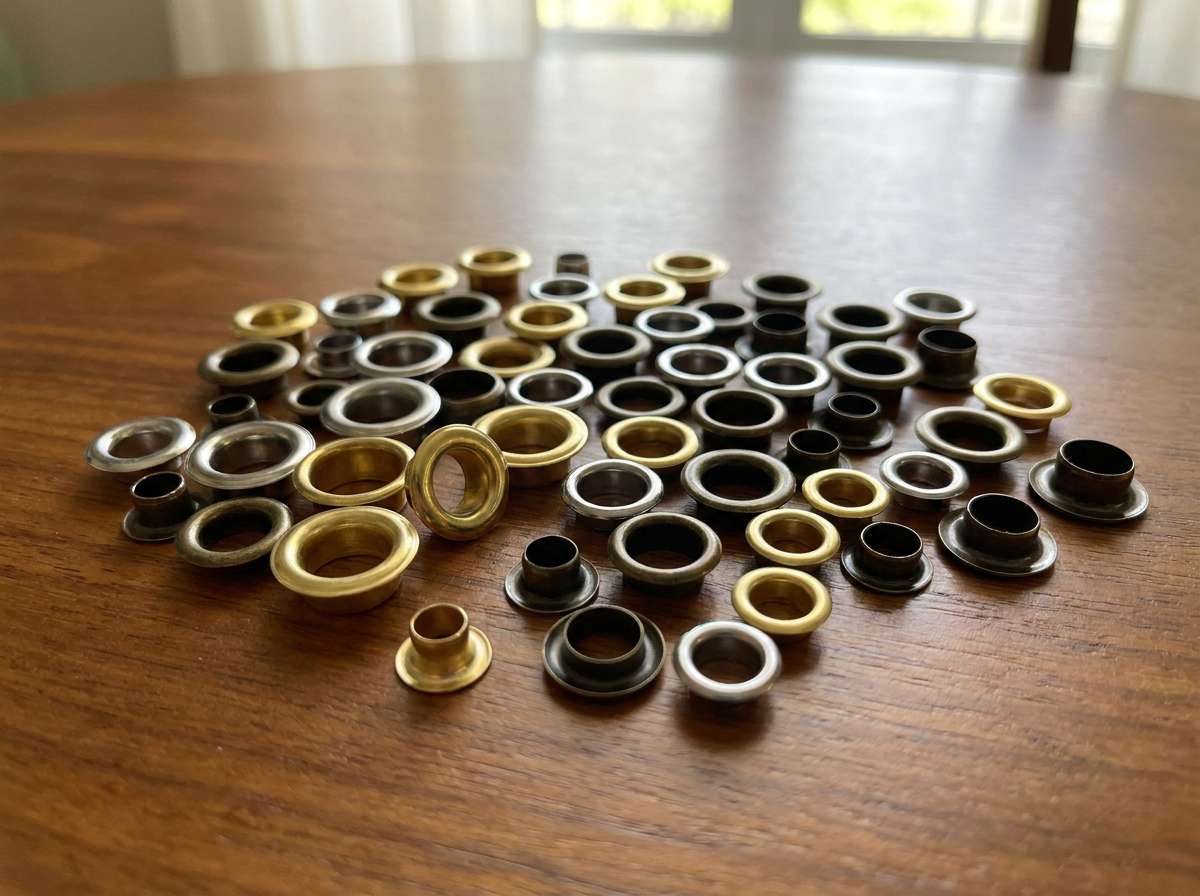
At JiaShan BaoCheng Clothing Accessories Co., Ltd., we manufacture customized metal hardware for B2B customers. When developing shoe eyelets, we prefer to understand the complete application rather than receiving only a nominal eyelet diameter.
The performance of the finished part depends on where and how it will be installed.
1. Eyelet Development Based on the Complete Upper Stack
Customers can provide the thickness of the outer material, reinforcement and lining at the eyelet position.
Using the complete installed stack makes it possible to evaluate barrel length more accurately.
This is especially valuable when a customer changes the eyestay reinforcement during development but wants to retain the same visible eyelet appearance.
In that situation, the inside diameter and flange may remain unchanged while the barrel length is adjusted to suit the new structure.
2. Custom Flange, Barrel and Hole Dimensions
Different shoe types require different proportions.
A refined leather shoe may need a compact visible flange. A work boot may require a larger support area. A lightweight textile sneaker may need geometry designed around a stabilized lace panel.
Bao Cheng can develop customized inner diameter, flange diameter, barrel diameter and barrel length according to drawings, reference samples and application requirements.
3. Support During Hole and Tooling Evaluation
When customers experience loose eyelets or damaged uppers, the problem can involve more than the metal part.
Photographs of the punched hole, reinforcement position, installed front side and rear barrel can provide useful information for troubleshooting.
These details help evaluate whether the likely cause is the component, hole preparation, material thickness or setting tooling.
4. Material Selection According to the Footwear Program
Depending on the project, Bao Cheng can support eyelet development using materials such as brass, stainless steel, aluminum and specialized JSW20 low-magnetic stainless steel.
Material selection should consider forming behavior, corrosion resistance, appearance, weight, surface treatment and the requirements of the finished shoe.
For programs with strict magnetic-performance or needle-detection requirements, JSW20 can be evaluated at the finished-component level according to the customer's application requirements.
5. Customized Surface Finishes
Shoe eyelets often need to coordinate visually with hooks, D-rings, buckles, zipper components or other metal hardware.
Bao Cheng supports customized surface treatment and color development according to approved project requirements.
For visible eyelets, appearance should ideally be evaluated after setting because the component undergoes mechanical deformation during installation.
6. Sampling Before Mass Production
For a new footwear project, loose metal samples are only the first stage.
The customer should install the eyelet into the actual eyestay construction and evaluate:
- hole alignment;
- flange appearance;
- barrel formation;
- upper compression;
- reinforcement stability;
- lace clearance;
- eyelet movement; and
- pull-out performance where required.
This allows design issues to be corrected before bulk uppers have already been punched.
7. Support for Different Eyestay Thicknesses
A footwear collection may use the same visible hardware design across a casual shoe, sneaker and boot while the internal upper structures differ.
In these situations, forcing every model to use exactly the same barrel length can create unnecessary production problems.
Bao Cheng can evaluate whether different barrel configurations are appropriate while maintaining the same visible flange design.
8. Batch Consistency During Bulk Production
Once a shoe factory establishes an approved punching and setting condition, dimensional consistency of the metal hardware becomes important.
Variation in barrel length or wall thickness changes forming behavior and can force operators to continually adjust press pressure.
Maintaining the approved component geometry helps the footwear factory achieve more stable results across large orders.
9. Compliance Support According to Project Requirements
For applicable projects, Bao Cheng can support relevant testing and documentation requirements such as OEKO-TEX, RoHS, REACH, Intertek-related testing and nickel-release testing according to the material, finish and customer specification.
Requirements should be discussed during development so the selected material and surface system can be aligned with the target market.
10. Drawing and Sample-Based Custom Manufacturing
Bao Cheng's main focus is B2B customized production rather than retail repair hardware.
Footwear brands, factories and sourcing teams can send drawings, existing eyelets, shoe samples or detailed application requirements.
This allows the metal component to be developed around the actual eyestay rather than asking the customer to redesign the shoe around a generic stock eyelet.
A Better Eyelet Specification Starts With the Shoe Construction
The most durable eyelet is not necessarily the thickest metal eyelet or the component with the largest flange.
The strongest design is the one in which the metal hardware and eyestay structure support each other.
The reinforcement must prevent excessive upper deformation. The punched hole must preserve enough material around the barrel. The flange must distribute load without becoming visually disproportionate. The barrel must match the complete reinforced thickness. Finally, the setting dies must form the eyelet without damaging the structure they are intended to secure.
For footwear brands, this changes the development question from “Which eyelet is strongest?” to “Which eyelet and eyestay combination is appropriate for this shoe?”
That distinction helps prevent oversized hardware, unnecessary material changes and repeated production troubleshooting.
Final Thoughts
Eyestay reinforcement is easy to overlook because much of it disappears inside the completed shoe. Yet it plays a direct role in how the lace load reaches the upper and how securely a metal eyelet remains installed.
When reinforcement is too weak, too narrow, badly positioned or poorly bonded, the eyelet can begin moving even when the metal component itself is correctly manufactured.
When reinforcement is appropriately designed, the lace-hole area becomes more dimensionally stable and the eyelet has a stronger structure to clamp.
This is why shoe eyelet durability should be developed from the inside outward.
Start with the upper material and expected lacing load. Define reinforcement according to that structure. Prepare a controlled hole. Select an eyelet whose flange and barrel dimensions match the complete stack. Then validate the component with the actual tooling and production shoe.
Bao Cheng supports customized eyelet development using this application-based approach, helping footwear customers connect metal hardware specifications with the real eyestay structure before mass production begins.
Focused FAQ
1. What is eyestay reinforcement in a shoe?
Eyestay reinforcement is an additional structural layer used around the part of the shoe upper that contains the lace holes. It helps stabilize the upper and distribute repeated lace tension away from the immediate edge of each eyelet opening.
2. Can a strong metal eyelet still pull out of a shoe?
Yes. If the surrounding upper or reinforcement stretches, tears or contains an oversized hole, an intact metal eyelet can still pull through the material. Eyelet retention depends on the complete hardware-and-upper assembly.
3. Does thicker eyestay reinforcement always improve durability?
No. Thickness is only one factor. Tear resistance, elongation, bonding, coverage area and compatibility with the upper are also important. A thick but easily deformable backing may not provide better support than a thinner, more stable reinforcement.
4. Why does reinforcement change the required eyelet barrel length?
The eyelet barrel has to pass through the complete material stack. Adding reinforcement increases the installed thickness, so the barrel may need additional length to provide enough metal for correct rear forming.
5. Can poor hole punching reduce the benefit of eyestay reinforcement?
Yes. A dull or incorrectly sized punch can tear, crush or delaminate the upper and reinforcement around the opening. The damage may later remain hidden beneath the eyelet flange but still reduce pull-out resistance.
6. How large should eyestay reinforcement be around each eyelet?
There is no universal dimension for every shoe. The backing should extend far enough beyond the eyelet to distribute load into a wider section of the upper. Shoe material, eyelet spacing, lace tension and overall eyestay construction all influence the required coverage.
7. Why does an eyelet rotate even when it has not pulled out?
Rotation can indicate insufficient clamping, an oversized hole, incorrect barrel length or compression of the surrounding upper. It can also develop when the eyestay material stretches under repeated lacing.
8. Should eyelets be tested on loose upper material or a complete shoe construction?
Loose material is useful for preliminary development, but final validation should reproduce the actual eyestay stack, including reinforcement and lining. The complete assembly determines setting behavior and long-term retention.
9. Can Bao Cheng customize eyelet barrel length for reinforced shoe uppers?
Yes. Bao Cheng supports customized B2B eyelet development based on drawings, reference samples and footwear construction requirements. Barrel length, flange dimensions, inside diameter, material and finish can be evaluated according to the complete upper structure.
10. What information should I provide for a custom eyestay eyelet project?
Provide the upper material, reinforcement structure, total compressed thickness, prepared hole diameter, required finished eyelet ID, flange dimensions, shoelace size, desired material and finish, reference drawing or sample, expected order quantity and any applicable testing requirements.
