






How Do Snap Buttons Work? How the Socket and Stud Create a Secure Mechanical Connection
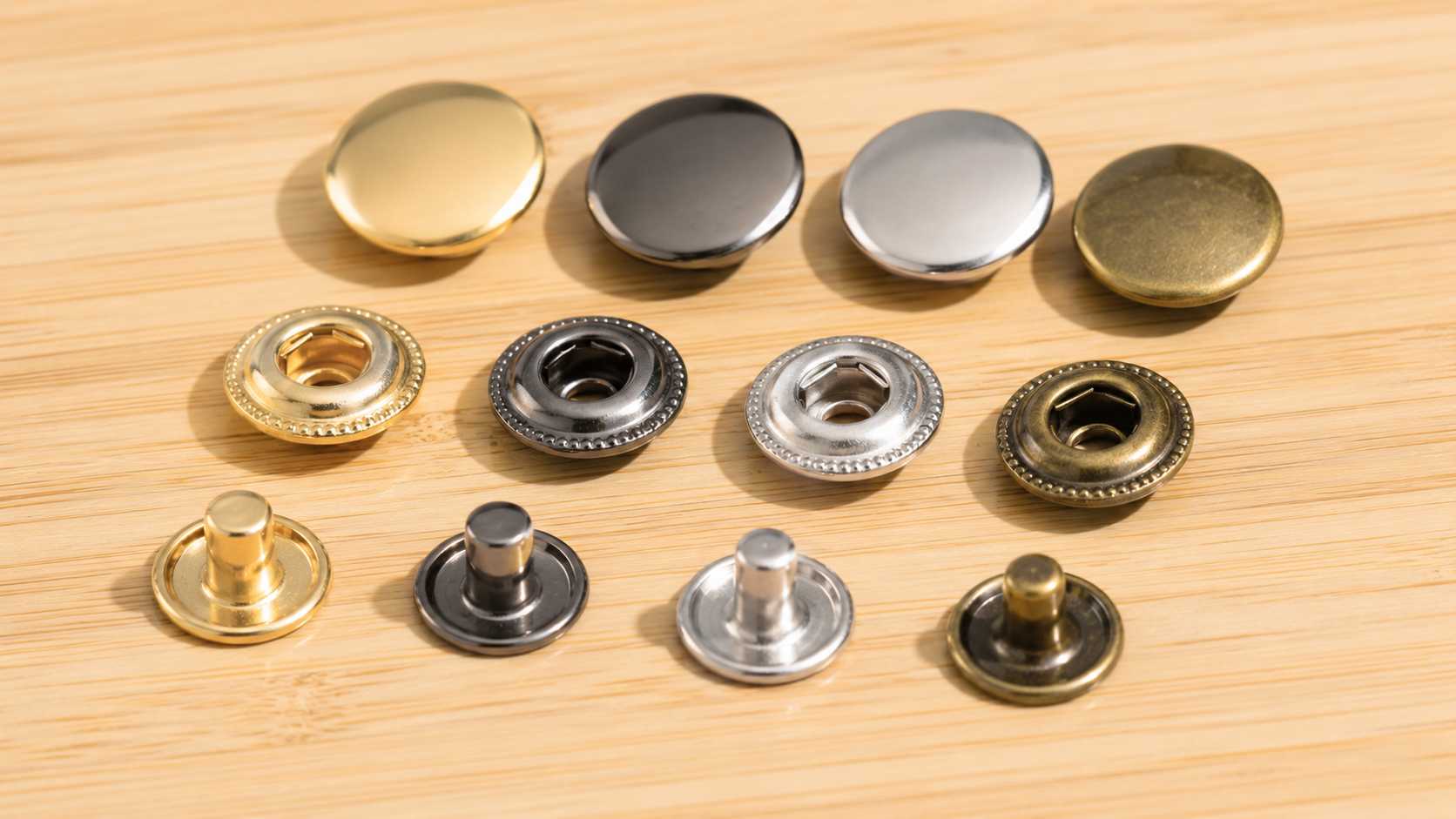
How Do Snap Buttons Work?
The question how do snap buttons work seems simple because the user experiences only two actions: press the two halves together until they click, then pull them apart when opening is required. Inside a well-designed metal snap, however, that click is produced by a controlled mechanical interaction between the socket and stud.
The stud is the male engagement component. The socket is the female component containing the elastic retaining geometry. As the stud enters the socket, its wider engagement section forces part of the socket to deflect. Once the widest portion passes the critical retaining point, the socket springs back toward its original shape and settles around a narrower region of the stud.
The two parts are then mechanically retained until a sufficient separating force causes the socket to deflect again and release the stud.
This means a snap button is neither a simple friction fit nor a permanent lock. It is a repeatable elastic mechanical connection designed to create a defined balance between secure retention and intentional release.
Understanding this balance is essential for buyers because a snap that feels “strong” is not automatically a better snap. The correct socket-and-stud relationship depends on the substrate, product construction, application, required opening force and expected service conditions.
The Socket and Stud Form the Functional Heart of the Snap
A conventional four-part metal snap normally contains a cap, socket, stud and post. The cap and post help anchor the hardware to the substrate, but the repeated fastening action occurs primarily between the socket and stud.
The socket performs two important jobs:
- it guides and accepts the stud during closure;
- it provides elastic resistance that holds the stud after engagement.
The stud provides the corresponding male geometry. Its diameter, profile and transition surfaces determine how far the socket must deflect during engagement and how easily the two components can later separate.
The socket and stud therefore have to be engineered as a pair. A socket that is perfectly functional with one stud can become too tight, too loose or completely incompatible with another stud that looks almost identical.
This is one reason visually similar metal snap fasteners should not automatically be mixed between different systems or suppliers.
What Happens Mechanically When Snaps Close?
When snaps close, the complete action can be divided into a sequence of mechanical stages.
1. Alignment
The stud is positioned approximately in line with the socket. The entrance geometry should provide enough guidance that the user does not need laboratory-level alignment to operate the product.
If the male and female halves are significantly misaligned, lateral loading can increase friction, distort the socket or make engagement difficult.
2. Initial Contact
The leading surface of the stud contacts the entrance of the socket. At this stage, only moderate resistance should normally be present.
Rounded or carefully formed transition surfaces help guide the stud inward instead of creating a sharp mechanical obstruction.
3. Increasing Interference
As the stud continues into the socket, its wider engagement section reaches a region where the free opening of the socket is smaller than the effective stud diameter.
This difference creates mechanical interference.
Interference is not a defect. It is necessary for the snap action. Without controlled interference, the socket would provide little resistance and the two halves would not remain securely connected.
4. Elastic Deflection
Additional closing force causes the retaining portion of the socket to expand, flex or move away from its unloaded position.
The metal is intended to deform within a controlled elastic range. After the external force changes, the retaining structure should recover toward its original geometry rather than remaining permanently opened.
5. Passing the Maximum Engagement Point
The widest effective portion of the stud passes through the point of greatest interference.
This is usually the stage associated with the strongest tactile resistance during closing.
6. Spring Recovery
After the widest portion passes, the socket can move inward again and settle around a narrower retaining region of the stud.
The stored elastic energy is released as the socket recovers. This sudden change in resistance creates much of the familiar click or snap sensation.
7. Closed and Retained Position
The stud is now mechanically retained. It cannot leave the socket without forcing the elastic structure through a similar deformation sequence in the opposite direction.
This is the core principle behind a reusable snap connection.
Why Does the Snap Make a Distinct Click?
The click is the physical result of moving from increasing elastic resistance into rapid spring recovery.
Before the stud passes the critical engagement point, the socket resists further movement. Immediately afterward, its elastic structure is able to return toward a lower-energy position around the retaining section of the stud.
This transition produces both tactile feedback and often an audible sound.
A clear click is useful because it tells the user that engagement has occurred, but sound alone should not be used as a quality specification. Two snap designs can produce different acoustic responses while both providing reliable mechanical retention.
More meaningful engineering criteria include closing force, opening force, component dimensional consistency and performance after repeated cycles.
Elastic Deformation Is the Key to Reusable Fastening
The socket must repeatedly deform without losing the geometry required to grip the stud.
This is fundamentally different from permanent riveting. A riveted joint is intentionally deformed during installation and then expected to remain fixed. The socket of a snap undergoes small repeated movements throughout the service life of the product.
The design therefore depends on an appropriate combination of geometry and material behavior.
If the retaining structure permanently deforms after only a few cycles, the effective interference becomes smaller and the snap gradually loses holding performance.
If the socket is too rigid, the force required to move the stud through the retaining area can become excessive.
A successful design keeps deformation within a range that provides repeatable spring recovery.
Interference: The Small Dimensional Difference That Creates the Lock
The reliability of the socket-and-stud system is strongly influenced by geometric interference.
Consider the critical engagement diameter of the stud and the free retaining diameter of the socket. If the stud is effectively larger at the engagement point, the socket has to deform before the stud can pass.
A small change in either dimension can therefore produce a noticeable change in fastening feel.
Too little interference can result in:
- weak tactile engagement;
- low opening resistance;
- movement while closed;
- unintentional opening.
Too much interference can result in:
- excessive closing force;
- excessive opening force;
- accelerated wear;
- socket deformation;
- high load transfer into the surrounding substrate.
The target is controlled interference, not maximum interference.
Closing Force, Holding Behavior and Opening Force
These three concepts are frequently mixed together, but they describe different aspects of snap performance.
Closing Force
Closing force is the force required to push the stud far enough into the socket for complete engagement.
It is influenced by socket stiffness, stud geometry, interference, surface condition, alignment and lubrication or friction conditions.
Holding Behavior
Once fully engaged, the snap resists external loads. The geometry surrounding the retained stud prevents easy separation and limits movement.
Holding behavior is important when a product experiences tension during normal use even when the customer is not deliberately opening the snap.
Opening Force
Opening force is the separating load required to force the stud back through the socket retaining geometry.
It is often one of the most important user-experience variables.
A snap for a lightweight shirt should be easy enough to open without damaging the placket. A snap on a more demanding product requires stronger resistance to unintended opening.
Specifying “maximum holding strength” without considering the substrate can create an unbalanced design.
Why Stronger Is Not Always Better
A snap does not operate in isolation. The opening force eventually becomes a load on the fabric, leather, canvas or other substrate surrounding the installed hardware.
If opening force is higher than the material can repeatedly tolerate, the snap may remain mechanically perfect while the finished product fails around it.
Possible consequences include:
- elongation of the installation hole;
- distortion around the hardware;
- fabric tearing;
- delamination of coated materials;
- the complete snap pulling out of the substrate.
The best snap therefore creates sufficient retention against unintended opening while remaining compatible with the mechanical strength of the finished product.
How Heavy-Duty Snaps Change the Mechanical Balance
Heavy duty snap fasteners are typically selected for applications that require greater resistance to separation, thicker substrates, repeated loading or more demanding service conditions.
The term “heavy duty” should not be interpreted only as thicker metal. Increased performance can come from changes in socket construction, spring geometry, stud profile, component size, material thickness and installation arrangement.
Heavy duty snap buttons must also transfer their increased opening loads into the substrate safely. A powerful snap installed in weak material without suitable reinforcement can create a worse finished product than a moderately loaded snap matched correctly to the substrate.
For technical textiles, workwear, covers and similar applications, hardware strength, reinforcement design and load direction should therefore be evaluated together.
Stud Geometry: Why the Shape Matters as Much as Diameter
A stud cannot be fully described by one diameter.
Its functional geometry can include:
- lead-in radius;
- maximum engagement diameter;
- head height;
- retaining-neck diameter;
- transition angle or radius;
- component concentricity.
The lead-in region influences how smoothly the stud begins entering the socket. The maximum engagement section determines how far the socket has to deflect. The retaining region affects how the socket sits after closure.
If transitions are too abrupt, local contact stress and friction can rise. If geometry is undersized, the engagement may lack definition.
Consistent stud forming is therefore essential for batch-to-batch fastening consistency.
Socket Geometry: Where Spring Action Is Designed
The socket must turn geometric movement into predictable elastic resistance.
Different snap families achieve this through different structures. Some use formed spring elements integrated into the socket, while others incorporate ring-like spring geometries.
Regardless of design, several principles remain consistent:
- the stud must be guided into the retaining region;
- the socket must deflect without uncontrolled permanent deformation;
- spring recovery must be sufficient to retain the stud;
- the geometry must tolerate repeated opening cycles;
- installation must not crush or distort the functional spring area.
This last point is especially important. A correctly engineered loose socket can be damaged by an incorrect setting die and perform poorly only after installation.
Why Material Properties Matter to the Socket–Stud Connection
Metal snaps depend on both component geometry and the forming behavior of the selected metal.
The socket needs stable elastic response. The stud needs dimensional stability and a consistent contact surface. Both components must survive stamping, forming, finishing and installation without losing their intended geometry.
Material selection also influences corrosion behavior, wear, surface finishing and magnetic characteristics.
A metal snap button should therefore be specified from the finished-product requirement rather than by appearance alone.
Brass and stainless steel can both be used in snap hardware, but they do not behave identically during forming or in every service environment. Stainless-steel grades also differ from one another.
Correct material selection supports the mechanical design; it does not replace it.
Surface Finish and Friction Affect the Fastening Feel
Socket and stud geometry are the primary factors in snap action, but the contacting surface also influences the force required to slide one component over the other.
Changes in plating, coating thickness, surface roughness, contamination or wear can modify friction at the engagement interface.
This becomes important when a product is developed using unfinished prototype components and later receives a production finish. If coating thickness changes the critical dimensions or the surface friction changes substantially, fastening feel can also change.
Final approval should therefore evaluate the actual finished components rather than relying exclusively on unfinished samples.
Why Repeated Opening Can Change Snap Performance
Every cycle requires the socket to flex and the contact surfaces to slide against one another.
Over repeated use, several changes are possible:
- minor wear on contact surfaces;
- change in surface finish;
- gradual socket deformation if stresses are excessive;
- reduction in friction;
- loosening of the installation if the substrate compresses.
A properly designed system limits these changes so that opening and closing remain reasonably consistent over the intended service life.
This is why cycle testing provides more useful information than evaluating only the first opening of a new sample.
Installation Can Change a Perfect Socket–Stud Design
Loose components can fit correctly on a test bench and still fail after installation if the setting process deforms them.
Common installation-related problems include:
- excessive pressure crushing the socket;
- insufficient pressure leaving the assembly loose;
- incorrect dies supporting the wrong surfaces;
- off-center setting;
- post buckling;
- component tilt;
- damage to the substrate around the installation point.
The socket is especially sensitive because it contains the functional retaining geometry.
Quality evaluation should therefore take place after the complete snap is installed on the intended substrate.
Alignment Changes How Force Travels Through the Snap
Ideal opening occurs when the load direction is reasonably aligned with the intended separation axis. Real products often introduce peeling, twisting and side loading.
A garment user may pull one edge first. A bag flap may bend. A cover can be tensioned from an angle.
These loading directions change the way force reaches the socket and stud.
Peeling action can begin opening one side of the snap before the opposite side is equally loaded, which may require less total force than a perfectly axial laboratory pull.
Application testing should therefore consider how the end product will actually be handled rather than relying on one theoretical load direction.
Why a Snap Button Won't Stay Closed
A user searching snap button won t stay closed is seeing the final symptom of a mechanical problem, but several different root causes can produce it.
Insufficient Socket–Stud Interference
If the stud is undersized or the socket opening is oversized, the retaining structure does not need to deform enough to generate suitable holding resistance.
Socket Permanent Deformation
A socket can become enlarged because of incorrect forming, installation damage or excessive service loading.
Incorrect Component Pairing
A visually similar stud and socket from different snap systems may engage weakly without being genuinely compatible.
Wear After Repeated Cycles
Excessive stresses, poor material selection or unsuitable geometry can cause the fastening action to deteriorate over time.
Contamination or Surface Damage
Dirt, corrosion products, heavy coating build-up or mechanical damage can interfere with normal socket recovery or seating.
Misalignment in the Finished Product
If the installed halves are offset, continuous side loading can partially disengage the stud even before the user deliberately opens the product.
The correct solution therefore depends on identifying which part of the socket–stud relationship has changed.
Metal Snap Fasteners and Corrosion
The mechanical connection also depends on preserving the functional geometry throughout service.
Corrosion can roughen contact surfaces, increase opening force, create debris, weaken thin spring areas and interfere with the free movement of the socket.
For metal snap fasteners used in outdoor, marine, high-humidity or chloride-containing environments, material selection and surface protection become part of the mechanical reliability strategy.
The hardware must not only look acceptable after exposure; the socket must continue to flex and recover correctly.
Low-Magnetic Requirements Add Another Material Variable
Some garment and technical-product applications require extremely low magnetic response, including projects involving needle detection or magnetically sensitive equipment.
The finished state matters because forming operations can change the magnetic response of some conventional austenitic stainless steels.
BC New Material can manufacture finished snap components from patented JSW20 ultra-low magnetic permeability stainless steel. JSW20 is designed to retain extremely low magnetic permeability after forming and also provides chloride-corrosion resistance.
This combination is relevant where the project requires both controlled magnetic behavior and environmental durability.
BC New Material supplies finished products and customized JSW20 components rather than raw JSW20 coils or sheets.
Why the Same Mechanism Feels Different on Different Products
The socket and stud may be identical, yet the user experience can still change after installation into different finished products.
Consider garment snap fasteners installed on several constructions:
- a lightweight shirt placket;
- two folded layers of denim;
- a padded jacket;
- a reinforced workwear pocket.
The surrounding material changes stiffness, grip position and the direction in which users apply force.
A flexible fabric can bend before the snap releases. A stiff reinforced placket transfers force more directly into the hardware.
This is another reason approved snap performance should be evaluated on the actual production material stack.
How Engineers and Buyers Can Evaluate Snap Action
A useful snap evaluation should look beyond whether the components simply “work.”
Relevant observations include:
- closing force;
- opening force;
- consistency across multiple samples;
- clear engagement without partial closing;
- absence of socket deformation;
- absence of stud damage;
- stability after repeated cycles;
- installation security;
- condition of surrounding substrate;
- performance after relevant environmental exposure.
For production control, sample results should be compared against an approved reference rather than relying only on subjective descriptions such as “tight enough.”
Why Batch Consistency Depends on Tight Dimensional Control
A snap can be mechanically well designed and still produce inconsistent production if critical dimensions vary excessively.
If the stud engagement diameter increases within one batch, closing and opening force can rise. If the socket retaining geometry becomes larger, force can fall.
When both dimensions vary simultaneously, the finished behavior becomes even less predictable.
Important production controls include:
- socket internal geometry;
- stud engagement diameter;
- stud retaining-neck dimensions;
- spring-forming consistency;
- component concentricity;
- material thickness;
- finish thickness;
- installation alignment.
Repeatable snap action is therefore the result of repeatable manufacturing, not simply a successful initial design.
How to Specify the Socket–Stud Connection in a B2B Project
Many RFQs describe appearance well but provide almost no information about fastening performance.
A stronger specification should include:
- snap family or approved reference sample;
- cap and component dimensions;
- actual substrate and total installed thickness;
- required material;
- required surface finish;
- expected opening and closing feel;
- opening-force requirement where technically defined;
- expected repeated-use conditions;
- washing, humidity, salt or other environmental exposure;
- existing installation tooling;
- production tolerance requirements;
- compliance requirements.
When a customer already has a successful product, providing a complete installed sample allows the supplier to evaluate the socket and stud as an actual mechanical pair rather than guessing from the visible cap.
Custom Socket and Stud Development at New Material
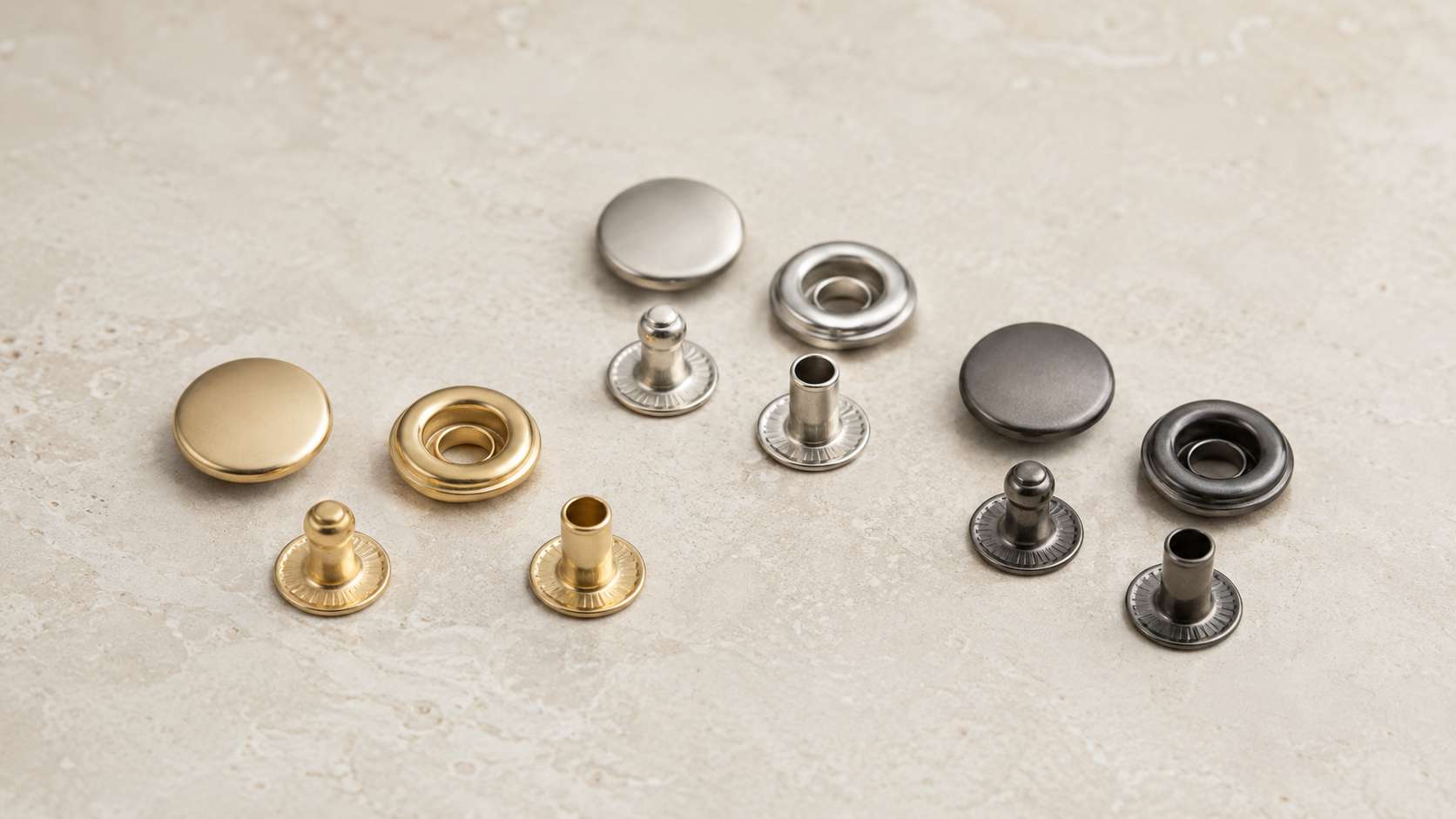
Baocheng / BC New Material supplies finished metal snap buttons and customized snap components for apparel, denim, children's clothing, leather goods, bags, workwear, outdoor products and other applications.
Customization can extend beyond the appearance of the cap. Depending on the project, development can consider socket construction, stud geometry, post dimensions, material selection, surface finish and the complete component combination.
Samples can be developed on the customer's actual fabric, denim, leather, coated textile, canvas or reinforced material structure. This allows the fastening action to be evaluated under the same installation thickness and substrate behavior expected in production.
For projects requiring stronger retention, the objective is not simply to increase opening force. The socket-and-stud geometry, substrate strength and reinforcement strategy are evaluated as one system.
For projects requiring very low magnetic response after forming, Baocheng can manufacture finished components from patented JSW20 ultra-low magnetic permeability stainless steel. JSW20 also provides chloride-corrosion resistance.
Where applicable to the project and certificate scope, material and finishing decisions can also consider REACH, RoHS, OEKO-TEX and nickel-release requirements.
Conclusion: A Secure Snap Is a Controlled Elastic Connection
The mechanical principle behind a snap button is straightforward, but reliable execution requires precision.
The stud enters the socket and creates controlled interference. The socket flexes, stores elastic energy and then recovers around the retaining portion of the stud. Opening reverses the process.
The quality of this connection depends on far more than whether the two parts can physically click together. Stud geometry, socket stiffness, material properties, surface condition, dimensional tolerance, installation quality, substrate strength and loading direction all influence the finished result.
The best snap is therefore not the one with the highest possible opening force. It is the snap whose retention is correctly matched to its application and remains consistent throughout production and repeated use.
For buyers, treating the socket and stud as a matched mechanical interface is the foundation for more reliable product development, fewer installation failures and more consistent fastening performance.
Focused FAQ
How does a snap button stay closed?
The stud forces the elastic retaining structure of the socket to deflect during engagement. After the widest part of the stud passes, the socket recovers around a narrower retaining area and mechanically holds the stud in position.
Is a snap button held together only by friction?
No. Friction influences the fastening feel, but the primary retention comes from geometric interference and elastic recovery of the socket around the stud.
What creates the click when a snap button closes?
The click occurs as the stud passes the maximum interference point and the socket rapidly recovers toward its retaining position.
Why can one snap feel tighter than another of the same size?
Visible size does not determine the complete engagement geometry. Differences in stud diameter, socket geometry, spring stiffness, finish, material and dimensional tolerance can all change opening and closing force.
Does a stronger snap always mean better quality?
No. Excessive opening force can damage the surrounding substrate. The correct force must balance secure retention with the strength and intended use of the finished product.
Why does a snap button become loose after repeated use?
Possible causes include socket deformation, component wear, excessive stress, incorrect stud/socket pairing or loosening of the installed hardware in the substrate.
Can installation change socket and stud performance?
Yes. Excessive pressure, wrong dies, misalignment or post deformation can distort the socket or change the orientation of the mating parts, even when the loose components were manufactured correctly.
How are heavy-duty snap buttons different?
Heavy-duty systems can use different component sizes, socket structures, stud geometries, materials or spring arrangements to provide greater resistance to separation. The surrounding substrate must also be strong enough to carry the increased load.
Can socket and stud components from different snap systems be mixed?
Compatibility should never be assumed. Small dimensional differences can produce excessive force, insufficient retention or complete failure to engage.
Can Baocheng customize snap opening and closing performance?
Baocheng / BC New Material can develop component combinations around the customer's application, actual substrate, socket-and-stud system, materials, post dimensions and required fastening behavior, followed by project-specific sampling.
Can JSW20 be used for low-magnetic snap components?
Yes. BC New Material can manufacture finished components from patented JSW20 ultra-low magnetic permeability stainless steel for projects requiring extremely low magnetic permeability after forming. JSW20 also provides chloride-corrosion resistance.
Does BC New Material sell raw JSW20 stainless steel?
No. BC New Material supplies finished products and customized components manufactured from JSW20 rather than raw JSW20 coils or sheets.
#SnapButton, #SnapFastener, #SocketAndStud, #SnapMechanism, #MetalSnaps, #MechanicalFasteners, #GarmentHardware, #SnapButtonDesign