







Eyelets for Corsets and Lace-Up Garments: Preventing Distortion and Pull-Out
Eyelets in a corset, lace-up bodice or adjustable garment form a load-transfer system. Tightening presses the lace against the inner rim and pulls the component toward the centre opening. Force then travels through the flange, barrel and optional washer into the textile stack.
A weak panel, oversized hole or poor installation can make the whole eyelet column ripple, twist or collapse toward the lacing gap. Individual parts may rotate, cut fibres, enlarge holes or pull through the garment.
Preventing failure requires coordination between metal and garment structure. A product listed as a grommet for fabric is not necessarily suitable for repeated corset tension. Buyers need dimensions, material, washer, stack, tooling and installed performance.
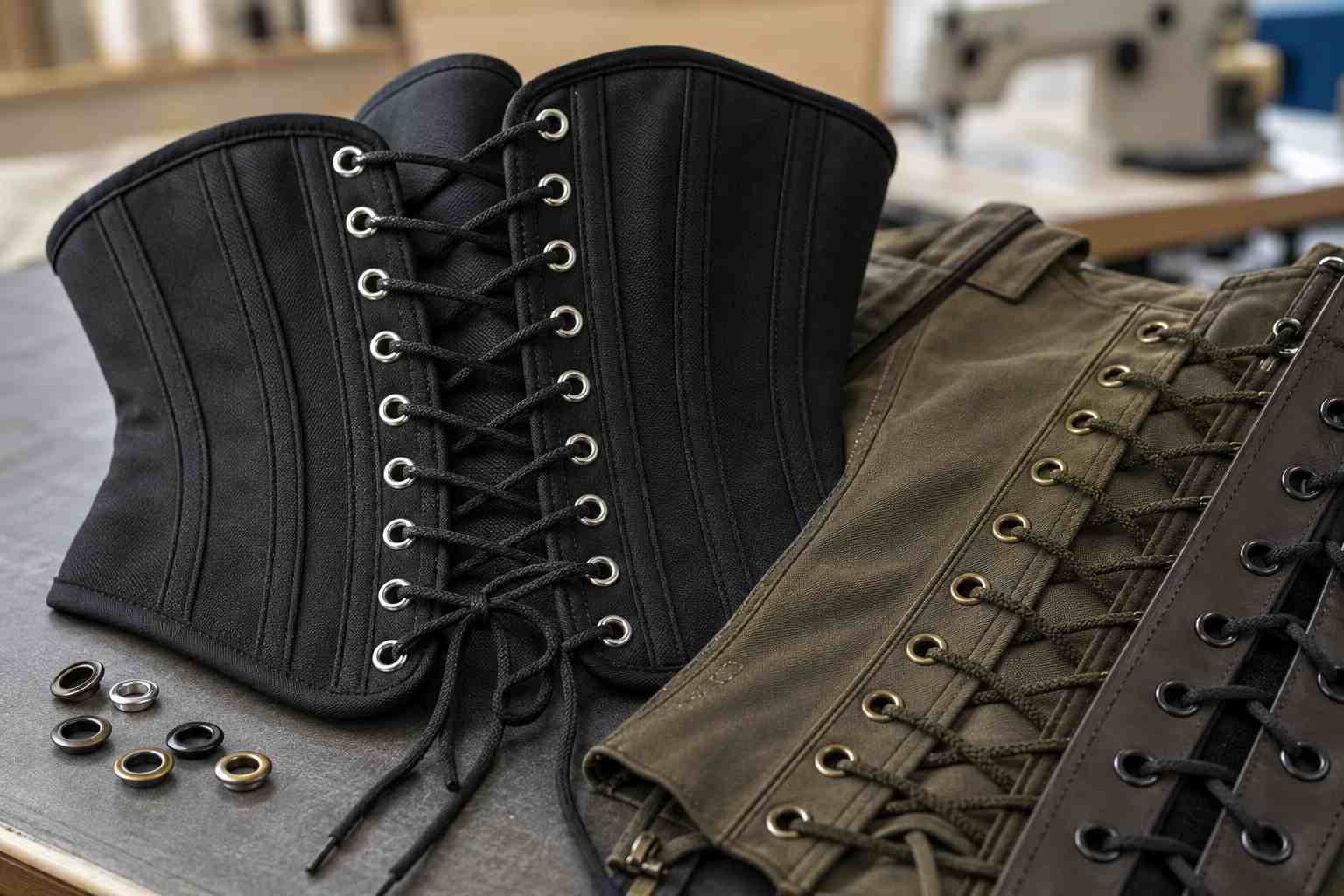
1. Understand the Direction of Force in a Lace-Up Panel
Unlike a decorative opening, a corset opening carries sustained directional load as lacing repeatedly draws two garment edges together.
The eyelet column can experience:
- Inward force toward the lacing gap
- Local pressure from the lace against the inner rim
- Bending when the body or garment moves
- Uneven peak loads during tightening
- Repeated loading and unloading during wear
- Moisture, sweat, abrasion and laundering
Force is rarely identical at every hole. The waist often carries more tension, while top and bottom openings are pulled at different angles. Tightening one position aggressively creates isolated peak loads.
A thicker metal part alone cannot prevent distortion. The row, reinforcement, structural support and lacing method must distribute force across a wider area.
2. Build a Stable Lacing Panel Before Selecting the Eyelet
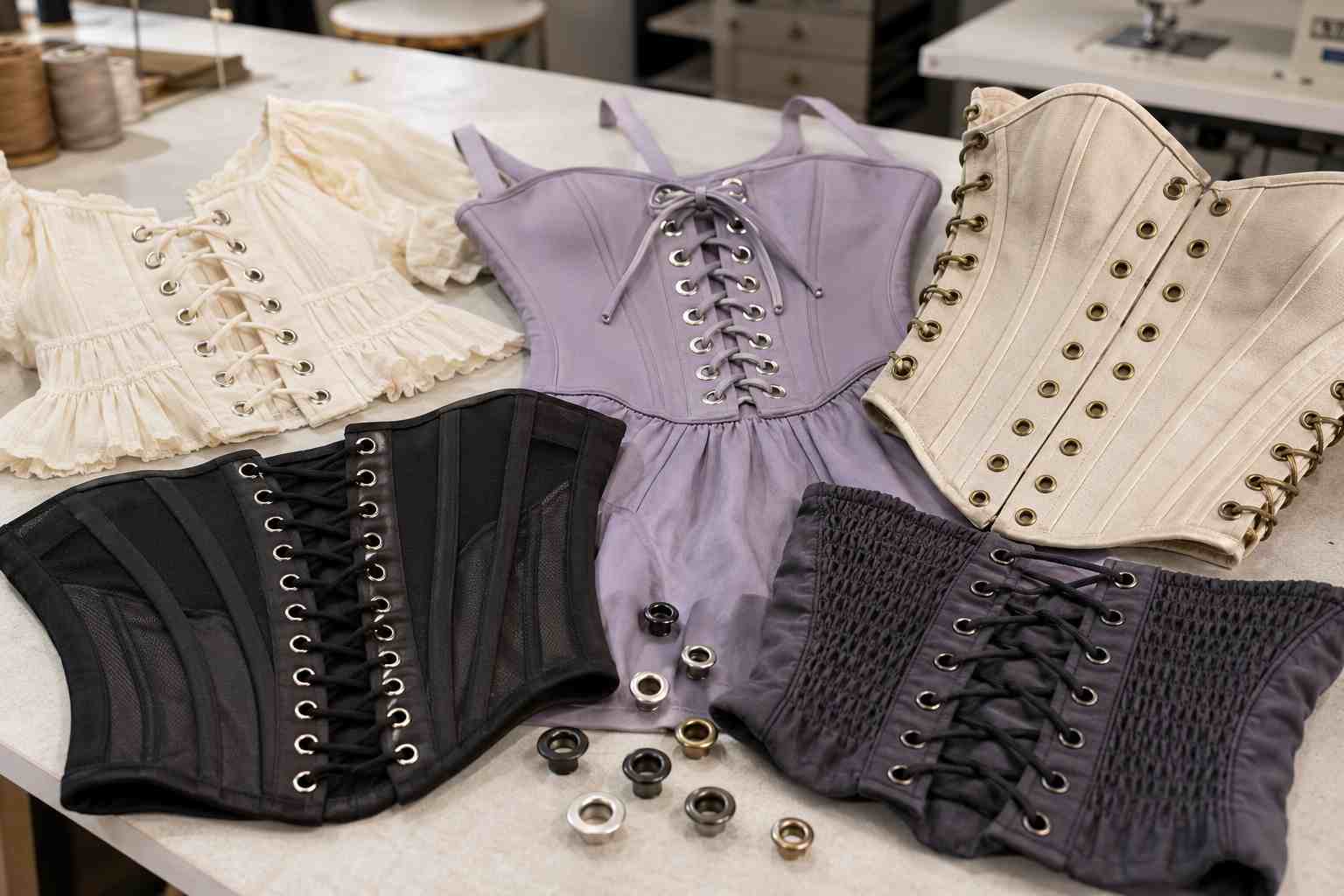
An eyelet cannot create missing textile strength. A high-tension corset normally needs a stable strength layer beneath the fashion fabric, potentially combined with lining, interfacing, waist reinforcement and local backing.
| Garment construction | Main risk | Practical development direction |
|---|---|---|
| Lightweight fashion top with loose lacing | Fraying and visible puckering | Local stable backing and moderate lace tension |
| Lace-up dress or bodice | Distortion across multiple seam panels | Reinforce the complete eyelet column, not isolated holes |
| Structured fashion corset | Column rippling and edge collapse | Stable strength layer plus vertical support near the openings |
| High-tension waist corset | Pull-out, hole growth and concentrated waist load | Engineered panel, washers, structural support and cyclic testing |
| Stretch garment with decorative adjustment | Elastic material creeping around rigid rings | Isolate the eyelet area from uncontrolled stretch |
High-tension constructions often use stiff vertical elements to stop the eyelet column folding like an accordion. Eyelets should not sit in an unsupported strip or directly over a bulky bone, seam allowance or hard edge.
Reinforcement should extend beyond the flange and washer. Individual patches create hard spots without stabilizing the full column; a continuous backing strip distributes load and improves alignment.
On transparent, satin or lightweight fabrics, backing must also avoid visible outlines, adhesive marks and colour show-through.
3. Choose the Opening From the Lace, Not the Catalogue Number
The finished ID must pass the production lace without excessive friction. Measure its thickest condition, including folded ribbon, doubled lace or ends that pass through the opening.
Too little clearance increases abrasion; too much lets the lace strike changing rim angles, exposes backing and looks unfinished.
| Lace-up application | Typical development starting ID | Main validation point |
|---|---|---|
| Fine decorative ribbon or narrow cord | 2.5–4 mm | Ribbon passes without folding damage |
| Fashion bodice or lace-up top | 3.5–5 mm | Smooth tightening with moderate tension |
| Structured corset with flat or round lace | 4–6 mm | Low friction and sufficient flange support |
| Heavy costume or outerwear lacing | 5–7 mm | Thick lace, glove handling and reinforced stack |
These are starting ranges, not universal standards. Some 3mm eyelets suit fine cord but are too small for doubled ribbon or high-friction flat lacing.
An eyelet sizing chart is useful only when it separates finished ID, flange OD, barrel OD and barrel length. Supplier numbers are not universal.
4. Balance Flange Diameter, Hole Size and Edge Distance
The front flange covers the textile edge and distributes load. A small flange looks refined but provides less bearing area; a large one spreads force but may interfere with neighbouring parts or overwhelm delicate fabric.
The prepared hole must suit the barrel. An oversized hole weakens retention; a small hole stretches fibres, puckers the panel and increases setting force.
Leave sufficient material between eyelet holes and garment edges. Tight spacing forms a perforation line, while excessive edge offset can distort the lacing gap or interfere with support.
Do not copy pitch from a photograph. Spacing depends on opening, flange, fabric, lace, curvature and tension. Any waist-area variation must remain symmetrical and compatible with the lacing method.
5. Decide Whether the Structure Needs a Washer
For high-tension panels, washer-backed construction is a sound starting point. It increases rear bearing area, supports the formed barrel and reduces pull-through risk.
A one-piece component may suit lower-tension lacing or an engineered panel, but pull and cyclic tests—not appearance alone—must demonstrate retention.
The washer must match the eyelet. Oversized washers may show through thin fabric; undersized or incompatible parts may not support the barrel. Thickness, hardness and hole diameter affect closure.
Products marketed as heavy duty eyelets are not automatically corset-ready. The term may mean large size, thick metal or outdoor use, without confirming close-pitch, body-contact or stack compatibility.
Rolled rims can provide a smooth lace-bearing edge. Split or spur-type rear geometry needs careful review near lining or skin.
6. Match Barrel Length to the Compressed Material Stack
Barrel length must suit every compressed layer: fashion fabric, strength layer, lining, interfacing, reinforcement and washer.
Measure a stack representative of installation. Soft layers and folds compress more than tightly woven support fabrics.
| Barrel condition | Likely result |
|---|---|
| Too short | Incomplete rear formation and weak washer engagement |
| Slightly short with excessive press force | Crushed fabric, bent flange or finish damage |
| Correct for stack | Secure rear form, flat flange and controlled opening |
| Too long | Collapsed barrel, sharp edge, rotation or loose rear roll |
| Variable stack across the row | Inconsistent retention and uneven appearance |
Confirm length with installed samples across minimum and maximum production thickness. Extra press force cannot correct the wrong barrel.
An uneven eyelet crimp indicates an off-centre part, washer, stack or die. Asymmetrical forming can create a pressure edge that eventually damages lace or fibres.
7. Select Metal and Finish for Forming, Friction and Wear
Material must form without cracking and remain strong after setting. Common choices are brass, plated steel and stainless steel.
A brass eyelet offers useful formability and decorative finishes. Plated steel is strong and economical but can corrode where plating is damaged. Stainless steel offers corrosion resistance, although grade, temper and forming response still matter.
Rough rims, uneven plating and coating buildup can abrade lace. Dark finishes may polish under rubbing, while brittle coatings can crack during forming.
Buyers should define:
- Approved colour and gloss sample
- Base metal and metal thickness
- Finish or plating system
- Inner-rim smoothness
- Wash, sweat, abrasion and corrosion requirements
- Applicable nickel-release or restricted-substance requirements
- Acceptable lot-to-lot colour variation
For projects with strict finished-component magnetic requirements, BaoCheng can manufacture custom eyelets from patented JSW20 ultra-low magnetic permeability special austenitic stainless steel. It is designed to retain very low magnetic response after stamping and forming. BaoCheng supplies finished JSW20 components, not raw sheet or coil.
8. Install With Matched Tooling and a Controlled Process
Buyers researching how to attach eyelets to fabric should begin with the production stack, matched parts and correct dies. Hammers, approximate pliers and universal dies lack the repeatability required for high-tension production.
A production eyelet press should support the flange while the lower die forms the barrel. Closing height, die profile and alignment control the result.
A controlled installation sequence is:
- Mark the eyelet row from an approved placement template.
- Reinforce the complete lacing panel.
- Prepare clean holes at the specified diameter.
- Confirm that seams, bones and allowances do not obstruct the dies.
- Insert the eyelet and matched washer in the correct direction.
- Set the component using documented machine parameters.
- Inspect the front, rear and finished opening.
- Check alignment and retention before continuing the full row.
Check first pieces before completing the row. First-piece approval is essential where seams or waist reinforcement change stack thickness.
9. Diagnose Distortion and Pull-Out by Failure Pattern
| Failure pattern | Likely causes | Corrective direction |
|---|---|---|
| Entire row ripples toward the gap | Weak panel, no vertical support or uneven lacing | Strengthen the complete column and review lacing load |
| One eyelet pulls out | Oversized hole, damaged fabric, weak local area or incomplete forming | Inspect hole preparation, reinforcement and rear form |
| Eyelet rotates | Long barrel, large hole, low closing height or stack variation | Correct component length and installation window |
| Fabric tears between eyelets | Pitch too close, weak grain direction or perforation effect | Increase material continuity and reinforce the full row |
| Flange sinks into fabric | Small flange, soft textile or excessive pressure | Review flange area, backing and machine setting |
| Lace frays quickly | Rough inner rim, burr, cracked finish or insufficient clearance | Improve edge quality and opening size |
| Lacing gap becomes uneven | Placement error, asymmetric tension or panel stretch | Control template, reinforcement and tightening sequence |
Damage location helps diagnosis. Waist failures suggest high local tension or weak reinforcement; first- or last-hole damage may indicate poor edge distance or outward pull.
Do not fit a larger eyelet into an enlarged damaged hole. It can hide broken fibres without restoring strength; evaluate the material and reinforcement first.
10. Approve the Installed System Through Relevant Testing
Test the production eyelet, washer, lace, fabric, reinforcement, dies and machine settings as one system.
A practical approval plan includes:
- Component and installed dimensional inspection
- Front and rear appearance assessment
- Eyelet rotation and sharp-edge checks
- Single-opening retention or pull-through evaluation
- Full-panel pull test in the intended lacing direction
- Repeated tightening and loosening cycles
- Bending and body-movement simulation
- Required laundering, sweat, abrasion and corrosion tests
- Post-test review of hole growth, panel distortion and finish loss
A strong individual eyelet can still sit in a weak row. Test the waist, row ends, seam-adjacent positions and production thickness limits.
Installed standards and boundary samples should define acceptable flange tilt, rear-form variation, colour difference and panel waviness.
11. Prepare a Complete RFQ for Custom Corset Eyelets
Brands, garment factories and wholesalers should provide:
- Garment type and intended lacing tension
- Eyelet placement drawing and row length
- Finished inner diameter, flange OD, barrel OD and barrel length
- Pitch, edge distance and quantity per garment
- Complete fabric and reinforcement stack
- Minimum and maximum compressed thickness
- One-piece or washer-backed requirement
- Base metal, thickness, colour and finish
- Lace or ribbon dimensions and construction
- Setting machine and die information
- Performance, wash and compliance requirements
- Sample quantity, order quantity and packaging method
For replacement parts, provide a drawing and physical sample; photographs cannot reveal barrel length, thickness, hardness or rear geometry.
Wholesalers should link each eyelet to its washer, dies, thickness range and drawing instead of selling unrelated colour items.
12. How BaoCheng Supports Lace-Up Garment Projects
JiaShan BaoCheng Clothing Accessories Co., Ltd. is a factory-trading integrated B2B supplier with in-house metal-stamping experience. BaoCheng can customize eyelet inner diameter, flange shape, barrel length, washer structure, material, colour and electroplating process for corsets, bodices, lace-up dresses, tops, costumes and other garments.
Development can begin from a drawing, physical reference sample or target application. BaoCheng can review the garment stack, lace size, placement and installation method, then prepare samples for testing on the customer’s actual material. Bulk production should begin only after the installed sample, drawing, colour and relevant performance tests are approved.
Depending on the product and project scope, supporting documents may include the JSW20 patent certificate, OEKO-TEX documentation, RoHS and REACH reports, Intertek reports and nickel-release test documentation. Applicability must be confirmed for the selected material, finish and product configuration.
Conclusion
Preventing eyelet distortion and pull-out begins with the lacing panel, not the press. The strength layer, vertical support, hole preparation, spacing, eyelet dimensions, washer, barrel length, metal, finish and tooling must work as one system. When that system is validated under repeated lacing load, corsets and lace-up garments can maintain a straight opening, smooth lace movement and reliable retention through production and wear.
Focused FAQ
1. Should every corset eyelet use a washer?
High-tension corsets often benefit from washer-backed construction because it increases rear bearing area. Lower-tension garments may use other structures after installed pull and cycle testing.
2. What eyelet opening is suitable for corset lacing?
A 4–6 mm finished ID is a useful development range for many structured corsets, but the actual lace thickness, end construction and required clearance must confirm it.
3. Why does an entire eyelet row become wavy?
Common causes include an unstable strength layer, missing vertical support, excessive tightening, inconsistent pitch or uneven material thickness across the row.
4. Can eyelets be installed directly into fashion fabric?
Only for genuinely low-load designs proven by testing. Functional corset lacing normally requires a stable strength layer and reinforcement around the complete column.
5. Why does one eyelet pull out while the others remain secure?
The local hole may be oversized, fibres may be damaged, reinforcement may be interrupted, or the rear form may be incomplete at that position.
6. Is a larger flange always stronger?
A larger flange can distribute load more widely, but it must fit the pitch, garment edge, washer and visual design. Installed system performance still requires testing.
7. Can extra press force correct a loose corset eyelet?
Not reliably. Excessive pressure may bend the flange, crush fabric or crack the finish. Correct the hole, barrel length, stack or tooling instead.
8. Why does corset lacing become frayed?
Likely causes include a burr, rough plating, cracked finish, sharp rear geometry, insufficient opening clearance or an unsuitable lace material.
9. Should eyelet spacing be closer at the waist?
Some designs vary spacing around the waist, but the pattern must remain symmetrical and retain enough fabric between holes. Validate it under realistic lacing tension.
10. What should buyers approve before bulk production?
Approve the drawing, installed sample, washer, rear form, lace movement, row alignment, pull and cycle results, finish, tooling settings and applicable documentation.
#Corset Eyelets, #Lace-Up Garments, #Garment Reinforcement, #Metal Eyelets, #Corsetry Hardware, #Fashion Hardware, #Apparel Sourcing, #Custom Eyelets, #Garment Manufacturing, #North America, #Europe, #United Kingdom, #Asia-Pacific
