







Eyelets for Shower Curtains: Corrosion, Sliding Wear and Wet-Environment Performance
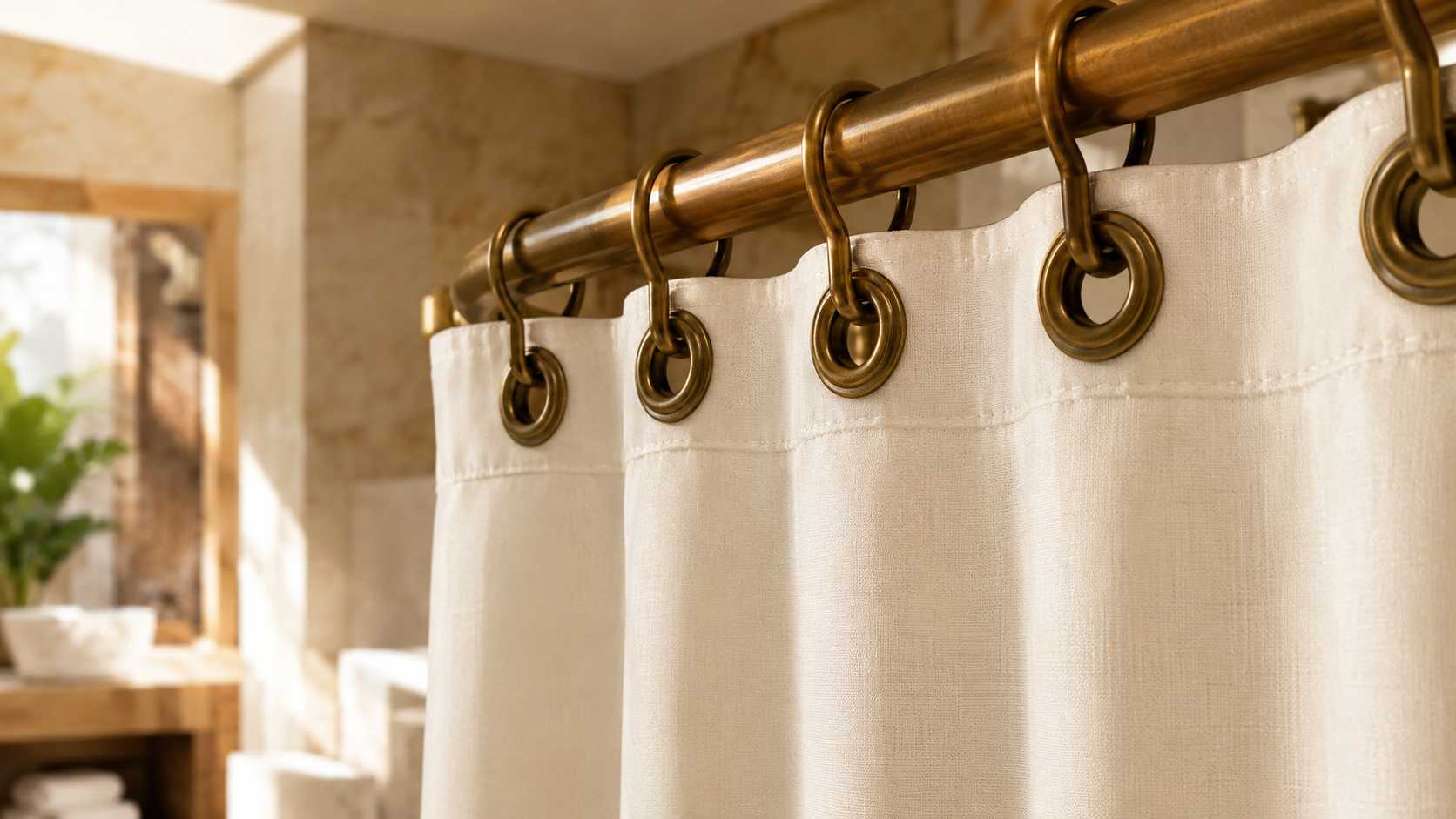
A Shower Curtain Is a More Aggressive Hardware Environment Than It Looks
A shower curtain does not operate outdoors, carry a heavy structural load or experience seawater. At first glance, its eyelets may therefore appear to have an easy job.
In reality, the top of a shower curtainis exposed to a repeated combination of humidity, condensation, water droplets, wet-dry cycles, bathroom cleaning chemicals and mechanical movement. Moisture can remain trapped between the eyelet flange and the curtain material long after the visible surface appears dry.
At the same time, each opening and closing cycle creates movement between the hardware components.
This makes shower curtain grommets a useful example of a small component whose performance depends on corrosion resistance and tribology at the same time.
The engineering question is not simply whether an eyelet can survive contact with water.
A better question is:
Can the complete installed eyelet retain its surface, geometry, smooth edge and fastening strength after repeated exposure to moisture, cleaners and mechanical movement?
First Identify Where the Sliding Wear Actually Occurs
Not every shower curtain uses the same hardware architecture, and this changes the wear mechanism substantially.
There are two common functional arrangements.
Eyelet plus shower curtain hook or ring
In this arrangement, the eyelet remains fixed in the curtain. A hook or ring passes through the eyelet, while the hook or ring itself travels along the shower rod.
The eyelet does not slide directly along the rod.
Instead, the hook rotates, rocks and rubs against the inner edge of the eyelet as the curtain is pulled.
The highest-wear location can therefore be a relatively small section of the eyelet inside diameter—often near the upper region where the hook carries the curtain weight.
Large eyelet directly on the rod
Some curtain constructions allow an oversized ring or grommet to run directly on the rod.
Here the wear interface is completely different. The lower inside circumference of the eyelet becomes a bearing surface supporting the curtain weight while simultaneously sliding along the rod.
Consequently, when specifying eyelets for shower curtains, the supplier should know whether the eyelet contacts a hook, a ring or the rod itself.
The same material and finish can behave very differently in those three interfaces.
Wet Corrosion and Sliding Wear Can Accelerate Each Other
Corrosion and wear should not be treated as independent problems.
A decorative finish may provide good protection when it is intact. Repeated rubbing at the eyelet ID can gradually polish, thin or locally remove that protective surface.
Once the base metal becomes exposed, moisture can reach the newly exposed region more easily.
Corrosion products then increase surface roughness.
The rougher surface creates more abrasion during subsequent movement.
The sequence can therefore become self-reinforcing:
sliding wear → coating damage → corrosion exposure → rougher surface → more sliding wear.
This is one reason wet-environment hardware should be evaluated after repeated movement rather than through corrosion testing alone.
Why Moisture Becomes Trapped Around an Installed Eyelet
The visible flange of a shower curtain eyelet often dries relatively quickly.
The interface beneath that flange is different.
Water can enter through capillary gaps between the metal and fabric, particularly where the curtain material flexes around the hardware.
If the curtain header contains multiple textile layers, moisture may remain around the punched hole for an extended period.
The backside rollover or washer can create another sheltered region.
These areas receive less air circulation than the exposed metal surface.
For some metals, this difference in oxygen availability changes local corrosion behavior and can make hidden interfaces more vulnerable than the polished visible flange.
A component that looks perfect from the front may therefore begin deteriorating underneath or around the backside first.
“Do Metal Grommets Rust?” Is Too Broad a Question
Buyers asking do metal grommets rust are really asking several different questions.
What is the base metal?
Is there a plating or coating?
Will the coating remain intact after setting?
What kind of water or cleaning chemicals will contact the part?
How long will the eyelet stay wet?
Will another metal hook repeatedly wear the inside surface?
Iron-containing hardware can develop conventional red corrosion if protective coatings are damaged.
Brass behaves differently. Stainless steel behaves differently again.
For meaningful B2B sourcing, “metal” is not a sufficient material specification.
Stainless Steel Is Corrosion Resistant, Not Corrosion Impossible
The question are stainless steel grommets rust proof should be answered carefully.
Stainless steel resists corrosion because a chromium-rich passive surface film develops on the alloy. If this film remains stable, the material can perform very well in humid environments without depending entirely on a decorative coating.
But “stainless” should not be interpreted as “cannot corrode.”
Possible causes of staining or localized attack include:
- chloride-containing cleaners;
- persistent deposits;
- metal contamination during manufacturing;
- poor cleaning after forming;
- crevice conditions around the installed flange;
- aggressive chemical exposure.
For many indoor shower applications, a properly processed stainless steel can provide a strong balance between appearance and corrosion resistance.
Where chloride exposure is more severe, material grade selection becomes more important.
304 and 316 Stainless Steel Should Be Selected by Environment, Not Prestige
304 stainless steel is widely used for general corrosion-resistant hardware and can be appropriate for many indoor wet environments when manufacturing and cleaning are properly controlled.
316 stainless steel contains molybdenum, giving it stronger resistance to certain chloride-driven localized corrosion mechanisms.
This does not mean every shower curtain automatically requires 316.
Using the highest-cost material regardless of actual exposure can unnecessarily increase product cost.
A more useful decision considers:
- normal residential or commercial humidity;
- cleaning frequency;
- cleaner chemistry;
- expected product life;
- appearance-retention requirement;
- regional water chemistry;
- project cost target.
Material grade should follow the actual risk rather than a simple “higher number is better” rule.
Stainless Steel Surface Condition Matters Almost as Much as the Grade
Even an appropriate alloy can perform poorly if the finished part carries contamination from production.
Stamping, forming and polishing tools can transfer iron-containing particles to stainless surfaces.
These contaminants may later oxidize and create visible rust-like staining even though the stainless substrate itself remains substantially intact.
For premium metal shower curtain grommets, manufacturing cleanliness is therefore part of corrosion control.
Edge condition is equally important.
A rough cut edge or badly formed rollover creates more surface area, retains contamination and provides a less controlled interface for water and cleaning chemicals.
Brass Does Not Form Red Rust, but It Can Still Corrode
Another common question is are brass grommets rust proof.
Brass does not form the same red iron oxide associated with carbon steel, because iron is not its primary constituent.
That does not mean brass is chemically inert.
Depending on alloy and environment, brass can tarnish, discolor or experience other forms of corrosion.
Cleaning chemistry is important because some aggressive compounds can attack copper alloys.
For decorative bathroom hardware, the engineering requirement may not be structural failure resistance alone. A relatively minor color change can already be unacceptable on a bright premium curtain.
Therefore appearance retention needs to be defined separately from basic functional integrity.
Solid Brass and Plated Brass Are Different Corrosion Systems
Solid brass grommets have brass as the base material throughout the component.
If the surface receives minor wear, the newly exposed material is still brass.
A plated product works differently.
Once the decorative or protective layer wears through, a different substrate becomes exposed.
This distinction becomes particularly important at the eyelet inner diameter because that is where shower rings or hooks can repeatedly rub.
For high-cycle applications, the buyer should therefore ask not only what the visible color is, but what lies underneath it.
Nickel-Plated Brass Can Provide Attractive Appearance—But the Wear Zone Still Matters
Nickel plated brass grommets can provide a bright or controlled metallic appearance and a different surface response from bare brass.
However, plating performance depends on:
- surface preparation;
- plating thickness and consistency;
- coverage at inner edges;
- forming after plating or before plating;
- adhesion;
- contact with the shower hook or ring.
The visible front flange may retain its finish for a long time while the inside opening experiences concentrated wear.
If product qualification evaluates only the flange, it can miss the part of the component that is actually working hardest.
Powder-Coated Hardware Has a Different Failure Mechanism
Powder coated grommets can provide strong color flexibility and an attractive decorative surface.
For wet-environment applications, however, the coating must be considered at the eyelet ID and formed edges—not only across the flat flange.
If a hard metal hook repeatedly contacts a coated internal edge, the coating can polish, chip or wear through.
If the base metal underneath is corrosion-sensitive, local exposure can lead to hidden rust formation that eventually spreads beyond the damaged area.
The setting operation can create another risk.
If coating is applied before a severe forming step, the finish needs enough flexibility to tolerate the resulting deformation.
Otherwise microcracking can occur at the rollover even before the curtain enters service.
Sliding Wear Depends on Contact Geometry, Not Just Material Hardness
Two identical metals can produce different wear simply because their contact geometry is different.
Consider a thin wire shower hook resting against a large eyelet.
The actual contact area may be very small.
Curtain weight is therefore concentrated over a narrow region of the eyelet ID.
A heavier curtain increases this local contact pressure.
If the hook has a rough seam or small burr, the pressure becomes even more damaging.
This is why a shower curtain eyelet should not be evaluated without considering the hook or ring that passes through it.
The Hook Can Damage the Eyelet Even When the Eyelet Is Correct
A high-quality eyelet cannot fully compensate for poor mating hardware.
Hook-related variables include:
- wire diameter;
- surface roughness;
- plating condition;
- open seams;
- sharp bends;
- material hardness;
- corrosion products already present on the hook.
A rough shower ring can rapidly wear a smooth plated eyelet.
If the hook itself corrodes, hard corrosion debris can act as an abrasive third body between the two surfaces.
Therefore accelerated wear testing should use the intended production hook or ring whenever possible.
Direct-on-Rod Grommets Have a Different Wear Pattern
When the eyelet itself runs directly along the curtain rod, most of the curtain weight is supported near the lower inner circumference.
Sliding repeatedly polishes this region.
The contact patch moves as the eyelet tilts, so wear may gradually become wider than a simple narrow line.
Clearance between rod and eyelet also changes the impact behavior.
A very loose metal eyelet can move vertically before striking the rod, producing both mechanical noise and repeated impact loading.
A tight system reduces impact but may increase continuous sliding friction.
For direct-on-rod systems, dimensional compatibility and wet-environment material selection must therefore be developed together.
Hard-Water Deposits Can Change the Sliding Interface
Water evaporating from bathroom hardware may leave mineral deposits.
These deposits can accumulate around edges, hooks and rings.
The result may be:
- higher sliding friction;
- rougher contact;
- visible white deposits;
- areas that retain moisture longer;
- more difficult cleaning.
A material can therefore remain chemically corrosion resistant while the complete hardware assembly becomes mechanically rougher over time.
This distinction matters when evaluating long-term customer experience.
Cleaning Chemicals May Be More Aggressive Than the Shower Water
Bathroom products are frequently cleaned with formulations designed to remove soap film, mineral deposits or biological contamination.
These chemicals can create a more demanding environment than normal water exposure.
Strong oxidizing or chloride-containing cleaners can be particularly relevant to stainless and plated systems, while acidic chemistry can also affect certain base metals and decorative finishes.
For B2B product validation, the correct question is therefore not simply “Is the eyelet waterproof?”
It is:
What cleaning chemistry is realistically expected in the target market, and how will repeated exposure affect both the base material and finish?
Why Marine-Test Language Should Not Be Used Carelessly for Bathroom Products
Terms such as saltwater resistant grommets describe a much more chloride-intensive exposure concept than most normal indoor shower curtains experience.
That type of performance can provide useful information when comparing materials, but a bathroom is not automatically a marine environment.
Specifying marine-level materials without understanding the actual use case can add unnecessary cost.
Conversely, a hotel, spa, pool-adjacent changing facility or highly chlorinated cleaning program may justify more demanding corrosion validation than a typical residential bathroom.
The correct approach is risk-based specification.
Corrosion Often Begins at the Areas Created During Setting
Incoming eyelets may look flawless before installation.
The setting operation changes the component.
The barrel can be expanded, rolled or compressed.
These high-strain regions are especially important for plated or coated parts.
Possible defects include:
- microcracks in plating;
- coating separation;
- split barrel edges;
- scratches from tooling;
- exposed base metal;
- rough backside edges.
Any exposed area can become a starting point for wet-environment degradation.
Corrosion qualification should therefore use fully installed samples rather than only loose components.
Backside Geometry Is Especially Important on Shower Curtains
The front flange is usually the decorative surface, but the backside may remain closer to wet fabric for longer periods.
If the rollover creates deep crevices, irregular splits or raised edges, these regions can hold water.
The backside should therefore be checked for:
- complete rollover;
- absence of cracks;
- smooth edge geometry;
- consistent height;
- no trapped loose coating;
- stable clamping of the curtain header.
A smooth backside is also important because repeated movement of wet fabric against a sharp edge can gradually damage the textile.
The Curtain Material Can Change the Moisture Exposure Around the Eyelet
Not every shower curtain retains water in the same way.
A relatively non-absorbent polymer sheet behaves differently from a woven textile curtain with a reinforced header.
A textile construction can retain moisture close to the eyelet interface for longer.
Multiple layers around the top hem can create additional capillary paths.
Therefore the same metal eyelet can experience different effective wet times depending on the curtain substrate.
This is another reason hardware testing should use the actual production material stack.
Hole Reinforcement Matters Even Though Shower Curtains Are Lightweight
A shower curtain generally weighs far less than heavy drapery, but the eyelet holes still experience repeated local loading.
Every time the curtain is pulled, the force is transferred through a relatively small number of hooks.
If one hook temporarily binds on the rod, load can become concentrated on one or two eyelets instead of being distributed evenly.
Wet textile can also behave differently from dry textile.
The eyelet therefore needs enough flange area and backside support to prevent progressive hole deformation.
Corrosion resistance alone is not sufficient if the hardware gradually pulls through the header.
Galvanic Contact Should Be Considered Where Different Metals Remain Wet Together
Shower curtain systems can combine stainless eyelets, plated steel hooks, brass components and different rod materials.
When dissimilar metals remain electrically connected in the presence of moisture, galvanic effects are theoretically possible.
Whether they become practically important depends on:
- specific metal pairing;
- area ratio;
- electrolyte conductivity;
- duration of wet contact;
- surface coatings.
For ordinary intermittently wet residential curtains, this may not dominate the design.
But in persistently wet or chemically aggressive installations, selecting compatible hardware materials can improve system robustness.
Do Not Use Salt-Spray Hours as a Direct Prediction of Bathroom Service Life
Accelerated corrosion testing can be useful for comparative screening, but test hours should not be translated directly into years of service.
A continuous salt environment does not reproduce the exact chemistry of a bathroom.
A better validation program combines material-level corrosion screening with application-specific cycling.
For example, manufacturers can evaluate:
- repeated wetting and drying;
- representative cleaning-agent exposure;
- humidity conditioning;
- opening and closing cycles;
- post-cycle appearance;
- post-cycle retention;
- inside-edge wear.
The purpose is to understand how the complete installed component deteriorates—not merely to achieve a large laboratory hour number.
A Strong Test Sequence Combines Corrosion and Movement
| Test Stage | What to Evaluate | Why It Matters |
|---|---|---|
| Initial inspection | Finish, burrs, ID, flange, rollover | Creates the baseline condition |
| Dry sliding cycles | Wear pattern and friction | Reveals purely mechanical weaknesses |
| Wet-dry conditioning | Staining, corrosion, trapped moisture behavior | Reproduces repeated bathroom exposure |
| Cleaner exposure | Finish stability and chemical sensitivity | Represents realistic maintenance |
| Additional sliding cycles | Wear after environmental degradation | Shows corrosion-wear interaction |
| Final retention check | Rotation, pull-through, rollover condition | Confirms structural integrity after aging |
This sequence is more informative than evaluating corrosion and wear on completely separate sample sets.
Inspect the Wear Track, Not Only the Overall Appearance
After cycling, the component should be examined specifically where contact occurred.
For hook systems, look at the upper internal edge.
For direct-on-rod systems, inspect the lower inside circumference.
Questions include:
- Has the finish become noticeably thinner?
- Is base metal visible?
- Has the edge become rough?
- Are corrosion products forming in the wear track?
- Has the opening become oval?
- Is the mating hook or rod also damaged?
The worst-performing region of the component may occupy only a few millimeters of the total surface.
Whole-part visual inspection can easily miss it.
Replacement Frequency Can Reveal the Original Design Problem
Demand for replacement components is not always caused by accidental damage.
Products described as replacement eyelets may be needed because the original system experienced:
- corrosion;
- finish wear;
- cracking;
- hook abrasion;
- poor retention;
- fabric tearing around the opening.
If a brand receives recurring replacement complaints, simply supplying a new ring may repeat the same failure.
The root cause should first be classified as material, finish, edge, setting or curtain-header related.
Material Selection Should Follow the Failure You Are Trying to Prevent
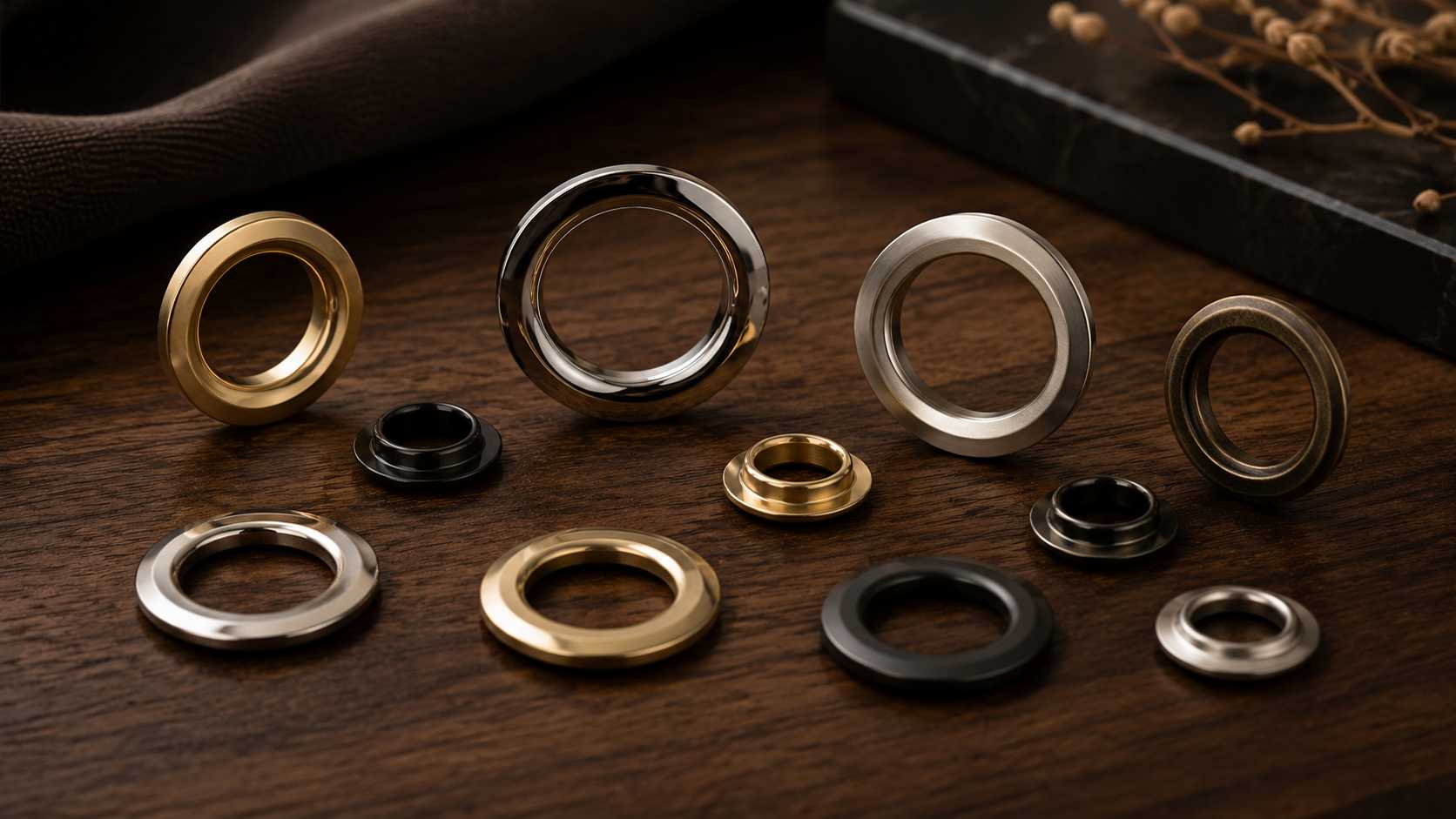
A useful B2B material decision can be summarized like this:
| Project Priority | Material / Finish Direction | Main Validation Focus |
|---|---|---|
| General indoor wet resistance | Suitable stainless steel or corrosion-controlled brass system | Wet-dry cycles and appearance retention |
| Bright decorative metallic finish | Plated brass or selected stainless finish | Plating adhesion and ID wear |
| High chloride exposure | More corrosion-resistant stainless option may be justified | Localized corrosion and cleaner exposure |
| Custom color | Coated metal system | Edge chipping and exposed substrate |
| High opening frequency | Durable base material and controlled inner edge | Wear track and mating-hook condition |
The best material is therefore the one that addresses the dominant failure mechanism at an acceptable project cost.
Incoming Material and Finished Component Must Both Be Controlled
Specifying a stainless grade or solid brass base is only one step.
Production consistency also depends on:
- material verification;
- stamping quality;
- edge deburring;
- forming consistency;
- surface preparation;
- plating or coating control;
- clean handling and packaging.
Two eyelets carrying the same commercial material description can behave differently if manufacturing quality is not equivalent.
For B2B Projects, the Finished Assembly Is the Real Product
A loose eyelet sitting in a sample tray does not reproduce the shower curtain environment.
The qualified assembly should include:
- production curtain material;
- real header thickness;
- production eyelet;
- production hook or ring;
- production rod where sliding compatibility matters;
- final surface finishes.
Only then can the buyer evaluate corrosion, wear, appearance and retention together.
What Information Should Be Included in a Shower Curtain Eyelet RFQ?
A useful RFQ should provide more than a photo and target color.
Recommended information includes:
- shower curtain construction;
- hole diameter;
- eyelet inside and outside dimensions;
- header thickness;
- hook, ring or direct-on-rod design;
- hook-wire diameter if relevant;
- base metal;
- surface finish;
- target appearance;
- wet-environment expectations;
- cleaning chemistry where known;
- expected opening frequency;
- annual volume;
- project compliance requirements.
This information allows the hardware supplier to evaluate both chemical and mechanical compatibility.
BC New Material's Approach to Custom Wet-Environment Eyelets
BC New Material supports customized metal eyelet and grommet components for B2B curtain, textile and accessory projects.
Available project materials can include stainless steel, brass, zinc alloy and other application-specific options, with dimensions and surface treatments developed around the finished product.
For shower curtain projects, useful development variables include inner-edge geometry, flange diameter, barrel length, washer or backside structure, base material and finish durability.
Where project requirements apply, documentation or testing support can also be coordinated for requirements such as RoHS, REACH, OEKO-TEX, Intertek or nickel-release-related evaluation according to the selected material and surface system.
Wet-Environment Performance Is Determined at the Interface
The most important lesson from shower curtain hardware is that corrosion resistance cannot be judged from the front surface alone.
The real product operates at several hidden interfaces:
between the eyelet and wet fabric;
between the eyelet ID and shower hook;
between coating and base metal;
between the backside rollover and the curtain header.
A premium-looking flange can coexist with a worn inner edge. A stainless component can still stain if contaminated or exposed to aggressive chemistry. Brass can avoid red rust while still tarnishing. A decorative coating can resist humidity yet fail mechanically where the hook repeatedly rubs.
That is why successful wet-environment design requires corrosion and wear to be developed together.
Select the material according to the actual water and cleaner environment. Identify the true sliding interface. Control internal edges. Inspect the component after setting. Combine wet-dry conditioning with repeated movement. Evaluate both the eyelet and its mating hook or rod.
When these details are resolved before mass production, shower curtain eyelets can retain smooth movement, clean appearance and stable attachment far more reliably throughout the intended service life.
Focused FAQ
1. Do shower curtain eyelets need to be stainless steel?
Not necessarily. Stainless steel can provide strong corrosion resistance, but brass and properly engineered plated or coated systems may also be suitable. The choice should reflect cleaning chemistry, humidity, appearance, wear and cost.
2. Can stainless steel shower curtain grommets rust?
Stainless steel is corrosion resistant rather than absolutely immune. Chlorides, contamination, persistent deposits and crevice conditions can still produce staining or localized corrosion under unfavorable conditions.
3. Is 316 stainless steel always better than 304 for shower curtains?
316 provides improved resistance to some chloride-related corrosion mechanisms, but many normal indoor applications may not require it. Material should be selected according to actual exposure and cost targets.
4. Do brass shower curtain eyelets rust?
Brass does not develop conventional iron-based red rust, but it can tarnish, discolor or corrode depending on alloy, moisture and cleaning chemicals.
5. Why does the finish disappear first inside the eyelet?
The inner opening is often the primary contact zone for a shower hook or ring. Repeated localized rubbing can wear the decorative or protective finish faster than the visible front flange.
6. Are powder-coated eyelets suitable for shower curtains?
They can be, but coating durability should be tested at inner edges and formed areas. Chipping or wear can expose a corrosion-sensitive base metal even when the visible flange remains intact.
7. Should shower curtain hardware be salt-spray tested?
Accelerated corrosion testing can help compare systems, but salt-spray hours should not be treated as a direct prediction of bathroom service life. Wet-dry, cleaner and sliding tests provide important application-specific information.
8. Why should testing use the actual shower hook?
Hook wire diameter, roughness, hardness and plating directly affect contact pressure and wear at the eyelet ID. A different hook can produce a completely different wear rate.
9. Can trapped water under the flange cause corrosion?
Yes. Moisture can remain in capillary gaps around the punched hole and backside structure after visible surfaces dry, creating a more persistent local exposure condition.
10. What should a buyer specify for custom shower curtain eyelets?
Provide the curtain material and thickness, eyelet dimensions, hook or rod interface, base metal, finish, expected cleaning environment, desired appearance, opening frequency, quantity and any project-specific testing requirements.
#ShowerCurtainEyelets, #ShowerCurtainGrommets, #MetalEyelets, #WetEnvironmentHardware, #CurtainHardware, #CorrosionResistance, #StainlessSteelGrommets, #DraperyHardware
