





Custom Snap Buttons Explained: Logo, Shape, Size, Color, Material and Finish Options
Custom Snap Buttons Are More Than Standard Snaps With a Logo
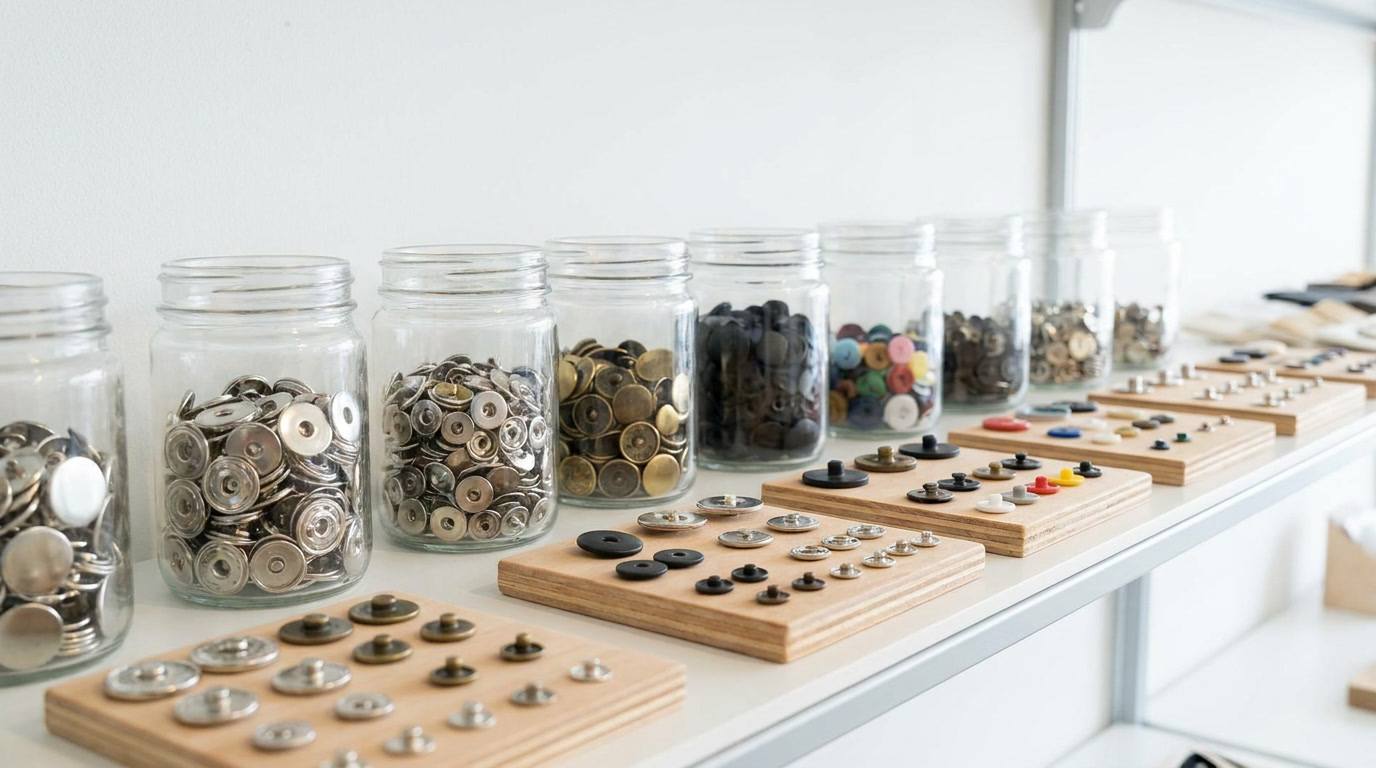
When buyers ask for custom snap buttons, the first request is often a logo or special color. In reality, customization can extend much further. The visible cap can be changed in shape, diameter, profile, color and branding, while the functional socket, stud and post can also be engineered around fabric thickness, closing force, environmental exposure and installation requirements.
This means there are two very different levels of customization. The first is cosmetic customization: keeping an established snap mechanism while changing the cap appearance, logo or finish. The second is functional customization: modifying dimensions, spring structure, post length, material or mating geometry so that the snap performs differently.
For most B2B projects, the most efficient solution is not to redesign every component. Instead, the buyer and manufacturer should identify which characteristics genuinely need to change and preserve proven standard geometry wherever possible. This reduces tooling cost, development time and production risk.
This guide explains the main customization options for metal snap buttons, including logo, shape, size, structure, color, material, finish and functional performance.
Start by Deciding What Actually Needs to Be Customized
Before requesting samples, divide the specification into three groups:
- Brand-critical features: logo, cap shape, visible diameter, color and finish.
- Application-critical features: post length, socket/stud structure, holding force, material and corrosion performance.
- Flexible features: internal dimensions or manufacturing details that the supplier can optimize without changing the final appearance or performance.
This distinction prevents unnecessary tooling. If the customer only needs a branded cap, an existing socket, stud and post system may remain unchanged. If the substrate is unusually thick or the product requires a special opening force, deeper engineering changes may be justified.
Logo Option 1: Embossed Branding
An embossed logo is raised above the surrounding cap surface. It creates a strong three-dimensional appearance and is commonly used when the button itself is intended to become part of the brand identity.
Embossing is usually formed through dedicated cap tooling. The logo depth, line width, cap curvature and metal thickness must be considered together. Fine artwork that looks clear on a computer screen may lose definition when formed into metal.
Embossed logos are well suited to denim, jackets, bags, workwear and other products where the hardware is visually prominent.
Logo Option 2: Debossed Branding
A debossed logo sits below the main cap surface. This produces a more restrained appearance and can be attractive for premium fashion and leather goods.
Because the logo is recessed, some areas may be less exposed to direct abrasion. However, very narrow recessed features can be difficult to polish or finish consistently, so the final artwork should be reviewed with the tooling manufacturer before production.
Logo Option 3: Laser Marking or Engraving
Laser processing can add logos, text, codes or fine graphic details to an existing cap without changing the complete cap-forming tool. This can reduce tooling requirements for smaller or more flexible branding programs.
The final effect depends on base material and surface finish. A laser mark on natural stainless steel looks different from a laser mark on black, gold or plated surfaces. Sample approval should therefore be carried out on the final finished cap rather than on raw metal.
Logo Artwork Should Be Designed for Metal Forming
For embossed and debossed logos, vector artwork is normally preferable. Buyers should provide:
- AI, EPS, SVG or other vector artwork;
- logo orientation;
- target diameter;
- minimum acceptable line width;
- raised or recessed preference;
- centered or directional positioning;
- reference photos where relevant.
A manufacturer may recommend simplifying extremely fine elements so that the logo remains clear after stamping, polishing and final finishing.
Cap Shape Can Change the Character of the Product
The visible cap does not have to be perfectly flat or conventionally domed. Cap profiles can include:
- flat caps;
- low-domed caps;
- high-domed caps;
- ring-shaped decorative caps;
- recessed center designs;
- stepped profiles;
- custom geometric faces;
- decorative pearl-style caps.
Buyers researching what is a dome fastener often encounter the term as another regional or commercial description for press fasteners, but “dome” can also describe the visible curved cap profile in hardware discussions. In a custom project, the actual cap curvature should be defined with a drawing rather than relying only on terminology.
Cap Shape Affects More Than Appearance
A deeper cap may require different forming operations and can change the internal space available for the mating post. A very flat cap may reveal small setting marks more clearly. Highly polished convex caps reflect light differently from matte flat caps.
Cap shape can also affect logo readability. A large flat logo may work well on a low-profile cap but become visually distorted when transferred to a highly curved surface.
For this reason, custom cap development should evaluate the logo, cap geometry and surface finish as one design system.
Pearl and Decorative Caps Require a Different Customization Approach
Decorative apparel often uses caps that imitate pearl, resin or other ornamental surfaces. pearl snap buttons for western shirts are a familiar example where the visible decorative element is a major part of the garment design rather than simply a functional closure.
For this type of project, the buyer should specify not only size and color but also:
- surface pattern;
- degree of translucency;
- color variation tolerance;
- rim appearance;
- metal backing color;
- impact resistance;
- compatibility with the internal snap system.
Decorative caps should still be evaluated for mechanical attachment because appearance cannot compensate for weak setting performance.
Snap Button Size Should Be Selected Around Proportion and Performance
Visible cap diameter affects the visual balance of a garment or bag, but it also affects bearing area and available internal geometry.
Small caps generally suit lightweight and compact products. Larger caps provide a stronger visual presence and can distribute installation pressure over a wider area. However, a larger cap does not automatically create a stronger closure.
Retention force is primarily controlled by the socket, stud and spring geometry. Buyers should therefore specify both visible cap size and required functional behavior.
Commercial Size Names Need Technical Confirmation
Terms such as Line 20 and Line 24 are widely used in leatherwork and heavy-duty snap applications, but buyers should still confirm actual dimensions with the supplier.
line 20 snaps for leather wallets can provide a useful commercial reference for compact leather closures, but the exact cap diameter, post length and socket/stud geometry should be verified before assuming compatibility between manufacturers.
Similarly, line 24 snaps for leather belts are commonly associated with larger, heavier-duty leather fastening applications. The name helps narrow the product category, but the final technical drawing should control procurement.
Custom Size Does Not Always Require a Completely New Snap System
If a buyer wants a different visible cap diameter, it may be possible to keep an existing functional socket and stud system and modify only the cap. This is often more economical than redesigning all four components.
A complete new structure is more likely to be required when:
- the post diameter changes substantially;
- the socket retention mechanism changes;
- the stud profile changes;
- the required load is outside the existing system range;
- the substrate is unusually thick or thin;
- the product requires a highly unusual cap-to-post relationship.
Structure Customization: Prong Snaps vs Post-Style Snaps
Not all snaps are installed using the same attachment principle. Traditional post-style snaps use a tubular or rivet-like post that passes through the substrate and is deformed during setting. Prong snaps use multiple metal teeth that penetrate and fold around the textile.
prong snap buttons for baby garments illustrate why structure selection should be linked to substrate and product safety. Lightweight children's textiles may require different attachment geometry from heavy denim or leather.
The buyer should validate attachment security, substrate damage and applicable product requirements rather than selecting a snap structure solely by appearance.
Gripper Snaps Provide Another Lightweight-Garment Structure
gripper snaps for baby clothing are commonly associated with light apparel where compact snap structures and efficient installation are desirable. When customizing this type of product, the design must consider fabric weight, reinforcement, prong penetration and pull-off resistance.
Logo and color customization can still be applied to lightweight snap systems, but functional geometry should not be compromised to achieve a purely decorative cap design.
Post Length Is One of the Most Important Custom Dimensions
Custom snap projects frequently require an adjusted post length rather than an entirely new snap mechanism.
The correct post must pass through the complete substrate while leaving enough metal for controlled setting deformation. A post that is too short can create insufficient attachment. A post that is too long can buckle, tilt or over-compress the material.
When requesting a custom post, provide:
- substrate type;
- total uncompressed thickness;
- compressed thickness where available;
- number of layers;
- reinforcement materials;
- installation equipment;
- approved sample or target post geometry.
Bag Closures Often Need Both Cosmetic and Functional Customization
snap buttons for bag closures may be highly visible while also carrying repeated mechanical loads. This creates a typical dual requirement: the cap must match the brand identity, while the internal snap must remain secure through frequent opening.
Bag projects may require custom logo caps, special colors, thicker posts, larger bearing surfaces or stronger socket retention. Leather, synthetic leather, woven fabric, lining and reinforcement boards can also create complex material stacks.
The best development process therefore uses the real bag construction rather than testing the snap on a single flat fabric layer.
Puffer Jackets Require Attention to Compressible Material Stacks
snap buttons for puffer jackets may pass through shell fabric, insulation, lining and reinforcement areas. These materials can compress dramatically under installation pressure.
A post chosen from the uncompressed jacket thickness may therefore be far too long. Customization should focus on the actual installation zone and may require reinforcement to prevent the snap from pulling through soft textile layers.
Cap design must also account for surface sensitivity because thin shell fabrics can show pressure marks more easily than heavy denim.
Technical Textiles May Require Performance-Led Customization
snap buttons for technical textiles are often selected for coated fabrics, protective covers, industrial textiles and engineered fabric assemblies where performance is more important than fashion appearance.
Customization can involve:
- post length for thick laminates;
- larger support surfaces;
- corrosion-resistant materials;
- low-magnetic materials;
- specific holding force;
- surface treatments compatible with chemical exposure;
- special mounting geometry.
In these projects, a standard decorative catalog snap may not provide the required environmental or mechanical performance.
Material Option 1: Brass
Brass remains an important snap-button material because of its good formability, relatively low magnetic response and compatibility with many decorative finishes.
It can be useful for fashion hardware, leather goods and applications where extensive forming is required. However, copper-based material cost can influence large-volume programs, and final corrosion requirements should still be evaluated according to the environment and surface treatment.
Material Option 2: 304 Stainless Steel
304 stainless steel provides good general corrosion resistance and is widely used in metal hardware. It can be suitable for many apparel, bag and outdoor applications.
Where magnetic response after heavy forming is important, buyers should evaluate the finished component because some austenitic stainless steels can become more magnetic after substantial cold work.
Material Option 3: 316 Stainless Steel
316 stainless steel is frequently considered for more demanding chloride-containing environments. It is particularly relevant when corrosion exposure is a major design factor.
For marine and coastal projects, the complete snap system should still be evaluated because material combinations, crevices, trapped salt and installation damage can influence long-term performance.
Material Option 4: JSW20 Ultra-Low Magnetic Permeability Stainless Steel
JSW20 is a patented austenitic stainless steel developed to maintain ultra-low magnetic permeability after substantial forming while providing good formability and chloride-corrosion resistance.
Available reference values include relative magnetic permeability around μr 1.001, yield strength Rp0.2 ≥350 MPa, tensile strength Rm ≥650 MPa and A50 elongation ≥40%. Within the referenced cold-deformation range, the material retains extremely low magnetic response.
This makes JSW20 particularly relevant when custom snap buttons must combine:
- needle-detection-sensitive production;
- complex stamped geometry;
- stainless-steel construction;
- chloride-corrosion resistance;
- low magnetic response after forming.
Final garment-level needle detection should still be validated because detector performance depends on component mass, quantity, geometry, orientation, other hardware and machine sensitivity.
Baocheng supplies finished snap buttons and customized components manufactured from JSW20 rather than raw JSW20 sheet or coil.
Material Option 5: Zinc Alloy
Zinc alloy can provide greater freedom for complex decorative shapes, especially when the visible cap contains detailed three-dimensional geometry that would be difficult to achieve by conventional sheet-metal drawing.
However, environmental durability relies heavily on the surface-protection system. For wet or corrosive applications, the complete finish specification should be validated rather than judging the product only by initial appearance.
Color Customization Starts With a Physical Standard
Common snap-button color directions include:
- natural stainless;
- bright nickel;
- matte nickel;
- black nickel;
- gunmetal;
- gold;
- rose gold;
- antique brass;
- antique copper;
- bronze;
- matte black;
- painted or coated custom colors.
Color names alone are not precise specifications. “Gunmetal,” “antique brass” or “rose gold” can vary substantially between suppliers.
For brand-critical projects, use a physical approved sample or another controlled reference and define acceptable variation before mass production.
Polished, Matte, Brushed and Antique Finishes Create Different Visual Effects
Color and finish should be treated separately. Two black snaps can look completely different when one is highly polished and the other is matte.
Common surface appearances include:
- mirror polished;
- bright polished;
- satin;
- matte;
- brushed;
- antique;
- textured;
- PVD-style metallic finishes;
- painted or coated finishes.
The underlying polishing process affects how the final coating looks, so the approved finish should be evaluated after the complete production sequence.
Finish Selection Should Include Environmental Performance
A decorative finish is also part of the protection system. Buyers should specify whether the snap will experience:
- repeated washing;
- perspiration;
- high humidity;
- outdoor rain;
- chloride exposure;
- cleaning chemicals;
- abrasion;
- frequent hand contact.
A beautiful sample that has not been tested under the intended environment may not represent long-term production performance.
Coating Thickness Can Affect Snap Function
The socket and stud are precision mating components. Plating or coating adds thickness to their contact surfaces, which can change closing and release force.
For projects requiring tightly controlled operating force, functional testing should be performed after the final finish is applied.
This is particularly important when switching from one finish to another. A natural stainless prototype and a thick decorative plated production part may not behave identically even when the base geometry is unchanged.
Custom Color Should Be Approved on the Final Base Material
The same coating can look different on brass, stainless steel and zinc alloy because the substrate, polishing process and underlayers influence reflectivity and tone.
When a project allows several materials, approve the color on the material that will actually enter mass production.
Custom Holding Force Is Possible Without Changing the Visible Cap
Buyers sometimes assume that changing snap strength requires changing the complete appearance. In many systems, retention force can be adjusted through the socket spring, stud geometry or component dimensions while preserving the same cap.
This is useful when a brand wants the same visual hardware across several products but different operating forces for shirts, jackets and bags.
The buyer should still test the final combination because increasing retention force also increases the opening load transferred into the substrate.
Do Not Specify “Maximum Strength” Unless the Product Really Needs It
More holding force is not automatically better. A snap that is extremely difficult to open can damage light fabrics, create user frustration and accelerate pull-out failure.
Custom performance should aim for an appropriate operating range:
- secure enough to prevent accidental opening;
- low enough to protect the substrate;
- consistent across production;
- stable after repeated cycles.
Custom Tooling Determines What Is Economically Possible
Customization involving logo, cap profile, component dimensions or internal geometry may require new tooling.
Before approving the project, clarify:
- which tools need to be created;
- one-time tooling charges;
- sample tooling versus production tooling;
- tool ownership;
- tool retention period;
- expected service life;
- cost of future design changes.
A design that requires several new component dies is naturally more expensive than a custom logo cap using an existing internal snap system.
MOQ Depends on the Depth of Customization
Minor customization may use existing tooling and therefore support relatively modest production quantities. Deep customization can require new stamping tools, special raw material, dedicated plating and exclusive packaging.
MOQ should therefore be discussed after the basic design direction is clear.
Buyers should also confirm whether the MOQ applies per:
- logo;
- size;
- material;
- finish;
- color;
- complete four-part set.
Sample Development Should Follow a Controlled Sequence
A practical custom-snap development process is:
- Confirm application and substrate.
- Define visible cap dimensions.
- Select a proven internal snap system where possible.
- Confirm post length.
- Select material.
- Develop logo and cap tooling.
- Approve raw-form geometry.
- Apply final surface finish.
- Install samples on real substrate.
- Test closing, release and attachment performance.
- Perform environmental testing where required.
- Approve final physical sample for production.
This sequence helps separate geometry problems from finishing problems and reduces unnecessary tooling changes later.
A Practical Custom Snap Button Specification
| Specification Area | Example Requirement |
|---|---|
| Application | Premium leather handbag closure |
| Cap diameter | 15 mm |
| Cap shape | Low dome |
| Logo | Debossed center logo |
| Socket / stud | Existing medium-retention system |
| Post length | Supplier to determine using actual material stack |
| Material | 304 stainless or JSW20 option for evaluation |
| Color | Dark gunmetal |
| Finish | Satin |
| Performance | Defined closing, release and pull-out range |
| Testing | Cycle and corrosion verification |
| Packaging | Lot-labelled components |
How Baocheng Supports Custom Snap Button Development
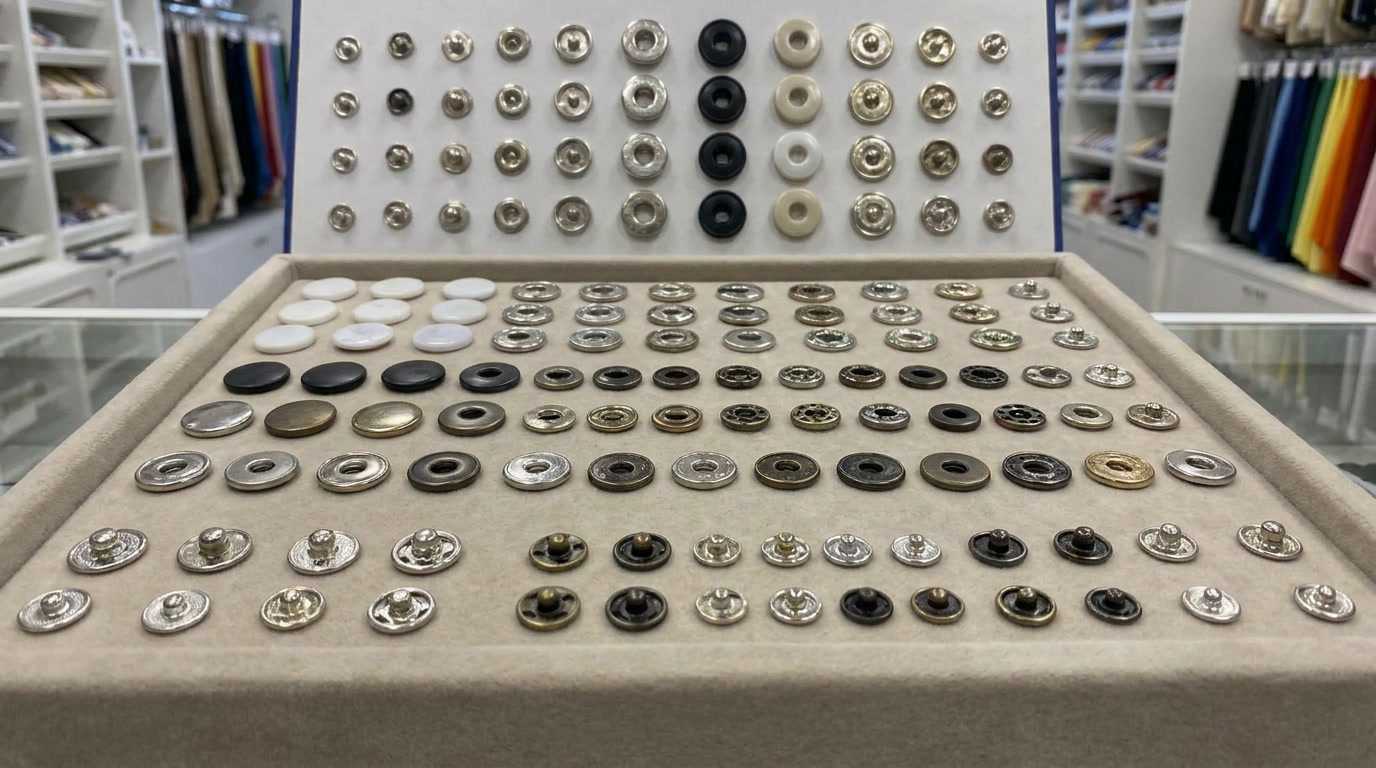
Baocheng can support projects ranging from simple cap-logo customization to more complete snap-system development. The objective is to customize the characteristics that matter to the final product while retaining proven structures wherever possible.
Customization options can include:
- cap diameter;
- cap profile and shape;
- embossed or debossed logos;
- laser marking;
- socket and stud structure;
- post length;
- spring geometry;
- holding force;
- 304 or 316 stainless steel;
- JSW20 ultra-low magnetic permeability stainless steel;
- brass;
- zinc alloy;
- decorative colors;
- surface finishes;
- matched installation tooling;
- sampling and OEM production.
Representative fabric, leather, coated textile or multilayer samples can be used during development to confirm post length and installation geometry. This is especially important when the custom appearance is combined with demanding mechanical or environmental requirements.
Buyer Checklist for Custom Snap Buttons
- What product will use the snap?
- Which characteristics must be visually customized?
- Can the existing internal snap mechanism remain standard?
- What cap diameter is required?
- What cap shape is required?
- Is the logo embossed, debossed or laser marked?
- What material will the snap pass through?
- What is the compressed material thickness?
- Is a special post length required?
- What closing and release force is appropriate?
- Which base metal best fits the application?
- Does the project require ultra-low magnetic response?
- Will the snap encounter chlorides, washing or outdoor exposure?
- What exact color reference will be used?
- Should the finish be polished, matte, satin, brushed or antique?
- Does the coating need functional testing after finishing?
- What custom tooling is required?
- What is the MOQ per size, logo and color?
- Will samples be installed on the real substrate?
- What tests must be passed before mass production?
Conclusion
Custom snap buttons can be personalized far beyond a simple logo. Cap shape, diameter, structural system, post length, spring behavior, material, color and surface finish can all be adjusted to fit a specific product.
The most efficient development strategy is to separate cosmetic customization from functional customization. If only the visible identity needs to change, retaining a proven internal snap structure reduces cost and development risk. If fabric thickness, holding force, environmental exposure or magnetic requirements are unusual, deeper engineering changes become justified.
Material selection should also be made before the final finish is approved. Brass, 304, 316, JSW20 and zinc alloy each offer different advantages, and the chosen substrate affects forming, corrosion, magnetic response and decorative finishing.
Successful customization therefore depends on treating the snap as a complete fastening system. Logo, appearance and color attract attention, but post length, mating geometry and environmental performance determine whether the finished snap will continue working after installation and repeated use.
Focused FAQ
Can I customize only the snap button cap without changing the socket and stud?
Yes. In many projects, the visible cap can be customized in diameter, logo, profile or finish while an existing proven socket, stud and post system remains unchanged. This is often the most economical route.
Do custom logo snap buttons always require new tooling?
Embossed, debossed and new cap shapes commonly require dedicated tooling. Laser marking may allow an existing standard cap to be customized with less tooling, depending on the required appearance.
Can snap button holding force be customized?
Yes. Holding and release behavior can be adjusted through socket spring geometry, stud profile and dimensional relationships. The final force should be validated on the real product rather than maximized automatically.
Can the same custom color be applied to different materials?
Similar colors can be developed on different substrates, but the final appearance can vary because brass, stainless steel and zinc alloy interact differently with polishing, underlayers and coatings. Approve color on the actual production material.
Which material is suitable when low magnetic response is important?
JSW20 is particularly relevant when the project requires ultra-low magnetic permeability after forming together with stainless-steel formability and chloride-corrosion resistance. Final needle-detection performance should still be validated on the finished product.
Can Baocheng develop both appearance and functional customization?
Yes. Baocheng can coordinate cap shape, logo, size, post length, socket/stud structure, holding force, material, color, surface finish, tooling and sample development according to the final application.