






Curtain Eyelets for Hotels, Coastal Homes and Outdoor Spaces
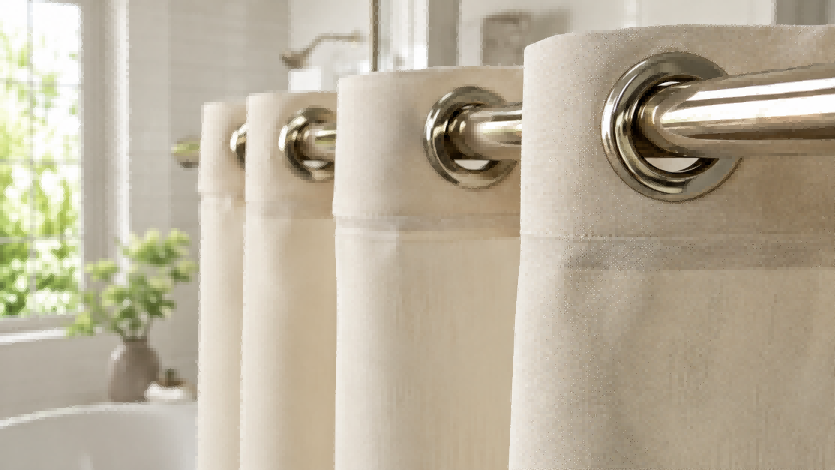 The Same Curtain Eyelet Can Perform Very Differently in Three Buildings
A metal curtain eyelet that performs perfectly in a dry residential bedroom may behave very differently when installed in a hotel suite, a coastal villa or an outdoor gazebo.
The component may look identical, but the environment around it has changed.
In a hotel, the dominant stresses may be repeated opening and closing, commercial cleaning, frequent room turnover and strict appearance consistency across hundreds of curtains.
In a coastal residence, airborne chlorides, condensation, humid air and periods of limited ventilation can become the more important risks.
In an outdoor space, the hardware can additionally encounter direct rain, temperature changes, wind-driven movement, airborne dirt and repeated loading of the curtain header.
This is why curtain eyelets should not be specified only by diameter and finish color.
The correct specification begins with the service environment.
For B2B buyers sourcing wholesale curtain grommets, the goal is not simply to find one universal ring that can be used everywhere. The goal is to create a controlled product family in which base material, surface treatment, geometry and setting method match each level of exposure.
Hotels Are Primarily a Repetition and Consistency Problem
Hotel curtain hardware is not necessarily exposed to the most chemically aggressive environment, but it often experiences far more repeated use than an ordinary residential curtain.
A guest may open and close blackout curtains several times during a stay. Housekeeping may move them again during room cleaning. Across a large property, this operation is repeated over hundreds of rooms.
As a result, small differences that are almost irrelevant in one bedroom can become significant at hotel scale.
The hotel buyer should consider:
- sliding wear at the eyelet ID;
- surface scratching from curtain rods;
- noise during opening and closing;
- eyelet rotation in the header;
- finish consistency between batches;
- replacement compatibility several years later;
- cleaning-agent exposure;
- appearance under repeated room lighting.
For hospitality programs, repeatability is itself a performance requirement.
Hotel Hardware Must Remain Visually Consistent Across Hundreds of Rooms
One slightly different metallic tone may be difficult to notice on a single curtain sample.
Install the same hardware across 300 rooms and the situation changes.
The eyelets are repeated in straight rows, often beside rods, handles, lamps and other metal decorative elements. Differences in gloss, color or plating can become visible to interior designers and hotel operators.
Manufacturers therefore need to control:
- base-material consistency;
- surface preparation;
- plating or finishing batches;
- flange profile;
- inside and outside diameter;
- setting height;
- front-to-back concentricity.
The premium character of hotel hardware comes as much from repetition and consistency as from the nominal material itself.
Replacement Strategy Should Be Considered Before the Hotel Opens
Hospitality products may remain in service for years.
Eventually some curtains will be damaged, renovated or replaced individually.
This makes curtain eyelet rings replacement a purchasing issue rather than merely a repair topic.
If the original component uses a proprietary size, color or backside structure that cannot be reproduced later, maintenance becomes more difficult.
For long hospitality programs, the brand should therefore retain:
- approved eyelet drawings;
- color masters;
- finish specifications;
- material designation;
- setting-die information;
- installed dimensions.
A replacement part needs to match not only visible color but also curtain-hole size, flange diameter, header thickness and curtain-rod clearance.
Coastal Homes Introduce a Different Risk: Chloride Is Everywhere Without Looking Dramatic
A curtain in a coastal home may remain completely indoors, yet the hardware can still face a more demanding corrosion environment than a curtain hundreds of kilometers inland.
Salt-containing aerosols can enter through open doors and windows. Moisture can condense on cooler surfaces. Air-conditioning can create repeated humidity changes.
The metal hardware may therefore experience thin electrolyte films rather than obvious water immersion.
This kind of exposure is important because corrosion does not require the eyelet to be visibly wet for hours.
Fine deposits combined with intermittent humidity can create localized surface conditions that gradually change appearance.
“Marine Grade” Should Trigger a Specification Question, Not End the Discussion
Buyers may search for marine grade grommets when planning coastal projects.
The phrase communicates an understandable intention: the hardware should tolerate a chloride-rich environment.
However, “marine grade” should not replace an exact engineering specification.
The buyer should still ask:
- What is the actual alloy?
- Is it 304, 316 or another metal?
- What surface condition is used?
- Is the term describing the base material or only a finish?
- What corrosion environment was considered?
For stainless steel projects, 316 is generally more resistant than 304 to certain chloride-driven localized corrosion mechanisms because of its molybdenum content.
That can make 316 attractive for demanding coastal conditions.
But material selection should still consider indoor exposure severity, cost and product life rather than using a marketing description alone.
Marine Hardware Provides Useful Lessons for Coastal Curtain Design
Products such as marine canvas grommets operate in much more aggressive environments than ordinary indoor curtains, but the design principles are relevant.
Marine applications emphasize:
- base-metal corrosion resistance;
- clean edges;
- good flange support;
- resistance to repeated wetting;
- compatible mating hardware;
- stable installation in flexible materials.
A coastal curtain does not automatically require the same hardware used on a boat cover.
However, marine-product thinking helps identify where ordinary decorative curtain specifications may become insufficient.
304 and 316 Stainless Steel Should Not Be Treated as Interchangeable Names
Both 304 and 316 stainless steels are widely used austenitic stainless grades.
For standard indoor hospitality curtains, 304 can provide a strong combination of corrosion resistance, appearance and cost when the environment is moderate.
For more chloride-intensive coastal exposure, 316 may provide an additional safety margin against localized corrosion.
But corrosion performance also depends on surface condition.
A poorly processed 316 part can still show contamination or staining, while a well-manufactured 304 component in a mild indoor environment may perform very well.
Therefore material grade and production cleanliness need to be specified together.
Brass and Stainless Steel Create Different Aging Characteristics
The question brass grommets vs stainless steel grommets is particularly relevant to premium curtains because both materials can support high-end hardware designs.
Stainless steel offers a modern metallic character and strong corrosion resistance when the grade matches the environment.
Brass offers excellent formability and a naturally warm metallic base that can suit luxury hotel and residential interiors.
However, the two materials age differently.
Stainless steel can remain visually stable for a long time when its passive surface is maintained.
Brass may gradually change tone or develop patina depending on its surface protection and environment.
This is not always a defect. Some interior concepts intentionally prefer aged brass character.
The important point is that the expected appearance after years of service should be specified, not only the appearance of the first sample.
Solid Brass Makes Surface Wear Less Visually Disruptive Than Some Plated Systems
With solid brass eyelets, the material exposed beneath a small scratch is still brass.
This differs from a thin decorative finish over a base metal of another color.
In high-use hotel curtains, repeated sliding or contact can eventually polish the inside edge of the eyelet.
A solid material construction can therefore create a different aging pattern from a plated product.
However, solid brass still needs appropriate evaluation for tarnish, cleaning chemistry and the desired long-term color.
Outdoor Curtains Add Mechanical Exposure to the Corrosion Problem
Outdoor privacy curtains, poolside curtains, patio curtains and gazebo curtains are not simply indoor drapery moved outside.
Once the product is exposed to weather, the curtain header becomes part of a flexible structure that responds to wind.
The eyelet may experience repeated:
- tilting;
- rotation;
- side loading;
- fabric pull;
- impact against rods or hooks;
- wet-dry cycling.
This means corrosion resistance alone is insufficient.
The eyelet must also remain mechanically stable in the curtain material.
Outdoor Shade Products Show Why Substrate Strength Matters
The same principle can be seen in shade cloth with grommets.
The metal component may remain completely intact while the textile around the hole elongates or tears.
That occurs because the complete joint is only as strong as the interaction between:
- eyelet flange;
- backside support;
- hole size;
- fabric reinforcement;
- edge distance;
- load direction.
Outdoor curtain design should therefore never assume that a stronger metal automatically creates a stronger curtain.
Awnings Provide an Important Wind-Load Comparison
Awning grommets are often installed in textiles that experience tension and changing environmental loads.
Although a decorative outdoor curtain is normally less permanently tensioned than an awning, wind can temporarily load the eyelet in a similar direction.
If the curtain catches a gust, the hardware can pull laterally rather than simply carrying vertical curtain weight.
This changes the stress around the hole.
For outdoor curtain projects, the designer should consider whether the curtain is:
- free hanging;
- tied back;
- fixed at the bottom;
- guided by a cable;
- frequently exposed to strong wind.
Those details can determine whether a standard decorative eyelet is sufficient.
Canopy Hardware Shows Why Backside Support Cannot Be Ignored
Canopy grommets often use stronger reinforcement than indoor decorative curtains because the substrate can experience repeated pulling.
Outdoor curtains do not always need the same heavy construction, but the principle remains useful.
If the eyelet flange is large and attractive on the front but the backside support is too small, the fabric can still deform around the opening.
A washer or broader backside structure may be useful when:
- the textile is relatively soft;
- the curtain is heavy;
- wind loading is significant;
- the hole is close to a seam or edge;
- the product will remain outdoors for long periods.
Canvas-Type Outdoor Textiles Need the Eyelet and Fabric to Be Designed Together
Searches for stainless steel grommets for canvas highlight an important principle that also applies to outdoor curtains.
Dense outdoor textiles can support robust hardware, but they can also contain coatings, multiple layers and stiff reinforcement.
These materials require the correct barrel length and setting geometry.
If the barrel is too short, the backside rollover cannot form securely.
If it is too long, the excess metal may buckle or split during setting.
The exact compressed textile stack should therefore be evaluated before selecting the final component.
Rainwater Is Not the Only Environmental Variable Outdoors
Outdoor curtain hardware may experience:
- rain;
- condensation;
- irrigation spray;
- pool chemicals;
- airborne salts;
- dust and sand;
- cleaning agents;
- large temperature changes.
In a sheltered gazebo, direct rainfall may be limited while humidity remains high.
In a coastal patio, airborne salt can be more damaging than occasional rain.
Near a swimming pool, cleaning and chemical splash conditions can differ again.
“Outdoor” should therefore not be treated as one standardized corrosion environment.
Ultraviolet Exposure Usually Attacks the Curtain Before It Attacks Bare Metal
Most common metals are not degraded by ultraviolet radiation in the way polymers and textile coatings can be.
However, UV can still indirectly influence the eyelet assembly.
Outdoor fabric coatings, synthetic leather layers, polymer washers or decorative paints may age and lose flexibility.
As the substrate becomes harder or more brittle, the stress distribution around the metal eyelet changes.
The hardware may still be mechanically sound while the curtain begins cracking around it.
This is another reason complete-product weathering is more informative than testing the loose eyelet alone.
Wind Converts a Decorative Opening into a Repeatedly Loaded Fastening Point
Indoor curtains usually see predictable vertical loading from gravity and sliding force from the user.
Outdoor curtains can see load from many directions.
A gust can push the curtain outward and generate leverage at the top eyelet.
The curtain then falls back and loads the hardware again.
Thousands of relatively small cycles can gradually enlarge the hole even without a dramatic one-time failure.
For this reason, outdoor testing should include cyclic movement rather than only a single static pull test.
The Indoor/Outdoor Boundary Is Often More Important Than the Product Name
A hotel may contain curtain hardware in:
- guestrooms;
- bathrooms;
- pool areas;
- open-air restaurants;
- covered terraces;
- spa areas;
- beach cabanas.
All may be ordered under the same hospitality project.
Yet they should not automatically use the same material specification.
A practical sourcing program can divide the project into environmental classes.
| Application Zone | Typical Main Risk | Hardware Focus |
|---|---|---|
| Indoor hotel room | High-cycle operation and appearance consistency | Wear, noise, finish uniformity, replacement consistency |
| Hotel bathroom / spa | Humidity and cleaning chemistry | Corrosion resistance and finish durability |
| Coastal indoor residence | Airborne chloride and condensation | Material grade and hidden-surface corrosion |
| Covered outdoor terrace | Humidity, occasional rain and wind | Corrosion plus mechanical retention |
| Fully exposed outdoor curtain | Rain, wind, contamination and wet-dry cycling | Material, reinforcement, backside support and cyclic testing |
Do Not Specify Corrosion Performance Only from the Visible Flange
The front flange is usually polished, plated or carefully finished because it is the part the customer sees.
However, corrosion can begin at less visible locations:
- inside the eyelet opening;
- under the flange;
- around the backside rollover;
- where the setting tool has scratched the surface;
- where water remains trapped against fabric.
Coastal and outdoor curtains should therefore be inspected from both sides after environmental testing.
Surface Finish Should Be Selected According to How the Curtain Will Age
Luxury projects often need a specific hardware appearance such as bright silver, matte silver, black, gunmetal, gold, warm brass or antique tones.
Every finish creates a different aging pattern.
A bright finish may reveal small scratches more clearly.
A dark coating may show a lighter base metal if the inside edge wears through.
An antique brass appearance may tolerate gradual tone variation better than a perfectly uniform mirror finish.
The best finish is therefore not simply the finish that looks most attractive on an unused sample.
It is the one whose long-term appearance matches the design intention.
Hotel Cleaning Programs Can Be More Important Than Normal Humidity
Commercial housekeeping introduces a factor that ordinary residential sampling often misses.
Hardware near windows, bathrooms or outdoor-access areas may be wiped repeatedly with cleaning products.
Surface treatments should therefore be evaluated against the cleaning chemistry expected in the project.
A finish that resists normal humidity may still discolor or lose gloss after repeated contact with an unsuitable cleaner.
For large hotel programs, even a small finish change can create visible room-to-room inconsistency.
Coastal Deposits Should Be Removed Rather Than Allowed to Accumulate
Corrosion-resistant materials perform best when surfaces remain clean.
Coastal airborne deposits can accumulate gradually on curtain hardware, especially on horizontal or sheltered surfaces.
Maintenance instructions can therefore become part of product performance.
Regular cleaning with an appropriate method can reduce deposit buildup and help preserve the surface.
This is particularly relevant to outdoor and semi-outdoor hospitality projects where environmental deposits are continuous.
Corrosion Testing Should Match the Environment Being Simulated
There is value in accelerated corrosion tests, but a test should answer a specific engineering question.
A highly aggressive salt test can compare material systems, yet it should not automatically be interpreted as an exact prediction of service years in a coastal hotel room.
For hospitality and outdoor curtain hardware, useful validation can combine:
- humidity exposure;
- wet-dry cycling;
- chloride exposure where relevant;
- cleaning-agent exposure;
- sliding or movement cycles;
- post-test visual inspection;
- retention checks.
This reveals how environmental aging and mechanical use interact.
Wear and Corrosion Can Reinforce Each Other
The inside of the eyelet often experiences repeated contact with a rod, hook or ring.
If the decorative finish is gradually worn through, the base material becomes more directly exposed to the environment.
If corrosion then roughens the exposed area, subsequent sliding becomes more abrasive.
The process can accelerate:
wear → finish loss → environmental exposure → roughening → more wear.
High-cycle hotel curtains and coastal curtains should therefore not be evaluated by corrosion and wear testing as completely separate topics.
Outdoor Curtains Need a Stronger Header, Not Merely Stronger Hardware
A heavy-duty metal eyelet installed in a weak curtain header simply transfers the failure into the textile.
For wind-exposed projects, manufacturers should consider:
- reinforcement tape;
- additional textile layers;
- local patches around the eyelet;
- larger flanges;
- backside washers;
- greater edge distance;
- appropriate hole spacing.
The hardware and fabric need to fail as a system—or preferably remain comfortably above the expected service load together.
Product Geometry Still Matters After the Correct Material Has Been Chosen
Selecting 316 stainless steel does not correct an oversized punched hole.
Using solid brass does not correct an eyelet barrel that is too short.
A premium finish does not correct a sharp backside rollover.
For hotel, coastal and outdoor curtain projects, the critical dimensions include:
- inside diameter;
- flange outside diameter;
- barrel outside diameter;
- barrel length;
- washer dimensions where applicable;
- finished installed height.
These dimensions need to match the actual curtain construction.
Why Baocheng Treats Curtain Eyelets as Application-Specific Finished Components
For curtain projects, Baocheng / BC New Material does not approach the eyelet simply as a generic metal ring.
We can develop finished curtain eyelets and grommets according to the customer's specific environment, fabric, curtain rod and appearance requirements.
For hotel projects, the focus can be placed on finish consistency, high-volume dimensional repeatability, smooth inner edges and replacement continuity.
For coastal homes, the development focus can move toward corrosion-resistant materials, surface cleanliness and long-term appearance in humid chloride-containing air.
For outdoor curtains, gazebos, awnings and similar products, the eyelet geometry can be developed together with fabric thickness, backside reinforcement and expected mechanical loading.
Baocheng Can Customize Curtain Eyelets in Multiple Materials

Depending on the project, available material options can include:
- 304 stainless steel for many general indoor and moderate wet-environment applications;
- 316 stainless steel when stronger resistance to certain chloride-related corrosion risks is required;
- brass for premium decorative appearance and good forming characteristics;
- zinc alloy for selected decorative or structural designs where the component geometry and project requirements suit this material;
- JSW20 patented ultra-low-magnetic-permeability austenitic stainless steel for specialized projects requiring extremely low magnetic response after forming.
JSW20 Is Baocheng's Key Differentiated Stainless-Steel Option
JSW20 is a proprietary patented austenitic stainless-steel material developed by Baocheng for applications where conventional stainless steel may show an undesirable increase in magnetic response after cold working and forming.
For an eyelet, this distinction is important because the component is not used in the same condition as a flat raw sheet.
The material is stamped, drawn, flared and set. These forming steps can change magnetic behavior in conventional stainless materials.
JSW20 is designed to maintain an extremely low magnetic permeability and near-nonmagnetic response after forming, making it valuable for specialized finished hardware where magnetic sensitivity matters.
Potential projects can include curtain or textile hardware used near magnetic-sensitive inspection systems, specialized electronics, controlled industrial environments or other applications with strict magnetic-permeability requirements.
JSW20 should not be confused with a corrosion-grade designation.
For a coastal project, chloride resistance and ultra-low magnetic permeability are separate engineering requirements.
If a customer needs both, the complete environment and performance specification should be evaluated rather than simply replacing a 316 requirement with a low-magnetic requirement.
Baocheng supplies finished and customized components manufactured from JSW20; we do not sell raw JSW20 coil material.
Color and Surface Appearance Can Be Customized Around the Interior or Exterior Design
Curtain hardware is highly visible, so Baocheng can develop multiple colors and surface effects according to project requirements and the selected base material.
Possible visual directions can include:
- bright silver;
- satin or matte silver;
- black;
- gunmetal;
- gold;
- warm brass tones;
- antique effects;
- other project-specific color references.
The feasible finish should always be confirmed together with the base material, forming process and target environment.
For coastal and outdoor products, decorative color cannot be evaluated independently from corrosion and wear resistance.
Baocheng Can Customize More Than the Color
For a B2B curtain project, customization can include:
- finished inside diameter according to the curtain rod;
- flange outside diameter;
- barrel length according to the complete fabric stack;
- barrel diameter and hole fit;
- washer or backside construction;
- front profile;
- metal thickness;
- base material;
- surface finish and color;
- setting-tool compatibility.
Actual curtain material, reinforcement tape and rod samples can be used during development to reduce the risk of selecting a component only from nominal catalog dimensions.
Sampling Should Reproduce the Finished Curtain, Not a Single Fabric Scrap
A reliable sample should include the same material stack expected in production.
For hotel blackout curtains, this may include face fabric, lining and reinforcement.
For outdoor curtains, it may include coated textile and local reinforcement.
The eyelet should then be installed using the intended setting method.
Evaluation can include:
- front and backside appearance;
- eyelet rotation;
- pull-through resistance;
- inner-edge smoothness;
- rod compatibility;
- sliding wear;
- wet-environment performance where required.
Large Hospitality Orders Need Lot-to-Lot Control
A hotel may initially approve several perfect samples, yet the commercial project can require tens of thousands of eyelets.
Production control should therefore monitor the variables most likely to drift:
- material lot;
- component dimensions;
- finish tone;
- gloss;
- inside-edge quality;
- setting-tool wear;
- installed appearance.
This is particularly important when the same curtain design is installed in multiple buildings or delivered over several construction phases.
Outdoor Projects Need Environmental and Mechanical Testing Together
For exposed curtains, checking only whether the metal shows rust after humidity exposure is incomplete.
A more realistic test sequence can include:
- initial dimensional and visual inspection;
- setting the eyelet into production-equivalent fabric;
- cyclic movement or loading;
- wet-dry exposure;
- chloride exposure where relevant;
- additional movement;
- final pull-through and visual inspection.
This helps reveal failures that occur only when environmental aging weakens the textile or wear damages the metal surface.
When an Awning or Outdoor Shade Specification Can Inform Curtain Hardware
Lessons from awning grommets, canopy grommets and other outdoor textile hardware can be useful when an outdoor curtain experiences meaningful wind loading.
The hardware itself may not need to be as heavy as an industrial cover fitting, but the design principles remain relevant:
- do not place the hole too close to the edge;
- distribute load through a suitable flange;
- use backside support when the substrate requires it;
- match barrel length to the actual material stack;
- evaluate cyclic loading rather than only one static pull.
What Should a Hotel, Coastal or Outdoor Curtain RFQ Include?
For a useful B2B quotation and engineering review, provide:
- application environment;
- indoor, semi-outdoor or fully outdoor classification;
- distance or exposure to coastal conditions where relevant;
- curtain material;
- complete header thickness;
- finished curtain weight;
- rod diameter;
- eyelet inside diameter;
- flange diameter;
- required backside structure;
- base material preference;
- finish and color;
- expected cleaning conditions;
- expected opening frequency;
- project quantity;
- testing or compliance requirements.
Material Selection Should Follow the Environment, Not a Universal Ranking
There is no single hierarchy in which one curtain-eyelet material is always the best.
A high-volume hotel room may prioritize consistent finish, smooth sliding and reliable replacement supply.
A coastal residence may prioritize resistance to chloride-containing humidity.
An exposed outdoor curtain may prioritize corrosion resistance, structural retention and repeated wind loading.
A specialized magnetic-sensitive project may prioritize the ultra-low magnetic permeability of JSW20.
The correct choice is therefore the material and geometry that solve the actual failure risks without adding unnecessary cost.
The Best Curtain Eyelet Is Designed for Where the Curtain Will Spend Its Life
A curtain eyelet may be only a small part of a large hospitality or architectural project, but its repeated visibility makes failure difficult to hide.
Corrosion marks, finish wear, loose rings and uneven replacements can all reduce the perceived quality of the complete curtain.
For hotels, focus on repetition, wear, appearance consistency and long-term replacement.
For coastal homes, focus on material grade, deposits, humidity and chloride exposure.
For outdoor spaces, add wind, wet-dry cycling, substrate reinforcement and multidirectional loading to the specification.
Then select the correct material—304, 316, brass, zinc alloy or a specialized option such as Baocheng's patented JSW20 ultra-low-magnetic-permeability stainless steel—according to the actual performance requirement.
When material, finish, geometry, curtain construction and environment are developed together, the eyelet becomes a controlled part of the curtain system rather than a decorative component whose real durability is discovered only after installation.
Focused FAQ
1. Are hotel curtain eyelets different from ordinary residential curtain eyelets?
They can use similar geometry, but hotel projects often require much stronger control of cycle wear, finish consistency, cleaning resistance, batch repeatability and long-term replacement compatibility.
2. Is 316 stainless steel always required for coastal curtain eyelets?
No. 316 offers improved resistance to some chloride-related localized corrosion mechanisms, but the correct grade depends on actual coastal exposure, humidity, cleaning conditions, required life and project cost.
3. What does marine grade mean for a curtain grommet?
The term indicates an intention for demanding corrosion resistance but is not sufficiently precise by itself. Buyers should specify the actual alloy, finish and expected exposure conditions.
4. Is brass suitable for luxury hotel curtains?
Yes. Brass offers excellent decorative potential and forming characteristics. The finish and expected long-term color change should be matched to the interior design and cleaning environment.
5. Why are outdoor curtain eyelets more likely to pull out?
Wind can load the eyelet from changing directions and repeatedly deform the curtain header. Hole diameter, flange size, reinforcement, edge distance and backside support all influence pull-out resistance.
6. Can the same eyelet be used for indoor hotel curtains and outdoor poolside curtains?
Possibly, but it should not be assumed. Outdoor exposure introduces additional corrosion, wind, wet-dry cycling and fabric-retention requirements that may justify a different material or structure.
7. What is JSW20 stainless steel?
JSW20 is Baocheng's patented ultra-low-magnetic-permeability austenitic stainless steel developed for finished components that need to remain near-nonmagnetic even after forming. Baocheng supplies finished and customized JSW20 components rather than raw coil material.
8. Does JSW20 replace 316 stainless steel for coastal applications?
Not automatically. Ultra-low magnetic permeability and chloride corrosion resistance are different engineering requirements. Coastal material selection should still consider the actual corrosion environment.
9. What colors can Baocheng provide for custom curtain eyelets?
Depending on base material and process, projects can be developed in silver, matte silver, black, gunmetal, gold, brass tones, antique effects and other customer-specified visual directions.
10. What should I send Baocheng for a custom curtain-eyelet project?
Provide the application environment, rod diameter, eyelet dimensions, curtain material and thickness, curtain weight, required material, finish, color, quantity, setting method and any corrosion, magnetic or compliance requirements.