







How to Choose Curtain Eyelet Size: A Practical Guide for Curtain Brands and Project Buyers
Choosing the right curtain eyelet size affects more than appearance. It influences fabric punching, pressing quality, rod fit, curtain movement, installation, and batch consistency. This guide explains how buyers can match eyelet size with rod diameter, fabric thickness, curtain weight, installation method, material, and project environment.

Why Curtain Eyelet Size Matters
For curtain manufacturers, soft furnishing brands, and project buyers, curtain eyelet size is a practical production detail, not just a visual choice. A small size mismatch can affect fabric cutting, hole punching, pressing quality, curtain installation, and final user experience.
In a curtain order, the eyelet must work with several other elements at the same time. It must fit the curtain rod. It must hold the fabric firmly. It must support the curtain weight. It must also look balanced on the curtain header. If one of these points is wrong, the finished curtain may still be usable, but it may not look professional or perform well over time.
Many buyers first pay attention to color, surface finish, and material. These are important because curtain hardware is visible. The eyelet color may need to match the curtain rod, door handles, lighting, furniture hardware, or interior design style. However, a good finish cannot solve a poor size match. If the eyelet is too small, the curtain may not slide smoothly. If it is too large, the top of the curtain may look loose or unstable.
This is especially important for hotels, apartments, commercial spaces, and engineering curtain projects. In these projects, the same curtain system may be repeated across many rooms. A small error may become a large delivery problem when it appears in hundreds of pieces.
This is why curtain eyelet size should not be treated as one simple number. It is part of a complete matching system. Buyers should evaluate the inner diameter, outer diameter, rim width, fabric hole size, holding depth, fabric thickness, rod diameter, and installation method together.
Key Dimensions Buyers Should Check
When buyers compare curtain eyelet ring, they should look beyond the general size shown in a catalog. A curtain eyelet normally includes several important dimensions.
The first is inner diameter. This is the opening that allows the curtain rod to pass through. It directly affects how smoothly the curtain moves. If the inner diameter is too close to the rod diameter, the curtain may feel tight when pulled. If it is too large, the curtain top may shake too much and look less stable.
The second is outer diameter. This affects the visual proportion of the eyelet on the curtain header. A smaller outer diameter can look cleaner on lightweight fabrics. A larger outer diameter can provide stronger visual support for heavy curtains. If the outer diameter does not match the curtain style, the final product may look unbalanced.
The third is rim width. The rim is the visible edge around the eyelet. It covers the fabric hole and helps create a clean finish. A wider rim may provide better coverage, especially when the fabric is thick or the punching tolerance needs more support. A narrower rim may look more refined, but it usually requires more accurate punching and pressing.
The fourth is fabric hole size. This is a common source of production problems. If the fabric hole is too small, pressing becomes difficult, and the fabric may wrinkle or deform. If the hole is too large, the eyelet may not hold the fabric firmly and may loosen after use.
The fifth is fabric holding depth. This is important for thick curtains, blackout curtains, acoustic curtains, hotel curtains, and layered fabrics. If the eyelet does not have enough holding depth, the front and back parts may not lock properly.
These dimensions work together. A larger curtain rod may require a larger inner diameter. A larger inner diameter may require a suitable outer diameter to maintain balance. A thicker fabric may require deeper holding space. This is why buyers should confirm technical details before bulk production.
Match Eyelet Size with Curtain Rod Diameter
Curtain rod diameter is usually the first technical point to confirm. In general, the eyelet inner diameter should be larger than the rod diameter and leave enough space for movement. This allows the curtain to open and close smoothly.
If the eyelet inner diameter is too close to the rod diameter, the curtain may create friction. The user may need more force to pull it. This can be annoying in home use and even more problematic in hotels or commercial spaces where curtains are used frequently.
However, choosing a much larger inner diameter is not always better. If the gap between the rod and eyelet is too large, the curtain may move unevenly. The top may look loose, and the finished curtain may feel less refined. For premium homes, hotels, and showroom projects, this can reduce the quality impression of the space.
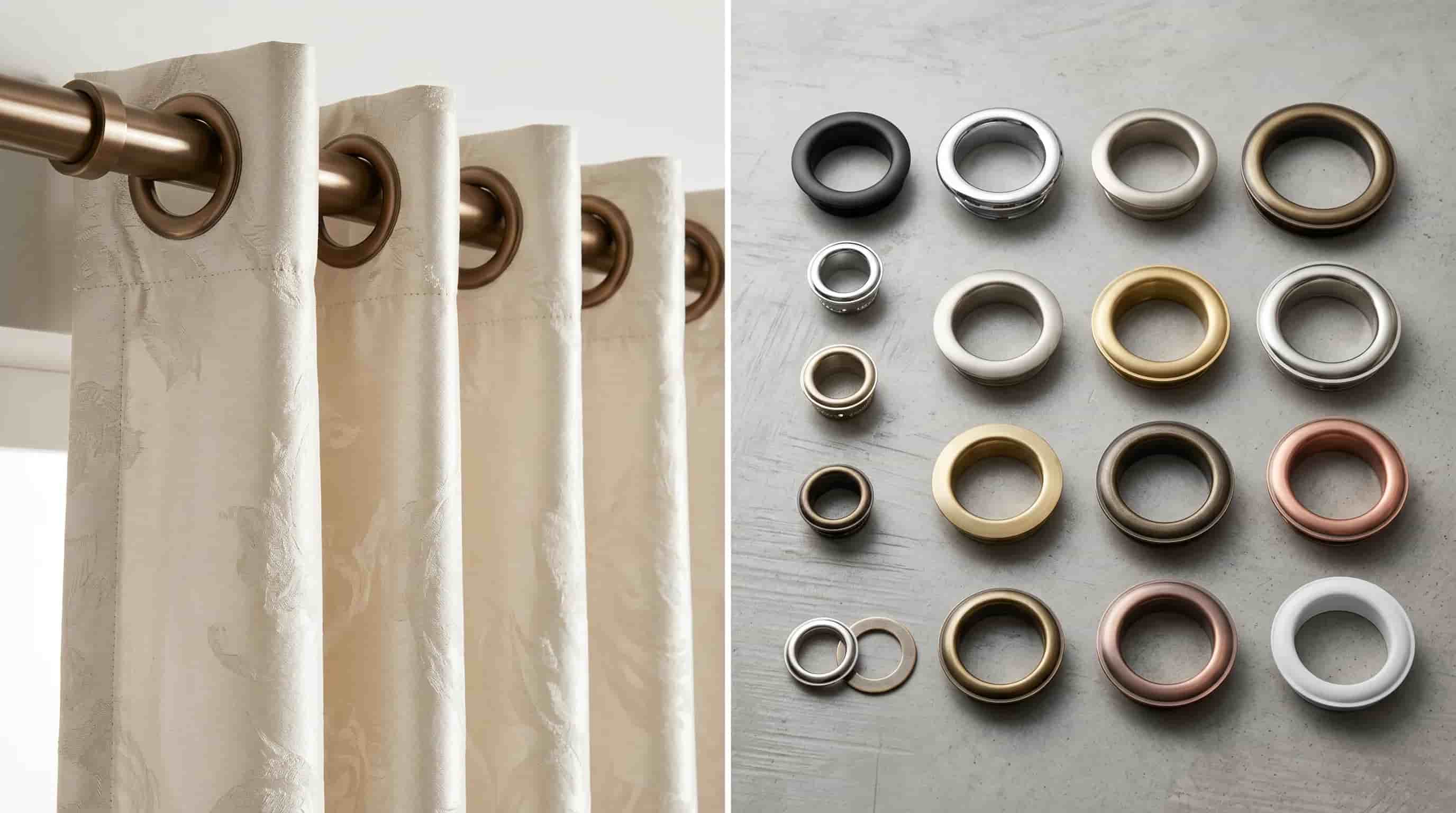
This is why buyers should not only ask for metal eyelet rings for curtains by outer diameter or color. The inner diameter and curtain rod diameter must be checked together. Two eyelets may look similar from the outside, but perform differently on the same curtain rod.
Different countries and regions may also use different curtain rod standards. Export curtain brands should confirm the target market’s rod diameter before finalizing the hardware specification. For project orders, buyers should provide rod diameter, fabric type, curtain weight, and installation method. This helps the supplier recommend a more accurate size.
Match Eyelet Size with Fabric Thickness and Curtain Weight
Fabric thickness also affects curtain eyelet size. Sheer curtains, cotton-linen curtains, velvet curtains, blackout curtains, and acoustic curtains all require different levels of support.
Thin fabrics usually need lighter and cleaner eyelet proportions. If the eyelet is too large or too heavy, the curtain header may look bulky. The fabric may also wrinkle around the eyelet during pressing. For lightweight curtains, a smaller and more refined eyelet often creates a better appearance.
Medium-weight curtains need balance. The eyelet should be strong enough to support the fabric, but not so large that it dominates the curtain design. Many home curtains, apartment curtains, and standard project curtains fall into this category.
Heavy curtains require stronger support. Blackout curtains, hotel curtains, theater curtains, and commercial curtains may use thicker fabrics and face more frequent movement. For these products, the eyelet should have suitable holding depth, stable rim width, and stronger material support. If the eyelet is too shallow or too small, the curtain header may deform after long-term use.
Buyers should also evaluate the finished curtain in real hanging condition. A sample may look good when placed flat on a table, but gravity and repeated pulling will test the eyelet after installation. For B2B curtain projects, this is an important step before mass production.
Choose Eyelet Size by Project Environment
Different curtain projects need different eyelet decisions.
For home curtains, the main concerns are appearance, easy installation, and smooth daily use. The eyelet should match the interior style and curtain rod while keeping the top area neat.
For hotels, batch consistency is critical. A hotel may need hundreds or thousands of curtains. If the eyelet size, color, or finish varies across batches, the rooms may look inconsistent. Hotel curtains are also used frequently by different guests, so the hardware must remain stable over time.
For apartments and rental properties, buyers often want simple installation and reasonable cost. Eyelet curtains are popular because they are easy to understand and replace. Still, the size must match the rod system used in the property.
For commercial spaces, durability and maintenance cost are more important. Offices, meeting rooms, retail stores, and event spaces may use curtains frequently. The eyelet should be strong enough to support repeated movement and reduce maintenance problems.
For bathrooms, coastal homes, outdoor shading systems, and humid environments, corrosion resistance becomes more important. In these cases, stainless steel curtain eyelets can be a better choice because they provide stronger long-term stability than many ordinary metal options.
The right eyelet size is therefore not only a technical decision. It is also a project decision. Buyers should consider how the curtain will be used, how often it will move, and what environment it will face.
When Custom Curtain Eyelet Sizes Are Needed
Standard sizes are useful, but they cannot solve every project need. This is why more brands and project buyers are paying attention to custom curtain eyelet sizes.
Custom sizing can reduce risk because the eyelet can be made to match the real curtain system more accurately. Some buyers may need a larger inner diameter for thicker rods. Some may need a wider rim to cover the fabric hole more securely. Some may need a smaller outer diameter for lightweight curtains. Some may need deeper holding space for heavy blackout fabrics.
Material, Finish and Supplier Capability
Size alone does not guarantee quality. Material and surface finish also affect long-term performance.
Plastic eyelets may work for low-cost home curtains. They are light and affordable, but they may not provide the same texture or durability as metal hardware. Standard metal eyelets can improve appearance and strength, but the base material and finish must be stable. If the coating is weak, the eyelet may fade or peel. If the base material is not suitable for humid environments, corrosion may appear.
Stainless steel curtain eyelets are becoming more popular because they offer better corrosion resistance and long-term stability. They are suitable for hotels, bathrooms, coastal homes, outdoor curtains, commercial projects, and premium curtain products.
Baocheng’s JSW20 ultra-low-magnetic stainless steel can be used to produce curtain eyelets and curtain hardware hooks. For projects that require stable material, accurate dimensions, corrosion resistance, and long-term performance, JSW20 provides a reliable material option.
Supplier capability is also important. A reliable supplier should help confirm rod diameter, fabric thickness, hole size, installation method, project environment, finish requirement, and order quantity before production. Baocheng can support custom eyelet and hook sizes, multiple electroplating colors, and different surface finishes. For new product development, color testing, sample orders, and project trials, no MOQ support can reduce purchasing pressure and inventory risk.
RFQ Checklist for Curtain Eyelet Buyers
Before sending an inquiry, buyers should prepare clear information.
First, provide the curtain rod diameter. This helps determine the eyelet inner diameter. Second, provide fabric type and thickness. The supplier needs to know whether the material is sheer, cotton-linen, blackout, velvet, acoustic fabric, outdoor shading fabric, or another textile.
Third, provide the required inner diameter, outer diameter, and hole size if available. If the buyer is unsure, the supplier can recommend a size based on the curtain system. Fourth, explain the project environment, such as home, hotel, apartment, commercial space, coastal area, bathroom, outdoor shading system, or humid environment.
Fifth, confirm the finish requirement. The eyelet color should match the curtain rod, furniture hardware, and interior style. Sixth, explain the order type, such as sample, trial order, project order, repeat order, or long-term product series. Seventh, confirm whether curtain hardware hooks are also needed. Developing eyelets and hooks together can improve consistency in material, finish, and product style.
A clear RFQ helps the supplier provide a more accurate quotation and a better technical recommendation. It also reduces communication time and lowers production risk.
Choosing the right curtain eyelet size is not only about making the curtain look good. It affects production efficiency, pressing quality, rod compatibility, curtain movement, visual proportion, batch consistency, and long-term use.
The best size is not always the largest size or the most common catalog size. It is the size that matches the curtain rod diameter, fabric thickness, curtain weight, project environment, installation method, and brand positioning.
For curtain brands and project buyers, eyelet size should be evaluated together with material, finish, and supplier capability. Custom curtain eyelet sizes, stainless steel materials, multiple electroplating colors, and flexible development support can help reduce project risk and improve delivery stability.
A curtain eyelet may be a small component, but the right size can make the whole curtain system work better, look cleaner, and last longer.
Focused FAQ
What is the most important curtain eyelet size to check?
The inner diameter is usually the first size to check because it must fit the curtain rod. Buyers should also confirm outer diameter, rim width, hole size, and fabric holding depth.
Should the eyelet inner diameter be larger than the curtain rod?
Yes. The inner diameter should be larger than the rod diameter and leave enough space for smooth movement. If the fit is too tight, the curtain may create friction.
Are larger curtain eyelets always better?
No. Larger eyelets may suit heavy curtains, but they can look oversized on light fabrics. The best size depends on fabric weight, rod diameter, and visual proportion.
Why does fabric thickness affect curtain eyelet size?
Thicker fabrics need enough holding depth and stronger structure. If the eyelet is too shallow, it may not lock properly and may loosen after use.
When should buyers choose custom curtain eyelet sizes?
Custom sizes are useful when standard eyelets do not match the curtain rod, fabric thickness, hole size, design proportion, or installation method.
What is the difference between curtain eyelets and curtain grommets?
In many markets, the terms are used for similar ring hardware installed at the top of curtains. The key is to confirm technical details, not only the product name.
Can Baocheng customize curtain eyelets and hooks?
Yes. Baocheng can customize eyelets and hooks in different sizes, finishes, and materials according to rod diameter, fabric thickness, installation method, and project needs.
Why is stainless steel useful for curtain eyelets?
Stainless steel offers better corrosion resistance and long-term stability, making it suitable for hotels, bathrooms, coastal homes, outdoor curtains, and commercial projects.
#Curtain Eyelet Size, #Curtain Eyelet Rings, #Custom Curtain Eyelet Sizes, #Metal Eyelet Rings for Curtains, #Curtain Grommets, #Curtain Ring with Eyelet, #Curtain Rings with Eyelets, #Curtain Rod Diameter, #Eyelet Inner Diameter, #Eyelet Outer Diameter, #Curtain Eyelet Hole Size, #Curtain Fabric Thickness, #Stainless Steel Curtain Eyelets, #Curtain Hardware Hooks, #Hotel Curtain Hardware, #Blackout Curtain Eyelets, #Custom Curtain Hardware, #No MOQ Curtain Hardware, #JSW20 Stainless Steel Curtain Eyelets, #B2B Curtain Accessories
