






Curtain Eyelet Quality Control: Roundness, Finish, Fit and Batch Consistency
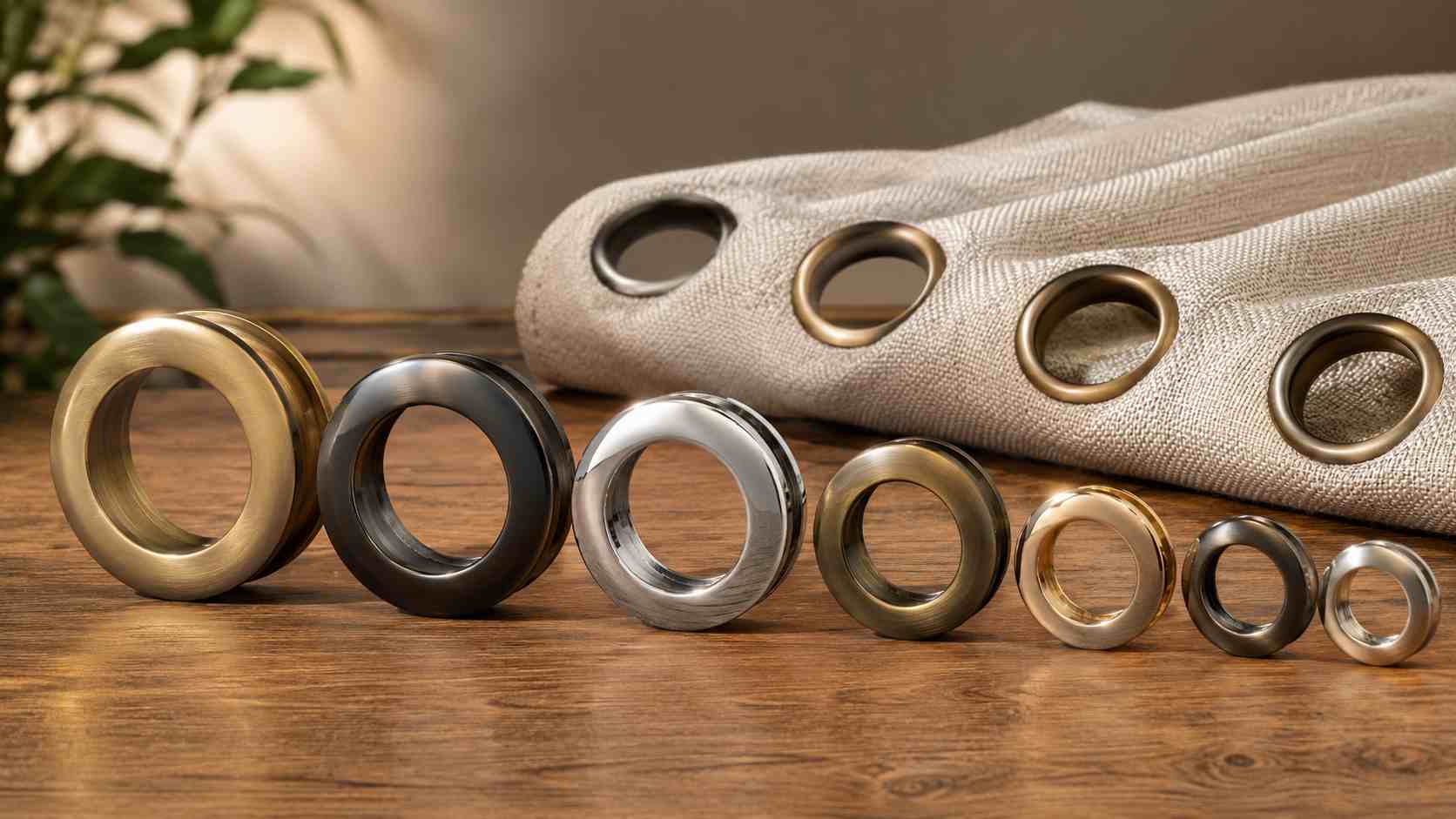
Curtain Eyelet Quality Is a System, Not a Cosmetic Inspection
A row of curtain eyelets can look excellent from two meters away and still contain dimensional or installation problems that become visible only after the curtain is hung.
One ring may be slightly oval. Another may have a smaller functional opening. A third may have a different barrel length. A new plating lot may be slightly warmer in color. A worn setting die may begin deforming the backside rollover without affecting the front appearance.
None of these defects necessarily looks dramatic when individual loose components are inspected.
But curtain hardware is repeated in a straight line, often ten, twelve or more times across one panel. That repetition makes small inconsistencies highly visible.
For B2B curtain manufacturers, quality control therefore needs to answer four separate questions:
- Are the loose eyelets dimensionally consistent?
- Is the decorative finish visually and mechanically consistent?
- Does the installed eyelet still fit the intended rod correctly?
- Can the same result be repeated across every production batch?
The final product should be evaluated as an installed hardware system rather than as a bag of attractive metal rings.
Quality Gate 1: Roundness and Functional Geometry
Roundness is one of the first characteristics buyers should control because the curtain rod interacts with the eyelet opening during every opening and closing cycle.
A nominally circular eyelet can become slightly oval because of:
- drawing variation;
- uneven forming;
- material springback;
- plating buildup;
- transport deformation;
- incorrect setting pressure;
- worn or misaligned tooling.
The important distinction is that diameter and roundness are not the same measurement.
An eyelet can pass one diameter measurement and still be noticeably oval if another direction measures differently.
Measure the opening in more than one direction
The eyelet inside diameter is one of the most important functional dimensions in a curtain application.
Instead of checking a single direction, development and QC teams should measure the opening across multiple orientations.
If one direction is 40.1 mm and another is 39.4 mm, reporting the component simply as “40 mm” hides useful information.
The smaller direction may determine whether the eyelet binds when tilted on the rod.
For a critical rod-fit application, the inspection plan should therefore define:
- nominal ID;
- minimum allowable ID;
- maximum allowable ID;
- allowable directional difference or roundness condition;
- whether measurements apply before or after curtain installation.
Outside Diameter Controls More Than Appearance
The eyelet outside diameter is highly visible, but it is also structural.
It determines the approximate flange area available to distribute curtain loads around the punched opening.
Variation in outside diameter can create several problems:
- one eyelet appears visibly larger than the others;
- flange overlap around the fabric hole changes;
- distance between neighboring eyelets appears inconsistent;
- large rings may crowd seams or reinforcement boundaries;
- the front profile may no longer fit the lower setting die correctly.
For large decorative curtain eyelets, even relatively small OD variation can be noticeable because the hardware is arranged in a straight horizontal line.
Concentricity Matters as Much as Diameter
An eyelet can have acceptable ID and OD while still looking wrong if the opening is not centered inside the flange.
This creates uneven flange width around the circumference.
Concentricity problems can originate during stamping, drawing, trimming or setting.
On a polished metallic curtain eyelet, the defect is particularly visible because the human eye quickly notices an opening that appears shifted inside a circular flange.
A practical QC system should therefore inspect not only maximum and minimum diameters but also whether the inner and outer circles remain visually and dimensionally centered.
Barrel-Length Variation Can Turn a Good Eyelet into a Bad Installation
The front of the eyelet is only half of the component.
The eyelet barrel length controls how much metal passes through the curtain header and remains available for backside forming.
If barrel length varies excessively within one batch, the same setting machine and same curtain material can produce different results.
A shorter component may form an incomplete rollover.
A longer component may produce:
- excessive wrinkles;
- higher installed height;
- barrel splitting;
- washer misalignment;
- greater forming force.
For this reason, barrel length should be treated as a functional dimension rather than a hidden manufacturing feature.
Inspect the Eyelet in the Condition in Which It Will Actually Work
Loose-component inspection is necessary, but it is not enough.
The curtain manufacturing process can change the hardware.
After setting, the eyelet may:
- become slightly oval;
- lose concentricity;
- develop an inward deformation;
- gain a local burr;
- show finish cracking;
- sit at a different installed height.
Therefore, an effective quality plan should have two dimensional stages:
- incoming loose-component inspection;
- installed finished-curtain inspection.
The second stage verifies what the customer will actually use.
Quality Gate 2: Surface Finish Must Be Evaluated Functionally
Curtain eyelets are decorative hardware, so surface appearance is extremely important.
However, a finish should not be approved only because its front face has the correct color.
Quality control should evaluate at least four zones:
- front flange;
- inside sliding edge;
- barrel wall;
- backside rollover after setting.
These zones experience different manufacturing and service conditions.
The flange is mainly visual.
The inside diameter may repeatedly rub against the curtain rod.
The barrel undergoes forming.
The backside can experience high deformation during setting.
Color Consistency Needs an Approved Master
Terms such as silver, gunmetal, black nickel, gold or antique brass are too broad for large B2B programs.
If several production lots are supplied months apart, the acceptable color should be defined against an approved physical or documented reference.
Variation can arise from:
- plating chemistry;
- bath age;
- surface preparation;
- base material;
- coating thickness;
- polishing condition;
- curing conditions for coated finishes.
A hotel or curtain brand may accept slight variation inside one hidden mechanical component but reject the same variation across a visible row of twenty large eyelets.
Gloss Is a Separate Quality Characteristic from Color
Two eyelets can have nearly identical hue yet appear different because one is more reflective.
For decorative curtain hardware, buyers may need to control:
- bright versus satin appearance;
- polishing direction;
- surface texture;
- visible polishing lines;
- localized dull areas;
- pressure marks caused during setting.
Final approval should preferably use installed samples viewed under representative lighting rather than only loose components under factory inspection lamps.
Inside-Edge Finish Can Determine Rod Wear
A highly polished flange does not guarantee a smooth sliding interface.
The inner circumference should be checked for:
- burrs;
- rough plating deposits;
- sharp transitions;
- tool marks;
- local coating buildup;
- finish cracking after setting.
If the curtain eyelet runs directly on a rod, this surface is one of the most important functional areas in the entire component.
A tiny defect repeated across hundreds of operating cycles can eventually create a long scratch on the curtain rod.
Quality Gate 3: Fit Must Be Checked as an Assembly
The eyelet does not operate by itself.
It operates around a real curtain rod, inside a curtain header of a specific thickness and under a specific curtain weight.
Therefore “fit” needs to cover more than whether the rod physically passes through the opening.
Quality control should ask:
- Does the eyelet slide without binding?
- Is the clearance large enough after tolerance variation?
- Is it so large that metal impact becomes noisy?
- Does the eyelet pass telescopic rod joints?
- Does installation distort the opening?
- Does the rod coating remain undamaged after cycling?
Use Worst-Case Dimensions, Not Only Nominal Dimensions
Suppose an eyelet is specified around a 40 mm nominal opening and the rod is specified at 32 mm.
The nominal difference looks generous.
But production engineering should check the smallest acceptable installed eyelet against the largest acceptable finished rod.
This worst-case combination represents the lowest functional clearance the customer could receive while both parts remain individually within tolerance.
The same logic applies to:
- flange versus punched-hole diameter;
- barrel versus washer opening;
- barrel length versus maximum curtain-stack thickness.
Go/No-Go Gauges Can Simplify High-Volume Inspection
For repeated production, not every characteristic needs to be measured manually with a caliper.
Functional gauges can make inspection faster and more consistent.
For example:
- a GO pin can confirm minimum functional ID;
- a NO-GO concept can help identify oversized openings where the project requires an upper limit;
- a rod simulator can check actual installed sliding clearance;
- a profile fixture can check setting height or backside geometry.
Such gauges translate engineering dimensions into simple production decisions.
Setting Dies Are Part of the Quality-Control System
Even excellent components can become inconsistent if the grommet setting dies are worn, damaged or poorly matched.
Tool deterioration can create gradual drift rather than an immediate obvious defect.
For example, a worn forming edge can progressively cause:
- uneven backside rollover;
- small internal burrs;
- increased ovality;
- front-flange pressure marks;
- greater installed-height variation.
Because tool wear develops over time, checking only the first-piece sample at the beginning of the shift may not be enough for a large production run.
Tooling Maintenance Should Be Linked to Product Measurements
A stronger process-control system does not replace dies only when they visibly break.
It monitors whether product dimensions and appearance begin drifting.
Warning signals can include:
- increased ID variation;
- more backside splits;
- increased setting force;
- visible die marks;
- more components sitting above the target installed height.
These trends can indicate tooling wear before customers receive defective curtains.
Quality Gate 4: Batch Consistency Begins with Material Control
A buyer asking what are eyelets made of should receive a more precise answer than “metal.”
Material selection influences:
- forming behavior;
- hardness;
- springback;
- corrosion resistance;
- surface finishing;
- magnetic response;
- dimensional stability after forming.
If the base material changes between batches without controlled approval, setting behavior can also change even when the drawing remains identical.
For repeat B2B orders, the material specification should therefore be locked to the project rather than selected independently by each production lot.
Batch Consistency Means Repeating a Process, Not Repeating a Drawing
A drawing describes the intended geometry.
It does not automatically guarantee that every shipment will have the same:
- material lot;
- forming behavior;
- surface color;
- plating thickness;
- barrel shape;
- inner-edge smoothness;
- installed behavior.
True batch consistency requires a controlled production route.
Critical process information can include:
- approved material;
- forming sequence;
- tool specification;
- surface-treatment specification;
- inspection method;
- approved master samples;
- packaging requirements that prevent scratching.
Bulk Orders Make Small Variation More Visible
When buyers purchase bulk metal grommets, variation that seems statistically minor can become commercially significant because thousands of pieces are used across many curtain panels.
A 0.5% unusual-color rate may look small as a percentage, but on a large hospitality project it can create many visible mismatches.
The same is true for:
- oval openings;
- wrong barrel lengths;
- plating defects;
- sharp inner edges;
- incorrect quantities per package.
Large orders therefore require stronger lot-release controls than isolated prototype orders.
Wholesale Supply Needs Replacement Continuity
Buyers sourcing wholesale metal eyelets often need more than one shipment.
A hotel program, curtain brand or furniture manufacturer may reorder the same component for years.
Supplier quality therefore includes the ability to reproduce:
- the same dimensions;
- the same material;
- the same color;
- the same finish texture;
- the same setting behavior.
If a replacement batch is visibly different from the original production, the customer experiences a quality problem even if both batches independently meet broad commercial specifications.
OEM Programs Need More Detailed Control Than Catalog Products
OEM metal eyelets are usually integrated into a specific customer's product rather than sold as generic hardware.
That means quality requirements can be linked directly to:
- a specific curtain rod;
- a specific header stack;
- a specific color master;
- a specific installation machine;
- a project-defined corrosion or magnetic requirement.
OEM quality control should therefore preserve the complete interface, not merely the visible dimensions of the eyelet.
How Buyers Should Evaluate Metal Eyelet Suppliers
Not all metal eyelet suppliers control the same manufacturing stages.
For a quality-sensitive curtain program, useful supplier questions include:
- Is material specification controlled by lot?
- Are forming tools maintained internally?
- Can dimensional reports be provided?
- How is color consistency controlled?
- Are installed samples evaluated?
- Can matching dies be developed?
- How are replacement orders matched to earlier batches?
- Can project-specific testing be coordinated?
The supplier should understand why a dimension matters, not only whether it appears on a drawing.
A Metal Grommet Manufacturer Should Control the Forming Process
Choosing a metal grommet manufacturer becomes particularly important when the eyelet uses customized dimensions, thicker material, nonstandard finishes or strict functional tolerances.
The manufacturer needs to coordinate:
- raw material;
- stamping;
- drawing;
- trimming;
- surface preparation;
- plating or coating;
- final dimensional inspection;
- application testing.
Separating these stages without clear quality ownership can make root-cause investigation more difficult when a batch problem occurs.
A Practical Curtain Eyelet QC Plan
| QC Stage | Key Checks | Main Failure Prevented |
|---|---|---|
| Incoming material | Material specification, thickness, lot identity | Unexpected forming or performance variation |
| Stamped component | ID, OD, roundness, concentricity, barrel length | Poor rod fit and installation variation |
| Finished surface | Color, gloss, scratches, inner-edge condition | Visible inconsistency and rod wear |
| Setting trial | Installed ID, rollover, height, flange condition | Assembly deformation |
| Functional test | Rod fit, sliding, noise, scratching | Field-use complaints |
| Lot release | Sampling across cartons / production periods | Batch drift |
| Retention sample | Approved samples and production records | Future replacement mismatch |
Do Not Inspect Every Characteristic at the Same Frequency
A useful quality plan separates characteristics according to risk.
Some dimensions may require frequent process checks because tooling wear can change them rapidly.
Other characteristics may be controlled primarily at material or surface-treatment lot level.
For example:
- installed ID may need frequent line checks;
- barrel length can be sampled during component production;
- material identity may be controlled by raw-material lot;
- color can be evaluated by finish batch;
- long-term sliding can be part of qualification rather than every-box inspection.
This creates a more efficient system than simply measuring every possible feature on every piece.
First Article Approval Should Use Production Tools
A hand-made development sample can prove that the concept is possible.
It does not prove that the production process is stable.
Before volume release, first-article samples should preferably use:
- production-equivalent metal;
- production forming tools;
- production finish;
- production setting equipment;
- production-equivalent curtain material.
This is particularly important for large curtain eyelets because production tooling can influence roundness and surface appearance significantly.
Packaging Is Part of Finish Quality
A batch can leave the plating line in perfect condition and arrive at the curtain factory scratched.
Large metal eyelets can rub against one another during transport.
Bright finishes are especially vulnerable to visible contact marks.
Packaging design may therefore need to consider:
- piece-to-piece abrasion;
- humidity during storage;
- carton contamination;
- mixed-lot identification;
- quantity control.
Finish quality is not complete until the component reaches the assembly line in acceptable condition.
Baocheng Can Build Curtain Eyelet Quality Around the Customer's Final Product
Baocheng / BC New Material can provide customized curtain eyelets and grommets for B2B curtain, hotel, drapery and architectural textile projects.
For quality-sensitive programs, development can begin from the customer's finished product rather than from a generic catalog size.
Customization can include:
- inside diameter;
- outside diameter and flange width;
- barrel diameter;
- barrel length according to curtain thickness;
- metal thickness;
- washer or backside structure;
- inner-edge geometry;
- surface color and gloss;
- matching setting tooling.
Actual curtain rods, fabrics, reinforcement materials or installation samples can be used to verify the finished fit.
Multiple Materials Can Be Selected According to the Project

Baocheng can develop finished curtain eyelets using different materials according to corrosion, appearance, forming and special functional requirements.
Options can include:
- 304 stainless steel for many general corrosion-resistant and decorative projects;
- 316 stainless steel for projects requiring stronger resistance to certain chloride-related corrosion conditions;
- brass for premium decorative appearance and excellent formability;
- zinc alloy for selected decorative structures;
- JSW20 patented ultra-low-magnetic-permeability austenitic stainless steel for projects requiring very low magnetic response after forming.
JSW20 Quality Control Focuses on the Finished Component, Not Only the Raw Material
Magnetic performance is particularly relevant to quality control because forming can change the magnetic response of some conventional austenitic stainless steels.
A curtain eyelet experiences stamping, drawing and further deformation before it becomes a finished component.
Therefore, for magnetic-sensitive projects, confirming that a flat incoming sheet appears non-magnetic is not sufficient.
The final eyelet needs to maintain the required behavior after forming.
Baocheng's proprietary JSW20 is a patented ultra-low-magnetic-permeability austenitic stainless-steel solution developed for finished components that need to retain near-nonmagnetic behavior after forming.
This can be relevant to specialized curtain, textile or architectural hardware installed in environments with:
- magnetic-sensitive inspection equipment;
- special electronics;
- controlled industrial systems;
- strict finished-component permeability requirements.
For JSW20 projects, Baocheng's value is not simply supplying a material name. The focus is controlling the finished component through material selection, forming and inspection so the project receives a repeatable low-magnetic result.
JSW20's core advantage is ultra-low magnetic permeability. It should not be treated as another name for 316 corrosion resistance.
Corrosion resistance and magnetic permeability are separate project requirements and should be specified separately.
Baocheng supplies finished and customized components manufactured from JSW20 and does not sell JSW20 raw coil material.
Baocheng Can Also Support Finish and Batch-Control Requirements
Depending on base material and process, curtain-eyelet projects can be developed in finishes such as:
- bright silver;
- matte or satin silver;
- black;
- gunmetal;
- gold;
- brass tones;
- antique effects;
- other project-specific colors.
For repeat orders, approved appearance references can be retained so later batches can be compared against the original project requirement.
According to specific material, finish and project requirements, Baocheng can also coordinate relevant testing or documentation support such as RoHS, REACH, OEKO-TEX, Intertek or nickel-release-related evaluation.
What Buyers Should Include in a Curtain Eyelet Quality Specification
A strong RFQ or quality agreement can include:
- base material;
- finished inside diameter and tolerance;
- outside diameter;
- roundness requirement;
- concentricity expectation;
- barrel length;
- metal thickness;
- surface color and approved reference;
- gloss or texture expectation;
- inner-edge requirement;
- curtain header thickness;
- rod diameter and finish;
- installed height;
- backside rollover acceptance;
- sampling and lot traceability requirements.
The Best Quality Control Prevents Variation Before Final Inspection
Final inspection is important, but inspecting defects after thousands of eyelets have already been produced is expensive.
A stronger system controls the process that creates the feature.
Roundness begins with stable forming tools.
Fit begins with controlled ID, rod OD and installation geometry.
Finish consistency begins with controlled base material, surface preparation and treatment batches.
Barrel performance begins with correct material thickness and forming dimensions.
Batch consistency begins with approved specifications, retained masters and traceable process control.
For curtain buyers, this changes quality control from “find the bad eyelets” to “prevent the production system from generating inconsistent eyelets.”
That distinction is particularly important in B2B curtain programs where one component is repeated thousands of times and a small defect can quickly become a visible project-wide problem.
Focused FAQ
1. How should curtain eyelet roundness be checked?
Measure the functional inside opening in multiple directions rather than using one diameter reading. Directional differences can reveal ovality that may affect rod fit after installation.
2. Why should the installed eyelet be measured again?
Setting can change ID, roundness, concentricity and edge condition. The installed eyelet represents the geometry the curtain rod will actually contact.
3. Why is barrel-length consistency important?
Different barrel lengths can produce different rollover heights and retention when the same machine settings are used. Excessively short or long barrels create different installation failures.
4. What finish defects should buyers inspect?
Check color, gloss, scratches, plating or coating uniformity, inner-edge roughness, finish cracks and tool marks after setting.
5. Can a curtain eyelet pass dimensional inspection but still fit poorly?
Yes. Fit depends on the combined tolerances of the eyelet, rod, installation geometry and eyelet tilt. Functional assembly testing is therefore important.
6. Why should setting dies be monitored?
Worn or misaligned dies can gradually create oval openings, uneven rollover, burrs and visible flange marks even when incoming eyelets are correct.
7. What is most important for batch consistency?
Control the material specification, forming process, critical dimensions, finish reference, setting process and lot traceability rather than relying only on the drawing.
8. Can Baocheng customize curtain eyelet QC requirements?
Yes. Baocheng can develop dimensions, materials, finishes, tooling and inspection controls around the customer's actual curtain, rod and project requirements.
9. Why is JSW20 relevant to quality control?
JSW20 is Baocheng's patented ultra-low-magnetic-permeability austenitic stainless steel. For magnetic-sensitive projects, the focus is maintaining extremely low magnetic response in the finished formed component rather than testing only the raw material.
10. What should buyers approve before mass production?
Approve production-equivalent installed samples, including dimensions, roundness, finish, rod fit, backside forming and visual consistency, and define how later lots will be compared with that approved condition.
#CurtainEyeletQuality, #CurtainGrommets, #QualityControl, #MetalEyelets, #DraperyHardware, #CurtainManufacturing, #CustomEyelets, #OEMHardware