






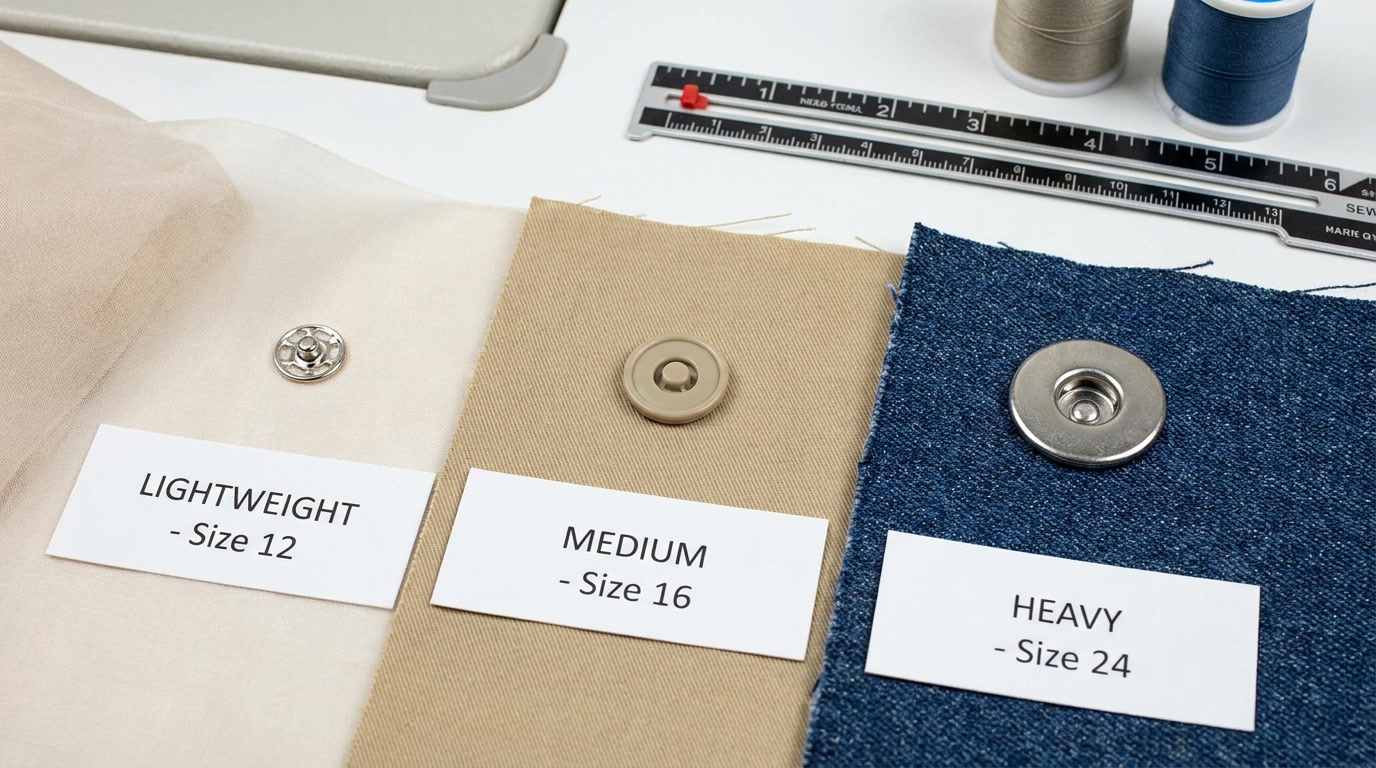
How to Choose Snap Button Size for Lightweight, Medium and Heavy Fabrics
How to Choose Snap Button Size for Lightweight, Medium and Heavy Fabrics
Snap button size should never be selected from fabric weight alone.
A lightweight shirt fabric, medium-weight jacket shell and heavy canvas can clearly require different hardware, but the difference is not simply that heavier fabric always needs a larger snap.
The correct selection depends on the complete mechanical system:
- fabric structure;
- actual layer thickness;
- local reinforcement;
- stretch and recovery;
- snap cap diameter;
- socket and stud structure;
- post, eyelet or prong attachment;
- required opening and closing force.
This distinction is important because visible snap diameter and mechanical strength are not the same specification.
A small snap with a relatively aggressive spring can create more local load than a larger snap designed for moderate retention. Likewise, a large decorative cap can sit over a relatively moderate internal fastening mechanism.
For professional sourcing, snap size should therefore be selected from the substrate outward.
First: What Does “Lightweight, Medium and Heavy Fabric” Mean?
There is no single universal snap-fastener standard that divides every textile into three fixed weight classes.
Fabric mass in gsm or oz/yd² is useful, but it cannot describe all of the properties that determine snap performance.
Two fabrics with similar weight can differ dramatically in:
- weave density;
- yarn strength;
- stretch;
- coating;
- compressibility;
- tear resistance.
For example, a dense woven fabric can provide better local support than a softer fabric of similar mass.
A laminated technical textile can have high apparent thickness but weak resistance to concentrated penetration.
A knitted fabric can stretch substantially around an attachment point even when its nominal weight is relatively high.
Fabric weight should therefore be treated as a starting category—not the final snap specification.
The Five Questions to Answer Before Selecting Snap Size
1. How Thick Is the Actual Installation Point?
Measure the complete material stack rather than one unused layer.
The snap may pass through:
- two or four folded layers;
- interfacing;
- lining;
- reinforcement tape;
- coatings;
- laminated backing.
2. How Strong Is the Material Around the Installation Point?
Higher release force transfers more load into the fabric every time the snap opens.
3. Is the Material Woven, Knitted or Stretchable?
Attachment architecture that performs well on stable woven fabric is not automatically suitable for knitwear.
4. How Often Will the Snap Be Opened?
A maintenance flap opened occasionally can tolerate different operating behavior from a shirt placket opened several times every day.
5. What Is the Required Visual Scale?
Cap diameter is partly a design decision.
The best size must satisfy both visual proportion and mechanical suitability.
Snap Size Has Four Different Meanings
When buyers talk about snap size, they can be referring to four different measurements.
Nominal Size
A commercial family designation such as Ligne or a nominal millimeter size.
Cap Diameter
The visible outside diameter.
Locking Dimensions
The socket and stud dimensions that create fastening action.
Attachment Dimensions
The post, eyelet or prong dimensions that secure the snap to the fabric.
Choosing a snap for different fabric weights requires all four to be considered.
Lightweight Fabrics: Start With Low Local Stress
Lightweight materials generally provide less material around the attachment point to absorb opening loads.
Typical applications include:
- shirts;
- blouses;
- light dresses;
- babywear;
- medical garments;
- lightweight linings and panels.
The most important objective is not simply using the smallest possible fastener.
It is keeping localized stress compatible with the material.
Why Small Snaps Are Often Useful on Lightweight Clothing
Searches for small snaps for clothing reflect a logical design requirement: thin garments often benefit from hardware that is visually proportional and physically low profile.
Smaller snaps can reduce:
- visual dominance;
- component weight;
- required installation space;
- interference with nearby seams.
However, small diameter does not guarantee gentle action.
The socket spring and stud geometry still determine release force.
Prong-Type Snap Structures for Delicate Fabrics
For certain lightweight and delicate fabrics, prong-type structures deserve special consideration.
Instead of concentrating attachment around one central post, multiple prongs penetrate the material at several points.
This can help distribute attachment and limit local movement when the prong geometry is properly matched to the fabric.
Prong-type miniature snaps are widely used for products such as:
- babywear;
- medical wear;
- light dresses;
- light workwear.
The final structure still needs validation on the real textile.
Knitwear Requires Extra Caution
A woven fabric has intersecting yarns that create relatively stable geometry.
A knit can stretch and redistribute around the hardware.
For this reason, snap structures that are suitable for woven fabrics should not automatically be transferred to knitted substrates.
Multi-prong structures are particularly valuable where attachment load needs to be distributed across a stretchable textile.
Reinforcement can also be required.
No-Sew Snaps on Lightweight Fabric
Searches for no sew snaps for fabric often refer to snap systems mechanically attached through the textile rather than stitched in place.
For lightweight fabrics, the key issue is not the absence of sewing.
The critical engineering questions are:
- how the attachment penetrates the fabric;
- how widely load is distributed;
- whether the fabric needs backing;
- how much release force is transferred into the substrate.
A mechanically attached snap can perform very well on lightweight material when the prong, post or eyelet architecture is correctly matched.
No-Sew Snaps for Clothing Still Need Foundation Thickness Control
The phrase no sew snaps for clothing does not describe one universal product.
Different snap families use different:
- prong lengths;
- post lengths;
- spring structures;
- cap diameters.
The correct choice depends on the foundation thickness at the installation position.
Suggested Direction for Lightweight Fabric
For light substrates, the starting direction is generally:
- smaller or moderate visible cap;
- low-profile structure;
- light to moderate snap action;
- attachment that minimizes local fabric damage;
- accurately matched prong or post length.
This is a starting framework rather than a universal numerical size rule.
Medium-Weight Fabrics: Balance Retention and User Comfort
Medium-weight fabrics cover a broad range of garments:
- casual jackets;
- overshirts;
- medium denim shirts;
- pants;
- workwear;
- bags and textile accessories.
These substrates usually provide more local support than lightweight fabrics, but they still need controlled opening loads.
This is where many standard S-Spring and comparable snap systems perform effectively.
S-Spring Structures for Medium and Light Garments
S-Spring sockets use two formed spring sections that open as the stud enters.
This architecture can provide relatively soft and controlled action.
For medium garments, it offers a useful balance between:
- secure closure;
- comfortable opening;
- moderate substrate loading;
- compact hardware geometry.
Choosing Cap Size for Medium-Weight Fabric
Cap diameter should be selected according to garment proportion rather than fabric weight alone.
Common commercial snap families often provide caps around 13 mm, 15 mm and 18 mm, but those sizes should be treated as design options rather than rigid fabric-weight rules.
For a medium jacket, a 15 mm cap may look well proportioned.
For a narrow shirt placket, a smaller cap may be visually better.
For a strongly styled outerwear product, a larger cap may be intentional.
A Broad Search Like “Snap for Clothing” Is Not a Complete Specification
A search such as snap for clothing identifies the general product category but leaves the engineering questions unanswered.
A professional specification should continue with:
- fabric type;
- layer thickness;
- cap size;
- socket mechanism;
- post or prong length;
- desired release force.
Button Snaps for Fabric Need to Match the Construction, Not Just the Fabric Name
For button snaps for fabric, the exact installation zone can matter more than the fabric category itself.
Consider the same jacket:
- the main body may contain one or two layers;
- the front placket may contain folded material plus interfacing;
- the cuff may contain additional reinforcement.
One visible snap design can therefore require different post lengths in different constructions.
Medium Fabric Does Not Automatically Mean Medium Snap Diameter
This is an important distinction.
The material category primarily influences:
- attachment capacity;
- acceptable release load;
- post or prong requirements.
Visible diameter is still strongly influenced by design.
The mechanical parts underneath the cap should be selected independently.
Heavy Fabrics: Greater Retention Requires Stronger Attachment
Heavy fabrics can include:
- heavy denim;
- workwear canvas;
- structured outerwear;
- heavy coated textiles;
- reinforced industrial fabrics.
These materials frequently require higher resistance to accidental opening.
However, the correct engineering response is not simply “use the biggest snap.”
The full system must support the higher forces.
Ring-Spring Systems for Heavy Garments
Ring-Spring snaps use a ring-shaped retaining spring in the socket.
The ring expands around the stud during closing and contracts into the retaining region after engagement.
This architecture is commonly chosen where stronger snap action is required.
Heavy garments and firm woven fabrics are typical applications.
Large Snaps for Fabric: When Does Larger Diameter Make Sense?
large snaps for fabric can be appropriate when the product needs:
- greater visual scale;
- a larger cap for branding;
- a larger attachment footprint;
- more substantial hardware styling.
But large visible diameter should not be confused with high holding force.
A large cap can still be paired with a moderate internal mechanism.
Large Snaps for Sewing and Heavy Garment Design
The search phrase large snaps for sewing often reflects a need for more substantial closures in jackets, outerwear, bags or craft constructions.
For heavy textiles, larger components can provide useful physical space for:
- stronger spring structures;
- larger attachment flanges;
- longer post options.
Actual performance still depends on the selected product family.
Heavy Fabric Requires More Attention to Post Length
Heavy textiles are frequently installed in folded or reinforced areas.
The real material stack can include:
- two or four fabric layers;
- binding;
- webbing;
- lining;
- coating;
- reinforcement patch.
Post length must be based on this complete compressed construction.
Why a Larger Snap Can Still Pull Out of Heavy Fabric
Heavy fabric does not eliminate pull-out failure.
A high-retention socket transfers greater force into the attachment point.
If the permanent attachment or local reinforcement is inadequate, possible failure modes include:
- hole enlargement;
- post pull-through;
- fabric tearing;
- coating separation;
- component rotation.
Stronger snap action must therefore be matched by stronger attachment.
Metal Snaps for Sewing: Metal Type Does Not Define Snap Size
Buyers looking for metal snaps for sewing should separate base material from size selection.
Metal choice affects:
- forming behavior;
- spring response;
- wear;
- corrosion resistance;
- surface finish.
But a brass, stainless steel or other metal snap can be manufactured in different sizes and structures.
“Metal” is a material category, not a size specification.
Sewing Snaps and Fasteners: Size Is Only One Part of Product Selection
The broad phrase sewing snaps and fasteners can cover products with very different attachment and locking methods.
For industrial garment development, size selection should therefore include:
- visible diameter;
- spring mechanism;
- attachment architecture;
- foundation thickness;
- material;
- expected cycle life.
A Practical Starting Matrix
| Fabric Category | Primary Risk | Snap Size Direction | Structure Direction | Critical Check |
|---|---|---|---|---|
| Very light woven | Tearing / puckering | Small to moderate visible size | Light-action / prong-type where appropriate | Fabric damage and backing |
| Light knit / stretch | Hole enlargement | Compact low-profile hardware | Distributed multi-prong attachment | Stretch and attachment stability |
| Medium woven | Balance of comfort and retention | Moderate size based on design | S-Spring or comparable moderate-action system | Release force |
| Medium denim / workwear | Layer thickness | Moderate to larger depending on design | Moderate or stronger system | Post length and pull-out |
| Heavy woven / canvas | High service loads | Moderate to large hardware where appropriate | Ring-Spring / stronger retention system | Reinforcement and attachment strength |
| Heavy coated textile | Coating cracking / pull-through | Selected by footprint and clearance | Strong lock with controlled attachment | Coating integrity |
Do Not Turn This Matrix Into a Fixed Size Standard
The matrix above describes engineering direction.
It does not mean:
light fabric = one exact diameter;
medium fabric = another exact diameter;
heavy fabric = the largest snap available.
The actual product still needs to be selected from:
- supplier dimensions;
- component drawings;
- reference samples;
- finished-product testing.
Fabric Thickness Often Matters More Than Fabric Weight
Weight and thickness are related but not identical.
A dense textile can be heavy without being extremely thick.
A foam-backed laminated material can be thick without having high tear strength.
Post selection is fundamentally a thickness problem.
Holding-force selection is fundamentally a load and substrate-strength problem.
Cap selection is partly a visual-design problem.
Keeping these decisions separate produces more reliable specifications.
How to Measure the Material Stack
Measure the exact installation zone in the production construction.
Include:
- folds;
- lining;
- interfacing;
- reinforcement;
- coatings.
Where the material compresses significantly, physical setting trials are more meaningful than relying on free-state thickness alone.
Choosing Post Length for Light Fabric
Thin material generally requires a shorter working attachment length.
If the post is excessively long, it can:
- buckle;
- form sideways;
- distort the socket or stud;
- leave the snap loosely clamped.
Choosing Post Length for Heavy Fabric
A thick stack requires sufficient post projection to create the designed flare or riveted attachment.
If the post is too short:
- forming remains incomplete;
- pull-out strength decreases;
- the component can rotate.
Post selection should always follow the actual compressed foundation thickness.
Snap Diameter Does Not Determine Post Length
A large cap can use several post-length variants.
A smaller snap family can also be supplied with more than one attachment length.
This means the following two specifications must remain separate:
Cap size = visible / design dimension.
Post length = substrate / attachment dimension.
Snap Holding Force Also Does Not Scale Directly With Diameter
A larger snap has more physical space, but its retention depends on:
- spring shape;
- spring stiffness;
- stud engagement diameter;
- dimensional interference;
- material;
- surface friction.
A small high-interference snap can require more release force than a larger decorative snap.
Choose Holding Force Before Finalizing Size
The desired user experience should be defined early.
Ask:
- Should the snap open easily with one hand?
- Must it resist movement or vibration?
- Will children use it?
- Will the fabric be repeatedly peeled during opening?
- Can the substrate safely carry the opening load?
These answers influence the correct socket system.
Peel Force Changes the Real Requirement
Users rarely open snaps in a perfect straight axial pull.
They usually peel the fabric from one side.
This concentrates load on one edge of the attachment.
Light fabrics are particularly sensitive to this behavior.
Sample testing should reproduce real opening direction.
Reinforcement Can Allow a Stronger Snap Without Increasing Cap Size
If the target snap creates too much stress for the fabric, increasing the cap diameter is not the only solution.
Local reinforcement can improve:
- tear resistance;
- pull-out strength;
- dimensional stability;
- appearance around the installation point.
This is especially useful for jacket plackets, workwear and technical textiles.
Foundation Thickness Is Critical for Prong Snaps Too
Prong-type structures do not use the same central post geometry, but foundation thickness still matters.
Prongs must penetrate and form securely without:
- remaining partially open;
- cutting excessive fibers;
- over-compressing the material.
Very small snap products are particularly sensitive to attaching conditions.
Lightweight Does Not Always Mean Prong Snap
Substrate structure should determine the solution.
A stable lightweight woven fabric with reinforcement may perform well with a conventional spring snap.
A stretch knit may benefit more from a multi-prong system.
The word “lightweight” alone cannot determine architecture.
Heavy Fabric Does Not Always Mean Ring-Spring
The same caution applies at the other end.
A heavy textile may need moderate opening force because:
- users open it frequently;
- the product is intended for limited hand strength;
- the fabric coating is sensitive;
- attachment points are close to an edge.
Ring-Spring is a useful strong-action option, not a mandatory rule for every heavy material.
When Large Visible Snaps Are Mainly Decorative
Fashion outerwear sometimes uses oversized caps to create a visual feature.
The visible diameter can be larger than required mechanically.
In these cases, designers should specify:
- cap diameter;
- internal socket/stud family;
- target release force;
- post length;
as separate parameters.
Surface Finish Adds Another Variable
Plating and coating influence both appearance and mechanical interaction.
They can affect:
- friction;
- effective component dimensions;
- wear;
- corrosion resistance.
The final finished snap should therefore be tested rather than approving only unfinished metal components.
Material Selection for Different Fabric Classes
Depending on the snap structure and project requirements, component materials can include:
- brass;
- 304 stainless steel;
- 316 stainless steel;
- JSW20 ultra-low magnetic permeability stainless steel;
- other project-appropriate materials.
Material selection should consider the environment as well as fabric weight.
Outdoor Heavy Textiles Need Corrosion Resistance Too
A technically strong snap can still lose consistent function if corrosion affects the spring or stud interface.
Outdoor heavy fabrics may experience:
- rain;
- humidity;
- chlorides;
- abrasion;
- contamination.
Material and surface treatment therefore remain part of the sizing and structural decision.
JSW20 for Low-Magnetic Snap Components
Some apparel and technical-textile projects require extremely low magnetic permeability in the finished formed hardware.
This is particularly relevant to needle-detection and magnetically sensitive applications.
Baocheng / BC New Material can manufacture suitable finished snap components from patented JSW20 ultra-low magnetic permeability stainless steel where the specific structure and forming requirements are appropriate.
JSW20 retains extremely low magnetic permeability after forming and also provides chloride-corrosion resistance.
Baocheng supplies finished JSW20 snap products and customized components rather than raw JSW20 coils or sheets.
A Better RFQ for Snap Size Selection
Instead of writing:
“Need snaps for heavy fabric.”
provide:
- finished product type;
- actual fabric sample;
- fabric construction;
- fabric weight;
- complete material-stack thickness;
- woven / knit / stretch information;
- reinforcement structure;
- target cap diameter;
- preferred socket type;
- desired opening force;
- opening frequency;
- base material;
- surface finish;
- environmental exposure.
A Practical Selection Sequence
Step 1: Classify the Fabric
Light, medium or heavy is the starting category.
Step 2: Identify Fabric Structure
Woven, knit, stretch, coated or laminated.
Step 3: Measure the Finished Stack
Include reinforcement and folds.
Step 4: Define Required Retention
Determine whether light, moderate or strong snap action is required.
Step 5: Choose the Socket Architecture
Evaluate prong, S-Spring, Ring-Spring or another suitable mechanism.
Step 6: Choose Visible Size
Select cap diameter according to proportion, available space and branding requirements.
Step 7: Match Attachment Length
Choose the post, eyelet or prong for the actual material thickness.
Step 8: Install Samples
Use production-equivalent material and finish.
Step 9: Validate the Complete System
Check:
- opening and closing force;
- pull-out resistance;
- fabric damage;
- rotation;
- cycle durability.
Custom Snap Size Development at BC New Material
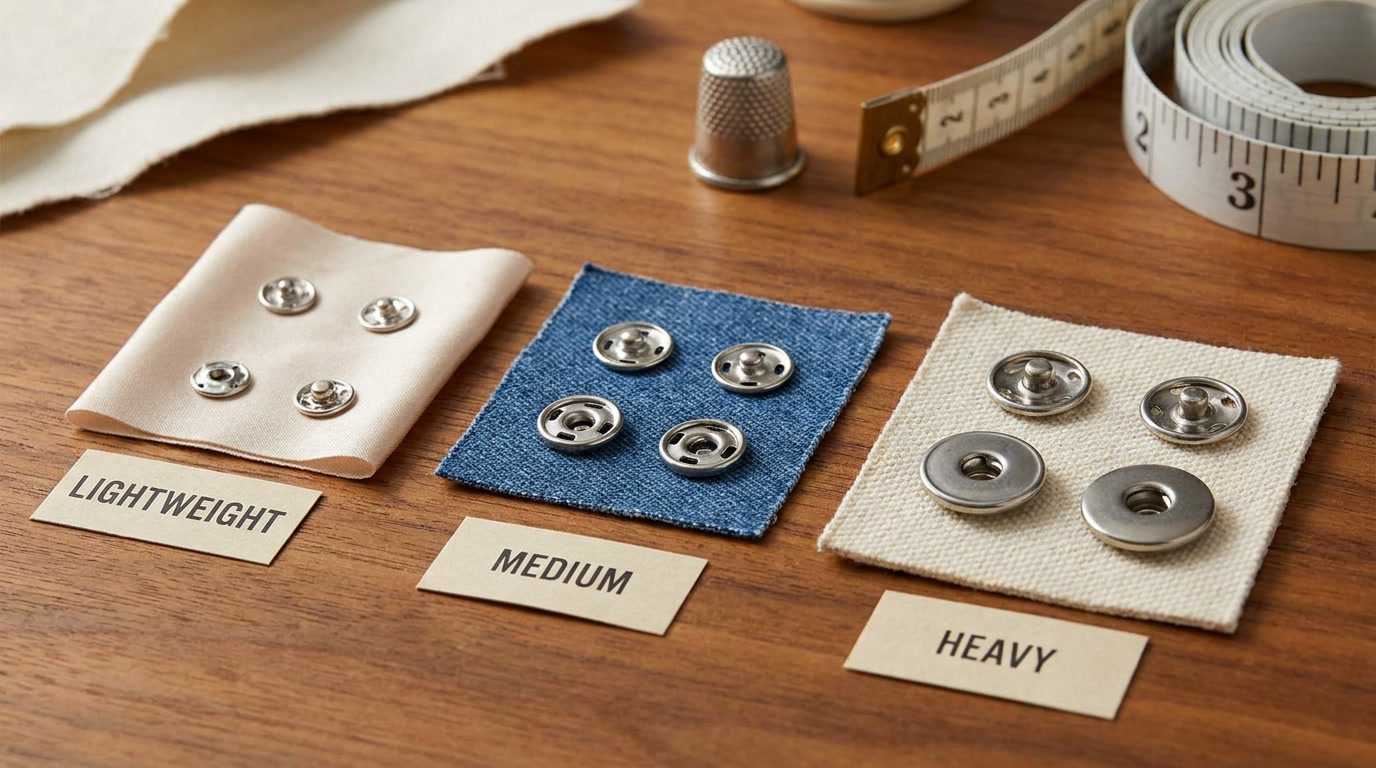
Baocheng / BC New Material supplies finished metal snap buttons, press studs and customized components for lightweight apparel, medium garments, denim, workwear and heavy technical textiles.
Snap development can be based on the customer's actual substrate instead of choosing hardware only by nominal diameter.
Depending on the project, Baocheng can customize:
- cap diameter and profile;
- socket and spring structure;
- stud engagement geometry;
- post and eyelet length;
- prong dimensions;
- base material;
- surface color and finish;
- logo and embossing;
- opening and closing behavior.
Sample development can use the customer's production fabric so that the snap can be evaluated on the real material thickness, layer construction and reinforcement.
Depending on project scope, materials can include brass, 304 stainless steel, 316 stainless steel, patented JSW20 ultra-low magnetic permeability stainless steel and other suitable metals.
Where applicable to the specific project and certificate scope, Baocheng can also consider REACH, RoHS, OEKO-TEX and nickel-release requirements.
Conclusion: Fabric Weight Is the Starting Point, Not the Snap Size
Lightweight, medium and heavy fabrics clearly create different fastening requirements, but there is no universal rule that directly converts fabric weight into one snap diameter.
Light fabrics require careful control of local stress and attachment damage.
Medium fabrics require a balance between retention and comfortable opening.
Heavy fabrics can support stronger snap systems but often need longer attachment components, better reinforcement and greater pull-out strength.
Cap diameter should be selected for visual scale and available space.
Socket and stud geometry should be selected for the required holding force.
Post, eyelet or prong dimensions should be selected for the actual foundation thickness.
The correct snap size is therefore the result of substrate engineering—not simply a number chosen from a catalog.
Focused FAQ
What snap size is best for lightweight fabric?
There is no universal diameter. Lightweight fabrics generally benefit from compact, low-profile hardware and light-to-moderate snap action, but fabric construction and attachment method should be validated first.
Are small snaps always better for thin fabric?
No. Small size improves visual proportion, but the spring and attachment geometry still determine fabric stress.
What snap structure works well for medium-weight fabric?
S-Spring and other moderate-action systems are common starting points for stable medium-weight woven garments because they balance retention and opening comfort.
What snap is suitable for heavy fabric?
Ring-Spring or another stronger-retention system can be appropriate for heavy, firm woven fabrics, provided attachment strength and reinforcement can support the opening load.
Should heavy fabric always use a larger snap?
No. Larger diameter can help with appearance and attachment footprint, but holding force is determined mainly by the socket, spring and stud geometry.
Does fabric weight determine post length?
No. Post length should be selected from the complete compressed thickness of the actual installation stack.
What is more important: fabric weight or thickness?
Both matter differently. Thickness is critical to attachment length, while local strength, weave and reinforcement strongly affect acceptable holding force.
Can a strong snap damage lightweight fabric?
Yes. Excessive release force can enlarge holes, tear yarns or pull the hardware through an insufficiently reinforced substrate.
Are prong snaps suitable for knitwear?
Multi-prong structures are particularly useful for many knitted or stretch fabrics because they distribute attachment across several penetration points.
Can the same snap cap be used with different fabric thicknesses?
Often yes, if the snap family provides compatible post or eyelet lengths and the complete combination is approved for the intended material thickness.
Can Baocheng help select snap size from my fabric?
Yes. Baocheng / BC New Material can develop and sample finished snap systems using the customer's actual lightweight, medium or heavy fabric construction.
Can JSW20 be used for finished snap components?
Where the component geometry and project requirements are suitable, Baocheng can manufacture finished snap components from patented JSW20 ultra-low magnetic permeability stainless steel. JSW20 retains extremely low magnetic permeability after forming and also provides chloride-corrosion resistance.
#SnapButtons, #SnapFasteners, #SnapButtonSize, #FabricWeight, #LightweightFabric, #HeavyFabric, #RingSpringSnap, #SSpringSnap, #GarmentHardware, #SnapButtonDesign