







Banner Eyelets or Banner Grommets? Choosing the Right Term and Structure

Banner Eyelet and Banner Grommet Often Describe the Same Job—but Not Always the Same Structure
In banner manufacturing, the terms eyelet and grommet are frequently used for the metal reinforcement installed around a hole in vinyl, mesh, coated textile or another flexible display material.
A printer may ask for banner eyelets. A hardware supplier may call the same component a grommet. A purchasing team in another country may use grommet only when the component includes a washer.
All three people may be discussing almost the same application while imagining slightly different hardware.
This is why the question are eyelets and grommets the same cannot be answered reliably with a simple yes or no.
In everyday commercial language, the terms overlap heavily.
In engineering and sourcing, however, the name should never replace a drawing or structural description.
A banner buyer should specify what the hardware actually consists of, how it locks onto the banner and what load the reinforced hole needs to withstand.
Terminology Is Regional, Historical and Industry-Specific
Grommet terminology is less standardized in everyday trade than many buyers expect.
In some textile and apparel industries, eyelet is commonly used for a small flanged metal ring installed through fabric or leather.
In sign, tarp and banner industries, grommet is often the more common commercial term.
Some suppliers use grommet for a two-part assembly consisting of a barrel component and washer, while eyelet may refer to a one-piece part.
Other suppliers use both words for both constructions.
This variation becomes particularly important in international B2B sourcing.
A purchase order reading only “10 mm metal banner eyelet” may leave unanswered questions about:
- whether a washer is included;
- whether the part is self-piercing;
- whether 10 mm means hole ID, barrel OD or another dimension;
- what material is required;
- what finish is required;
- what material thickness it must set through.
The safest approach is therefore to treat eyelet and grommet as product-category words and define the actual construction separately.
Start with the Physical Parts, Not the Product Name
Understanding the parts of a grommet is much more useful than debating vocabulary.
A typical banner reinforcement system may include:
- a visible front flange;
- a cylindrical or slightly tapered barrel;
- a backside rollover or flare;
- a separate washer in two-piece systems;
- teeth, spurs or cutting features in specialized designs.
The front flange distributes load around the hole and creates the visible finished surface.
The barrel passes through the banner material.
During installation, the barrel is expanded, rolled or compressed so the component cannot simply pull back through the material.
If a separate washer is used, the washer supports the backside and becomes part of the mechanical lock.
What Is a Grommet Ring?
Buyers asking what is a grommet ring may be referring to several different things.
In casual product descriptions, the term can describe the visible ring-shaped front component.
It may also describe the complete installed grommet after the barrel has been set.
For sourcing purposes, “ring” is therefore too vague.
Buyers should specify:
- finished inside diameter;
- flange outside diameter;
- barrel diameter;
- barrel length;
- metal thickness;
- backside structure.
Two products with almost identical front-ring appearance can use very different barrel and washer structures.
Those differences directly affect installation strength and compatibility with the banner substrate.
What Is a Grommet Washer?
The question what is a grommet washer is important because the washer is not merely a decorative backside ring.
In a two-part system, the washer provides a controlled surface against which the grommet barrel can roll or flare.
Depending on the design, it can help:
- increase backside bearing area;
- distribute load around the opening;
- stabilize flexible banner material;
- control the final barrel rollover;
- reduce the risk of the grommet pulling through the hole.
The washer opening and barrel diameter must be correctly matched.
If the washer opening is too large, the barrel may not lock it securely.
If it is too small, installation can require excessive force or cause barrel splitting.
Why Do Some Banner Grommets Use Washers?
When buyers ask why do grommets have washers, the answer is mainly mechanical load distribution and setting control.
Vinyl banner material can carry significant tensile load but still deform locally around a punched hole.
The grommet concentrates the load from ropes, hooks, cable ties or mounting hardware into a small area.
A properly designed washer can spread part of that load across a broader backside region.
This becomes especially useful when:
- the banner is large;
- wind loading is significant;
- the material is relatively soft;
- the product will be installed outdoors;
- the hole is repeatedly loaded during installation and removal.
However, a washer cannot repair poor banner design.
If the hole is too close to the banner edge, reinforcement is inadequate or grommet spacing is too wide for the wind load, adding a washer alone will not eliminate tearing.
One-Piece and Two-Piece Structures Solve Different Production Problems
A one-piece structure can simplify inventory and assembly because only one hardware component is handled.
Depending on the eyelet design and banner substrate, the barrel itself may be rolled directly against the material.
A two-piece grommet-and-washer structure introduces another component but can provide stronger backside support and more controlled setting geometry.
The correct choice depends on:
- banner thickness;
- banner reinforcement;
- expected tensile load;
- wind environment;
- installation equipment;
- production speed;
- target cost.
This is why a buyer should not assume that “grommet” automatically means stronger than “eyelet.”
Actual geometry and installation quality matter more than the label.
Vinyl Banner Construction Should Determine the Hardware
Grommets for vinyl banners need to work with a substrate that behaves very differently from woven apparel fabric.
A vinyl banner may consist of a PVC-coated reinforcement scrim or another laminated flexible structure.
The material around the grommet therefore experiences both local compression and tensile loading.
During installation, the grommet must clamp the material without cutting through the reinforcement unnecessarily.
During use, it must resist forces transferred from ropes or fixing points.
Buyer specifications should therefore consider:
- total banner thickness;
- reinforcement construction;
- hole diameter;
- distance from hole to banner edge;
- grommet spacing;
- expected outdoor exposure;
- mounting method.
Metal Grommets for Banners Are Not All the Same
Metal grommets for banners can be produced from different materials and with different surface systems.
Common engineering considerations include:
- formability during setting;
- resistance to splitting;
- corrosion resistance;
- surface appearance;
- material hardness;
- cost;
- compatibility with the setting machine.
For short-term indoor advertising, the corrosion requirement may be relatively moderate.
For permanent outdoor signage, coastal advertising or banners repeatedly exposed to rain, moisture and pollutants, the material and finish need more attention.
Material selection should therefore follow the final environment rather than a single universal recommendation.
Self-Piercing Designs Combine Cutting and Setting
Self piercing grommets for banners are designed so that the installation process can penetrate or cut the banner material as the hardware is set.
This can remove a separate pre-punching operation in suitable production systems.
The potential advantages include:
- fewer manufacturing steps;
- faster production;
- more consistent alignment between hole and grommet;
- reduced handling between punching and setting.
However, self-piercing does not mean tooling becomes unimportant.
The die must support the cutting and forming action correctly.
If the cutting edge is dull, alignment is poor or the material is unsuitable, the banner may be stretched rather than cleanly cut.
Pre-Punched and Self-Piercing Systems Need Different Process Control
In a pre-punched process, hole quality is an independent production variable.
The hole should be:
- the correct diameter;
- centered beneath the flange;
- cleanly cut;
- free from excessive tearing;
- positioned consistently from the banner edge.
In a self-piercing process, cutting and setting occur as part of one operation.
That reduces one alignment step but increases the importance of:
- die sharpness;
- machine alignment;
- setting stroke;
- grommet geometry;
- material compatibility.
The Visible Flange Is Only One Part of Banner Performance
Banner buyers often choose hardware by outside appearance because the front flange is visible in product photographs.
But a large, attractive flange does not automatically create a strong installation.
Performance depends on:
- how much the flange overlaps the cut material;
- how much barrel remains for setting;
- whether the backside is supported;
- whether the material is reinforced;
- whether the component remains concentric after setting.
A premium-looking grommet with an incomplete backside lock can fail much earlier than a simpler component with properly matched geometry.
Banner Failure Often Starts in the Material, Not in the Metal
When a banner grommet pulls out, the metal component may remain perfectly intact.
The banner material around it may have elongated or torn.
This means the weakest part of the system was the substrate or the local reinforcement—not the grommet itself.
Common causes include:
- hole too close to the edge;
- insufficient reinforcement;
- large grommet spacing;
- high wind loading;
- sharp loading from a hook or cable tie;
- incorrect barrel length;
- poor setting.
For outdoor banners, hardware strength and banner reinforcement should therefore be developed as one system.
Wind Loading Changes How Banner Grommets Fail
A banner installed outdoors is not under one constant static load.
Wind pressure changes continuously.
The flexible banner moves, pulls and relaxes.
This creates repeated cyclic loading at every fixing point.
One grommet may temporarily carry more load than the others if the banner twists or one mounting point becomes loose.
Repeated small movements can gradually enlarge the hole even when no single event is strong enough to cause immediate failure.
For this reason, large outdoor banners should be evaluated for repeated loading rather than only a one-time pull test.
Grommet Spacing Is Part of the Structural Design
Hardware spacing determines how the overall banner load is distributed across fixing points.
Increasing the distance between grommets reduces hardware quantity, but it also means each fixing position may need to support a larger portion of the load.
The correct spacing depends on factors such as:
- banner dimensions;
- substrate strength;
- edge reinforcement;
- installation method;
- indoor or outdoor use;
- expected wind conditions.
This is another example of why choosing the correct grommet structure cannot be separated from banner construction.
A Banner Grommet Kit Is Useful for Prototyping, but Production Needs More Control
A banner grommet kit may include grommets, washers, a punch and a simple setter.
Such kits can be useful for:
- small repairs;
- prototype banners;
- low-volume manual production;
- checking approximate size and appearance.
However, commercial production requires stronger repeatability.
The setting process should control:
- hole position;
- upper and lower die alignment;
- setting force or displacement;
- backside rollover;
- installed height;
- grommet concentricity.
A sample that can be installed successfully with a hammer does not automatically prove that thousands of identical parts can be produced consistently.
Buyers Should Specify Dimensions by Function
One of the most common sourcing problems is an unclear size description.
For example, “12 mm grommet” could theoretically refer to several dimensions depending on the supplier's convention.
A B2B drawing should therefore identify dimensions explicitly:
- finished inside diameter;
- flange outside diameter;
- barrel outside diameter;
- barrel length;
- washer inside and outside diameter;
- metal thickness.
The banner hole diameter should also be stated separately where pre-punching is used.
Barrel Length Must Match the Real Banner Stack
Some banners use a simple single folded edge.
Others use:
- double-folded hems;
- reinforcement tape;
- welded edge layers;
- additional webbing;
- multiple coated layers.
The hardware must pass through the complete construction.
If the barrel is too short, the backside lock may be incomplete.
If it is too long, the barrel can wrinkle or split when the press attempts to absorb the excess metal.
Actual finished edge thickness is therefore more useful than the nominal thickness of the raw banner sheet.
Corrosion Requirements Depend on Banner Service Life
Not every banner needs the same metal.
A temporary indoor exhibition banner may only be installed for several days.
An outdoor building banner may remain exposed to rain and humidity for months.
A coastal banner may experience salt-containing air.
The material and surface system should therefore reflect:
- indoor versus outdoor use;
- exposure duration;
- humidity;
- coastal chloride conditions;
- appearance requirements;
- budget.
Appearance Matters More on Premium Display Products
Although banner grommets are primarily functional reinforcement, they can still influence visual quality.
High-end retail, exhibition and branded signage may require consistent:
- silver tone;
- black or gunmetal finish;
- gold or brass tone;
- gloss;
- flange diameter;
- concentricity.
For large branded programs, batch-to-batch finish consistency can be important because banners manufactured at different times may be displayed in the same retail environment.
How Baocheng Defines a Banner Eyelet or Grommet Project
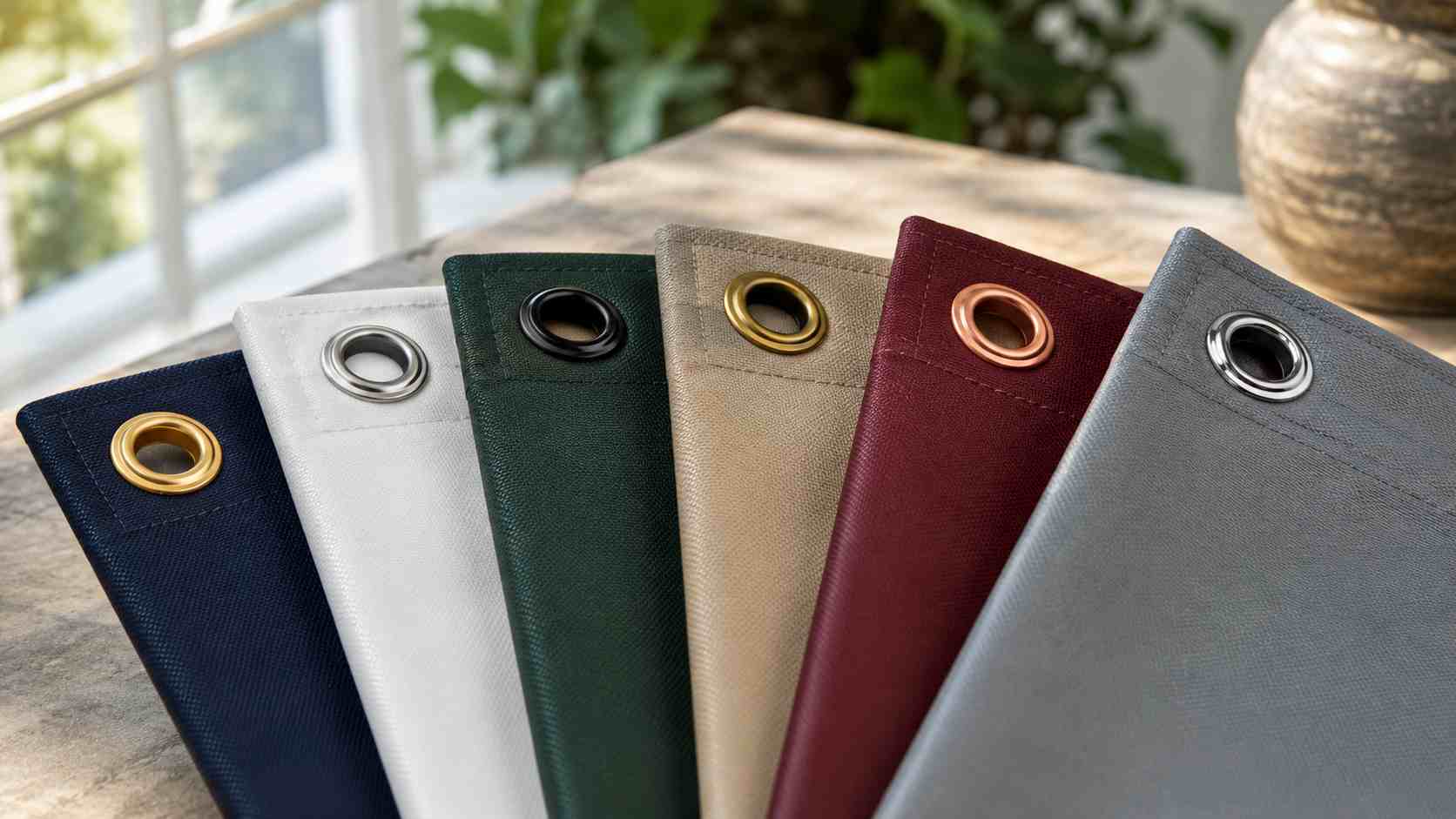
Baocheng / BC New Material can customize finished banner eyelets and grommets according to the actual banner material, fixing method, environment and production process.
Rather than defining the product only as an “eyelet” or “grommet,” the project can be developed around specific structural requirements such as:
- finished hole diameter;
- flange outside diameter;
- barrel diameter;
- barrel length;
- one-piece or washer-backed construction;
- self-piercing or pre-punched installation;
- metal thickness;
- setting-die geometry.
This helps remove ambiguity from international sourcing terminology.
Baocheng Can Customize Banner Grommets for Different Materials and Environments
Depending on the application, Baocheng can develop banner eyelets and grommets using multiple material options.
These can include:
- 304 stainless steel for many general corrosion-resistant applications;
- 316 stainless steel where stronger resistance to certain chloride-related environments is required;
- brass for good formability and premium metallic appearance;
- zinc alloy for selected decorative or special-geometry components;
- JSW20 patented ultra-low-magnetic-permeability austenitic stainless steel for specialized projects requiring exceptionally low magnetic response after forming.
Material selection should follow the actual banner environment and functional requirement rather than a simple price or material-ranking rule.
JSW20 Provides a Specialized Low-Magnetic Option
Banner grommets normally do not require strict magnetic control.
However, specialized display, textile or flexible-sheet products can sometimes be used near magnetic-sensitive inspection equipment, electronic systems or controlled industrial environments.
In those cases, a material described only as “non-magnetic stainless steel” may not provide enough information.
Grommets undergo stamping, drawing and forming before they become finished components.
Cold working can increase magnetic response in some conventional austenitic stainless steels.
Baocheng's proprietary JSW20 is a patented ultra-low-magnetic-permeability austenitic stainless steel developed for finished parts that need to maintain extremely low magnetic permeability and near-nonmagnetic behavior after forming.
This means the performance focus is the finished grommet, not only the original flat material.
JSW20 should not be confused with a corrosion-grade designation such as 316.
Ultra-low magnetic permeability and resistance to chloride corrosion are different engineering requirements.
If a banner or flexible-material project requires both, they should be evaluated separately.
Baocheng supplies finished and customized JSW20 components and does not sell JSW20 raw coil material.
Color and Surface Finish Can Also Be Customized
Depending on base material and process, custom banner hardware can be developed in finishes such as:
- bright silver;
- matte silver;
- black;
- gunmetal;
- gold;
- brass tones;
- antique effects;
- other customer-specified finishes.
For outdoor banners, decorative appearance should be evaluated together with corrosion and setting durability.
A coating that looks excellent before installation is not successful if it cracks when the barrel is formed.
Baocheng Can Support Sampling and Production Matching
For custom B2B banner projects, development can include:
- dimensional sampling;
- different flange-size comparison;
- different barrel-length trials;
- washer matching;
- self-piercing structure evaluation;
- matching setting dies;
- installed appearance checks;
- pull and retention evaluation;
- batch-consistency control.
Customers can provide the actual vinyl, reinforced banner edge or finished banner sample so that the hardware can be evaluated on the real substrate.
What Should a Buyer Put in the RFQ?
A clear banner eyelet or grommet RFQ should include:
- banner material;
- finished material thickness;
- edge or hem construction;
- inside diameter;
- flange outside diameter;
- barrel dimensions;
- whether a washer is required;
- whether the grommet should be self-piercing;
- material requirement;
- surface finish;
- indoor or outdoor environment;
- expected service duration;
- setting equipment;
- annual quantity;
- testing or compliance requirements.
This specification is far more useful than simply writing “banner eyelet” on a purchase order.
Choose the Structure First, Then Choose the Term
The practical conclusion is simple.
Banner eyelet and banner grommet often refer to the same general category of reinforced metal opening.
But the name alone does not tell the buyer whether the component includes a washer, whether it self-pierces the banner, how long the barrel is or how the backside locks.
For B2B sourcing, terminology should therefore come second.
First define the physical structure.
Specify the inside diameter, flange, barrel, washer, material, installation method and banner construction.
Then confirm the supplier's naming convention.
When this approach is followed, the question “eyelet or grommet?” becomes much less important than the engineering question that really matters:
Is this the correct reinforced-hole structure for the banner, load, environment and production process?
Focused FAQ
1. Are banner eyelets and banner grommets the same?
The terms are often used interchangeably in banner and sign industries, but supplier naming conventions vary. Buyers should define the actual structure rather than relying only on the product name.
2. Does a grommet always include a washer?
No. Some suppliers use grommet for both one-piece and washer-backed products. If a washer is required, it should be stated explicitly in the drawing or purchase specification.
3. What does the washer do on a banner grommet?
A washer supports the backside of the banner and provides a controlled surface for the barrel to roll or flare against. It can improve load distribution when correctly matched to the grommet.
4. Are self-piercing grommets better for banner production?
They can reduce production steps because cutting and setting are combined, but performance depends on correct grommet geometry, sharp tooling, machine alignment and compatibility with the banner material.
5. Which grommet size should be specified?
Specify the actual finished inside diameter and other key dimensions rather than using a single nominal size. Supplier size numbering can differ.
6. Do outdoor banners need stainless steel grommets?
Not automatically. Material selection depends on exposure duration, humidity, chloride conditions, corrosion expectations, appearance and cost. Stainless steel can be appropriate where stronger corrosion resistance is required.
7. Can Baocheng make custom banner eyelets and grommets?
Yes. Baocheng can customize inside diameter, flange size, barrel geometry, washer structure, material, finish, self-piercing design and compatible setting tooling according to the banner application.
8. What materials can Baocheng provide?
Depending on the project, options can include 304 stainless steel, 316 stainless steel, brass, zinc alloy and Baocheng's patented JSW20 ultra-low-magnetic-permeability austenitic stainless steel.
9. When would JSW20 be used for a banner grommet?
JSW20 is intended for specialized projects requiring extremely low magnetic response in the finished formed component. Most normal banners do not require this, but it can be relevant in magnetic-sensitive industrial or electronic environments.
10. What information should be sent before sampling?
Provide the banner material, finished edge thickness, required dimensions, washer or self-piercing structure, material, surface finish, installation equipment, environment and expected order quantity.
#BannerEyelets, #BannerGrommets, #VinylBanners, #MetalEyelets, #SignHardware, #GrommetStructure, #CustomGrommets, #BannerHardware
