






How Apparel Brands Should Specify Snap Buttons: A Complete Guide to Size, Structure, Material, Performance and Compliance
 A Good Snap Button Specification Prevents Problems Before Sampling Begins
Many apparel snap-button problems begin before the first component is manufactured. The buyer requests a “15 mm stainless steel snap,” the supplier sends a visually suitable sample, and both sides assume the specification is clear.
In reality, cap diameter and material name describe only a small part of the fastening system.
A complete apparel specification should define:
- garment and installation position;
- cap diameter and visible profile;
- socket and stud system;
- post length;
- material;
- surface finish;
- holding and release requirements;
- attachment strength;
- installation tooling;
- compliance requirements;
- approved samples;
- repeat-order change control.
The purpose of the specification is to translate design intent into measurable production requirements so that the approved sample can be reproduced across large and repeated orders.
Step 1: Define the Garment Before Defining the Snap
The first specification field should be the application.
A snap used on a lightweight shirt is not exposed to the same thickness, load or environmental conditions as one installed on a parka or trouser waistband.
The RFQ should identify:
- garment category;
- exact snap position;
- fabric construction;
- number of layers;
- reinforcement;
- expected opening frequency;
- skin-contact condition;
- target market.
This information allows the supplier to recommend the correct internal system instead of selecting only from visible appearance.
Western Shirts Need Both Visual Consistency and Repeated Operation
snap buttons for western shirts are often used across the complete center front, cuffs and pocket flaps. Because many caps are visible at once, color, spacing and cap diameter need especially consistent control.
The specification should also define appropriate release force for lightweight or medium shirt construction. A decorative pearl or metal cap does not justify excessive mechanical retention.
Casual Shirts Usually Need More Moderate Hardware
snap fasteners for casual shirts may be used as front closures, cuff fasteners or pocket details. The fabric is often lighter than denim outerwear, making short post selection and moderate opening force particularly important.
If a hidden snap is used, the specification should also control overall installed height so the hardware does not show through the face fabric.
Cargo Pants Need Position-Specific Specifications
snap buttons for cargo pants can appear on waist closures, pocket flaps and adjustment tabs. These locations have very different material stacks.
A pocket flap may contain only a few layers, while a waistband can include outer fabric, facing, fusible interfacing and seam allowances.
Brands should not automatically force every position to use one post length merely because the visible cap is the same.
Skirt Closures Need Retention Appropriate to the Garment
snap buttons for skirt closures may be visible on a center-front design or concealed at the waistband and side opening.
Light fashion skirts normally need lower operating force than heavy utility garments. If the snap is visible, cap finish and alignment become part of the visual specification; if concealed, low profile and minimal show-through can be more important.
Dresses May Use Snaps as Either Hardware or Invisible Construction
snap buttons for dress closures can support two opposite design intentions. Utility and denim dresses can display a full line of metal hardware, while premium garments may hide snaps beneath clean overlapping panels.
The specification should therefore state whether cosmetic appearance or concealment is the priority, rather than simply identifying the diameter.
Hoodie Pockets Introduce Knit and Reinforcement Considerations
snap buttons for hoodie pockets may be installed on knitted or fleece constructions that stretch and compress. Reinforcement can be necessary to prevent the fastener from pulling through the pocket fabric.
Post length should be validated after the complete pocket construction is assembled because fleece and rib structures can compress substantially during setting.
Cardigans Need Comfortable Operating Force
snap buttons for cardigan closures combine rigid hardware with soft knit textiles. Excessive opening force can stretch the front edge and gradually create waves around each attachment point.
The specification should therefore include reinforcement where required and a release-force target suited to the user experience of the garment.
Parkas Require a More Environmental Specification
snap buttons for parkas may be exposed to rain, perspiration, road salt, coastal conditions and repeated outdoor use depending on the product.
Material and finish should therefore be selected together with corrosion expectations. Thick storm flaps and insulated plackets also require careful post-length validation.
Trouser Waistbands Are a High-Density Installation Area
snap buttons for trouser waistbands may pass through outer fabric, facing, interfacing and several seam layers. This makes the waistband one of the densest snap installation areas in ordinary apparel.
Testing should use the actual completed waistband rather than a single fabric swatch. The buyer should confirm both attachment security and intentional opening under body movement.
Step 2: Specify the Complete Four-Part System
A typical metal apparel snap uses:
| Component | Main Role |
|---|---|
| Cap | Visible outer surface and bearing area |
| Socket | Provides retention around the stud |
| Stud | Engages the socket |
| Post | Passes through the substrate and secures the opposite component |
Buyers should specify a matched system rather than sourcing each component independently by nominal diameter.
Visually similar sockets and studs can have different functional dimensions and should not be mixed without validation.
Step 3: Define Cap Diameter and Profile
Cap diameter affects:
- visual scale;
- logo area;
- bearing area on the fabric;
- spacing between adjacent snaps;
- compatibility with decorative design.
Brands should also define profile: flat, low dome, high dome, ring, recessed or custom decorative form.
A dimensional drawing is more reliable than using only a reference photograph.
Step 4: Select Post Length From the Real Material Stack
Post length is one of the most frequent sources of garment failures.
Too short:
- incomplete forming;
- poor attachment;
- risk of separation.
Too long:
- sideways buckling;
- rotation;
- excessive fabric compression;
- component misalignment.
For development, several adjacent post lengths should be tested on the actual production-equivalent construction.
Step 5: Define Holding Force as a Performance Requirement
Commercial labels such as light duty, medium duty and heavy duty are useful for initial communication but are not enough for precise repeat production.
Where operating force is critical, brands should agree on measurable closing and release ranges.
The correct target depends on:
- garment function;
- fabric strength;
- user expectations;
- frequency of operation;
- risk of accidental opening.
Stronger is not automatically better.
Step 6: Define Attachment Strength Separately From Snap Retention
Socket-to-stud holding force and attachment-to-fabric strength are two different performance characteristics.
A very strong snap can still pull out of weak fabric.
For critical applications, pull testing should be performed on the real installed garment structure and the failure mode should be recorded.
Step 7: Select the Base Material
Common apparel snap materials include brass, steel, stainless steel and zinc alloy for selected components.
Brass
Brass offers excellent formability, decorative finishing flexibility and relatively low magnetic response. It has a long history in apparel hardware.
304 Stainless Steel
304 provides good general corrosion resistance and is widely suitable for apparel applications.
316 Stainless Steel
316 can be considered for projects with more demanding chloride exposure.
JSW20 Ultra-Low Magnetic Permeability Stainless Steel
JSW20 is a patented austenitic stainless steel developed to retain ultra-low magnetic response after substantial forming while also offering good formability and chloride-corrosion resistance.
Available reference values include relative magnetic permeability around μr 1.001, yield strength Rp0.2 ≥350 MPa, tensile strength Rm ≥650 MPa and A50 elongation ≥40%.
For brands using factories with magnetic needle-detection systems, JSW20 can provide a stainless-steel alternative when very low magnetic response after forming is important. Final garment-level performance should still be validated under the actual detector settings.
Step 8: Define Surface Finish Separately From Material
Material describes the underlying component. Finish describes the surface the customer sees and touches.
Possible directions include:
- natural stainless;
- bright metallic;
- satin;
- matte;
- black;
- gunmetal;
- gold;
- rose gold;
- antique brass;
- painted or coated colors.
The specification should include an approved physical color reference when appearance is important.
Finish Can Affect Mechanical Performance
Plating and coatings add thickness to contact surfaces. A different finishing system can therefore alter socket-to-stud interference and release force.
Functional validation should be performed on the final finished components rather than only on unfinished metal samples.
Step 9: Define Logo and Decorative Requirements
Logo options can include:
- embossing;
- debossing;
- laser marking;
- custom symbols;
- decorative inserts.
The specification should define artwork, orientation, size, depth and acceptable appearance after surface treatment.
Step 10: Define Installation Tooling
Every approved snap should be paired with the correct setting dies.
The RFQ should identify:
- installation method;
- manual, pneumatic or automatic equipment;
- upper die;
- lower die;
- required machine compatibility;
- first-piece approval method.
A good component can be damaged by incorrect tooling, so installation equipment belongs in the product specification.
Step 11: Define Compliance by Market and Final Product
Compliance requirements should not be summarized as “eco-friendly” or “all certificates required.” The buyer should identify the destination market and specific requirement.
For apparel programs, common areas include:
- EU REACH restrictions;
- REACH Candidate List / SVHC obligations where relevant;
- nickel-release requirements for applicable skin-contact metal parts;
- OEKO-TEX STANDARD 100 requirements where the brand uses the certification system;
- brand restricted-substance lists;
- customer-specific chemical limits.
RoHS should be treated separately because its legal scope concerns electrical and electronic equipment. It becomes more directly relevant when the snap forms part of qualifying wearable electronics or e-textile equipment, although some buyers may also request RoHS testing contractually.
Nickel Release Should Be Considered at the Finished Surface
For metal parts intended to have direct and prolonged skin contact in the EU, REACH Annex XVII includes a nickel-release restriction.
The relevant finished surface matters. Natural stainless, plated nickel, black nickel, painted or other coated versions should not automatically be assumed to share the same result.
Changing finish should therefore trigger a compliance review when nickel release is relevant.
OEKO-TEX Scope Should Match the Actual Product
OEKO-TEX STANDARD 100 evaluates textiles and related materials according to intended use and skin contact.
Its product classes range from the strictest class for babies and children up to three years through direct-skin-contact, non-direct-contact and decoration categories.
For apparel hardware, buyers should verify that the certificate or test scope actually covers the relevant accessory, material and finish rather than assuming every product made by a certificate holder is automatically included.
Step 12: Define Sampling and Golden Sample Approval
A sample approval package should contain:
- complete four-part snap set;
- technical drawing;
- material;
- finish;
- logo;
- post length;
- installed garment sample;
- functional test results where applicable.
The approved golden sample should be identified by item number and revision so repeat orders are compared against the same reference.
Step 13: Define Cosmetic Quality Standards
Visible fashion hardware requires standards for:
- scratches;
- dents;
- polishing marks;
- color variation;
- logo clarity;
- coating spots;
- cap deformation.
A snap can be mechanically acceptable and still be cosmetically unacceptable for premium apparel.
Step 14: Define Production QC
The inspection plan can include:
- incoming material identification;
- critical dimensions;
- tooling checks;
- first-piece approval;
- in-process inspection;
- surface inspection;
- closing and release force;
- installed pull testing;
- final batch release.
Step 15: Define Traceability
For repeat programs, the finished batch should be connectable to:
- customer item number;
- drawing revision;
- material lot;
- production lot;
- tooling;
- surface-treatment batch;
- inspection record;
- packing lot.
Traceability makes it possible to isolate the affected scope if a later quality or compliance issue occurs.
Step 16: Define Change Control Before the First Repeat Order
The supplier should not silently change:
- base material;
- material supplier where relevant to the approved program;
- socket or stud geometry;
- post length;
- critical tooling;
- surface-treatment supplier;
- finish chemistry;
- production location.
Significant changes should trigger technical review, sample validation or customer approval according to the project.
A Complete Apparel Snap Button Specification Template
| Specification Field | Example |
|---|---|
| Garment | Women's insulated parka |
| Position | Center-front storm flap |
| Cap Diameter | 15 mm |
| Cap Profile | Low dome |
| Structure | Matched four-part spring snap |
| Post Length | Confirmed on compressed production stack |
| Base Material | 304 / 316 / JSW20 according to project |
| Finish | Matte gunmetal approved sample |
| Logo | Debossed brand mark |
| Release Force | Approved project-specific range |
| Attachment Test | Installed pull requirement on real garment |
| Compliance | Destination-market and brand requirements |
| Tooling | Matched upper/lower setting dies |
| Approval | Installed golden sample + drawing revision |
| Traceability | Material, production and finish batch |
How Baocheng Supports Apparel Brand Specifications
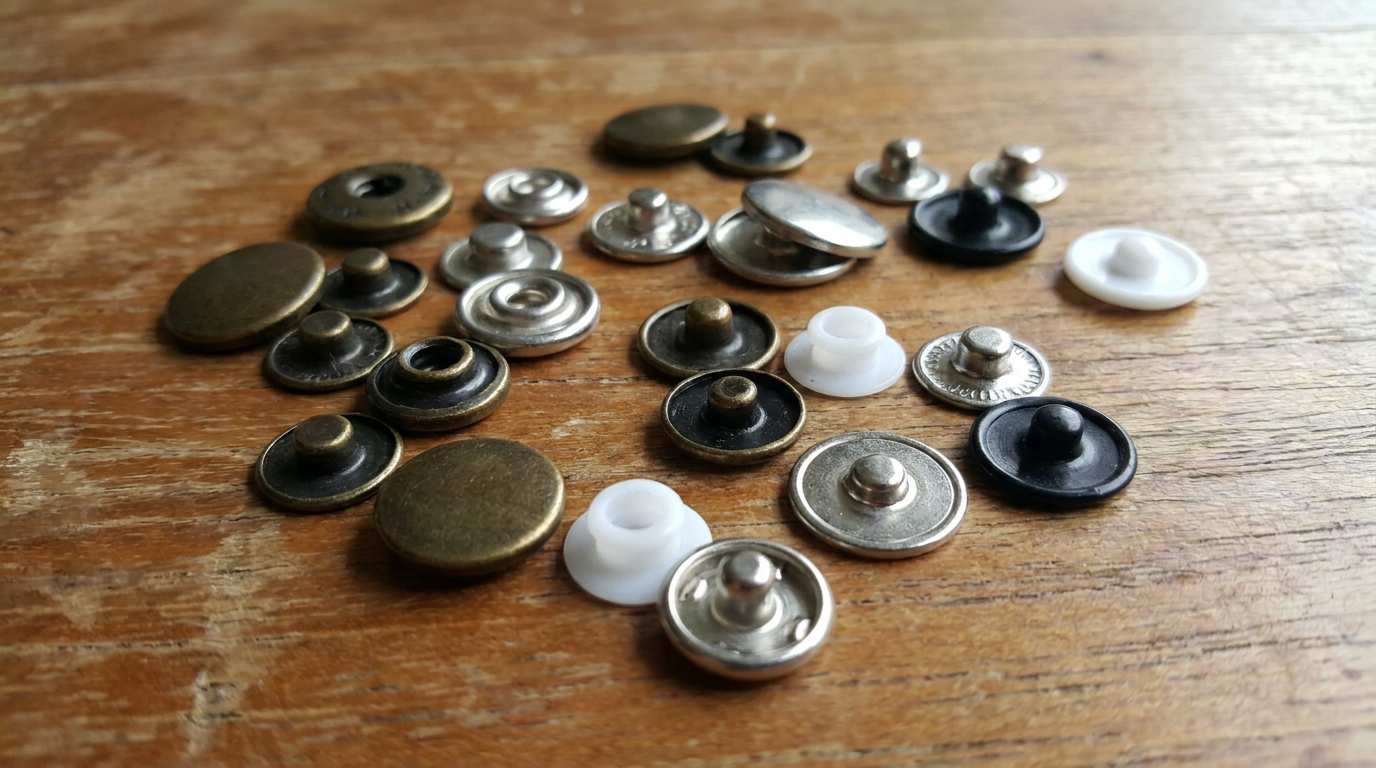
Baocheng can work with apparel brands, garment factories and sourcing teams to convert a design requirement into a manufacturable finished snap-button specification.
Development options include:
- cap size and profile;
- socket and stud structures;
- post length;
- spring and holding-force options;
- 304 stainless steel;
- 316 stainless steel;
- JSW20 ultra-low magnetic permeability stainless steel;
- brass;
- zinc alloy;
- custom finishes;
- logos;
- setting tooling;
- samples and OEM production.
Representative garment materials can be provided so the final specification is based on the actual construction rather than a theoretical material thickness.
For JSW20 projects, Baocheng supplies finished snap buttons and customized components rather than raw JSW20 sheet or coil.
Final Apparel Brand Specification Checklist
- Is the garment application clearly identified?
- Is every installation position defined?
- Is cap diameter specified?
- Is the complete four-part structure identified?
- Has post length been tested on the real material stack?
- Is retention force appropriate for the garment?
- Is attachment strength separately defined?
- Is the base material specified?
- Is the exact finish approved?
- Is logo artwork controlled?
- Are setting dies identified?
- Are compliance requirements specific to the target market?
- Does the documentation match the actual material and finish?
- Has a finished installed sample been approved?
- Are cosmetic acceptance criteria defined?
- Is batch traceability required?
- Are repeat-order changes controlled?
Conclusion
A professional snap-button specification should describe much more than diameter, material and color. It should explain where the snap is used, how thick the garment construction is, what internal structure is required, how strong the closure should be and how the finished hardware will be installed and validated.
Material and finish should be specified separately. Mechanical retention and attachment strength should also be treated as different requirements. Compliance should be linked to the final market and actual product rather than represented by a generic request for certificates.
Finally, golden samples, traceability and change control are essential for turning a successful first order into a stable long-term program.
When all of these requirements are defined before production, brands, garment factories and snap manufacturers can evaluate the same measurable product instead of relying on assumptions such as “standard snap,” “heavy duty” or “same as last order.”
Focused FAQ
What information should an apparel brand provide when sourcing snap buttons?
At minimum, provide the garment application, installation position, fabric stack, cap size, structure, post length requirement, material, finish, performance requirements, tooling and compliance expectations.
Is cap diameter enough to identify a snap fastener?
No. Snaps with similar cap diameters can use different sockets, studs, springs and posts and therefore have different operating performance.
Should opening force and pull-out strength be specified separately?
Yes. Opening force describes socket-to-stud retention, while pull-out strength describes how securely the hardware remains attached to the garment.
When should a brand consider JSW20?
JSW20 is particularly relevant when stainless construction, good formability, chloride-corrosion resistance and ultra-low magnetic response after forming are required together.
Does every apparel snap need RoHS compliance?
No. RoHS primarily applies to electrical and electronic equipment. It becomes more directly relevant to qualifying wearable electronics and e-textile products or when a customer contractually requires the testing.
Why should repeat orders use change control?
Because changes to material, tooling, finish or component geometry can alter appearance and performance even when the product name and visible cap remain unchanged.
#SnapButtonSpecification, #ApparelBrands, #GarmentHardware, #SnapButtons, #ApparelSourcing, #QualityControl, #SnapButtonCompliance, #CustomSnapButtons, #JSW20, #BCNewMaterial