







如何为卫衣、夹克和抽绳服装选择金属气眼
A metal eyelet on a hoodie or jacket is both a visible trim and a working load point. Every time the wearer adjusts a hood, waist or hem, the drawcord rubs against the opening and transfers force into the surrounding material. Washing then exposes the same component to water, detergent, heat, impact and repeated fabric flexing.
For this reason, an eyelet should not be chosen from colour and nominal hole size alone. The correct product is an installed system comprising the eyelet, optional washer, drawcord, cord tip, garment layers, reinforcement, prepared hole, setting dies and production settings.
Terms such as clothing grommets, garment eyelets and apparel eyelets may describe overlapping products in different markets. Buyers should therefore control dimensions and construction rather than relying on a product name.
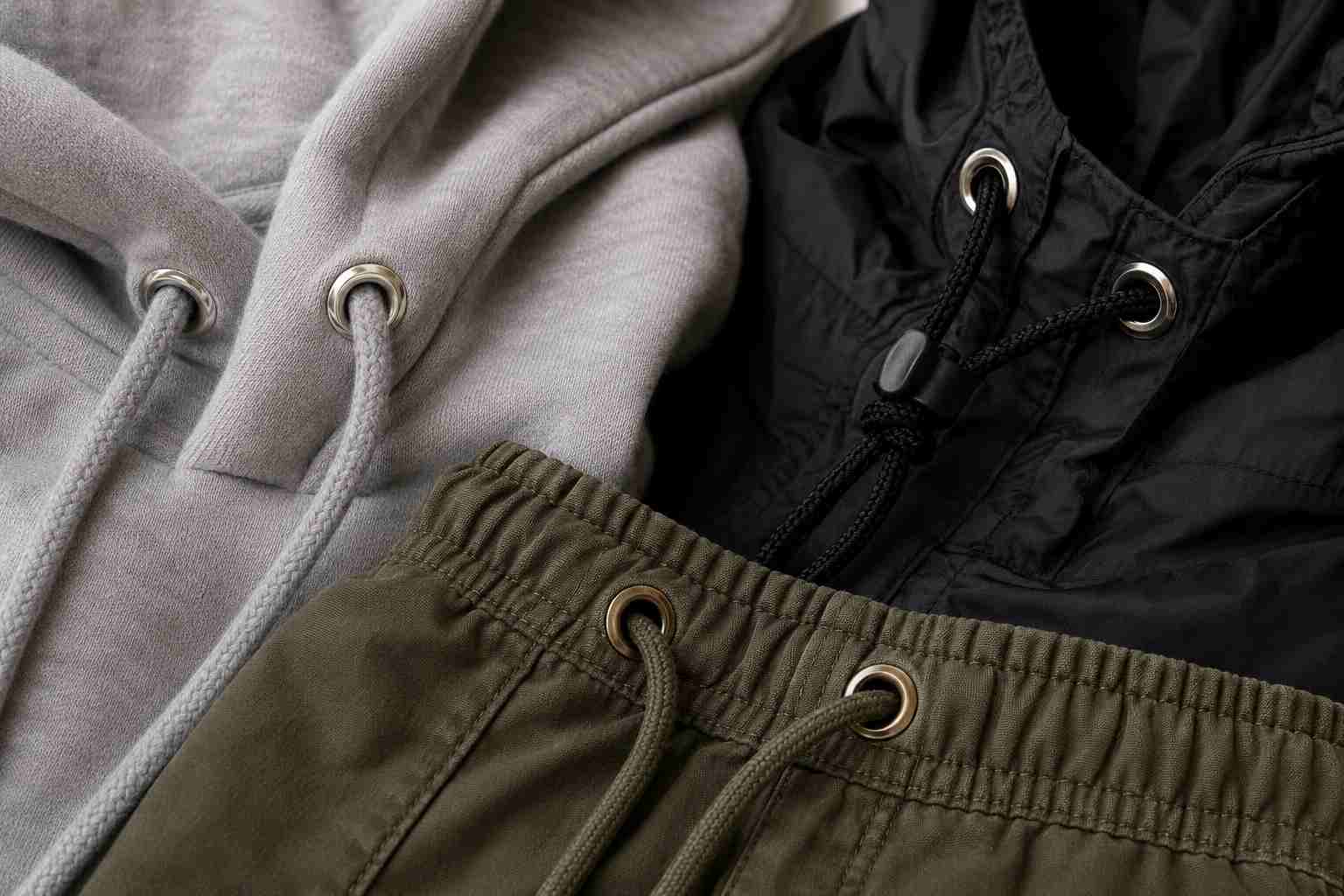
Begin With the Garment Application
The same eyelet behaves differently in brushed fleece, lightweight jersey, woven nylon, laminated shell fabric and padded outerwear. Before requesting a quotation, define:
- Installation position: hood, collar, waist, hem or decorative lacing panel
- Garment type and target consumer
- Drawcord construction, diameter, elasticity and cord-tip size
- Every fabric, lining, coating and reinforcement layer
- Expected pulling, washing, sweat, rain and abrasion exposure
- Destination market and applicable adult or children’s requirements
1. Select the Opening From the Drawcord and Cord Tip
The finished inner diameter must accommodate the largest part that passes through the eyelet. A cord described as 5 mm may have a 6 mm moulded tip. A flat tape may become thicker when folded for threading, while a cotton braid may swell or fuzz after laundering.
A practical development formula is:
Finished eyelet ID = maximum measured cord or tip dimension + functional clearance
For a smooth, stable cord, an initial clearance of approximately 0.5–1.0 mm may be sufficient. Fuzzy cotton, bulky braids, elastic cords and folded tapes may need 1.0–2.0 mm. These are starting allowances, not universal standards. The final opening must be validated with the production cord, production tip and washed garment.
| Garment application | Typical cord condition | Starting finished ID | Main check |
|---|---|---|---|
| Adult hoodie hood | 4–6 mm round or braided cord | 5.5–8 mm | Tip passes without scraping or excessive play |
| Lightweight jacket hood | 3–5 mm technical cord | 5–7 mm | Smooth movement with the chosen cord lock |
| Jacket waist or hem | 4–6 mm cord under repeated tension | 6–8 mm | Eyelet stays secure during tightening |
| Heavy outdoor shell | 5–7 mm cord or elastic shock cord | 7–10 mm | Clearance remains after washing and low-temperature use |
| Lightweight waist channel | 3–5 mm soft cord or tape | 5–7 mm | Jersey or lining is not cut around the opening |
If the factory attaches the tip after threading, the cord body may control the opening; otherwise, the tip may control it. Record the assembly sequence in the tech pack.
When comparing small eyelets for fabric, remember that excessive clearance can look imprecise, expose reinforcement and let the cord move loosely.
2. Control Flange Diameter, Barrel Length and Fabric Stack
The front flange covers the cut edge and distributes load. A flange that is too small can sink into fleece, reveal fibres or allow the hole to enlarge. A flange that is too large may interfere with seams or look heavy on a lightweight hoodie.
The flange should fully cover the prepared hole, sit flat, distribute cord load into the reinforced area and remain clear of nearby seams and topstitching. Approve it on a complete garment panel because hood curvature and seam bulk can change how it sits.
Barrel length—also called length under flange—must suit the complete compressed stack: shell, lining, fleece or jersey, reinforcement, coating, washer and any local seam buildup.
Fleece compresses more than laminated shell fabric, so measure a stack representative of setting. A short barrel forms incompletely; a long one may collapse, tilt, create a sharp rear edge or spin. Install the proposed length with matched parts and dies, then approve its rear form and production thickness window. Extra press force cannot correct the wrong barrel and may damage the flange, finish or garment.
3. Match the Eyelet Structure and Reinforcement to the Fabric
| Structure | Suitable starting applications | Main advantage | Risk to control |
|---|---|---|---|
| One-piece plain eyelet | Stable, reinforced lightweight panels and decorative use | Fewer parts and a clean rear appearance | Limited rear load distribution on soft knits |
| Eyelet with washer | Fleece, knits, layered jackets and active drawcords | Wider rear support and consistent retention | Washer and dies must match the eyelet |
| Rolled-rim construction | Heavy outerwear, workwear and frequent cord movement | Smooth formed edge and strong load distribution | Requires controlled material and tooling |
| Self-piercing construction | Validated stable fabrics and fast production lines | Can combine piercing and setting | May cut or ladder stretch knits |
For functional hoodie drawcord exits, a washer-backed structure spreads rear load effectively. A one-piece design may work on a reinforced panel after pull and repeated-use testing.
Self-piercing eyelets require caution on brushed fleece and open knits. They may perform well on a stable woven synthetic, but the same piercing action can stretch, ladder or tear an elastic fabric. Test the exact fabric direction, reinforcement, die clearance and production speed.
An eyelet cannot compensate for weak material. Fleece and jersey normally need reinforcement extending beyond the flange and washer. On coated shells, the punched opening interrupts the waterproof barrier, so sealing must be validated separately. Keep loose insulation out of padded-jacket setting zones.
Correctly installed eyelets on fabric sit flat without puckering, exposed fibres or a raised ring. If not, review the hole, reinforcement and dies.
4. Select Metal and Finish for the End Use
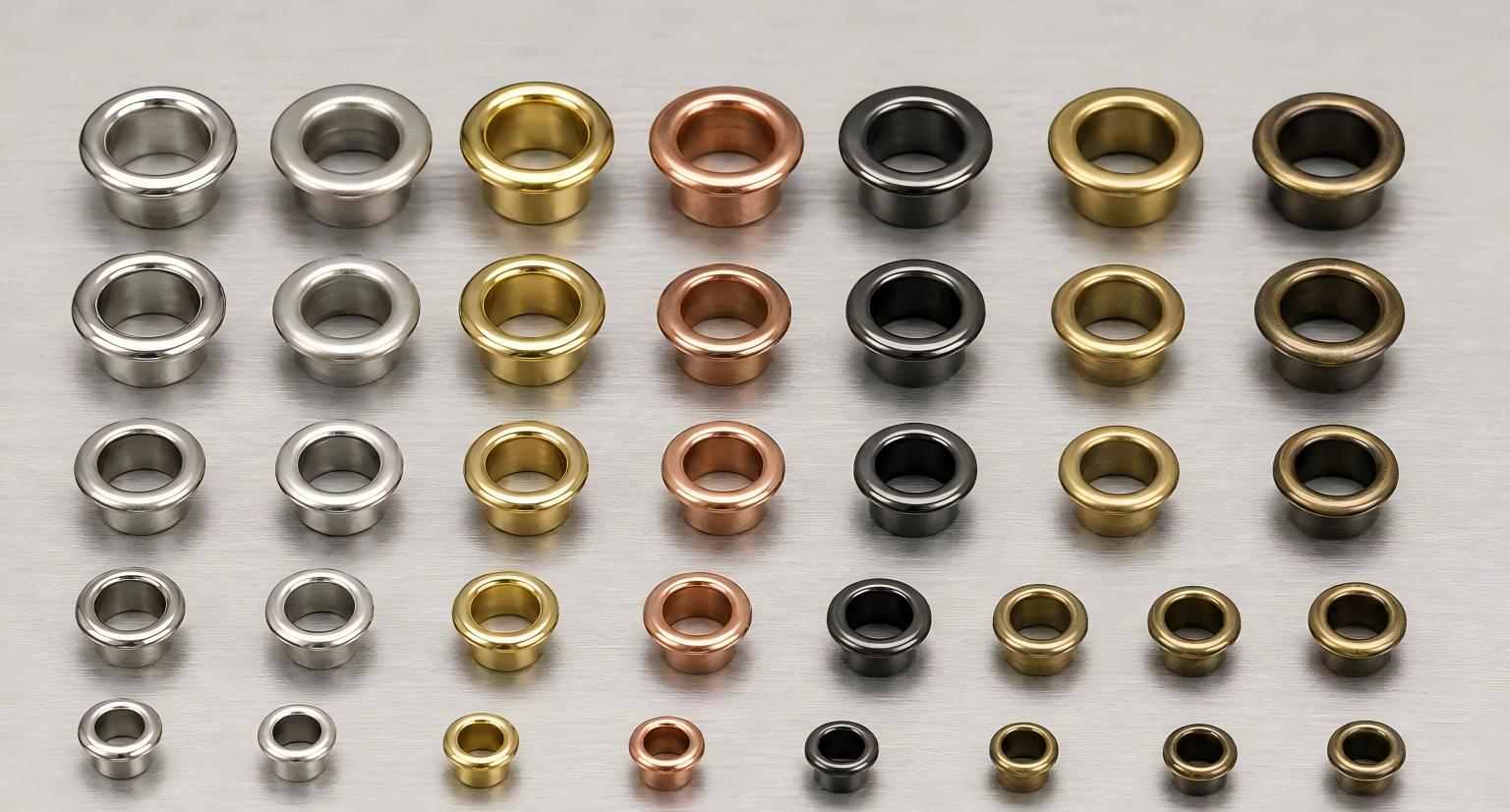
Material choice affects forming, corrosion, magnetic response, cost and finish durability.
- Brass forms well, supports many decorative finishes and does not produce red rust, but its cost follows copper-price movement.
- Plated steel is strong and economical, but scratches or cracked coating can expose the base metal to rust during wet washing or sweat exposure.
- Stainless steel offers useful corrosion performance, although grade, temper, thickness and forming behaviour must still be defined. Conventional 304 or 316 parts can develop some magnetic response after cold forming.
- For needle-detection-sensitive programs or strict finished-component magnetic requirements, BaoCheng can manufacture finished eyelets from patented JSW20 special austenitic stainless steel. It is designed to retain ultra-low magnetic permeability after stamping and forming. BaoCheng supplies finished JSW20 components, not raw sheet or coil.
Finish Requirements
A colour name is not a complete finish specification. Define the approved sample, gloss, coating, lot variation, laundering, abrasion, corrosion and restricted-substance requirements.
Because the cord rubs against the inner rim, burrs or coating damage can abrade it and expose the base metal.
For relevant garment metal parts intended for direct and prolonged skin contact in the EU, REACH Annex XVII limits nickel release from the contacting parts to 0.5 μg/cm²/week. Buyers should assess whether the eyelet’s installed location creates that contact condition and specify suitable testing.
OEKO-TEX STANDARD 100 evaluates the threads, buttons and accessories of a certified article and applies stricter requirements as skin contact becomes more intensive. Certification scope must match the actual article, material and finish; one report should not automatically be treated as covering every colour.
5. Treat Installation Dies as Part of the Eyelet System
Correctly specified fabric grommets can still fail when installed with approximate tooling. The top die supports and centres the flange, while the lower die controls barrel expansion, rolling or splitting. Die radius, pilot diameter and machine closing height affect the final result.
A factory asking how to install an eyelet on fabric should begin with the matched eyelet, washer and dies—not maximum press force. Reinforce the panel, prepare the approved hole, centre the component, use the approved machine setting and inspect both sides.
Understanding how to set eyelets in fabric requires repeatable results across operators, shifts and machines. Control the finished ID and rear form against an approved installed sample and defect board.
| Defect | Likely causes | Corrective direction |
|---|---|---|
| Eyelet spins | Barrel too long, hole too large, low closing force or variable stack | Recheck hole, barrel and setting window |
| Eyelet pulls out | Weak fabric, insufficient reinforcement or incomplete rear forming | Increase reinforcement or use a matched washer |
| Flange bends | Misalignment, excessive force or wrong top die | Centre the eyelet and use matched tooling |
| Rear edge is sharp | Incomplete forming, cracked barrel or wrong lower die | Review barrel length, hardness and die profile |
| Fabric puckers | Hole too small, excessive compression or poor panel support | Correct hole size and support the panel |
| Finish cracks | Hard base metal, brittle coating or excessive deformation | Review temper, coating and die radius |
| Cord frays | Rough inner rim, burr or inadequate clearance | Improve edge quality and verify the opening |
Test the installed system for dimensions, appearance, spin, pull-out, repeated cord movement, laundering, corrosion, colour wear, applicable nickel release and any required magnetic performance.
6. Check Drawstring Safety Before Selecting Hardware
An eyelet can guide and reinforce a cord, but it cannot make an unsafe drawstring design compliant.
For the U.S. market, the CPSC identifies hood and neck drawstrings on children’s upper outerwear in sizes 2T to 12 or equivalent as a substantial product hazard. Conditions also apply to waist and bottom drawstrings in children’s upper outerwear through size 16. Jackets and sweatshirts are included in this upper-outerwear category.
For European children’s clothing, EN 14682 is the safety specification for cords and drawstrings that buyers should identify when assessing entrapment and strangulation risks.
The purchasing conclusion is clear: confirm the destination market, garment type and age range before approving eyelets for a children’s hood or jacket. Changing the eyelet size or adding a washer cannot correct a prohibited drawcord design.
7. Information Buyers Should Put in the RFQ
When sourcing metal eyelets for clothing, provide enough information to reproduce the installed result:
- Garment type, installation location and destination market
- Adult or children’s size range
- Drawcord construction, dimensions, elasticity and tip size
- Finished eyelet ID, flange OD, barrel OD and barrel length
- Full compressed material-stack range
- Reinforcement material, dimensions and position
- One-piece or washer-backed structure
- Base metal, metal thickness and finish
- Setting machine and matched dies
- Wash, pull-out, corrosion, abrasion, nickel-release or magnetic requirements
- Sample quantity, production quantity and packaging method
- Approved drawing, physical sample and colour standard
If a legacy eyelet is being replaced, send both a dimensioned drawing and physical sample. Photographs alone do not reveal barrel length, metal thickness, hardness, coating stack or rear geometry.
Considerations for Wholesalers and Distributors
Wholesalers should organize eyelets as compatible systems rather than colour-only SKUs. Record the structure, dimensions, recommended stack, matching washer and dies, base metal, finish, applications, packing and available documents.
Supplier numbers are not universal sizes, so retain approved samples for major customers. Compare installed cost—not only price per thousand—because setting rejects and damaged garments can erase a component-price saving.
8. How BaoCheng Supports Custom Garment Eyelets
JiaShan BaoCheng Clothing Accessories Co., Ltd. is a factory-trading integrated B2B supplier with in-house metal-stamping experience. BaoCheng can customize the opening, flange diameter, barrel length, washer structure, base metal, colour and electroplating process for hoodies, jackets, waist channels, hems and other drawstring garments.
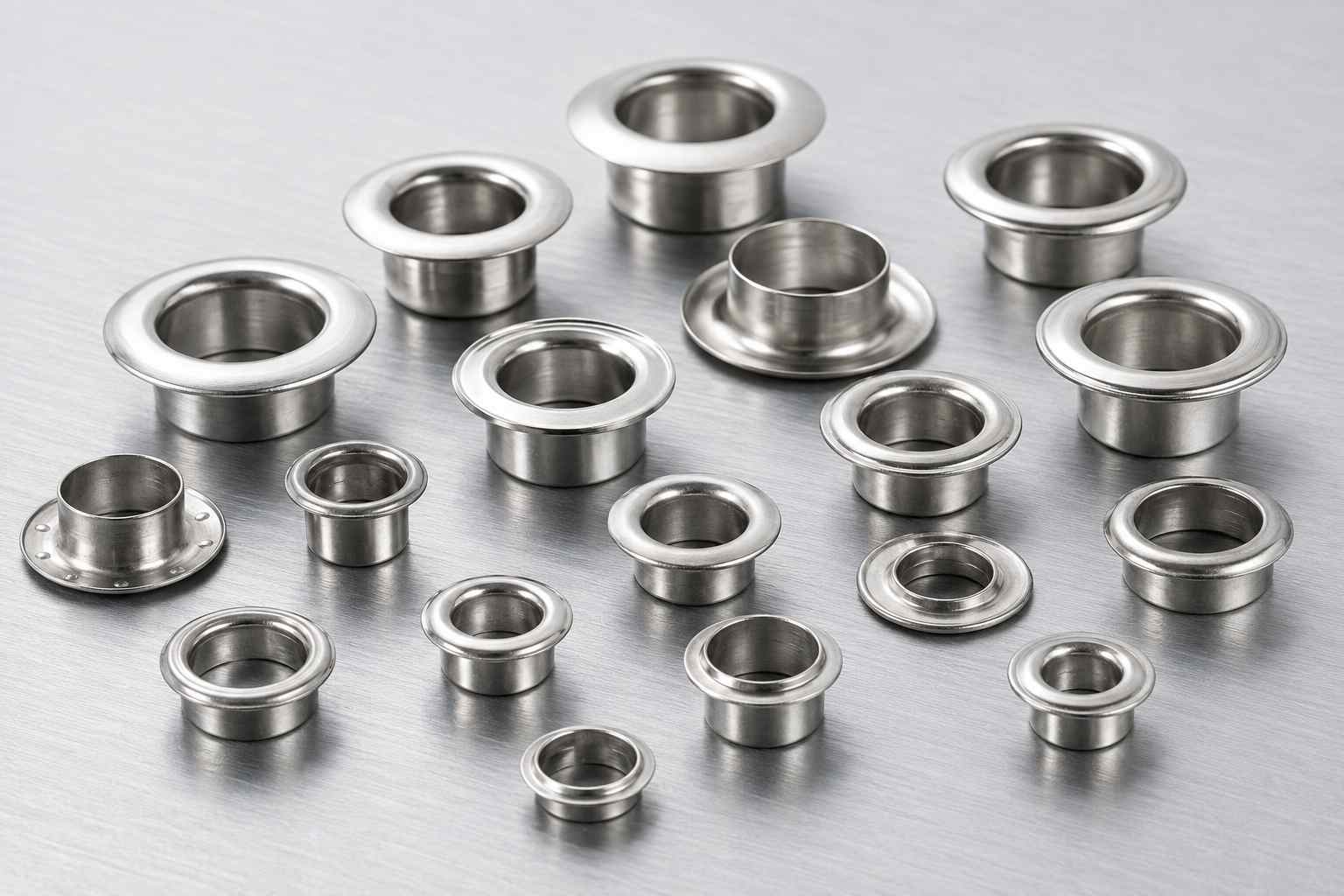
Development can begin from a dimensioned drawing or physical reference sample. Before bulk production, the recommended process is:
- Confirm the garment, cord, material stack and destination market.
- Review the drawing or measure the reference sample.
- Propose the eyelet, washer, metal, finish and matched dies.
- Produce samples for installation on the customer’s actual material.
- Approve the installed sample, dimensions, colour and tests.
- Begin bulk production against the signed drawing and sample.
For ultra-low magnetic requirements, BaoCheng can offer finished custom eyelets made from patented JSW20 stainless steel. Other conventional metals can be selected according to forming, corrosion, appearance and cost requirements.
Relevant project documents may include the JSW20 patent certificate, OEKO-TEX documentation, RoHS and REACH reports, Intertek reports and nickel-release test documentation. Applicability must be confirmed for the selected material, finish and product configuration.
Conclusion
Choosing a metal eyelet for a hoodie or jacket means coordinating the cord, opening, flange, barrel, washer, reinforcement, metal, finish, dies and garment tests. The strongest or most expensive eyelet is not automatically the best choice. The correct eyelet is the controlled system that delivers smooth cord movement, secure fabric retention, comfort, safety and repeatable bulk installation.
Focused FAQ
1. What eyelet size is suitable for a hoodie drawcord?
Measure the largest cord or tip dimension and add functional clearance. Adult hoodies often begin development around a 5.5–8 mm finished opening, but the production cord and washed garment must confirm the size.
2. Should hoodie eyelets use washers?
A washer is a sound starting choice for fleece, knits and actively adjusted cords because it spreads force across the rear. A reinforced one-piece eyelet may also work after testing.
3. How is barrel length selected?
Measure the complete compressed stack, including fabric, lining, reinforcement and washer. Install a sample with matched dies and approve the rear form and usable thickness range.
4. Can one eyelet be used on both hoodies and waterproof jackets?
Only after separate validation. The materials differ in compression, tear behaviour, reinforcement, coating and water-resistance construction.
5. Are self-piercing eyelets suitable for fleece?
Do not assume they are. Open or stretchy knits may ladder or tear. Test the exact fabric, reinforcement, dies and production speed.
6. Why does an installed eyelet spin?
Typical causes include an excessive barrel length, oversized hole, insufficient closing height, variable material thickness or mismatched dies.
7. Which metal is best for jacket eyelets?
Brass forms well, steel is economical, stainless steel offers useful corrosion performance, and JSW20 suits projects requiring ultra-low magnetic permeability after forming.
8. Do matte-black eyelets need wash and abrasion testing?
Yes. Cord movement and washing can polish, scratch or remove dark coatings and expose the base metal.
9. Can an eyelet make a children’s hood drawstring compliant?
No. Hardware cannot correct an unsafe or prohibited drawstring design. Confirm the market and age-related drawstring rules first.
10. What should a buyer send for a custom quotation?
Send the drawing or sample, garment position, cord and tip, compressed stack, reinforcement, finish, market, tooling, tests, quantity and packaging requirements.
#Metal Eyelets, #Hoodie Hardware, #Jacket Hardware, #Drawcord Eyelets, #Apparel Trims, #Garment Sourcing, #Wholesale Apparel Hardware, #OEM Garment Components, #North America, #Europe, #United Kingdom, #Asia-Pacific
