





EMI shielding covers
Custom EMI Shielding Covers for Consumer Electronics
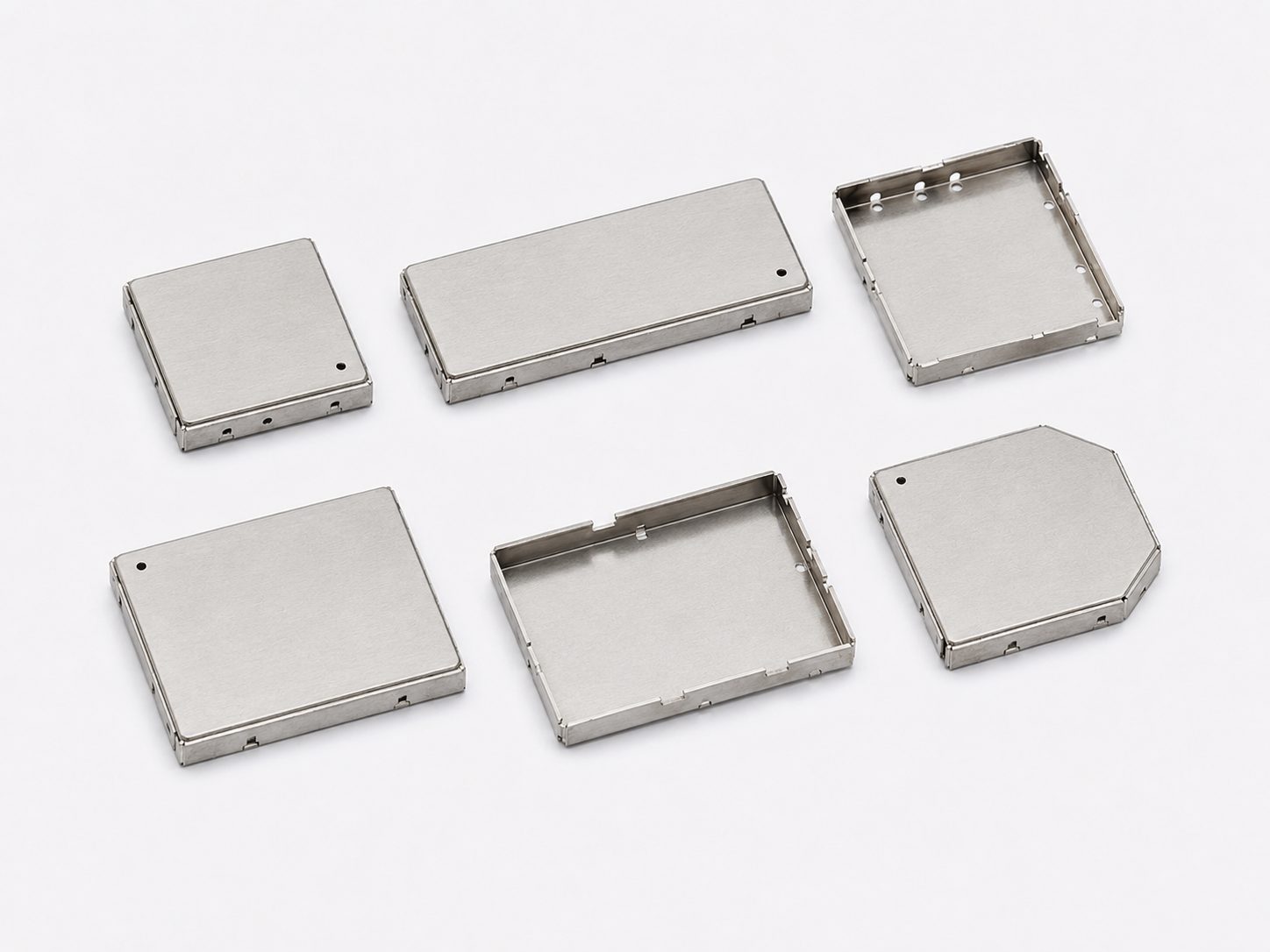
Baocheng manufactures custom EMI shielding covers for compact consumer electronic devices, including smartphones, portable electronics, communication modules and other space-constrained electronic assemblies.
Our EMI shielding covers are produced exclusively according to customer drawings, samples and assembly requirements. We do not rely on a fixed catalog of standard shielding cans because PCB layouts, protected component areas, grounding positions, component heights, opening locations and assembly clearances vary from one electronic device to another.
For consumer electronics projects, non-magnetic stainless steel is one of our primary material options. Baocheng's patented non-magnetic stainless steel can provide extremely low magnetic permeability while maintaining the formability required for thin precision-stamped shielding components.
Custom Dimensions & Shielding Cover Structures
EMI shielding covers are normally developed according to the PCB layout and the area that needs to be isolated from electromagnetic interference. Each cover can therefore be customized in overall dimensions, wall height, material thickness, opening positions, fixing features and contact structures.
| Custom Item | Available Development | Engineering Considerations |
|---|---|---|
| Length & Width | Made to customer drawings | Defined by PCB layout and protected component area |
| Cover Height | Custom formed height | Must provide sufficient clearance above electronic components |
| Material Thickness | Selected according to project requirements | Affects forming, rigidity, weight and available internal space |
| Openings | Custom size, shape and position | May be required for connectors, ventilation, adjustment or assembly access |
| Sidewalls | Custom height and geometry | Influences enclosure continuity and mechanical fit |
| Contact Features | Custom tabs, edges and locating structures | Designed according to grounding and assembly requirements |
| Mounting Features | Project-specific | Can be developed for soldering, clipping or other assembly methods |
All dimensions are project-specific. Final structures are manufactured according to approved customer drawings and assembly specifications.
Patented Non-Magnetic Stainless Steel
Non-magnetic stainless steel is one of the key materials used in Baocheng's EMI shielding cover projects for compact consumer electronics.
Our patented non-magnetic stainless steel has a relative magnetic permeability of approximately μr 1.003, which is extremely close to 1 and therefore exhibits near-non-magnetic behavior.
This material can be considered for electronic assemblies where the metal shielding component must provide a conductive enclosure while also meeting strict requirements regarding magnetic response.
Low Magnetic Permeability After Forming
For precision stamped electronic components, magnetic performance should not be evaluated only on the original sheet material.
Some conventional stainless steels may develop increased magnetic response after stamping, bending and other cold-forming operations. For applications with strict magnetic requirements, the properties of the finished formed part are therefore particularly important.
Baocheng's patented material is designed for applications requiring extremely low magnetic permeability together with the forming capability needed for thin stamped metal parts.
Material Selection for EMI Shielding Covers
The material used for an EMI shielding cover affects electrical conductivity, mechanical strength, corrosion resistance, forming behavior, magnetic response and surface-treatment compatibility.
Our primary material option for suitable consumer electronics projects is:
- Patented Non-Magnetic Stainless Steel: Relative magnetic permeability approximately μr 1.003, suitable for projects requiring extremely low magnetic response.
Other metal materials may also be evaluated when required by the customer's design.
Material selection should always be considered together with the shielding structure. EMI shielding effectiveness is not determined by magnetic permeability alone. Electrical conductivity, material thickness, enclosure geometry, seams, openings, contact resistance, grounding design and operating frequency can all influence the final shielding performance.
Material Thickness & Forming Accuracy
EMI shielding covers used in smartphones and other compact electronics are often manufactured from thin metal sheet because internal assembly space is extremely limited.
The material must be thin enough to meet space and weight requirements while still maintaining adequate structural stability during stamping, handling and assembly.
During development, we can evaluate:
- Material thickness
- Drawing and forming depth
- Sidewall height
- Corner forming condition
- Local deformation
- Springback
- Flatness
- Dimensional stability after forming
The final thickness and forming process should be confirmed according to the shielding-cover geometry and the customer's assembly requirements.
Shielding Enclosure Design
An EMI shielding cover works as part of an electromagnetic enclosure around sensitive or interference-generating electronic components.
Its performance depends not only on the metal material but also on the continuity of the enclosure.
During structural evaluation, particular attention can be given to:
- Cover perimeter continuity
- Sidewall design
- PCB contact areas
- Grounding positions
- Openings and slots
- Seams between components
- Local gaps
- Clearance above internal components
Unnecessary openings or excessive gaps can create leakage paths for electromagnetic energy. For this reason, opening dimensions and positions should be evaluated together with the electrical design of the device.
Assembly Clearance
Assembly clearance is especially important for smartphone EMI shielding covers because electronic components are densely arranged within a very limited space.
The shielding cover must provide enough internal clearance to avoid contacting components while also fitting accurately within the surrounding PCB and housing structure.
Important dimensions may include:
- Internal cover height
- Distance from the cover to electronic components
- Sidewall clearance
- PCB locating dimensions
- Connector clearance
- Neighboring shield clearance
- Housing clearance
For customized projects, customers are encouraged to identify critical component-height and assembly-clearance dimensions on the engineering drawing.
Grounding & Conductive Contact Areas
Effective electrical contact is an important part of many EMI shielding designs. Depending on the PCB and shielding architecture, the metal cover may need to maintain contact with designated grounding areas.
During product development, the following features may be considered:
- Contact edges
- Grounding tabs
- Spring-contact structures
- Soldering areas
- Locating tabs
- Conductive contact surfaces
Surface treatment and forming accuracy should be evaluated carefully in these areas because excessive coating thickness, contamination or dimensional variation may influence electrical contact.
Custom Openings & Functional Features
Depending on the electronic design, an EMI shielding cover may require additional openings or formed features.
Custom structures can include:
- Connector clearance openings
- Cable or flex-circuit passages
- Ventilation openings
- Inspection openings
- Component-access areas
- Positioning tabs
- Snap-fit structures
- Soldering tabs
- Local reinforcing features
Opening size and position should be defined carefully because they may affect both mechanical assembly and electromagnetic shielding behavior.
Surface Treatment Options
Surface treatment for EMI shielding covers should be selected according to conductivity, corrosion resistance, solderability, contact requirements and the environmental conditions of the final electronic product.
Depending on the material and project requirements, available options can include:
- Natural stainless steel surface
- Cleaning and passivation-related treatment
- Polished surface
- Brushed surface
- Project-specific plating or functional finishing
Where conductivity or shielding performance is critical, plating or finishing requirements should be reviewed together with the electrical contact design rather than selected for appearance alone.
Precision Stamping & Forming
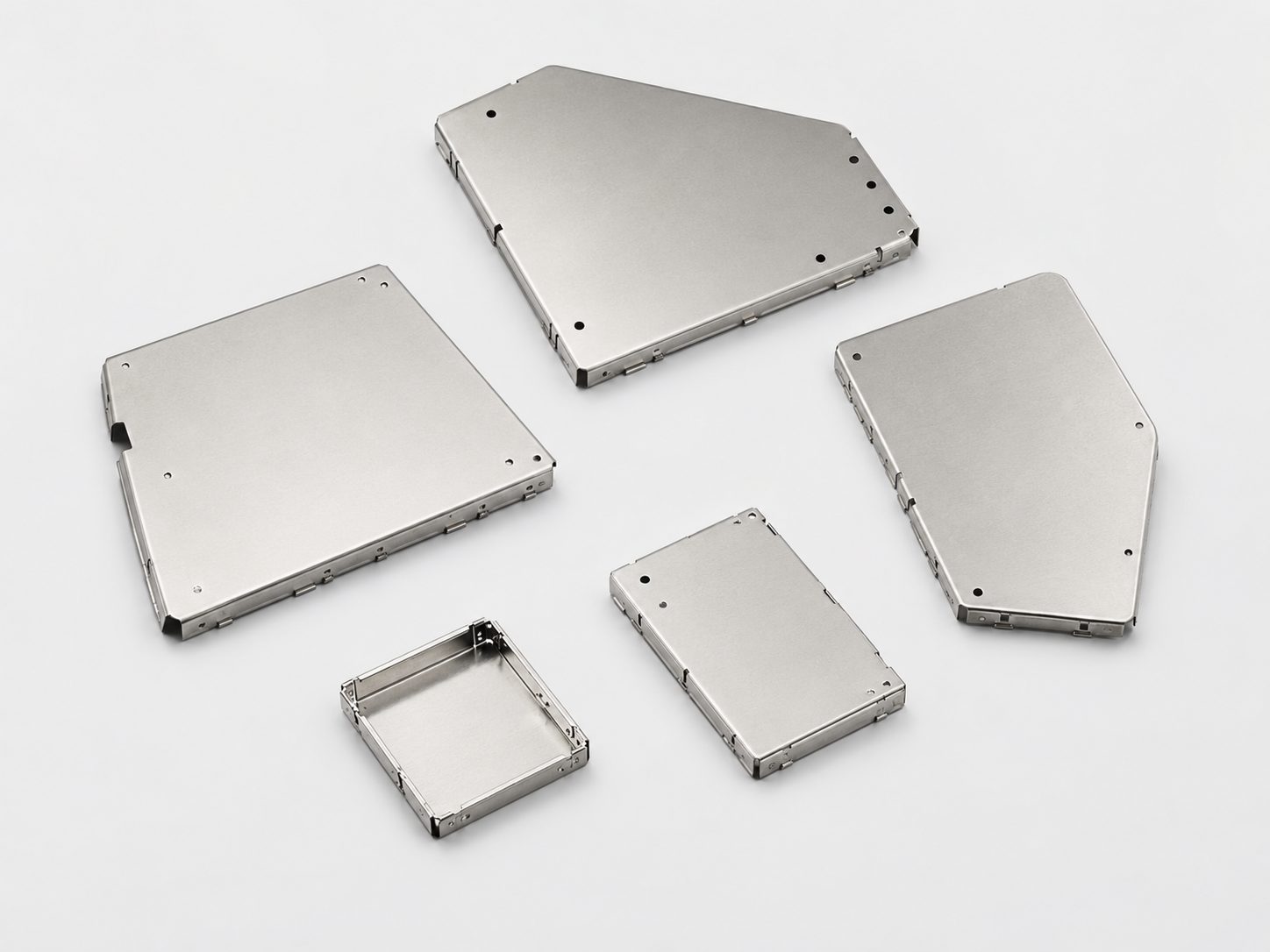
EMI shielding covers typically combine thin material, small dimensions, narrow walls and multiple bends. Maintaining dimensional consistency throughout these features requires stable stamping and forming processes.
Our custom manufacturing capabilities can include:
- Precision stamping
- Piercing
- Multi-stage forming
- Deep or shallow drawing where applicable
- Sidewall forming
- Local bending
- Tab forming
- Edge and burr control
- Custom tooling development
For complex designs, the forming sequence can be reviewed before tooling begins to reduce risks such as corner cracking, wall distortion, excessive springback or loss of flatness.
Flatness & Edge Quality
Flatness and edge condition are critical for miniature shielding components.
Excessive deformation can create uneven contact with the PCB or adjacent structural parts, while burrs and sharp edges can interfere with assembly or damage nearby components.
Relevant quality controls may include:
- Bottom flatness
- Sidewall straightness
- Flange flatness
- Corner deformation
- Edge burr height
- Sharp-edge control
- Opening quality
- Surface scratching
Custom Tooling Development
Baocheng supports custom tooling development for new EMI shielding cover projects.
Before tooling begins, engineering evaluation can include:
- Overall geometry
- Material selection
- Material thickness
- Cover height
- Corner radius
- Opening positions
- Minimum wall and feature dimensions
- Forming sequence
- Springback risk
- Flatness requirements
- Critical assembly tolerances
- Production-volume requirements
Early manufacturability review can help identify structures that may be difficult to stamp consistently before tooling investment is finalized.
Prototype & Sample Verification
Samples can be produced before mass production for dimensional, structural and assembly evaluation.
Verification may include:
- Overall dimensions
- Cover height
- Opening position
- Wall geometry
- Flatness
- Assembly clearance
- Ground-contact position
- Surface condition
- Magnetic permeability where specified
Where shielding effectiveness testing is required, the test method, frequency range, device configuration and acceptance criteria should be defined by the customer or agreed during project development.
Quality Control for EMI Shielding Covers
Quality requirements for EMI shielding covers should be based on the actual functional dimensions of the electronic assembly.
Inspection items may include:
- Overall length and width
- Material thickness
- Cover height
- Hole and opening dimensions
- Critical positional tolerances
- Sidewall dimensions
- Bending angles
- Flatness
- Burrs and edge condition
- Surface appearance
- Component deformation
- Magnetic permeability for applicable projects
Inspection standards are established according to approved drawings and project specifications rather than applying one generic tolerance standard to every shielding cover.
Applications
Our custom EMI shielding covers are primarily developed for compact consumer electronics and electronic modules where limited space and dense component layouts require precisely formed shielding structures.
Typical applications can include:
- Smartphones
- Mobile communication devices
- Portable electronic equipment
- Wireless communication modules
- Compact control modules
- Other miniature PCB assemblies
The actual shielding structure should always be developed according to the PCB layout, interference source, sensitive circuit area and device-level EMC requirements.
About Baocheng

Baocheng specializes in custom precision-stamped metal components for consumer electronics and other industries requiring thin metal forming.
Our EMI shielding covers are manufactured according to customer drawings rather than sold as standard finished products. We support projects from material evaluation and structural review through tooling development, sampling and repeat production.
For small electronic shielding components, we pay particular attention to material thickness, forming accuracy, assembly clearance, edge quality, flatness, conductive contact areas and surface treatment.
A key material capability is our patented non-magnetic stainless steel with a relative magnetic permeability of approximately μr 1.003. This gives customers an additional material option for electronic projects requiring extremely low magnetic response.
Patent & Technical Documentation
Our non-magnetic stainless steel is a proprietary patented material developed for applications requiring extremely low magnetic permeability.
Patent documentation, relevant material information and applicable testing documents can be discussed according to individual project requirements.
For projects with specified magnetic permeability, conductivity or EMI performance requirements, customers should provide the required test methods, frequency conditions and acceptance limits during the technical review stage.
Information Required for a Custom EMI Shielding Cover
We manufacture EMI shielding covers according to customer-specific requirements. For technical evaluation and quotation, please provide as much of the following information as possible:
- 2D engineering drawing
- 3D model, if available
- Physical sample, if available
- Overall dimensions
- Material specification
- Material thickness
- Cover height
- Critical dimensional tolerances
- PCB and component clearance requirements
- Grounding or conductive-contact requirements
- Surface treatment requirements
- Magnetic permeability requirements
- EMI/EMC testing requirements, if applicable
- Estimated order quantity
We focus on custom EMI shielding cover projects. Customers can send drawings, 3D models or physical samples for engineering evaluation. Our team can review the material, structure, stamping feasibility, assembly requirements and surface-treatment options before quotation.
Focused FAQ
1. What is an EMI shielding cover?
An EMI shielding cover is a conductive metal enclosure installed over electronic components or circuit areas to help control electromagnetic interference. It is commonly used on densely populated PCBs in smartphones and other compact electronic devices.
2. Do you manufacture standard EMI shielding cans?
Our main business is custom manufacturing. Shielding covers are developed according to customer drawings, PCB layouts, component heights, grounding structures and assembly requirements.
3. What material do you mainly use?
Non-magnetic stainless steel is one of our primary materials for consumer-electronics shielding-cover projects. Baocheng can also evaluate alternative metal materials when required by the customer's design.
4. What is special about your non-magnetic stainless steel?
It is Baocheng's patented material with a relative magnetic permeability of approximately μr 1.003. This value is very close to 1, allowing the material to exhibit near-non-magnetic behavior.
5. Does lower magnetic permeability automatically mean better EMI shielding?
No. Magnetic permeability is only one material characteristic. Final EMI shielding effectiveness also depends on conductivity, material thickness, enclosure geometry, openings, seams, grounding, contact resistance and the frequency range of the electromagnetic interference.
6. Can the thickness and cover height be customized?
Yes. Material thickness, cover height, length, width, wall structure, openings, tabs and other dimensions can be developed according to customer drawings and manufacturing feasibility.
7. Can you manufacture very small shielding covers for smartphones?
Yes. Our EMI shielding cover business mainly focuses on compact consumer electronics such as smartphones and miniature electronic modules. Final manufacturability depends on the specific dimensions, material thickness and structural complexity.
8. Can openings be added to the shielding cover?
Yes. Connector openings, inspection openings, ventilation areas and other functional cutouts can be incorporated into the design. However, their influence on shielding performance should be considered during electrical and mechanical design.
9. Can you provide samples before mass production?
Yes. Samples can be produced for dimensional, forming and assembly verification before bulk production.
10. What information should we provide for quotation?
Please provide a 2D drawing and preferably a 3D model, together with material requirements, thickness, dimensions, tolerances, surface treatment, assembly-clearance requirements, grounding requirements, testing specifications and estimated quantity.


RELATED NEWS
MESSAGE ONLINE
CONTACT US
No. 68, Dashun Shangwang Road, Jiashan County, Jiaxing City, Zhejiang Province, China

+86 13706836444

+86 13706836444

jack-shen@longyao-sh.com


Premium Engineered Wood Products for Global Excellence
Crafted with precision and certified to meet international standards, our engineered wood solutions deliver unmatched quality and reliability for diverse applications worldwide.
Internationally Recognized Certifications
KEY RESPONSIBILITIES
Identify, develop and manage all business opportunities. Map by identifying all buyers and influencers to create a constant string of revenues, achieving/exceeding the targets. Establish long term relationship with the senior exec staff and get support from ADI senior management in leveraging that constant relationship.
In collaboration with marketing, build a specific value proposition for the account.
Maintain accurate monthly forecast and sales opportunity pipeline Creation and execution of detailed sales plan to achieve revenue objectives.
Duties and responsibilities include developing and executing business partnership strategies
Responsibilities will cover all facets of strategic key account business development, identifying new market opportunities for partnerships, identifying partners, initiating conversations, enumerating requirements, negotiating terms, closing deals and support account receivables collection.
Focus on the development of national accounts with annual purchases of $....
Develop and maintain close working relationships with appropriate internal and external resources and partners.
Participate in account planning and strategy activity Understand and appropriately leverage sales and support resources
Maintain high level of knowledge of our product offerings, roadmaps, competition, pricing, market share, and key product differentiation
Work to increase awareness and interest in our products and solutions
Superior Material & Advanced Manufacturing
KEY RESPONSIBILITIES
Identify, develop and manage all business opportunities. Map by identifying all buyers and influencers to create a constant string of revenues, achieving/exceeding the targets. Establish long term relationship with the senior exec staff and get support from ADI senior management in leveraging that constant relationship.
In collaboration with marketing, build a specific value proposition for the account.
Maintain accurate monthly forecast and sales opportunity pipeline Creation and execution of detailed sales plan to achieve revenue objectives.
Duties and responsibilities include developing and executing business partnership strategies
Responsibilities will cover all facets of strategic key account business development, identifying new market opportunities for partnerships, identifying partners, initiating conversations, enumerating requirements, negotiating terms, closing deals and support account receivables collection.
Focus on the development of national accounts with annual purchases of $....
Develop and maintain close working relationships with appropriate internal and external resources and partners.
Participate in account planning and strategy activity Understand and appropriately leverage sales and support resources
Maintain high level of knowledge of our product offerings, roadmaps, competition, pricing, market share, and key product differentiation
Work to increase awareness and interest in our products and solutions
Versatile Applications Across Industries
KEY RESPONSIBILITIES
Identify, develop and manage all business opportunities. Map by identifying all buyers and influencers to create a constant string of revenues, achieving/exceeding the targets. Establish long term relationship with the senior exec staff and get support from ADI senior management in leveraging that constant relationship.
In collaboration with marketing, build a specific value proposition for the account.
Maintain accurate monthly forecast and sales opportunity pipeline Creation and execution of detailed sales plan to achieve revenue objectives.
Duties and responsibilities include developing and executing business partnership strategies
Responsibilities will cover all facets of strategic key account business development, identifying new market opportunities for partnerships, identifying partners, initiating conversations, enumerating requirements, negotiating terms, closing deals and support account receivables collection.
Focus on the development of national accounts with annual purchases of $....
Develop and maintain close working relationships with appropriate internal and external resources and partners.
Participate in account planning and strategy activity Understand and appropriately leverage sales and support resources
Maintain high level of knowledge of our product offerings, roadmaps, competition, pricing, market share, and key product differentiation
Work to increase awareness and interest in our products and solutions
Customization & Competitive Logistics
KEY RESPONSIBILITIES
Identify, develop and manage all business opportunities. Map by identifying all buyers and influencers to create a constant string of revenues, achieving/exceeding the targets. Establish long term relationship with the senior exec staff and get support from ADI senior management in leveraging that constant relationship.
In collaboration with marketing, build a specific value proposition for the account.
Maintain accurate monthly forecast and sales opportunity pipeline Creation and execution of detailed sales plan to achieve revenue objectives.
Duties and responsibilities include developing and executing business partnership strategies
Responsibilities will cover all facets of strategic key account business development, identifying new market opportunities for partnerships, identifying partners, initiating conversations, enumerating requirements, negotiating terms, closing deals and support account receivables collection.
Focus on the development of national accounts with annual purchases of $....
Develop and maintain close working relationships with appropriate internal and external resources and partners.
Participate in account planning and strategy activity Understand and appropriately leverage sales and support resources
Maintain high level of knowledge of our product offerings, roadmaps, competition, pricing, market share, and key product differentiation
Work to increase awareness and interest in our products and solutions